
How to Master Social Media Ad Targeting in 5 Simple Steps
Why Are Effective Social Media Ad Targeting Strategies Vital for Modern Businesses in 2026?

To master social media ad targeting, start with the commercial outcome, define who can realistically buy, choose the platform that matches that audience, use first-party data where available, test creative as a targeting signal, and review performance against real conversion quality. At RankingCo, we use this process to connect paid social targeting with practical business goals rather than treating audience settings as isolated platform toggles.
In our experience managing paid social campaigns for Australian small and medium-sized businesses, targeting quality depends on more than demographic selections. We typically look at the full path from audience intent to conversion tracking before deciding how narrow or broad a campaign should be. That means assessing the offer, buying cycle, website journey, creative angles, and available first-party data before committing budget to a targeting structure.
Last reviewed: 27 August 2026 by RankingCo's performance marketing team, which manages Google Ads, Meta Ads, social media advertising, Search Engine Optimisation (SEO), Pay-Per-Click (PPC), and Conversion rate optimisation (CRO) campaigns for Australian businesses.
In August 2026, targeting has evolved beyond static demographic checkboxes. Social ad platforms now use delivery systems that evaluate advertiser inputs, engagement signals, creative response, and conversion feedback. For Australian businesses across Brisbane, Sydney, and Melbourne, mastering these mechanics is useful, but platform recommendations still need human judgement, commercial context, and careful testing before they become a dependable campaign strategy. For platform-specific setup and policy details, advertisers should refer directly to current Meta, LinkedIn, and TikTok business help documentation.
By combining audience segmentation, first-party data activation, creative testing, and cross-channel optimisation, businesses can turn social advertising into a more measurable customer acquisition channel. Aligning these campaign objectives with specialised social media advertising support helps connect media spend with clear business goals. To see how our team supports paid social and broader digital growth, explore our services or contact RankingCo.
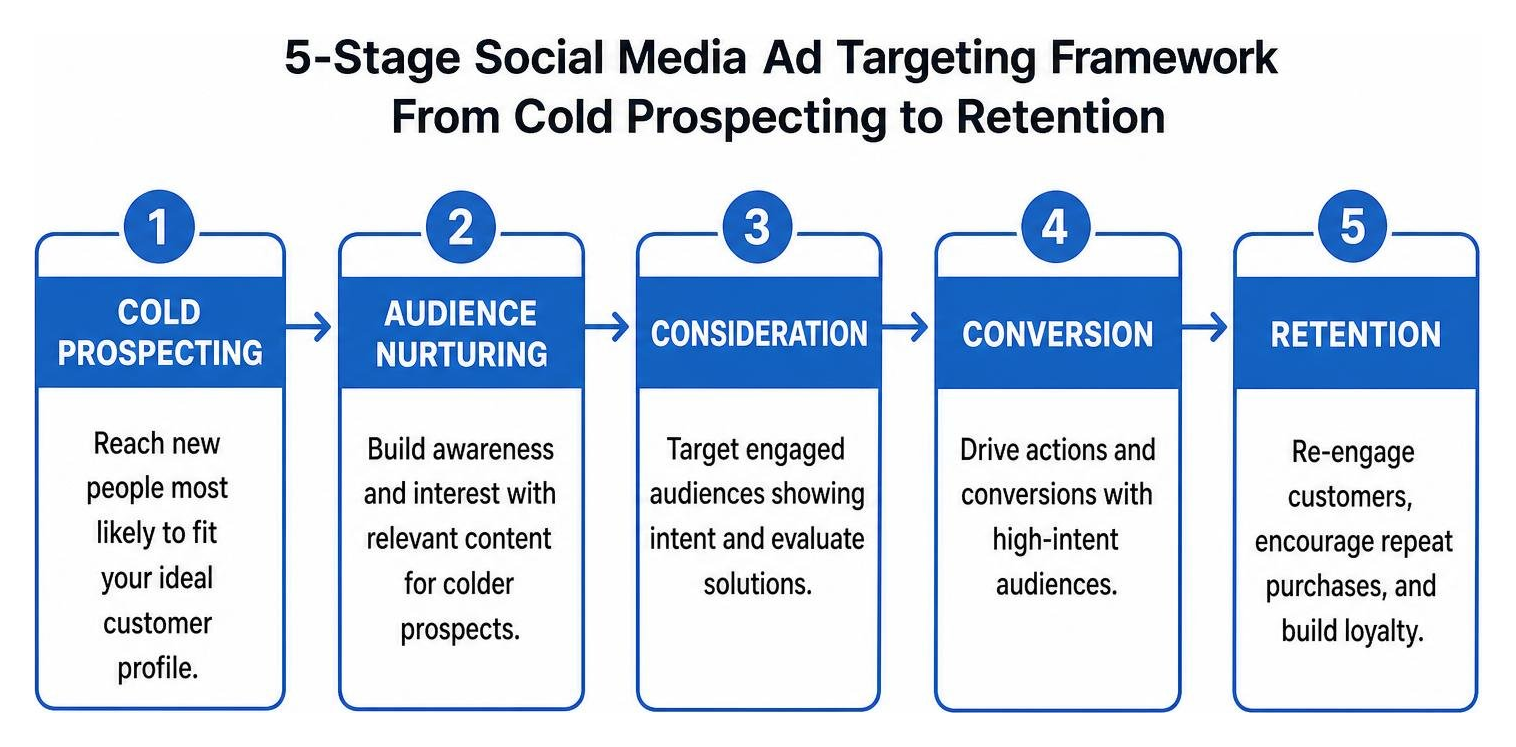
How Do You Build and Execute an Effective Social Media Ad Targeting Strategy in 5 Simple Steps?
Building a high-converting paid social system requires a structured process that balances platform automation with human strategic insight. RankingCo’s methodology starts with commercial context first, then uses platform tools to support the strategy.

How RankingCo Approaches Social Ad Targeting
Our paid media process usually follows six connected stages: audience research, campaign objective selection, platform selection, creative testing, conversion tracking, and ongoing optimisation. We use this sequence because platform targeting settings only perform well when they are connected to a realistic customer journey and a measurable business outcome.
We typically begin by reviewing the customer profile, service area, offer strength, sales cycle, and existing website data. From there, we define the campaign objective, such as lead generation, eCommerce sales, appointment bookings, or remarketing. Platform selection comes next, based on where the audience is most likely to take action rather than where the business simply wants to be visible.
In our experience, Australian small and medium-sized businesses often see stronger paid social performance when campaigns are built around clear conversion intent, practical local targeting, and creative that qualifies the audience before the click. For example, a Brisbane service business may need tighter geographic filtering and stronger lead-quality checks, while an eCommerce brand may benefit from broader audience testing supported by product-specific creative and clean purchase tracking.
We distinguish our methodology from platform recommendations by treating automated suggestions as inputs, not instructions. Platform prompts can help with delivery efficiency, but we still review whether a recommendation suits the budget, audience size, data quality, website conversion path, and commercial objective.
How Do I Target the Right Audience on Social Media?
To target the right audience on social media, start with the commercial outcome, then work backwards to the people most likely to take that action. Define the service area, ideal buyer, buying trigger, likely objections, conversion event, and creative message before choosing detailed platform settings.
A practical targeting decision framework looks like this:
| Decision question | What to review | Targeting implication |
|---|---|---|
| Who can realistically buy from you? | Location, budget, service area, product fit | Exclude regions or segments you cannot serve profitably |
| What problem are they trying to solve? | Search intent, social comments, sales calls, enquiry themes | Shape creative hooks around real buyer needs |
| How close are they to buying? | Website visits, cart actions, lead forms, video views | Separate cold, warm, and high-intent audiences |
| What proof do they need? | Reviews, case studies, guarantees, demonstrations | Match creative to the buyer’s level of trust |
| How will success be measured? | Leads, bookings, purchases, qualified enquiries | Optimise campaigns toward meaningful conversion events |
This prevents a common mistake: treating audience targeting as a list of interests rather than a decision about who is most likely to respond to the offer.
Step 1: Define High-Value Buyer Personas Using Psychographics and Zero-Party Data
Every successful campaign begins with an accurate definition of your ideal customer. Demographic attributes such as age, gender, and geographic location establish baseline boundaries, but psychographic and behavioural insights help explain purchasing decisions.
- Demographics : Define age brackets, household income ranges, education levels, and geographic regions where the business can realistically serve customers.
- Psychographics : Identify core values, personal aspirations, professional pain points, lifestyle preferences, and brand attitudes.
- Behavioural triggers : Review prior brand interactions, recent browsing activity, content consumption habits, and purchase history where that data is available and compliant.
To gather deeper customer insights, collect zero-party data directly from your audience through interactive website quizzes, customer onboarding surveys, and direct feedback forms. Integrating high-intent marketing explained methodologies can help isolate prospects actively looking for solutions, rather than targeting passive scrollers.
Which Platform Is Best for My Business?
The best social media advertising platform is the one where your audience is most likely to take the next commercial action. For many Australian businesses, Meta Ads works well for broad consumer lead generation and eCommerce, LinkedIn suits higher-value Business-to-Business (B2B) decisions, and TikTok can support discovery-led offers.
| Business situation | Platform to test first | Why it may fit |
|---|---|---|
| Local service business seeking enquiries | Facebook Ads and Instagram Ads | Strong local reach, lead forms, retargeting, and practical geo-targeting |
| eCommerce brand with product visuals | Meta Ads or TikTok Ads | Creative-led discovery and product-focused conversion objectives |
| Professional service or B2B offer | LinkedIn Ads | Job title, company, seniority, and industry targeting |
Use this table as a starting hypothesis, not a fixed rule. Budget, sales cycle, creative assets, offer strength, and conversion tracking quality should all influence the final platform choice.
Step 2: Select the Right Advertising Platform for Your Audience and Objectives
Different social networks cater to distinct user mindsets, demographic groups, and buying intentions. Selecting the appropriate platform prevents wasted ad spend and aligns with your commercial objectives.
- Meta Ads (Facebook and Instagram) : Reaches broad consumer demographics with optimisation options for eCommerce sales and direct lead generation. Deploying professional Facebook Ads management and dedicated Instagram Ads provides granular conversion tracking across high-intent consumer pools.
- LinkedIn : Supports Business-to-Business (B2B) lead generation through professional audience criteria, including job title, company, seniority, industry, and skills.
- TikTok : Useful for reaching mobile-first audiences through immersive, creator-led vertical video formats, particularly when the offer suits short-form discovery.
| Platform | Core Audience Fit | Primary Strengths | Best Conversion Objectives |
|---|---|---|---|
| Meta Ads | Broad consumer and local service audiences | Algorithmic matching, custom audiences, retargeting | eCommerce purchases, inbound leads |
| LinkedIn Ads | B2B professionals and decision-makers | Job titles, industry categories, company size | High-value B2B leads, consultations |
| TikTok Ads | Mobile-first discovery audiences | High-engagement vertical video and creator-led reach | App installs, direct product discovery |
How Does Social Media Ad Targeting Work in 2026?
In 2026, social media ad targeting works through a combination of advertiser inputs, first-party data, platform learning systems, creative signals, and conversion feedback. Advertisers still define campaign objectives, locations, exclusions, budgets, and audience signals, but delivery systems increasingly decide which individual users are most likely to respond.
That means creative quality now influences targeting more than many businesses expect. The hook, visual style, offer, landing page, and early engagement signals all help platforms learn who should see the ad next. For this reason, we usually treat creative testing and conversion tracking as part of the targeting system, not as separate tasks.
Step 3: Capitalise on First-Party Data and Server-Side Tracking
Due to ongoing privacy framework updates and browser tracking restrictions, relying solely on standard client-side browser pixels is no longer sufficient. Businesses should implement server-side tracking, such as Meta's Conversions API (CAPI), to transmit offline conversion data, Customer Relationship Management (CRM) purchase records, and website actions directly to ad platform servers.
With clean first-party data, you can build custom audiences and value-based lookalike audiences. In practice, seed quality matters more than list size alone. Instead of using generic website visitor lists that consist of high-bounce traffic, we usually recommend prioritising verified purchasers, qualified leads, or high-value customer segments where privacy consent and data quality are clear.
Broad vs Interest Targeting: Which Should You Use?
Use broad targeting when the account has useful conversion signals, a clear offer, enough budget to learn, and multiple creative angles to test. Use interest-based targeting when the account is new, the audience is niche, the budget is limited, or the campaign needs more manual guidance before the platform has enough performance data.
| Targeting approach | Best used when | Watch out for |
|---|---|---|
| Broad algorithmic targeting | The account has conversion history, strong creative, and a clear conversion event | Poor tracking or weak creative can send the system the wrong signals |
| Manual interest targeting | The audience is niche, the account is new, or early testing needs tighter control | Overlapping interests can make the audience too narrow |
| Lookalike targeting | The source list contains qualified leads, purchasers, or high-value customers | Weak seed lists can create weak lookalikes |
| Retargeting | Users have already visited, engaged, enquired, or started checkout | Small audiences can fatigue quickly if creative is not refreshed |
Step 4: Solve the Targeting Paradox with Creative-Led Algorithmic Delivery
The targeting paradox refers to the strategic choice between narrow manual interest targeting and broad algorithmic delivery. In modern social advertising, overly narrow interest stacking can restrict ad platform auction models and increase acquisition costs when the audience pool becomes too small.
For accounts with sufficient conversion history, broad targeting combined with automated campaign tools can support delivery efficiency. In this environment, your ad creative becomes a major targeting signal because visual elements, copy hooks, and early engagement help platforms learn which users may respond. You can explore this further in our guide to AI-driven ad targeting.
How Much Audience Targeting Is Too Narrow?
Audience targeting is usually too narrow when the platform cannot find enough relevant people to test, learn, and optimise efficiently. Warning signs include repeated learning limitations, rising costs without better lead quality, the same users seeing ads too often, and very small retargeting pools receiving the same creative for too long.
Instead of narrowing every campaign by age, interest, behaviour, device, placement, and location at once, we usually recommend changing one major variable at a time. This makes it easier to see whether performance changed because of the audience, the creative, the offer, or the landing page.
Step 5: Apply Precise Geo-Targeting, Exclusions, and Testing Frameworks
For Australian businesses targeting specific metropolitan hubs like Brisbane, Sydney, or Melbourne, location settings must be configured carefully. Setting a radius that is too narrow can restrict delivery and inflate costs, while broad national delivery can waste budget on areas the business cannot service.

When running regional service campaigns, combine local Facebook ad campaigns with professional Search Engine Optimisation (SEO) services to capture both active search intent and passive social engagement.
To maintain healthy audience hygiene and reduce internal audience overlap, apply clear audience exclusion rules:
- Exclude recent purchasers from cold prospecting campaigns when repeat purchase timing does not justify immediate retargeting.
- Exclude warm retargeting segments such as website visitors and engaged social followers from top-of-funnel acquisition sets when those users are already being nurtured elsewhere.
- Exclude low-quality engagement pools , such as visitors who bounced quickly or only visited customer support pages.
How Should Australian Businesses Target Customers by Location?
Australian businesses should target customers by location based on where they can profitably deliver the service, not just where they want brand visibility. A Brisbane service provider may need suburb-level or metropolitan targeting, while a national eCommerce store may need state-level testing, shipping exclusions, and separate campaigns for areas with different buying patterns.
A simple location framework is:
| Business model | Location targeting approach | Practical consideration |
|---|---|---|
| Local service business | Target suburbs, service regions, or nearby metropolitan areas | Exclude locations outside the real service area |
| Multi-location business | Separate campaigns by city or region where budgets allow | Compare lead quality across Brisbane, Sydney, and Melbourne |
| eCommerce brand | Start broader, then segment by delivery performance or demand | Align ads with shipping rules, stock, and seasonal demand |
| Appointment-based business | Target areas close enough for realistic attendance | Match ads to booking availability and travel expectations |
Social Media Ad Targeting Mistakes We See Businesses Make
The most common targeting mistakes are not only technical platform errors. They usually come from unclear strategy, weak data, or campaign structures that do not match how customers make decisions.
| Mistake | Why it wastes budget | Better approach |
|---|---|---|
| Starting with interests before defining the offer | The campaign may reach people who match a profile but do not care about the message | Clarify the offer, audience pain point, and conversion action first |
| Making audiences too narrow too early | The platform has limited room to learn and costs can rise without better quality | Test broader structures with clear exclusions and strong creative |
| Using weak custom audience seed lists | Lookalikes can mirror low-quality visitors or unqualified leads | Build seeds from purchasers, qualified enquiries, or higher-value segments |
| Treating platform recommendations as instructions | Automated suggestions may not reflect margins, service areas, or lead quality | Review recommendations against commercial context before applying them |
| Ignoring location exclusions | Budget can be spent in areas the business cannot serve effectively | Match targeting to real service areas, delivery zones, and sales capacity |
| Refreshing targeting but not creative | The campaign may keep sending similar messages to similar people | Test new hooks, proof points, formats, and offers alongside audience changes |
How Do You Layer Audience Segments for Maximum Funnel Impact?
To maximise Return on investment (ROI), advertisers should structure ad sets into a cohesive full-funnel architecture that guides prospects from initial brand discovery to purchase and long-term retention.
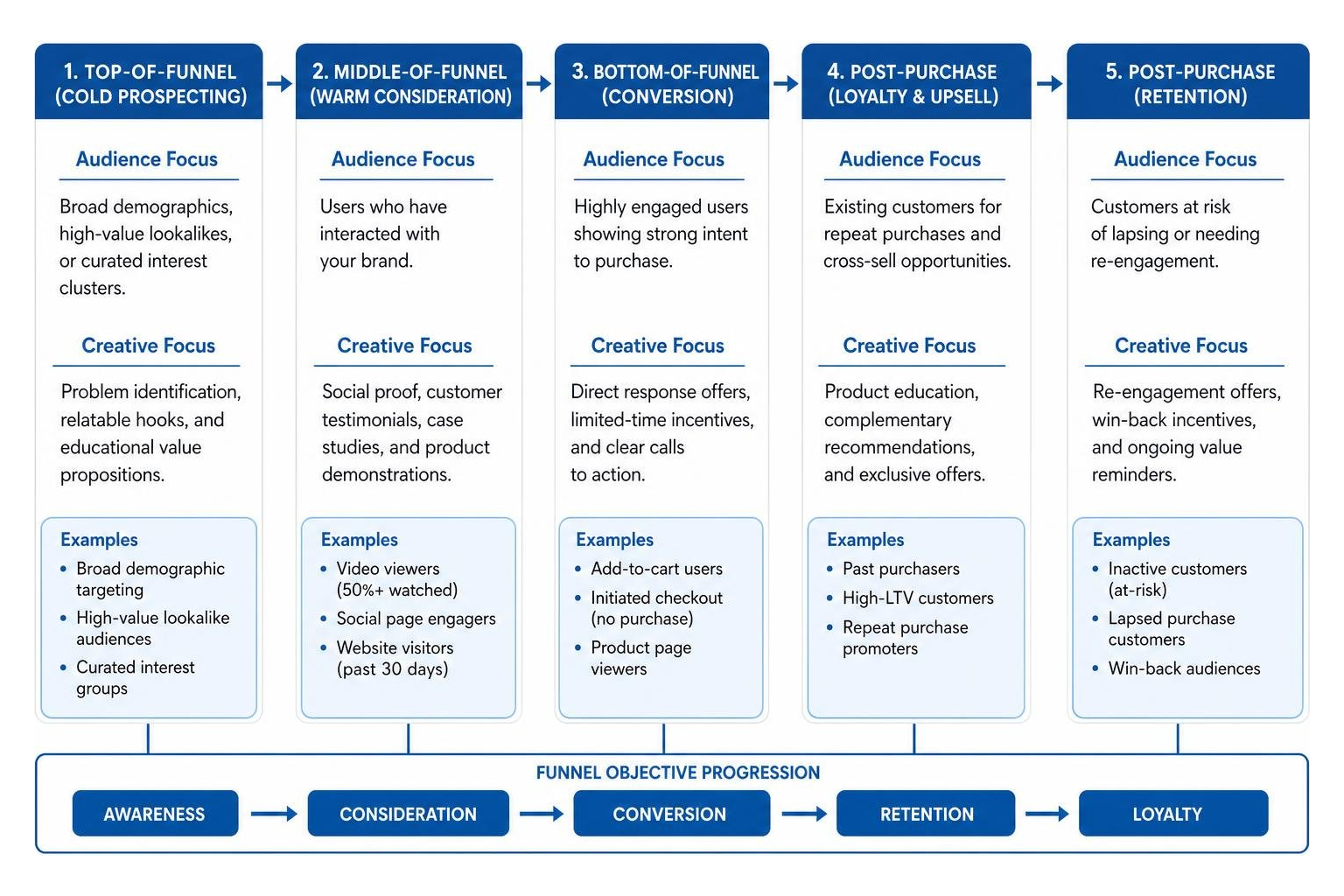
1. Top-of-Funnel (Cold Prospecting)
Target broad demographic parameters, high-value lookalikes, or curated interest clusters. Ad creative at this stage should focus on clear problem identification, relatable hooks, and educational value propositions without demanding immediate commitments. Budget weighting should depend on the business model, audience size, and conversion data maturity rather than a fixed universal split.
2. Middle-of-Funnel (Warm Consideration)
Target users who have interacted with your brand, such as video viewers, social page engagers, or general website visitors. Creative assets at this stage should showcase social proof, customer testimonials, case studies, and product demonstrations to build trust.
3. Bottom-of-Funnel (High-Intent Retargeting)
Target high-intent abandoners, including users who viewed specific product pages, initiated checkout, or added items to their shopping cart. Deliver friction-reducing messaging such as customer guarantees, transparent shipping policies, answers to common objections, and clear calls to action. You can discover more high-converting techniques in our overview of targeted advertising strategies that convert.
4. Post-Purchase Retention and Upsell
Target existing customer lists with dedicated campaigns designed to encourage repeat purchases, cross-sell complementary accessories, or introduce subscription models.
When scaling campaigns, we prefer controlled testing over sudden budget increases. That usually means testing new creative concepts, audience hypotheses, and lookalike variations separately before increasing spend. The goal is to understand what is driving performance before scaling the campaign.
If you are looking to scale your business with tailored social media marketing, you can explore our services or contact RankingCo to speak with our performance marketing specialists.
How Can Businesses Improve Social Media Ad Targeting?
Businesses can improve social media ad targeting by matching the right audience, platform, creative message and campaign objective, then using performance data to refine each decision. Strong targeting is not just about selecting interests or demographics. It depends on knowing who can realistically buy, what action they are ready to take, which platform suits that behaviour, and whether the campaign is attracting useful enquiries or sales.
At RankingCo, we approach social media advertising as a connected system. We review audience quality, location fit, creative response, conversion tracking and campaign objectives together, so targeting decisions are guided by commercial context rather than platform settings alone. This helps Australian small and medium-sized businesses make practical decisions about broad targeting, interest-based targeting, retargeting and location filters without relying on unsupported benchmarks.
For support with campaign planning, targeting and ongoing optimisation, explore these RankingCo service pages or contact our team to discuss your advertising goals:
Frequently Asked Questions About Social Media Ad Targeting
How do you target the right audience on social media?
To target the right audience on social media, start with the commercial outcome and work backwards to the people most likely to take that action. At RankingCo, we usually review the service area, ideal buyer, buying trigger, offer strength, likely objections, conversion path, and available first-party data before recommending detailed audience settings.
Is broad targeting or interest targeting better for social media ads?
Broad targeting is often better when the account has reliable conversion signals, strong creative, and a clear optimisation event, while interest targeting can be useful when the audience is niche or the account needs more manual guidance. We treat both approaches as testable campaign hypotheses rather than universal rules, because the right choice depends on the offer, budget, data quality, creative, and conversion tracking setup.
How do I target customers in a specific location with social media ads?
To target customers in a specific location, set campaigns around the areas the business can profitably serve and exclude locations that are unlikely to convert into useful enquiries or sales. For Australian small and medium-sized businesses, this may mean suburb-level or metropolitan targeting for local services, city-specific campaigns for multi-location brands, or broader regional testing for eCommerce where delivery rules and demand vary by location.
What is the difference between a custom audience and a lookalike audience?
A custom audience is built from people who already have a connection with the business, while a lookalike audience is used to find new people who share similar characteristics with a source audience. In practice, custom audiences are usually better suited to retargeting warm prospects, and lookalikes work best when the source list is based on high-quality first-party data such as qualified leads, purchasers, or valuable customer segments.
Which social media platform is best for advertising?
The best social media advertising platform is the one where the target audience is most likely to take the next commercial action. Meta Ads can suit broad consumer lead generation and eCommerce, LinkedIn Ads can suit Business-to-Business (B2B) targeting, and TikTok can support discovery-led offers, but platform choice should always be tested against the business model, audience, creative assets, and conversion goal.
How can I tell if my social media ad targeting is working?
Social media ad targeting is working when campaigns are reaching commercially relevant people and producing useful conversion quality, not just cheap clicks or high engagement. At RankingCo, we look at lead quality, purchase value, enquiry relevance, conversion rate, Cost Per Acquisition (CPA), landing page behaviour, audience overlap, creative response, and whether the campaign is helping the business move closer to its actual growth goal.
What are the most common social media ad targeting mistakes?
The most common social media ad targeting mistakes are starting with interests before clarifying the offer, making audiences too narrow too early, using weak first-party data, ignoring location exclusions, and treating platform recommendations as instructions. We usually recommend reviewing targeting decisions against the customer journey, commercial objective, creative message, and tracking quality before increasing spend.
How often should social media ad targeting be reviewed?
Social media ad targeting should be reviewed regularly whenever performance changes, the offer changes, the audience changes, or the platform introduces meaningful campaign updates. At RankingCo, we prefer ongoing optimisation based on conversion quality, creative response, audience fatigue, location performance, and tracking reliability rather than making changes on a fixed schedule without evidence.



Share online


