
Google Ranking Help: How Aussie Businesses Build Search Visibility in 2026
What Is Google Ranking Help and How Can It Improve Your Visibility?

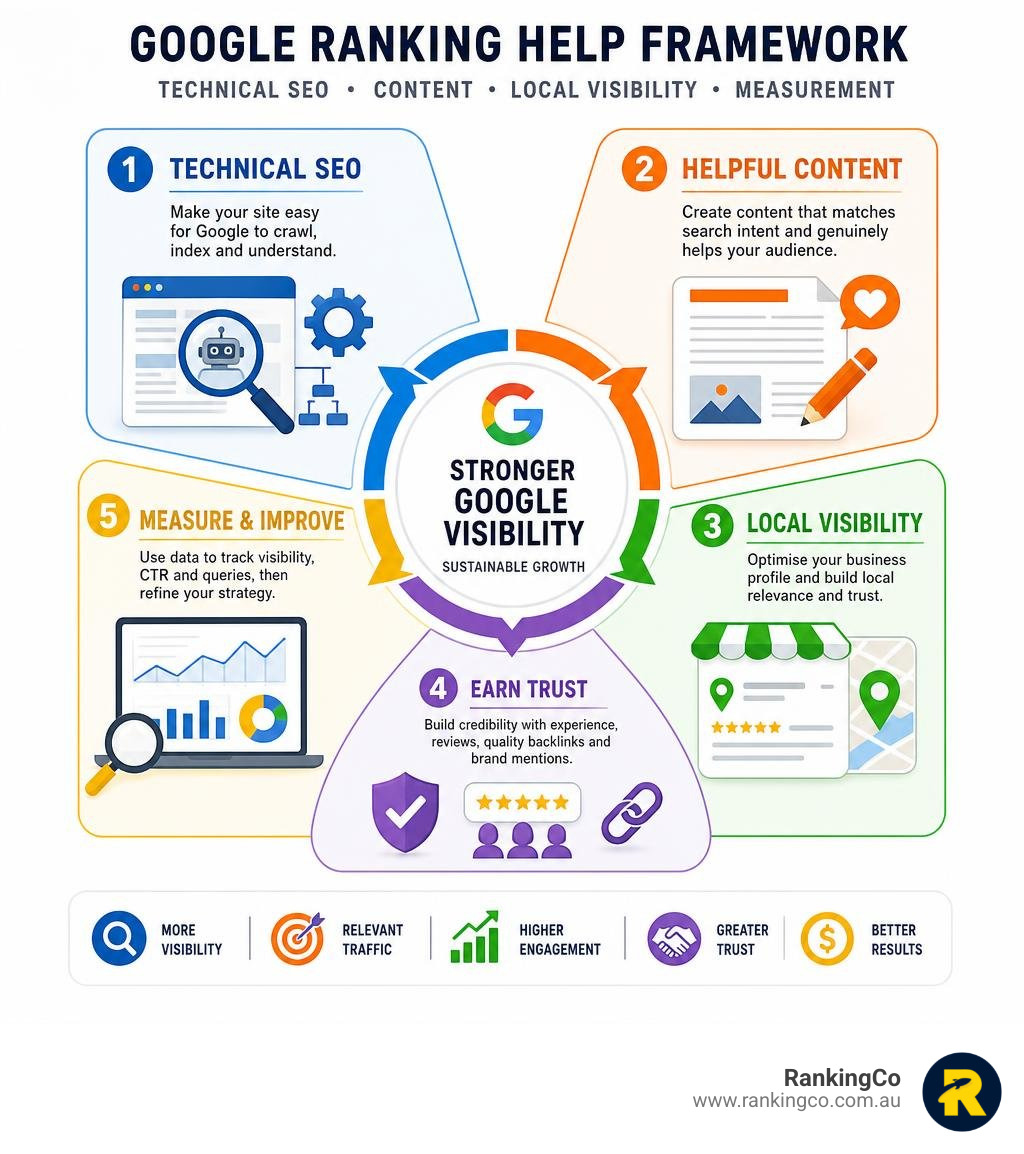
At RankingCo, when Australian small businesses ask us for Google ranking help , we look well beyond traditional search engine results pages. In 2026, search engine visibility is about total customer discovery across Google rankings, Google AI Overviews, AI search tools, and local SEO. The core objective is simple: make your business straightforward for Google to crawl, genuinely helpful for searchers, and authoritative enough to earn visibility wherever prospective customers are searching.
- Match search intent: Build content that directly answers real questions and solves specific problems for your target audience.
- Establish a solid Search Engine Optimisation (SEO) foundation: Optimise technical performance, site architecture, mobile experience, and page indexing.
- Strengthen local SEO visibility: Keep your Google Business Profile detailed, verified, and active to capture local customer discovery.
- Earn digital authority: Produce experience-backed content that naturally attracts relevant links, reviews, and brand mentions.
- Track commercial metrics: Use Google Search Console to monitor Click-through rate (CTR), search impressions, and active customer queries.
While SEO drives sustainable long-term discovery, Pay-Per-Click (PPC) channels like Google Ads and Meta Ads can support immediate campaigns. Both approaches should be evaluated against Return on investment (ROI) and Conversion rate optimisation (CRO) to support your eCommerce or lead-generation growth.
Google does not offer shortcuts or guaranteed ranking positions, and no realistic provider can promise specific AI placement or top positions. What yields real results is a practical strategy connecting technical site health, helpful content, local presence, and genuine brand trust. To discuss how tailored search strategies can support your growth targets, check out our services or reach out via Contact RankingCo.
Complete Framework to Get Effective Google Ranking Help
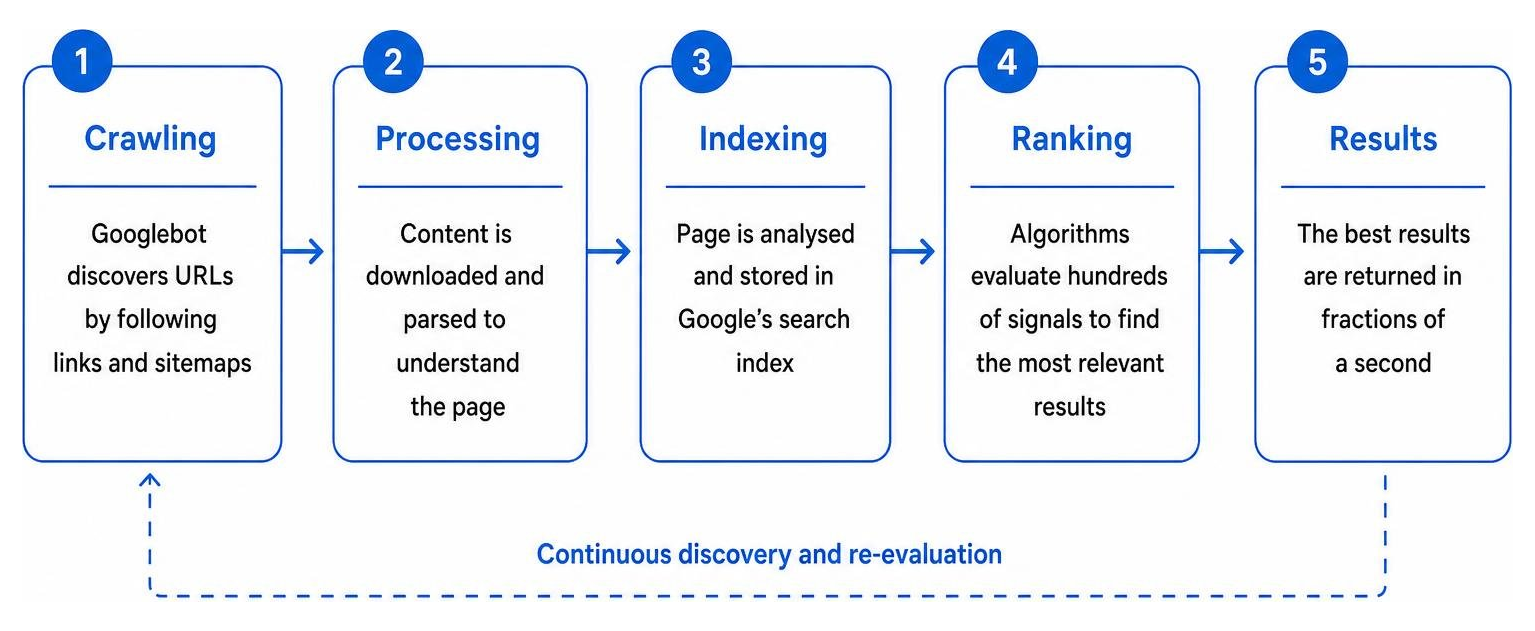
Understanding how search engines process digital content is the starting point for effective search engine optimisation. Google discovers pages through automated web crawlers that follow links across the internet. Once discovered, these pages are processed and stored in a vast database known as the search index. When a user submits a query, Google algorithms analyse hundreds of ranking signals to deliver relevant results in fractions of a second.
Aligning your website with user search intent is essential for customer discovery. Google continually updates its language models to understand the deeper context of search queries rather than looking for exact keyword repetitions. To build a solid foundation, website owners should consult the official SEO Starter Guide: The Basics provided by Google developers.
A comprehensive search strategy balances technical performance, on-page content alignment, and off-page authority signals. You can learn more about balancing these factors in our overview of SEO on Page and Off Page principles. Technical health ensures search engines can crawl and render your pages without friction. This includes optimising Core Web Vitals metrics, maintaining fast page load speeds, and ensuring full mobile responsiveness, as Google primarily evaluates websites using mobile-first indexing.
Content evaluation heavily relies on Google's Experience, Expertise, Authoritativeness, and Trustworthiness framework, commonly known as E-E-A-T. Webmasters should align their editorial processes with official guidelines for Creating Helpful, Reliable, People-First Content. High-quality content coupled with authoritative editorial backlinks signals to Google that your site is a legitimate authority in your industry.
Positioning matters significantly in organic search results. Research published in a Shopify study on Google ranking factors shows that a first-place ranking on desktop and mobile generates a 39.8% Click-through rate (CTR), compared with 18.7% for second position and 10.2% for third position.
Search patterns in 2026 also involve generative AI features such as AI Overviews and AI search experiences. These summaries rely on Retrieval-Augmented Generation processes and query fan-out mechanics to extract concise answers from top-ranked, trusted web pages. Rather than replacing traditional optimisation, AI search features build directly upon standard search indexing systems. Australian business owners interested in deep-dive ranking criteria can review our insights on Google Ranking Factors to understand core algorithmic priorities.
To discuss how tailored search strategies can support your growth targets, check out our services or Contact RankingCo to speak with our strategy team.
Core Technical and Content Tactics for Google Ranking Help

Translating search engine guidelines into everyday actions requires focus on site architecture and content delivery. A clean, logical website structure helps both human visitors and search crawlers navigate your content effortlessly. Organise your topically similar pages into intuitive subdirectories and maintain short, descriptive, human-readable URL structures.
Page speed and user experience metrics directly impact site usability and search evaluation. Core Web Vitals evaluate real-world user interactions:
- Interaction to Next Paint (INP): Measures page responsiveness and how quickly a page responds to user inputs such as taps or clicks.
- Largest Contentful Paint (LCP): Measures perceived loading speed by recording when the main content block renders on screen.
- Cumulative Layout Shift (CLS): Measures visual stability by tracking unexpected layout shifts during page loading.
On-page element optimisation remains a staple of effective Search Engine Optimisation (SEO). Craft unique title tags and clear meta descriptions that summarise the page content while encouraging clicks from search engine result pages. Ensure your internal link architecture connects related blog posts and service pages using clear, descriptive anchor text. For localised businesses, combining sound on-page structures with regional targeting yields excellent visibility, which we detail in our guide on SEO Services for Local Businesses.
When writing website content, avoid commodity information that simply rewrites existing web pages. Create expert-led content based on first-hand industry experience, original data, or specialised insights. Focus on comprehensively answering the target query and satisfying customer intent without artificial word counts or unsupported ranking guarantees.
Frequently Asked Questions About Google Ranking Help
How do I optimise my Google Business Profile for better local ranking?
Optimising your Google Business Profile starts with completing business verification to prove legitimate ownership. Ensure your Name, Address, and Phone number details are consistent across your profile, official website, and third-party web directories. Select accurate primary and secondary business categories that directly reflect your actual operations.
Provide detailed profile information, including regular operating hours, holiday hours, payment types accepted, and granular attributes like wheelchair accessibility or dedicated parking. Add high-resolution photos and videos showing your premises, team, and products. Retail businesses operating in eligible regions can also display in-store product inventory directly on their profiles.
Maintaining a healthy review velocity by consistently collecting authentic customer feedback is vital. Respond promptly and professionally to all reviews, addressing both positive comments and constructive criticism. For official step-by-step instructions, refer to Google's guide on Tips to improve your local ranking on Google. RankingCo provides tailored support with local search visibility across Australia. Explore our services to learn more.
What key factors provide the most Google ranking help?
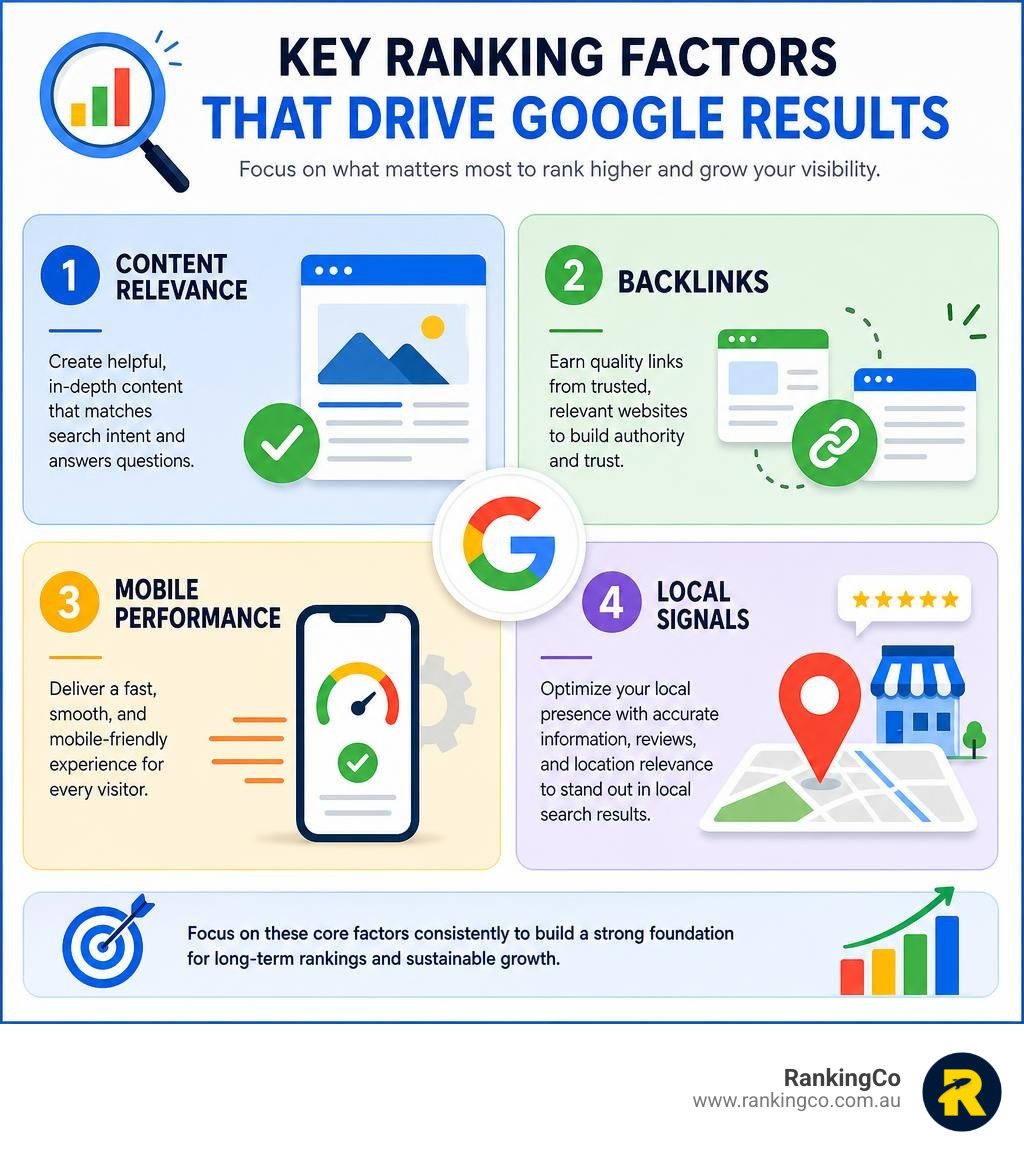
The most influential ranking factors centre on content relevance, website quality, technical accessibility, and off-page trust signals. Ensuring your web content directly resolves the user's explicit search intent is paramount. Pages must load quickly, render cleanly on mobile devices, and deliver a smooth user experience that keeps searchers engaged.
A strong backlink profile consisting of contextual links from recognised, relevant websites serves as a core endorsement of site authority. Technical health verified through regular audits in Google Search Console helps ensure search bots crawl and index critical URLs without encountering blocks or duplicate content confusion. Regular measurement also helps identify which searches, pages, and local signals are contributing to overall customer discovery.
What is the difference between relevance, distance, and prominence in local SEO?
Google determines local search rankings primarily through three pillars: relevance, distance, and prominence. Relevance measures how effectively a local profile or web page matches a specific search query, which is improved through accurate business categories and localized content. Distance represents the physical geographic proximity between the searcher and the business address. Prominence evaluates how authoritative and trusted a business is within its area, relying on review volume, customer sentiment, directory citations, and website backlink authority.
How do backlinks and page authority impact search positioning?
Backlinks function as digital votes of confidence from one website to another. When reputable, topically relevant websites link to your content, search engine algorithms interpret those links as evidence that your information is credible and valuable.
Quality far outweighs sheer link volume. A single link placed editorially within a comprehensive article on a respected industry website carries substantially more weight than numerous low-quality links from generic web directories. Focus on earning natural editorial links through digital public relations outreach, releasing original market research, publishing highly educational guides, and establishing strategic brand partnerships within your target market.
How can content be optimised for AI Overviews and generative search?
Optimising for Google AI Overviews and generative search features relies on strong foundational SEO principles rather than artificial manipulation. Generative search tools use Retrieval-Augmented Generation processes to extract facts directly from high-performing, indexed web pages.
To maximise visibility within AI-generated search summaries, structure content logically with clear headings, publish original expert insights, implement accurate schema markup, and address natural language conversational queries directly. For assistance with optimising your online presence across local search, Google Ads, and organic SEO, explore our services or reach out directly via Contact RankingCo.



Share online


