
The Ultimate Guide to Google Ads ROI Benchmarks in Australia
What Is a Good Google Ads ROI in Australia?

A good Return on investment (ROI) for Google Ads in Australia is a return that creates profit after ad spend, management fees, sales costs, delivery costs, and fulfilment costs are accounted for. There is no single universal ROI percentage because the right target depends on gross margin, average customer value, conversion rate, sales close rate, and customer lifetime value.
- Start with profitability: a campaign must produce more contribution profit than it costs to run.
- Judge leads by quality: a phone call or form submission only has value when it becomes a viable sale.
- Factor in customer lifetime value: repeat purchases, retained clients, and referrals can justify a higher acquisition cost.
- Use reliable tracking: conversion tracking, call tracking, and offline sales data turn Google Ads reporting into a business decision.
- Get strategic support: explore our Google Ads management services for a clearer view of campaign performance.
At RankingCo, we help Australian businesses look beyond clicks and dashboard revenue to understand the commercial outcome of their Pay-Per-Click (PPC) advertising. Our approach connects keyword intent, landing-page performance, conversion data, qualified leads, sales outcomes, and true campaign profitability.
If you want a practical starting point, ask whether every dollar spent on Google Ads is returning enough gross profit to fund the campaign, support your sales process, and still leave room for business growth. That is the benchmark that matters most.
What Is a Good ROAS for Google Ads?
A good Return on ad spend (ROAS) for Google Ads is the revenue multiple that still leaves profit after your real costs are deducted. In practice, ROAS is only useful when it is interpreted alongside gross margin, cost of goods or services, management fees, sales costs, and customer lifetime value.
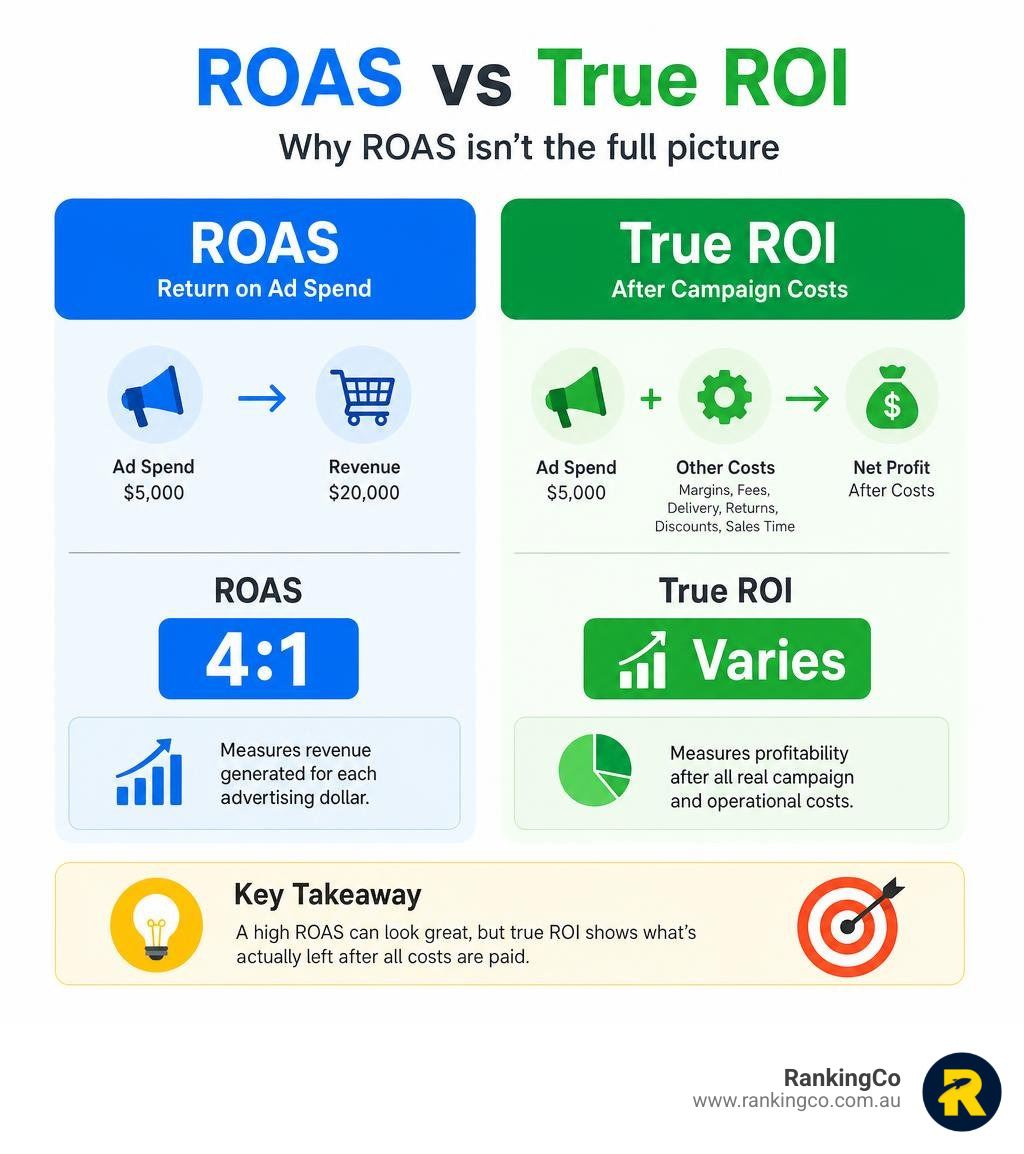
ROAS measures revenue generated for each advertising dollar, while ROI measures profitability after costs. A campaign that spends $5,000 and generates $20,000 in attributable revenue has a 4:1 ROAS . That sounds strong, but it does not confirm profit until you check margins, management fees, delivery costs, discounts, returns, and sales time.
This is why we separate ROAS from true commercial performance when reviewing Google Ads accounts. Brand campaigns, repeat buyers, and high-intent returning customers can all lift ROAS without proving that acquisition campaigns are profitably winning new customers.
How Do You Calculate Google Ads ROI?
You calculate Google Ads ROI by comparing the profit generated from campaigns with the total cost of running those campaigns. Use gross profit where possible, not just top-line revenue, so the calculation reflects real commercial performance for the Australian business.
Use this formula:
ROI = (profit generated from Google Ads - total campaign costs) ÷ total campaign costs × 100
Total campaign costs should include media spend, management fees, landing page work, sales tools, call tracking, and any internal sales or fulfilment costs directly tied to the campaign.
For example, an Australian service business might spend $5,000 on Google Ads and attribute $20,000 in revenue to those campaigns. If that business has a 50% gross margin, the campaign produced $10,000 in gross profit before campaign costs. The ROI calculation becomes:
($10,000 - $5,000) ÷ $5,000 × 100 = 100% ROI
That distinction matters because a campaign can show strong dashboard revenue while still producing weaker profit if the margin is low, the leads are poor quality, or the sales process is expensive.
What ROI Should Australian Businesses Aim For?
Australian businesses should aim for the Google Ads ROI that supports profitable growth after ad spend, management fees, delivery costs, sales costs, and fulfilment are allowed for. Instead of copying a generic ROAS target, set your benchmark from your own margins, job value, close rate, capacity, and customer lifetime value.

Use this framework to determine your acceptable return:
| Benchmark input | What to check | Why it matters |
|---|---|---|
| Average sale or job value | Typical revenue from a converted lead or order | Higher-value sales can support higher acquisition costs when margins are healthy |
| Gross profit margin | Profit left after direct delivery, product, labour, or fulfilment costs | Revenue can still be weak if the margin is too thin |
| Lead-to-sale conversion rate | The percentage of enquiries that become paying customers | Poor lead quality or follow-up increases the true customer cost |
| Maximum acceptable customer acquisition cost | The most you can spend to win a customer and still make worthwhile profit | This turns ROI into a spending guardrail |
| Customer lifetime value | Repeat work, retained clients, repeat purchases, and referrals | Strong lifetime value can justify a lower first-sale ROI if cash flow allows it |
| Available capacity | Whether the business can handle extra work or orders | Extra leads only help if the business can service them profitably |
Google Ads ROI for Trades
Google Ads ROI for trades should be evaluated against booked work, job value, service area fit, call quality, booking rate, and delivery cost. Plumbers, electricians, builders, and other trade businesses can receive urgent searches, planned-project enquiries, and low-fit price shoppers through the same account, so a useful ROI review separates profitable jobs from general enquiry volume.
Google Ads ROI for Professional Services
Google Ads ROI for professional services should be evaluated against qualified consultations, client value, sales cycle length, and close rate. Legal, accounting, consulting, healthcare, and other professional service campaigns usually need fewer but better-qualified enquiries because each lead may require time, trust-building, and careful assessment before it becomes revenue.
Google Ads ROI for eCommerce
eCommerce Google Ads ROI should be evaluated against gross margin, average order value, repeat purchase behaviour, fulfilment costs, delivery costs, returns, payment fees, and discounting. Return on ad spend (ROAS) needs to be assessed against real margin because dashboard revenue can look strong while product costs and fulfilment absorb most of the sale value.
Google Ads ROI for B2B
Google Ads ROI for Business-to-Business (B2B) campaigns should be evaluated against lead qualification, sales cycle length, deal value, decision-maker fit, and offline conversion data. A practical B2B ROI benchmark connects Google Ads data with sales outcomes, including qualified opportunities, proposals, closed deals, and retained accounts.
This industry-specific view helps Australian businesses determine whether Google Ads are actually profitable in their situation. The right target changes by trade, service model, sales process, margin, and customer value, which is why we tailor Google Ads campaigns around how each business actually wins customers.
Why Can a High ROAS Still Be Unprofitable?
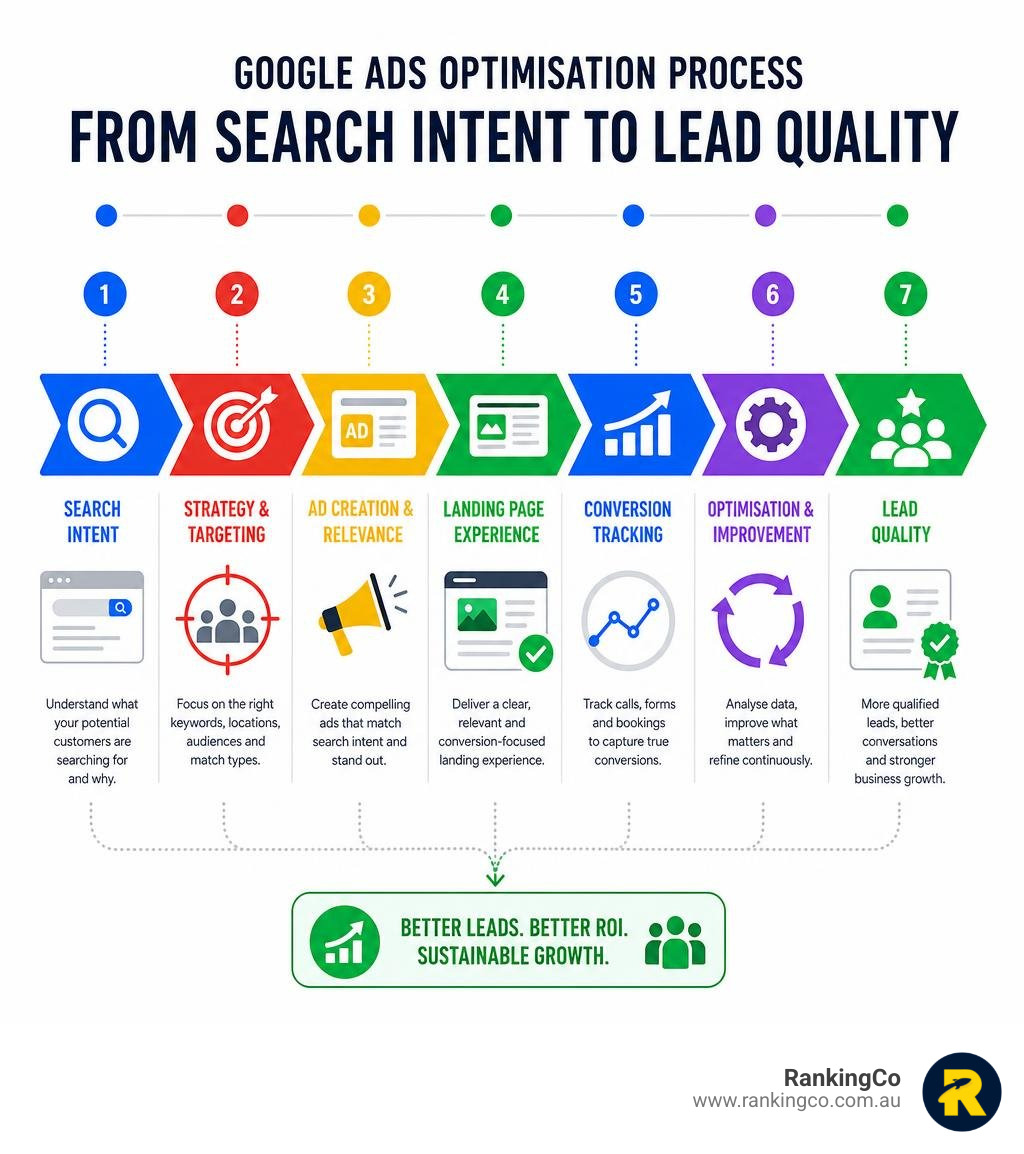
A high ROAS can still be unprofitable when revenue is absorbed by product costs, delivery, discounts, returns, management fees, sales time, and low-quality enquiries. ROAS can also look inflated when brand traffic, repeat customers, or existing demand are counted alongside new-customer acquisition.

When we review Google Ads accounts, we often see performance look stronger than it really is because every conversion is treated as equal. A form submission from a price shopper, a missed call, a repeat enquiry, and a high-intent sales call can all appear as conversions in the same column.
Common ROI distortions include duplicate conversions, calls counted before they are long enough to indicate intent, poor lead quality, enquiries outside the service area, brand traffic being mixed with acquisition campaigns, and offline sales not being imported into Google Ads or Customer Relationship Management (CRM) systems.
Before increasing spend, we look for clean tracking, qualified enquiries, realistic close rates, and evidence that the campaign is producing profitable customers rather than simply more activity. Frameworks for evaluating true campaign performance are detailed in our guide on Smart Spending: Measuring and Improving Your Marketing ROI.
How to Measure Google Ads ROI Accurately
Measuring Google Ads ROI accurately means connecting ad spend to qualified leads, closed sales, gross profit, and customer value, not just counting every form submission or phone call as equal. The cleaner the tracking and attribution, the easier it is to decide whether the campaign is genuinely profitable.
We usually check whether:
- Conversion tracking separates meaningful enquiries from low-value actions.
- Phone calls are long enough and relevant enough to indicate real buying intent.
- Brand, non-brand, remarketing, and acquisition campaigns are reviewed separately.
- Sales teams record which leads become quotes, bookings, purchases, or retained customers.
- Offline conversion data is imported into Google Ads or Customer Relationship Management (CRM) systems where appropriate.
- Revenue is reviewed against gross profit after delivery costs, returns, discounts, and fulfilment.
This keeps measurement focused on commercial outcomes. A campaign should not be judged only by clicks, impressions, or total enquiry volume if those actions do not translate into profitable customers.
For a broader view of how paid search fits into a commercial growth strategy, explore Our Services or review our Google Ads services.
How Long Does It Take to Reach a Profitable ROI?
The time it takes to reach a profitable Google Ads ROI depends on competition, budget, conversion volume, tracking quality, landing page performance, and the length of the sales cycle. Some campaigns identify profitable patterns quickly, while others need more testing before reliable decisions can be made.
A new account often needs time to gather enough conversion data to judge search terms, ad messaging, landing pages, and lead quality. A mature account may improve faster if it already has clean tracking, historical data, and clear sales feedback.
The key is to avoid judging performance from early click or enquiry volume alone. We look for whether the campaign is producing qualified opportunities, whether those opportunities are closing, and whether the resulting profit supports continued investment. If you want help checking whether your current campaigns have enough reliable data to assess profitability, you can Contact RankingCo for a practical review.
How Can You Improve Google Ads ROI?
You can improve Google Ads ROI by reducing wasted spend, improving conversion quality, strengthening sales follow-up, and focusing budget on campaigns that produce profitable customers. The goal is better commercial outcomes from the right searches.
Useful improvement steps include:
- Review search terms and add negative keywords where irrelevant traffic appears.
- Separate brand, non-brand, remarketing, and acquisition campaigns for clearer reporting.
- Tighten conversion tracking so duplicate forms, short calls, and low-value actions are not overcounted.
- Import qualified lead or closed-sale data where appropriate.
- Improve landing pages so the message, offer, form, and call to action match search intent.
- Review lead quality with the sales team, not just the advertising dashboard.
If you want a clearer view of whether your Google Ads campaigns are producing profitable customers, our team can help review tracking accuracy, lead quality, search intent, sales feedback, and campaign structure. Learn more about our Google Ads management services, explore Our Services, or Contact RankingCo to discuss a practical campaign review.
Frequently Asked Questions About Google Ads ROI
What is a good ROAS for a small business?
A good ROAS for a small business is the revenue multiple that still leaves enough gross profit to cover product or service delivery, sales time, management fees, and overhead contribution. A smaller service business with strong margins may accept a lower ROAS than an eCommerce store with product costs, delivery, returns, and discounting to absorb.
Can Google Ads be profitable with a low conversion rate?
Google Ads can be profitable with a low conversion rate when average customer value, gross margin, and close rate offset the lower enquiry volume. Compare the cost of each qualified opportunity against expected profit, rather than judging conversion rate alone.
What should I do if my Google Ads campaign is generating leads but no sales?
If Google Ads is generating leads but no sales, review lead quality, search terms, location targeting, call recordings where available, form details, and sales follow-up before increasing spend. The issue may be unqualified traffic, weak enquiry handling, slow response times, poor offer fit, or a landing page that attracts curiosity rather than buying intent.
How can I tell if my Google Ads leads are actually profitable?
You can tell whether Google Ads leads are profitable by tracking each lead through to quoted work, closed sales, gross profit, repeat purchases, and customer lifetime value. A simple lead source report in your Customer Relationship Management (CRM) system can show whether the campaign is producing commercially useful opportunities or just activity.
Should I increase my Google Ads budget if my campaign is profitable?
You should increase Google Ads budget only when the campaign is profitable, tracking is reliable, and there is enough search demand to scale without lowering lead quality. Increase budget gradually, monitor cost per qualified lead and close rate, and separate new-customer acquisition from brand or repeat-customer traffic.
Why has my Google Ads ROI suddenly dropped?
Google Ads ROI can drop suddenly because of higher click costs, tracking changes, landing page issues, competitor activity, seasonality, weaker sales follow-up, or a shift in the mix of brand and non-brand traffic. Check recent account changes, conversion tracking, search terms, auction insights, lead quality, and sales outcomes before assuming the whole channel has stopped working.
When should I pause an underperforming Google Ads campaign?
Pause an underperforming Google Ads campaign when spend is consistently producing poor-quality leads, tracking confirms the issue, and practical fixes have not improved commercial outcomes. First check whether the problem is limited to certain keywords, locations, ads, landing pages, or times of day.





Share online


