
How to Improve Ad Relevance: Make Your Google Ads More Relevant to Searchers
How to Improve Ad Relevance in Google Ads
Ad relevance improves when the searcher's intent, the ad message and the landing page all line up. It is not simply a matter of inserting a keyword into an ad. The stronger approach is to understand what the person is looking for, organise campaigns around that need, write a specific message and carry the same promise through to the page after the click.
Google Ads uses Quality Score to highlight potential disconnects across expected click-through rate (CTR), message fit and landing page experience. Treat it as a prompt for closer investigation, not a standalone target to optimise. This guide explains how to assess search intent, align keywords and ads, improve landing page relevance, use negative keywords and search-term data, and identify what to review when relevance is weak. Paid advertising results vary by budget, industry and targeting.
Key Takeaways
- Start with search intent, not keyword volume alone.
- Group closely related searches so an ad can answer one clear customer need.
- Make the ad message and landing page deliver the same promise.
- Use search-term data, negative keywords and Quality Score diagnostics to identify relevance gaps.
- Treat ad relevance as an ongoing optimisation process, not a one-time setup task.
Businesses reviewing the bigger picture can also explore our guide to creating high-performing Google Ads that sell, which connects campaign structure, search intent, keywords, ads and landing pages.
Start With Search Intent, Not Just Keywords

What does search intent have to do with ad relevance?
Searches that use similar language can signal different needs. Someone searching for “office chairs” may be browsing broadly, while “ergonomic office chair for back support” suggests a specific requirement. Searches for “budget office chairs” and “office chair repairs” point to different expectations again, so they should not automatically receive the same message.
Before writing an ad, consider what the person wants to find, where they are in the buying journey, which product or service they expect and what message would genuinely answer that search. This keeps Google Ads ad relevance practical: the ad should make sense for the search that triggered it.
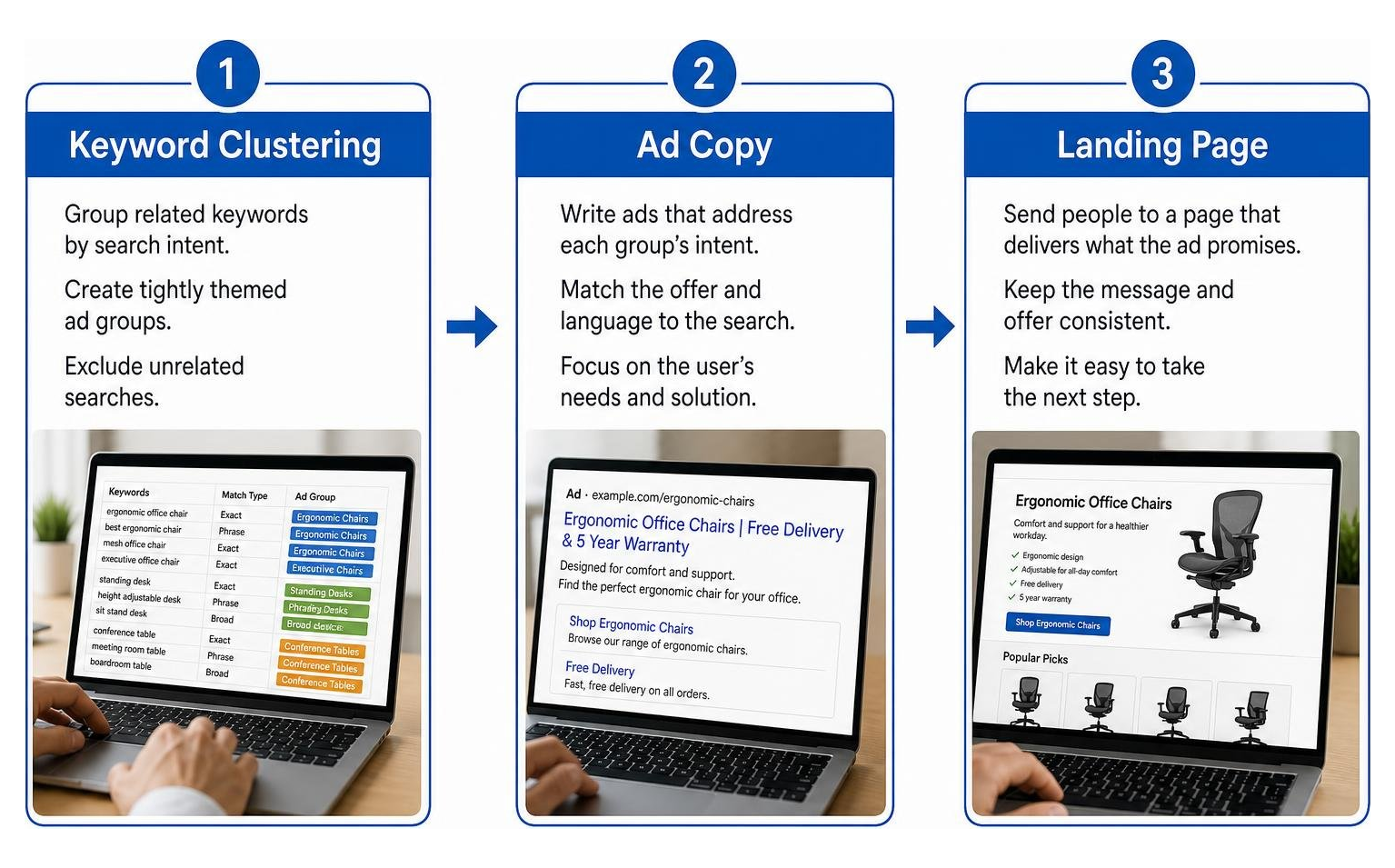
Group keywords around the same customer need
Tightly themed keyword groups make relevant Google Ads easier to build. A broad group containing furniture, office chairs, standing desks and conference tables forces the copy to stay generic. Separating themes such as ergonomic office chairs, standing desks and conference tables gives each ad a clearer job.
The aim is not to create an ad group for every keyword. It is to ensure that keywords sharing a commercial intent can be addressed by the same ad message. If a keyword cannot be answered naturally by the same headlines, descriptions and landing page, it may belong in another theme.
If you are starting with campaign structure, our guide to Google Ads campaign optimisation explains how keyword themes, match types and negative keywords support a more controlled setup.
Make Your Ad and Landing Page Match the Search
Write ad copy that answers the search
Relevant ad copy should answer the specific need behind the search. Make the product or service obvious, use language that reflects the customer's problem, highlight the most relevant benefit or offer, and choose a call to action that suits the next step. Specificity is usually more useful than copy that could apply to many unrelated searches.
Advertisers do not need to repeat an exact keyword in every line. Instead, the message should make it clear that the ad is a sensible response to the search. Google also recommends creating relevant, distinct ad assets rather than relying on repetitive headlines. See Google's guidance on creating relevant ads for practical asset and messaging considerations.
Keep the ad promise consistent with the landing page
The customer journey is simple: search, ad, then landing page. If someone searches for a specific service, clicks an ad for that service and reaches a generic page that does not clearly address it, relevance breaks down after the click.
Match the landing page headline to the promise in the ad, make the relevant service or product immediately clear, keep the next action consistent and make important information easy to find on mobile. Google's guidance on optimising ads and landing pages also reinforces the value of testing the full post-click experience.
Your landing page is where relevance needs to continue. Our guide to building a Google Ads landing page that actually converts goes deeper into message matching, page structure and the post-click experience.
Use Search Terms and Quality Score to Find Relevance Gaps
What does ad relevance mean in Google Ads?
In Google Ads, ad relevance is a Quality Score component that indicates how closely an ad matches the intent behind a user's search. Google reports the diagnostic as Below Average, Average or Above Average. Use that signal to investigate a potential mismatch between the keyword theme, ad message and landing page, rather than treating Quality Score as a standalone performance target. Google's Quality Score guidance explains the diagnostic and its components.
Check the search terms triggering your ads
The Search Terms Report shows the searches that are actually activating ads. Review it for irrelevant searches, unexpected intent, informational searches in a commercial campaign, products or services you do not offer, and queries that would be better handled by another campaign or ad group.
Those findings can inform negative keyword decisions as well as campaign restructuring. Our guide to using negative keywords effectively in Google Ads explains how search-term data can help remove searches that do not belong in a campaign.
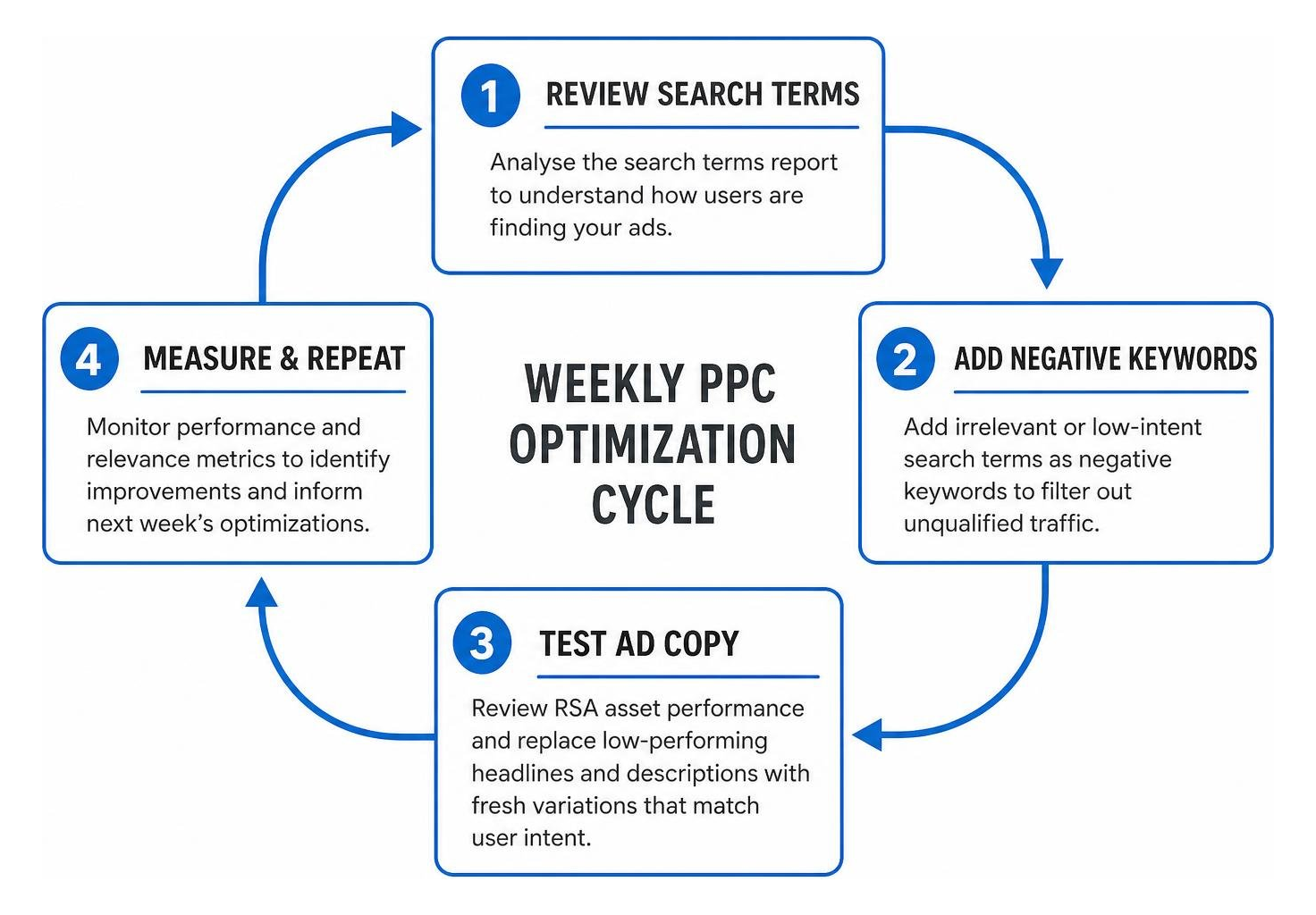
Improve Ad Relevance by Fixing the Whole Customer Journey
Check these four areas when relevance is low
Use a simple diagnostic framework when Google Ads relevance is weak:
- Search: Are ads appearing for the right searches? Review search terms, keyword themes, match types and exclusions.
- Ad: Does the ad answer the search? Review the headlines, descriptions, offer and call to action.
- Landing page: Does the page deliver what the ad promised? Check relevance, clarity, navigation and the next step.
- Outcome: Is the traffic producing meaningful enquiries, sales or another agreed conversion goal? Relevance is not the same as business performance, so look beyond clicks.
This whole-journey review makes it easier to identify the real disconnect. A weak diagnostic may come from search matching, generic ad copy, an unclear landing page or a mismatch between the traffic being attracted and the outcome the business needs.
When Your Google Ads Need a Relevance Check
A relevance review can be useful when ads are attracting searches that do not match the offer, different products or services are being handled by broad messaging, ad relevance is reported as Below Average, search terms reveal unexpected intent, or the ad and landing page make different promises.
At RankingCo, we assess the full path from the search query to the business outcome. That means looking beyond a single Google Ads Quality Score diagnostic and focusing on whether the campaign is attracting the right people, answering their needs clearly and guiding them to an appropriate next step.
Make Relevance Part of Your Google Ads Strategy
Better ad relevance is not about making ads sound more like keywords. It is about making the whole experience make sense to the person searching: the right search, the right message, the right landing page and the right business outcome.
If your campaigns need a practical relevance review, Contact RankingCo, explore Our Services, or learn more about our Google Ads management. We help small and medium-sized businesses take a clear, transparent approach to improving the connection between search intent, advertising and conversion goals.
Frequently Asked Questions About How to Improve Ad Relevance
What is ad relevance in Google Ads?
Ad relevance is a Google Ads Quality Score component that indicates how closely an ad relates to the intent behind a search. It is useful as a diagnostic because it can highlight gaps between a keyword theme, the ad message and the landing page experience.
How can I improve ad relevance in Google Ads?
Improve ad relevance by aligning search intent, closely related keyword themes, ad copy and landing pages. Then use search-term data, negative keywords and Quality Score diagnostics to identify the parts of the journey that need attention.
Does ad relevance affect Quality Score?
Yes. Ad relevance is one of the components Google uses in the Quality Score diagnostic, alongside expected click-through rate and landing page experience. It should be used to investigate possible improvements, not as a guaranteed measure of campaign success.
Why are my Google Ads showing for irrelevant searches?
Irrelevant searches can result from broad matching, loose keyword themes, missing negative keywords or campaigns that combine different customer needs. Review the Search Terms Report to identify the search patterns that should be excluded or moved into a better-matched campaign.
How do I make my Google Ads more relevant to customers?
Start by identifying what the customer expects from a search, then make the ad and landing page respond to that expectation. Clear product or service information, a relevant benefit and a consistent call to action help create a more coherent experience.
Does improving ad relevance lower CPC?
Improving relevance may support stronger auction outcomes, but it does not guarantee a lower cost per click. Use relevance diagnostics to investigate the quality of the search-to-landing-page experience, while assessing costs alongside conversion quality, competition, budget and targeting.





Share online


