
Google Ads Cost Guide for Australia: Plan Your Budget
Google Ads Cost Guide Australia: How to Plan and Budget for Sustainable Growth

Google Ads has no fixed price in Australia. Advertisers set their own budgets, while dynamic auctions establish individual click pricing. To determine what your business can afford, evaluate search competition in your target locations, calculate permissible customer acquisition targets from profit margins, and factor in GST, tracking setup, and management fees.
I am Kerry Anderson, Co-Founder of RankingCo. I help Australian business owners use Google Ads and digital strategy to make data-led investment decisions. I developed this guide to help you assess advertising spend through customer value rather than surface-level click volume. Outcomes and timelines vary depending on budget, industry competitiveness, targeting, and external market factors.
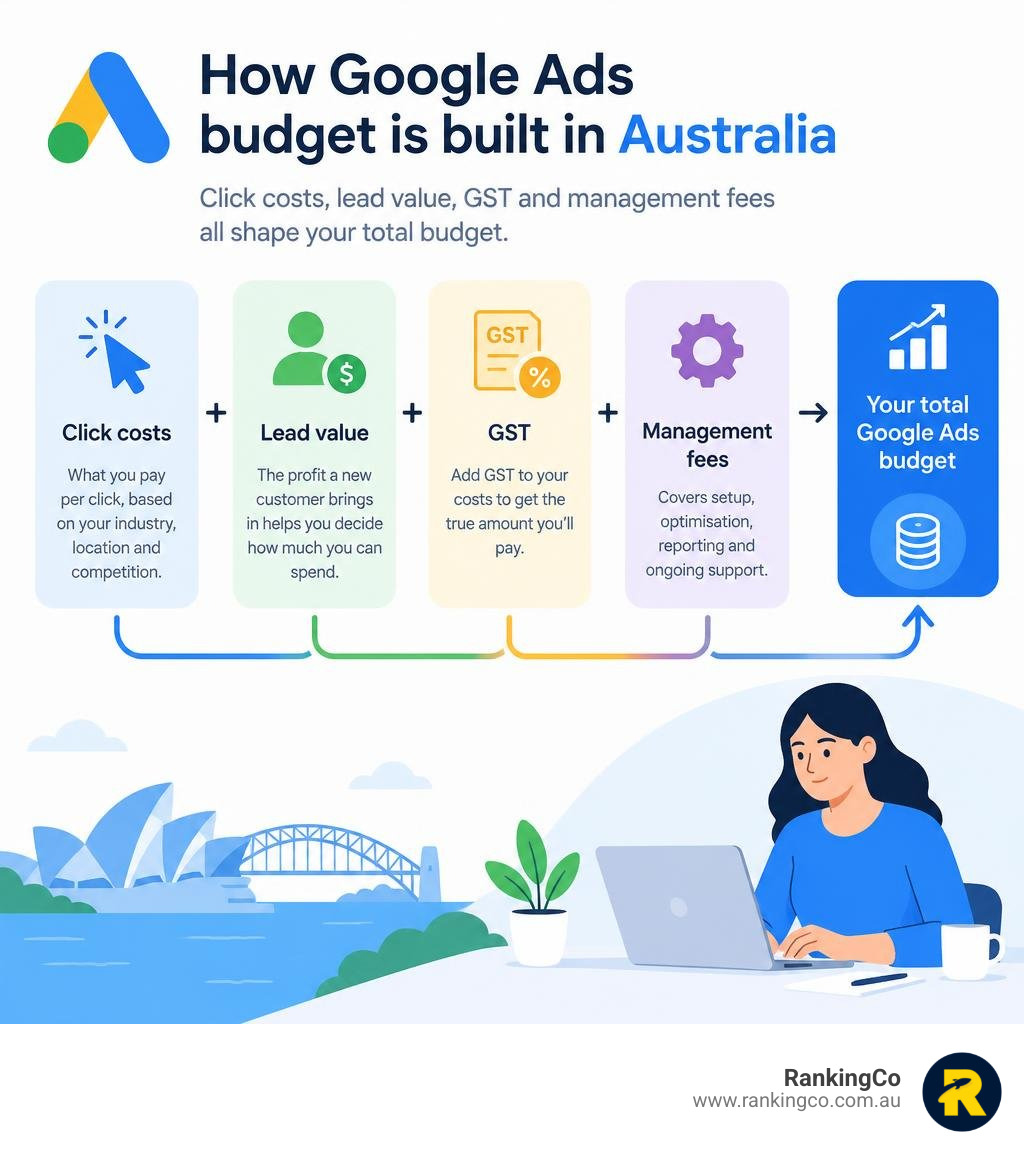
Managing Pay-Per-Click (PPC) advertising across Australia requires understanding how search spend converts into qualified enquiries. Viewing ad spend as an investment linked directly to cash flow helps protect marketing capital.
Key Takeaways
- Auction Pricing: Australian click costs depend on market competition, geographic location, search intent, and Quality Score.
- Margin-Led Planning: Budgets should be calculated backwards from average sale values, profit margins, and conversion rates.
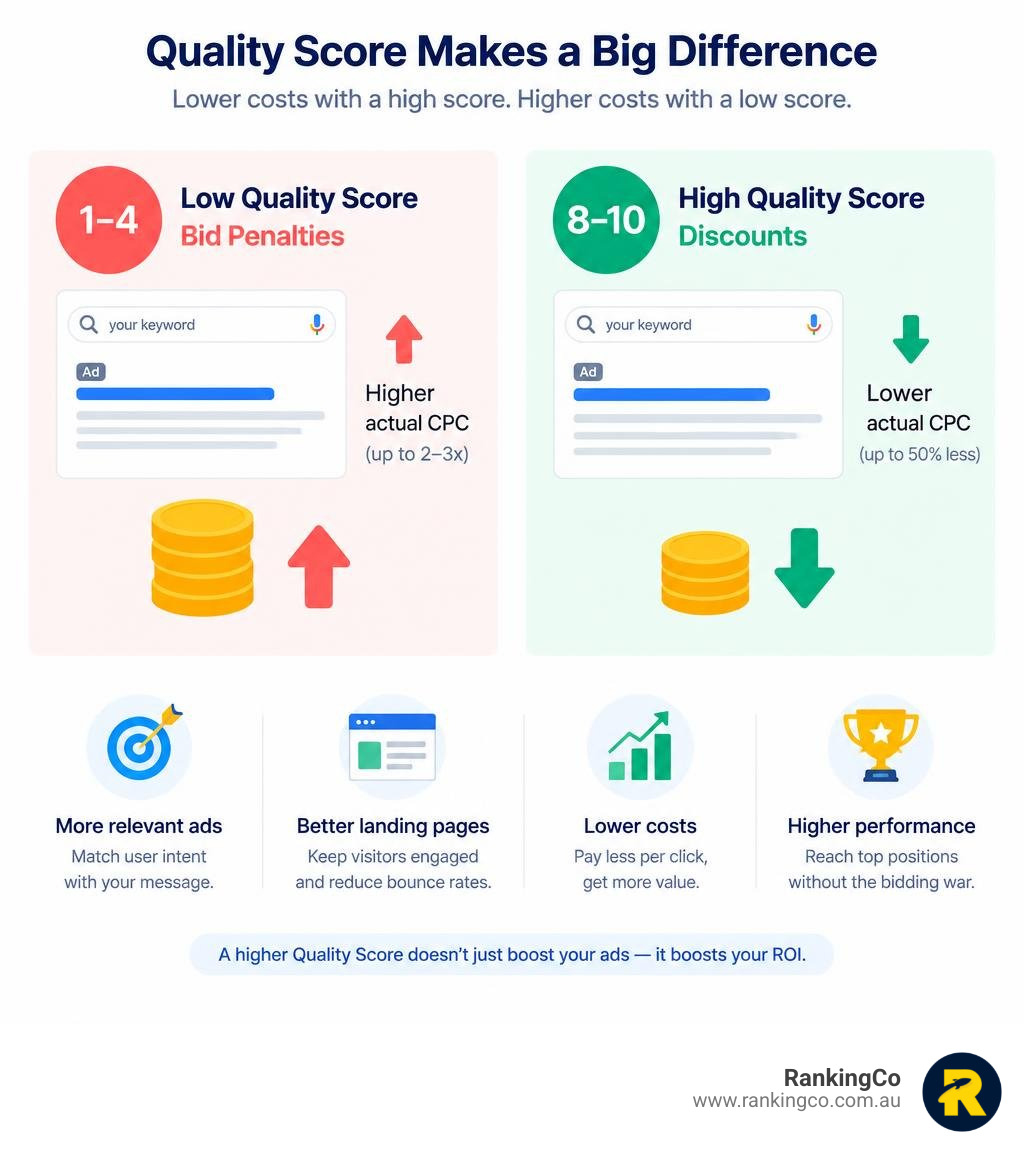
- Quality Score Impact: High ad relevance and landing page performance can reduce required auction bids.
- Operational Expenses: Australian businesses must account for 10% Goods and Services Tax (GST), analytics tracking, and professional management.
- Dedicated Funnels: Strong commercial outcomes rely on directing high-intent searches to relevant landing pages.
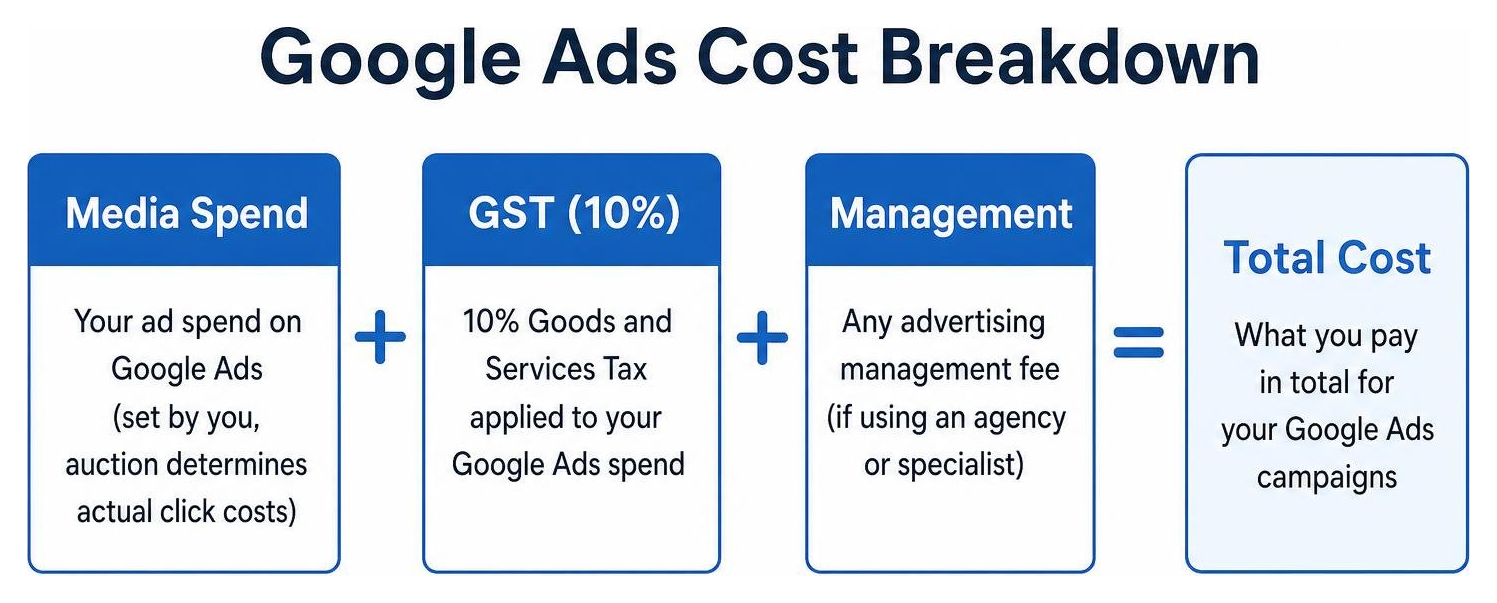
How Google Ads Pricing Operates for Australian Businesses
Google Ads uses an automated auction system rather than fixed advertising rate cards. Whenever a user enters a search query, Google runs an auction to determine ad placement.
Google calculates Ad Rank for every competing advertiser. According to Google Ads Help, Ad Rank incorporates your bid amount, auction-time Quality Score (comprising expected Click-Through Rate (CTR), ad relevance, and landing page experience), ad rank thresholds, search context, and the expected impact of ad assets. An advertiser with high relevance and a strong user experience can achieve prominent placement while paying less per click than a competitor with poor relevance. Investing in focused lead generation campaigns helps secure qualified enquiries without overspending.
Auction Dynamics Across Different Sectors
In Australian search auctions, cost per click reflects local competitor bidding, search intent, and customer lifetime value. Market dynamics vary by sector:
- Trades and Home Services: Bids reflect urgent local search intent and immediate service availability across designated service areas.
- Professional and Legal Services: Bids reflect substantial client transaction values, specific geographic catchments, and longer decision cycles.
- Finance and Insurance: Bids reflect high customer lifetime value, strict compliance considerations, and intense nationwide bidding competition.
- Real Estate and Property: Bids fluctuate according to regional market conditions, seasonal listings, and competing agency activity.
- eCommerce Retail: Pricing balances search volume against individual product profit margins, supported by tailored eCommerce ad strategies.
Because auction dynamics change continuously across cities like Brisbane, Sydney, and Melbourne, industry benchmarks should serve only as broad references rather than guaranteed pricing.
Quality Score and Australian GST Requirements
Improving your Quality Score helps increase cost efficiency. When ad copy aligns with user search queries and directs traffic to a fast, mobile-responsive page, required bids decrease.
Australian advertisers must also budget for essential operational requirements:
- Goods and Services Tax (GST): Google applies 10% GST to ad spend for accounts with Australian business addresses. GST-registered entities generally claim this as an Input Tax Credit on Business Activity Statements (BAS). Unregistered entities must treat GST as a direct marketing cost. Businesses should seek guidance from a registered tax professional.
- Conversion Tracking: Accurate measurement requires configuring Google Analytics 4, call tracking, and form event tracking.
- Landing Pages: Directing traffic to tailored landing pages reduces bounce rates and supports campaign performance.
How to Calculate Target Acquisition Metrics and Allocate Budgets
Setting an ad budget should start with financial margins, average transaction values, and lead conversion rates rather than arbitrary numbers.
Allowable Cost Per Click and Cost Per Lead Framework
To identify sustainable cost targets, establish four metrics:
- Average Transaction Value (ATV): Gross revenue generated per customer.
- Gross Profit Margin (%): Profit margin before marketing expenses.
- Lead-to-Sale Close Rate (%): Proportion of enquiries converted into customers.
- Website Conversion Rate (%): Proportion of ad clicks resulting in an enquiry.
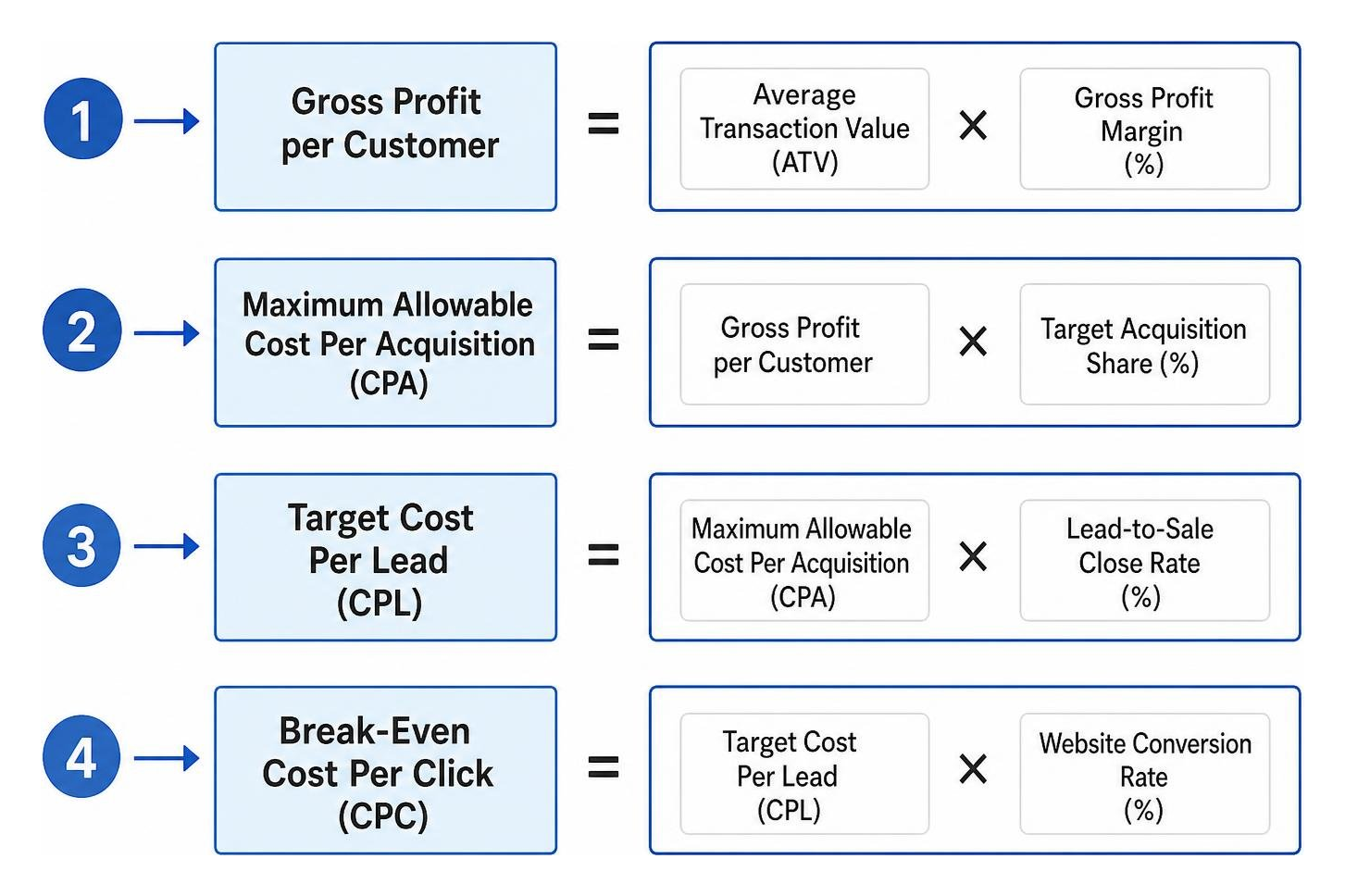
Illustrative Calculation Model:
- Gross Profit per Customer = Average Transaction Value × Gross Profit Margin %
- Target Cost Per Acquisition (CPA) = Gross Profit per Customer × Target Marketing Margin %
- Target Cost Per Lead (CPL) = Target CPA × Lead-to-Sale Close Rate %
- Target Cost Per Click (CPC) = Target CPL × Website Conversion Rate %
For a hypothetical trade business with a $1,200 average job value, 40% gross profit ($480), a 30% marketing margin allocation ($144 target CPA), a 33% close rate ($47.52 target CPL), and an 8% landing page conversion rate, the target CPC ceiling is $3.80. Actual conversion rates vary based on offer quality, market competition, and follow-up speed.
Budget Management and Campaign Allocation Guidance
Under official Google Ads daily budget rules, daily spend may reach up to twice your average daily budget on high-traffic days, but will not exceed your monthly charging limit (30.4 times your average daily budget).
To structure a scalable account, divide your media spend across targeted campaign tiers:
- Core High-Intent Search (70% to 80% of budget): Focus on exact match and phrase match terms indicating immediate commercial intent. This tier captures ready-to-buy prospects and establishes your baseline Cost Per Acquisition.
- Brand Protection (5% to 10% of budget): Defend your brand name against competitors bidding on your business terms, ensuring low-cost navigational traffic lands on your preferred conversion pages.
- Testing and Expansion (10% to 20% of budget): Allocate remaining funds to experimental audiences, broader keywords, or Performance Max campaigns once conversion tracking is mature.
Regularly reallocate budget toward campaign groups delivering the lowest validated Cost Per Lead. To evaluate your current account performance, a structured Google Ads checkup identifies wasted spend and efficiency opportunities across campaigns.
Planning for Management Fees Alongside Media Spend
When budgeting for Google Ads, account for total investment rather than media spend in isolation. Your total monthly marketing expenditure comprises media spend, applicable 10% GST on ad charges, and professional agency management fees.
Agency management models in Australia generally fall into two categories:
- Flat Monthly Retainers: A fixed fee covering campaign optimisation, negative keyword expansion, ad testing, and reporting. Flat retainers provide cost certainty for growing small businesses.
- Tiered or Percentage-of-Spend Fees: A fee structure that scales with ad volume or campaign complexity, often applied to larger accounts requiring extensive feed management or multi-location architectures.
To ensure commercial viability, plan your fee-to-spend ratio so management costs remain proportionate to expected gross profit. Engaging an agency is practical when internal time is limited, ad spend warrants specialist oversight, or you require comprehensive support across Our Services including ad management, landing page design, and Search Engine Optimisation (SEO). You can Contact RankingCo to explore campaign options.

Practical Next Steps
- Determine Unit Economics: Clarify customer transaction values, profit margins, and close rates before committing budget.
- Verify Tracking: Set up conversion tracking across forms and phone calls in Google Analytics 4.
- Target Search Intent: Focus on exact and phrase match keywords aligned with commercial intent.
- Manage Negatives: Add negative keywords regularly to prevent irrelevant search matching.
- Optimise Landing Pages: Align ad messaging with fast, relevant landing pages to improve Quality Score.
Frequently Asked Questions About Google Ads Costs in Australia
What is a realistic starting budget for Google Ads in Australia?
Google Ads has no mandatory minimum spend requirement. Businesses should set a starting budget sufficient to generate enough clicks for meaningful performance data based on their specific industry auction prices and target locations. For most local service businesses, starting with enough budget to generate three to five clicks per day allows initial keyword validation within the first month.
How does a limited daily budget perform on Google Ads?
A modest daily budget allows advertisers to test specific exact-match keywords or narrow geographic areas. In competitive markets with higher click pricing, a limited daily budget captures fewer clicks over time, extending the period needed for automated bidding systems to gather conversion data and stabilise performance.
How does Australian GST apply to Google Ads billing?
Google applies 10% GST to advertising charges for Australian billing accounts. GST-registered businesses generally claim this tax back through Input Tax Credits on their Business Activity Statements, whereas non-registered businesses must absorb GST as an unrecovered marketing expense.
How does Google handle invalid and competitor clicks?
Google uses automated multi-layered detection systems to identify invalid clicks from bots or accidental interactions. Detected invalid clicks are filtered before billing, and confirmed invalid activity identified after billing is credited back to the advertiser account balance.
Why do search ads often have higher click costs than social media ads?
Google Search Ads capture active commercial intent from users searching for specific services or products. Because these users are closer to making purchasing decisions, advertiser competition in search auctions is typically higher than on social platforms that rely on passive interest targeting.
Build a Profitable Google Ads Budget for Your Australian Business
Building a profitable search strategy requires clear financial targets, disciplined budget control, and consistent account optimisation. RankingCo works with small and medium-sized businesses across Brisbane, the Gold Coast, and Australia to deliver transparent, data-driven advertising campaigns. As a certified Google Premier Partner, we focus on measurable growth aligned with your commercial goals.
To see how our team can assist your business, explore these resources:





Share online


