
Are Your Ads Delivering Results? Comparing Facebook Ads and Google Ads
How Can You Compare Facebook Ads vs Google Ads Performance to Make Better Budget Decisions?

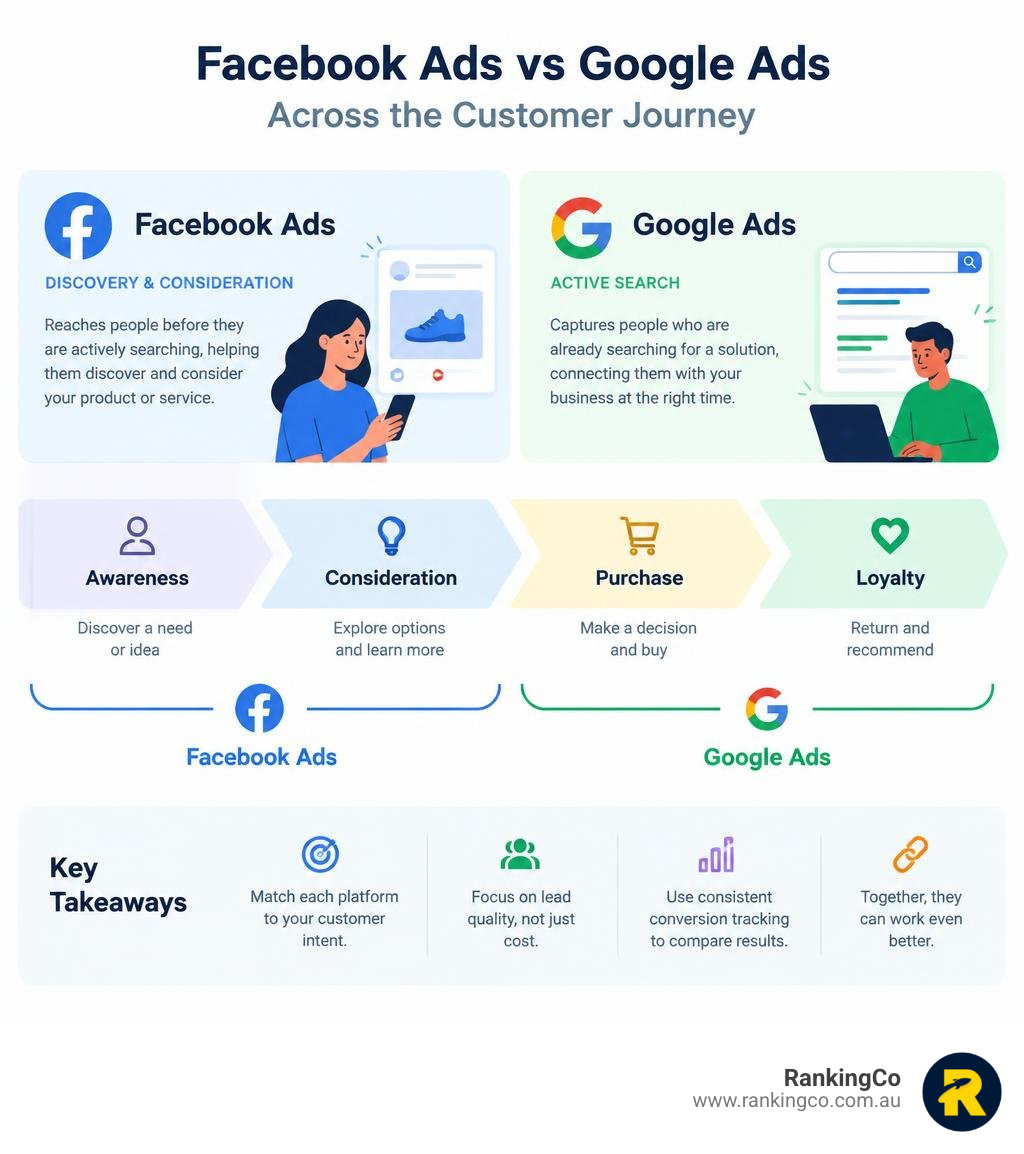
Google Ads often suits businesses whose customers are already searching for a solution. Facebook Ads can help people discover a product or service before they think to search for it. Neither platform wins on cost alone: compare the cost of acquiring a customer, lead quality and sales outcomes against each campaign's goal. Results vary by budget, industry and targeting.
This guide gives small and medium-sized businesses a practical way to assess both platforms, including what to track, where attribution can mislead you and when using them together makes sense.
Hi, I'm Kerry Anderson, Co-Founder of RankingCo. I help Australian small and medium-sized businesses use clear reporting and practical paid advertising strategies to make more informed decisions about Google Ads and Meta Ads.
What Are the Key Takeaways?
- Match Google Ads to active search demand and Facebook Ads to discovery and consideration.
- Judge leads by their likelihood of becoming customers, not just their cost.
- Use consistent conversion tracking before shifting budget between platforms. Our Google Ads management service explains how we approach measurement and reporting.
Analysing Facebook Ads vs Google Ads Performance for Australian Businesses
When evaluating paid media, comparing raw metrics in isolation can lead to flawed budget decisions. A low cost-per-click on social media does not automatically produce cheaper sales, and a higher cost-per-click on search does not mean a campaign is inefficient. Performance must be interpreted through campaign objectives, user intent, funnel position, and customer conversion paths.
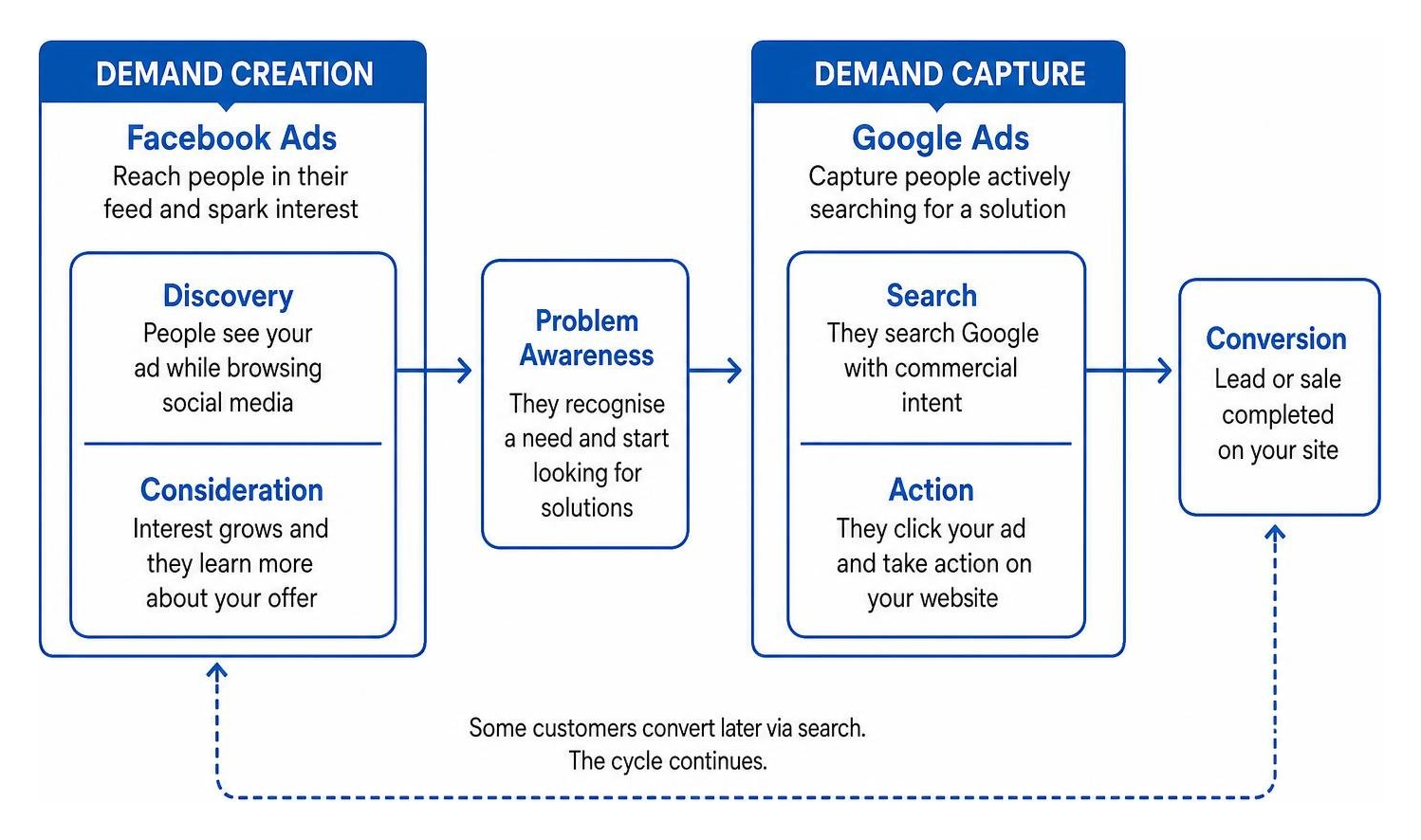
Demand Capture vs Demand Creation
The fundamental operational distinction between these two channels centres on user intent:
- Demand Capture (Google Ads): Google captures existing, declared intent. When a prospect types a commercial query into Google Search, they have identified a problem and are actively evaluating solutions. This pull marketing mechanism connects advertisers directly with prospects at the point of evaluation, aligning with commercial queries and active buying intent.
- Demand Creation (Facebook Ads): Facebook Ads (Meta Ads) operate on predicted receptivity and discovery. Users scroll through their feeds for entertainment and social connection rather than shopping. Facebook leverages demographic, behavioural, and interest signals to deliver relevant visual creative, building initial awareness and cultivating interest before search intent begins.
Comparing Cost and Delivery Benchmarks
Because delivery mechanics differ, comparing search and social metrics requires evaluating what each dollar achieves across different campaign objectives:
- Cost-Per-Click (CPC): Social media clicks often reflect visual feed discovery, whereas Search clicks reflect active user queries seeking specific solutions.
- Cost-Per-Thousand Impressions (CPM): Meta CPM represents targeted visual delivery within an active social environment. On Google, visual impressions across the Display Network serve broad branding goals, while Search impressions are tied directly to competitive keyword search auctions.
- Cost-Per-Lead (CPL): In-platform Meta Lead Ads can achieve a lower nominal CPL because native pre-filled instant forms reduce user friction, although downstream qualification and sales-readiness vary compared to search landing page submissions that require active multi-step completion.
Understanding these benchmarks helps businesses evaluate their Google Ads ROI benchmarks in Australia and assess how each channel contributes to broader Return on investment (ROI).
Platform Comparison Matrix
| Evaluation Dimension | Meta Ads (Facebook Ads) | Google Ads (Search & Shopping) |
|---|---|---|
| Primary Audience Intent | Passive discovery and interest (Push) | Active solution searching (Pull) |
| Primary Targeting Method | Demographics, interests, lookalikes, AI signals | Keyword intent, search terms, user location |
| Ad Delivery Medium | Visual storytelling (video, carousel, image) | Text search snippets, Shopping product listings |
| Sales Cycle Position | Top-to-middle funnel (awareness, consideration) | Bottom-to-middle funnel (intent, purchase) |
| Conversion Speed | Multi-touch consideration path | Direct response to specific search queries |
| Primary Scaling Constraint | Creative fatigue and audience saturation | Available monthly search query volume |
Evaluating Lead Quality and Conversion Paths
A balanced evaluation requires measuring how effectively each platform's traffic converts through your sales pipeline rather than looking solely at initial acquisition volume. Meta Lead Forms facilitate frictionless data capture on social feeds, making them effective for building top-of-funnel contact lists and generating awareness. However, nurturing workflows, automated email follow-ups, or qualifying questions are often necessary to guide prospects toward a commercial decision.
On the other hand, Google Search engages users who proactively type targeted queries and evaluate dedicated landing pages. While Pay-Per-Click (PPC) costs per visitor may vary depending on category competition, the active search intent often yields direct enquiries ready for immediate assessment. When evaluating Facebook vs Google Ads pros and cons, calculating cost per qualified sales opportunity rather than cost per top-level form submission provides a clearer picture of channel efficiency.
Aligning Platform Selection with Business Models
Business models and customer transaction lifecycles influence how marketing budgets should be allocated:
- Multi-Touch and High-LTV Models: SaaS platforms, specialised medical services, and lifestyle eCommerce brands benefit from using Meta Ads to generate initial awareness and brand engagement. Even when immediate transaction value is distributed over time, customer lifetime value supports top-of-funnel audience development.
- Immediate-Need and Direct-Search Services: Local trades, time-sensitive legal services, and urgent repair providers typically capture commercial demand when a customer is actively seeking help, making Google Search an effective channel for capturing in-market intent.
Integrating a Full-Funnel Advertising Strategy
Rather than viewing these platforms as competing options, marketing strategies often achieve balanced outcomes by deploying them together across the customer journey. When evaluating options before deciding where to spend your ad budget, integrating both channels balances prospecting with active demand capture.
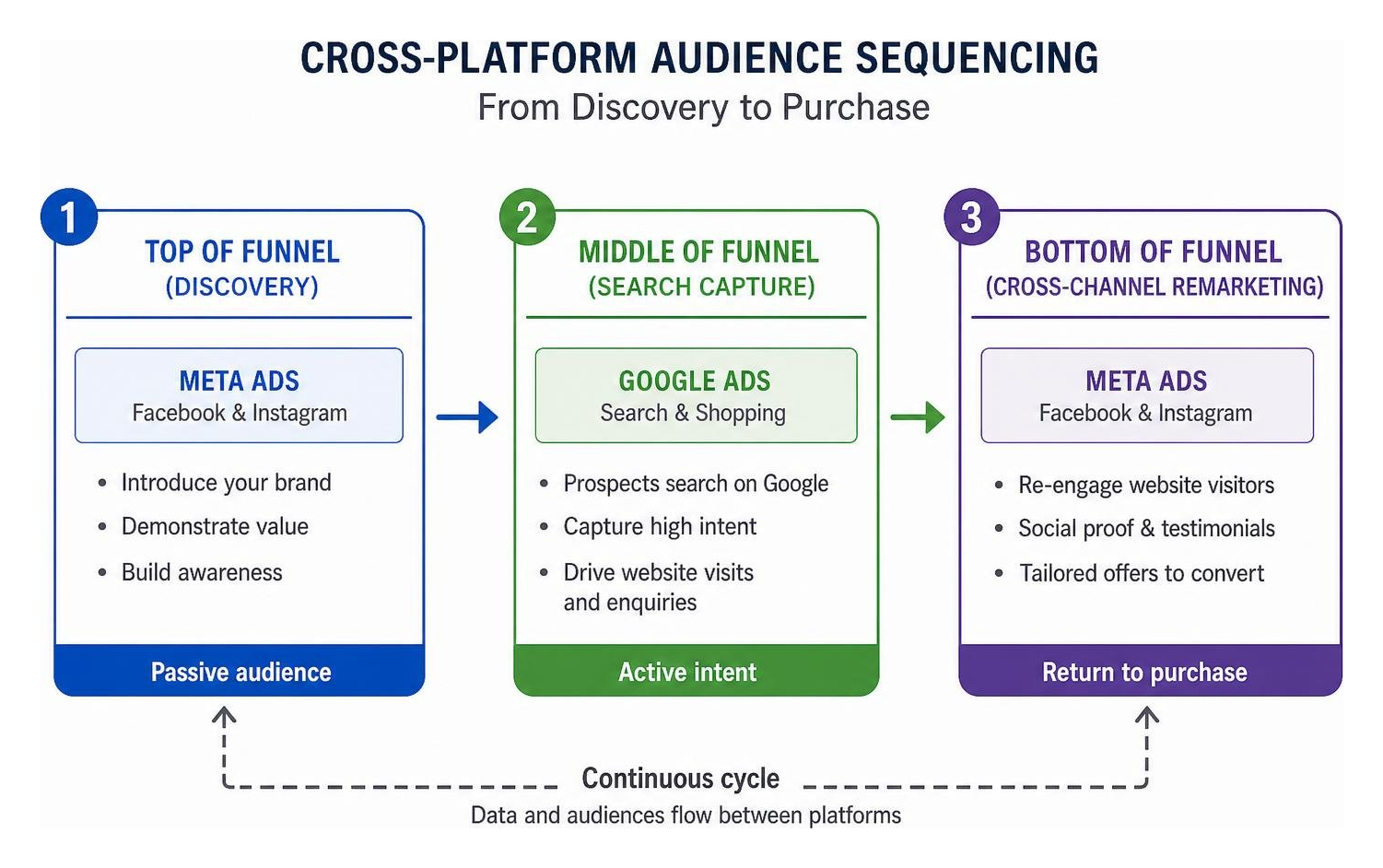
- Top of Funnel (Discovery): Meta video and carousel campaigns introduce your brand, demonstrate product value, and engage prospective buyers who may not yet be searching for your solution.
- Middle of Funnel (Search Capture): Prospects inspired by social discovery frequently search for the brand or product category on Google. Branded and category Google Search campaigns capture these active queries.
- Bottom of Funnel (Cross-Channel Remarketing): Prospects who visit your website via search without completing a conversion can be re-engaged across Facebook and Instagram with social proof, product demonstrations, and targeted promotional offers.
To execute this integrated approach, Australian businesses partner with our team for expert Facebook Ads management alongside online advertising services that unify cross-channel data.
Platform Optimisation Techniques
To control costs and maintain campaign efficiency across both platforms:
- Google Ads: Implement negative keyword lists to filter irrelevant queries, refine match types, and leverage Smart Bidding strategies (such as Target CPA or Target ROAS) once sufficient conversion history is established.
- Facebook Ads: Manage creative fatigue by refreshing visual assets periodically, leverage Advantage+ audience expansion, and combine broad targeting with clear creative messaging to allow delivery algorithms to identify interested buyers.
Key Metrics Influencing Facebook Ads vs Google Ads Performance

Effective performance analysis requires looking beyond top-level metrics to the underlying quality signals that determine ad auction costs and placement efficiency.
Quality and Relevance Scoring Mechanics
Both advertising platforms use auction quality scores to reward relevant user experiences:
- Google Quality Score: Evaluated on a 1-to-10 scale based on expected Click-through rate (CTR), ad relevance, and landing page experience, as detailed in the official Google Ads Quality Score documentation. Higher Quality Scores help reduce effective CPC bids while maintaining prominent ad positions.
- Meta Ad Relevance Diagnostics: Assessed through quality ranking, engagement rate ranking, and conversion rate ranking relative to competing ads in the same auction. Lower scores indicate creative fatigue or audience misalignment, which can elevate CPM rates.
Tracking Infrastructure, Consent, and Attribution
Accurate tracking provides the foundation for performance evaluation and budget allocation. Privacy changes, such as Apple's App Tracking Transparency and Google Consent Mode v2, require robust measurement frameworks:
- Server-Side Tracking: Implementing tools like the Meta Conversions API alongside browser pixels improves data reliability by sending event data directly from your web server.
- First-Party Analytics: Setting up Google Analytics 4 in accordance with official Google Analytics conversion guidance helps measure engagement across channels while respecting user consent settings.
- Holistic Attribution (Marketing Efficiency Ratio): Individual platform dashboards often claim attribution for overlapping customer touchpoints. Evaluating Marketing Efficiency Ratio (MER), calculated as total business revenue divided by total paid ad spend across all channels, provides a blended view of overall advertising sustainability.
Essential Performance KPIs
When comparing paid media performance, track these essential metrics:
- Click-Through Rate (CTR): Measures creative and headline relevance against targeted search intent or visual feed placements.
- Conversion Rate (CVR): Indicates how effectively landing pages and native lead forms turn ad traffic into commercial outcomes, guiding Conversion rate optimisation (CRO) strategies.
- Impression Share (Google Ads): Identifies the proportion of eligible search auctions your ad participated in, revealing opportunities for scale.
- Frequency (Facebook Ads): Tracks the average number of times an individual views your creative, acting as an early indicator of audience saturation.
- Return on Ad Spend (ROAS): Evaluates gross revenue generated per advertising dollar relative to product margins.
- Cost Per Acquisition (CPA): Measures the media investment required to secure a verified customer or sales lead.
At RankingCo, we are committed to helping Australian small and medium-sized businesses navigate digital advertising with complete transparency, data-led strategies, and sustainable growth frameworks. Based in Brisbane and the Gold Coast, our team of certified specialists designs integrated marketing strategies tailored to your commercial objectives. To review your paid advertising performance or explore new growth opportunities, explore Our Services, learn more about our Google Ads management service, or Contact RankingCo today.
Frequently Asked Questions About Facebook Ads vs Google Ads Performance
How Do Privacy Changes Affect Facebook Ads vs Google Ads Performance?
Privacy updates such as Apple iOS tracking restrictions and Google Consent Mode v2 have altered how ad platforms collect browser cookies and attribute conversions. These changes reduced deterministic third-party tracking, causing platform-reported attribution to rely more heavily on statistical modelling. In response, Meta improved its predictive delivery and signal capture via the Conversions API, while Google leverages direct search query data and first-party conversion tags. Businesses must maintain server-side tracking, build first-party data assets, and align their digital tracking with relevant Australian privacy standards. For specific legal compliance requirements, businesses should seek independent legal advice.
How Should eCommerce Stores Evaluate ROI Across Both Platforms?
Evaluating ROI in eCommerce depends on product type, visual appeal, and buying behaviour. For visually compelling products, apparel, and lifestyle goods that benefit from impulse discovery, Meta Ads provides strong creative reach through Advantage+ shopping campaigns. For products with established search volume, catalogue retail, and specific brand or model queries, Google Shopping and Search ads capture shoppers actively comparing options. Many growing eCommerce brands balance their budget by pairing Meta Ads for visual prospecting with Google Shopping for search intent capture.
When Should Small Businesses Prioritise Search Ads Over Social Ads?
Small businesses typically prioritise Search ads when their offerings address specific, urgent needs with established search volume. Emergency services, specialised B2B consulting, and local professional services benefit from engaging consumers at the exact moment they enter a commercial query. In contrast, businesses launching novel products or building broad brand awareness benefit from allocating budget to visual social campaigns where prospects can discover their offerings.
Can You Combine Facebook Ads and Google Ads on a Limited Budget?
Yes, but allocating limited budgets across both channels requires careful structuring to avoid spreading spend too thinly across platform learning phases. If your monthly budget is constrained, focusing the primary share on your primary commercial channel ensures campaigns gather sufficient conversion volume to optimise delivery. The remaining portion can fund targeted remarketing on the secondary platform, re-engaging site visitors and maintaining top-of-mind awareness without exhausting resources.
How Does Customer Intent Differ Between Search and Social Advertising?
Search advertising relies on pull marketing where users declare explicit intent by typing specific search queries to find solutions, products, or services. Social advertising relies on push marketing where algorithms serve visual ads to targeted users based on their interests, demographics, and browsing habits while they consume content. Search engages what a user is actively researching at that moment, whereas social engages users based on who they are and what they are likely to find compelling.





Share online


