How to Improve Local Search Visibility: A Practical Guide for Australian Businesses
How Can You Improve Local Search Visibility?

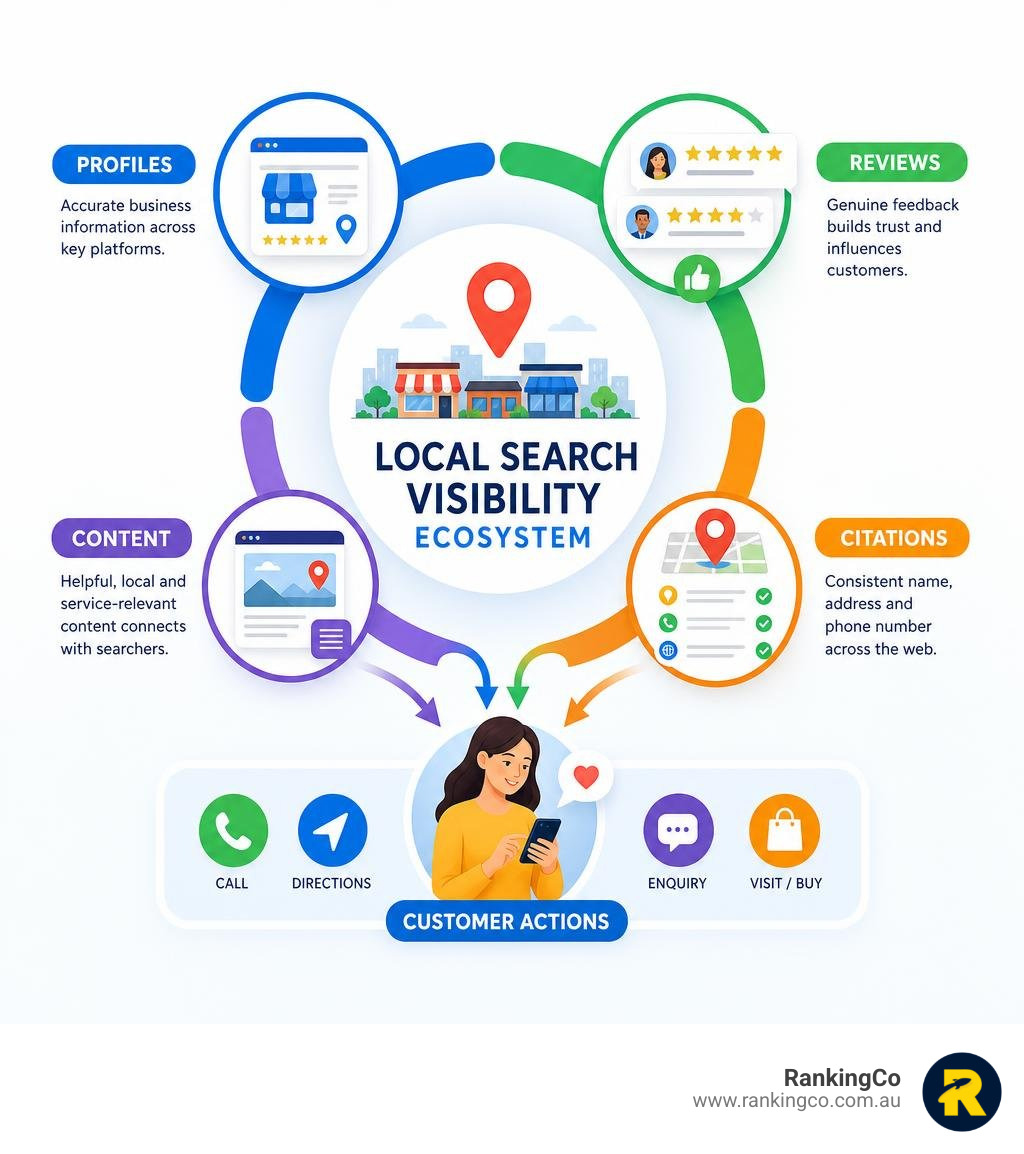
To improve local search visibility, keep information accurate, build trust and create useful content. Local search visibility is how easily people find a business when they search for products, services or answers nearby. It matters across Google Search, Google Maps, directories and AI-assisted search experiences.
Being a good local business does not automatically make it easy to find. Search platforms need clear information about what you do, where you operate and why customers should trust you before they can confidently show your business in local results.
Improving local search visibility is a practical sequence: make business information consistent, demonstrate local relevance and trust, create useful content, help search systems interpret it and measure whether the work produces customer actions.
This guide covers three connected areas: accurate local business information, stronger local reputation and authority, and a useful, technically sound website for AI-assisted discovery. Focus on information customers can verify and actions they can complete locally.
Key Takeaways
- Keep your Google Business Profile complete, accurate and current.
- Use consistent business name, address and phone number details across your website, profiles and directories.
- Build local trust through genuine reviews, helpful responses, useful local content and credible mentions.
- Create service and location pages that answer customer questions instead of repeating target phrases.
- Support local Search Engine Optimisation (SEO) with clear headings, mobile-friendly pages, crawlable content and accurate LocalBusiness structured data.
- Treat AI search visibility for local businesses as an extension of good local search optimisation.
- Track calls, enquiries, bookings, direction requests, qualified leads and revenue alongside local search rankings.
At RankingCo, we help small and medium-sized Australian businesses apply these principles through Search Engine Optimisation (SEO), Google Ads, Meta Ads, website development and content strategy. Our guide to AI-powered local SEO for retailers and small businesses explains how the same local foundations support changing search behaviour.
Get the Local Business Fundamentals Right

Strong local business visibility starts with accurate, consistent information. Google, customers and AI-assisted search tools need reliable answers to basic questions: what is the business called, what does it offer, where does it operate and how can customers contact it? This foundation helps staff give customers the same answers across every touchpoint online and offline.
Keep your Google Business Profile complete and current
A Google Business Profile can display business details in Google Search and Google Maps. Google's local ranking guidance advises businesses to keep categories, address or service area, hours and other customer information complete, accurate and up to date.
Choose the primary category that best describes the core business. Add secondary categories only when they represent real related services. Update holiday hours, services, attributes, photos and the business description as the business changes. An outdated profile can create a poor experience for customers ready to call, visit or book.
Make Name, Address and Phone number details consistent
Name, Address and Phone number (NAP) consistency means using the same core contact details wherever the business appears. Your website, Google Business Profile, social profiles and relevant directories should not conflict.
An old address, a former trading name, an outdated phone number or duplicate listing can leave customers unsure which information is correct. Check formatting as well as accuracy, then use the same customer-facing version everywhere.
Represent locations and service areas honestly
A business with customer-facing premises should make its physical address clear. A service-area business should explain the suburbs, cities or regions it can genuinely serve without trying to appear everywhere.
This helps customers understand whether they can visit, whether the business travels to them and whether their area is covered. It also gives search systems clearer context for Google Maps visibility and local search rankings.
How Local Search Visibility Supports AI-Assisted Discovery
Clear business information does not make a specific AI system recommend a business. It gives search systems consistent material to interpret: identity, services, locations, opening hours and contact details.
Check whether your name is consistent, your address or service area is current, your hours are accurate, your category is appropriate and duplicate listings have been removed. These checks do not guarantee results, but they remove avoidable friction.
Build Local Relevance, Reputation and Authority

Once business information is correct, customers and search systems need evidence that the business is active, relevant and trustworthy locally. Genuine reviews, useful local pages and credible local references each support a different part of that picture. For local search rankings, each signal should reflect a genuine customer experience or relationship.
Earn and respond to genuine reviews
Reviews help prospective customers understand real experiences and contribute to a business's wider reputation. Invite genuine customers to leave honest feedback after a completed purchase, appointment or job, without coaching them to use keywords or overly positive language.
Respond to positive reviews with a relevant thank you. Handle negative feedback calmly, acknowledge the issue and offer a practical next step without sharing personal information publicly.
Create pages with real local usefulness
Location pages should explain how the business serves people in that area, not swap a suburb name into a generic template. A weak page repeats "SEO Brisbane". A useful page explains available services, relevant areas, common customer questions and the next step.
Service pages should explain what is included, who the service is for and how it connects with the local customer journey. Natural internal links between service pages, location pages and supporting guides help readers continue their research. Our guide to the benefits of local SEO for small businesses provides useful context for this approach.
Build recognition through relevant references
Local citations, backlinks and brand mentions can show that a business is recognised by relevant organisations and communities. Useful examples include industry associations, local organisations, community partnerships, suppliers, sponsorships and reputable local publications.
Prioritise relevance and authenticity over volume. Keep citation details current and focus on genuine relationships rather than link schemes.
Connect local trust with AI search visibility
AI-assisted discovery is part of the same local search optimisation process, not a separate trick. Consistent information, clear service and location content, genuine reviews and credible third-party references give search systems a more coherent picture of who the business is and why it may be relevant to a local question.
That does not guarantee inclusion in an AI-generated answer. It makes local business visibility more understandable and supportable for people and search systems.
Optimise the Website and Measure What Matters

Local SEO is valuable when it helps the right people move from discovery to enquiry, booking or purchase. The website should turn local relevance into a straightforward customer journey, while measurement shows whether that visibility produces meaningful business outcomes.
Optimise service and location pages for local intent
Local on-page Search Engine Optimisation (SEO) includes clear titles, headings, service descriptions and location relevance. A service page explains what the business offers; a location page explains how that service is available in a particular area. Link them naturally so readers can move from a local question to useful detail.
Use phrases such as local SEO, Google Maps visibility, local search optimisation and local business visibility only where they clarify the topic. The priority is answering what customers need to know: the process, availability, decisions and next steps.
Pages also need to work well on mobile, load reliably and make it easy to call, enquire or request directions. Stronger local search rankings have less value if the customer journey becomes difficult after the click.
Use structured data to clarify, not overpromise
LocalBusiness structured data is code that helps search engines interpret a business's name, address, contact information, opening hours and services. It should match information people can see on the page.
Structured data can help search engines interpret information, but it does not guarantee higher rankings, rich results or AI citations. It works alongside accurate information, useful pages, consistent local context and crawlable, indexable content.
Answer conversational questions directly
Customers often ask detailed local questions, such as:
- "Who provides X near me?"
- "What is the best X for a small business in Brisbane?"
- "Which X offers a specific service?"
- "How much does X typically cost?"
- "What should I look for when choosing an X?"
Answer these questions in clear headings and concise paragraphs. Explain actual services and locations, offer practical decision criteria and support important claims with credible information. This improves AI search visibility for local businesses because it gives search systems clearer, self-contained passages to interpret. Our guide to using AI and SEO strategically explains why AI should support a thoughtful search strategy rather than replace the fundamentals.
Measure customer outcomes, not rankings alone
Track calls, website enquiries, direction requests, bookings, qualified leads, relevant organic traffic, conversions and revenue alongside local search rankings. If visibility rises but enquiries do not, review the page experience, offer clarity, contact options and alignment with customer intent. Conversion rate optimisation (CRO) can help improve the path from visit to action. Use a simple monthly review to compare visibility with lead quality, sales outcomes and issues customers report at every stage of the enquiry process.
Where paid activity supports a local campaign, Pay-Per-Click (PPC) advertising through Google Ads or Meta Ads can complement SEO. Review Return on investment (ROI), Click-through rate (CTR), conversions and eCommerce sales alongside customer lead quality.
Businesses with inconsistent listings, weak enquiry flow, new service areas or limited internal capacity may benefit from specialist support. We can connect local SEO with broader digital marketing through our Search Engine Optimisation services, our services and contact our team.
Turn Local Visibility Into Real Business Growth
Local search visibility comes from accurate information, local relevance and reputation, useful website content, sound technical foundations and measurable customer outcomes. We provide practical, ongoing support for businesses resolving local listing issues, improving enquiry flow or expanding into new areas.
- Explore Search Engine Optimisation services for stronger local visibility.
- See how Google Ads services can support high-intent search campaigns.
- Review Meta Ads services for local audience engagement.
- Learn about website development services that support clearer customer journeys.
- Explore content creation services for useful service and location content.
- Contact our team to discuss a local search visibility plan.
Frequently Asked Questions About Local Search Visibility
What is local search visibility?
Local search visibility is how easily people find a business when they search for a relevant service, product or answer in a specific area. It appears across Google Search, Google Maps, directories and AI-assisted search experiences.
How can I improve my local search visibility?
Improve local search visibility through accurate business information, local relevance and trust, and useful website content and technical SEO. Start with a current Google Business Profile and consistent contact details, then build genuine reviews, helpful location pages and credible local references.
Does Google Business Profile help local SEO?
Yes. A Google Business Profile provides practical details about a business, including its name, location or service area, hours, services, reviews and website link. Keeping it complete and current supports local SEO, but it does not guarantee better rankings on its own.
How important are reviews for local SEO?
Reviews help customers assess a business and contribute to its wider reputation. Focus on honest feedback from real customers and professional responses, rather than coaching people to use keywords.
What are the most important local SEO ranking factors?
Accurate business information, relevant categories and services, consistent contact details, useful local content, genuine reviews, credible local references and solid technical foundations all matter. No single factor works in isolation.
How do I get my business to appear on Google Maps?
Create or claim the correct Google Business Profile, complete it accurately and keep it current. Your website and other listings should support the same address or service area, hours, categories, services and contact details.
Why is my business not showing in local search?
An incomplete profile, inconsistent contact information, unsuitable categories, limited local content or weak reputation signals can make a business harder to find. Competition and proximity can also affect what people see, so begin with an audit rather than assuming one technical cause.
How does local SEO help with AI search?
Local SEO makes business information, services, locations and trust signals clearer and more consistent. Answer-first content gives search systems more context when they interpret local questions.
Can local SEO improve visibility in AI search?
Local SEO can support AI search visibility by providing clear business information and direct answers to local customer questions. It is not a shortcut or a guarantee that a particular AI system will mention a business.
What should a local SEO strategy include?
A local SEO strategy should include Google Business Profile management, NAP consistency, accurate location or service-area details, review management, useful local content, internal linking, technical SEO and outcome tracking. It should assign responsibility for profile updates, review requests and reporting, so essential tasks are not delayed until information becomes outdated or inconsistent.
How long does it take to improve local search visibility?
The timeframe varies with competition, location, profile health, website authority and the work required. Correcting outdated information may happen quickly, while building local relevance and reputation requires consistent effort over time.
Should I hire an SEO agency for local SEO?
Professional support can help when a business lacks time, systems or specialist knowledge to manage profiles, content, technical work and reporting consistently. We provide integrated support across SEO, Google Ads, Meta Ads, website development and content work. Review our services or contact our team to discuss the right level of support.




Share online