Technical SEO Basics 101: A Beginner’s Guide
Technical SEO Fundamentals: How to Improve Website Crawlability and Organic Visibility
Technical Search Engine Optimisation (SEO) makes your website easier for search engines to find, understand and index. Start by checking that important pages can be crawled, load properly on mobile, use secure HTTPS connections and have clear internal links.
These basics support search visibility, but they do not replace useful content or a strong marketing strategy. Results and timelines vary with budget, industry competitiveness, targeting and factors outside an agency's control.
I’m Kerry Anderson, Co-Founder of RankingCo. Over more than 15 years working across SEO, analytics and digital strategy, I’ve learned to approach technical SEO fundamentals as practical checks that help businesses find and fix barriers to online discovery.
Key Takeaways
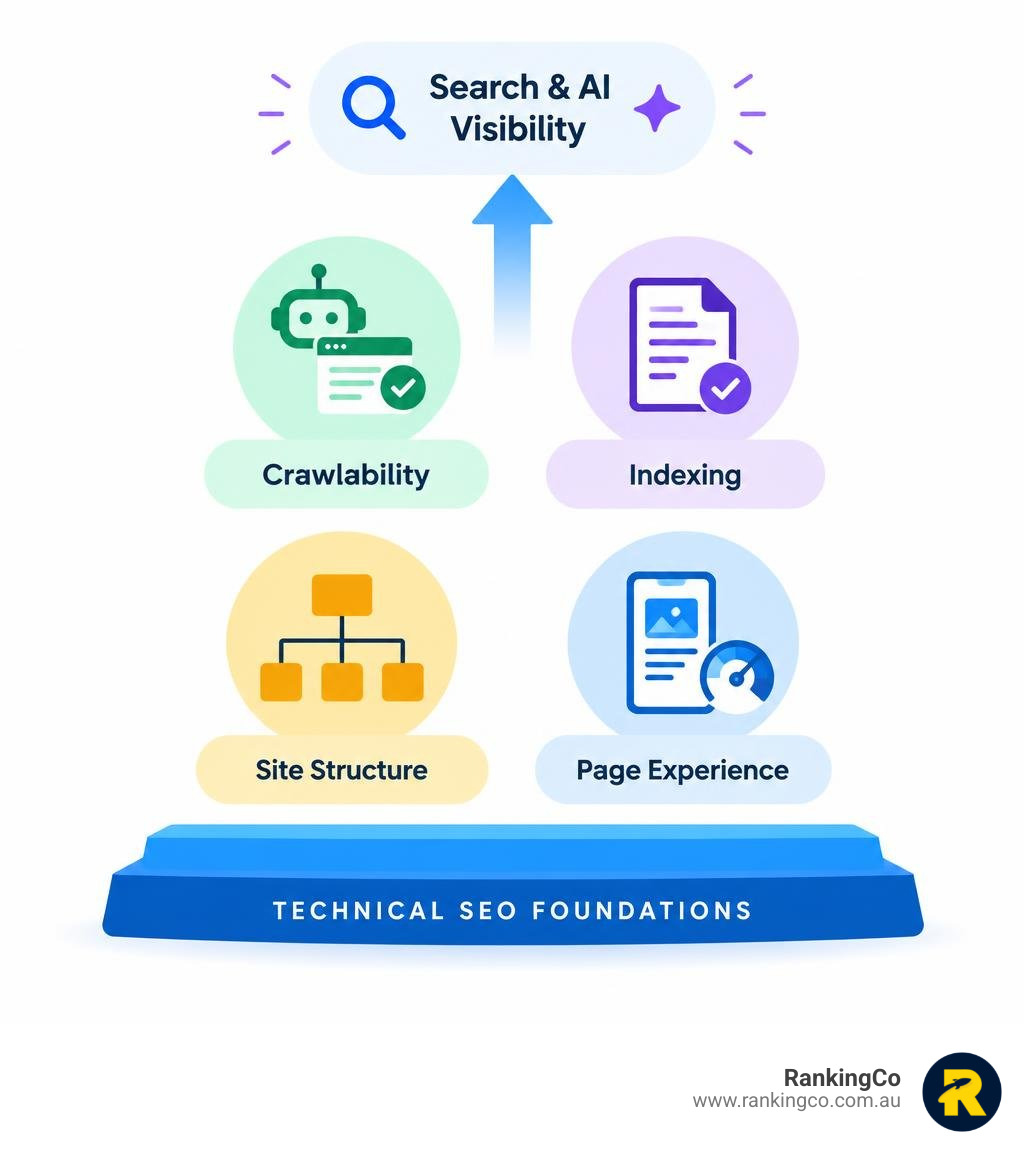
- Technical SEO establishes the infrastructure that allows search engine bots and AI discovery systems to discover, render and evaluate your web pages.
- Crawlability and indexability represent the primary baseline of search performance; if search engines cannot fetch your URLs, your content cannot appear in search results.
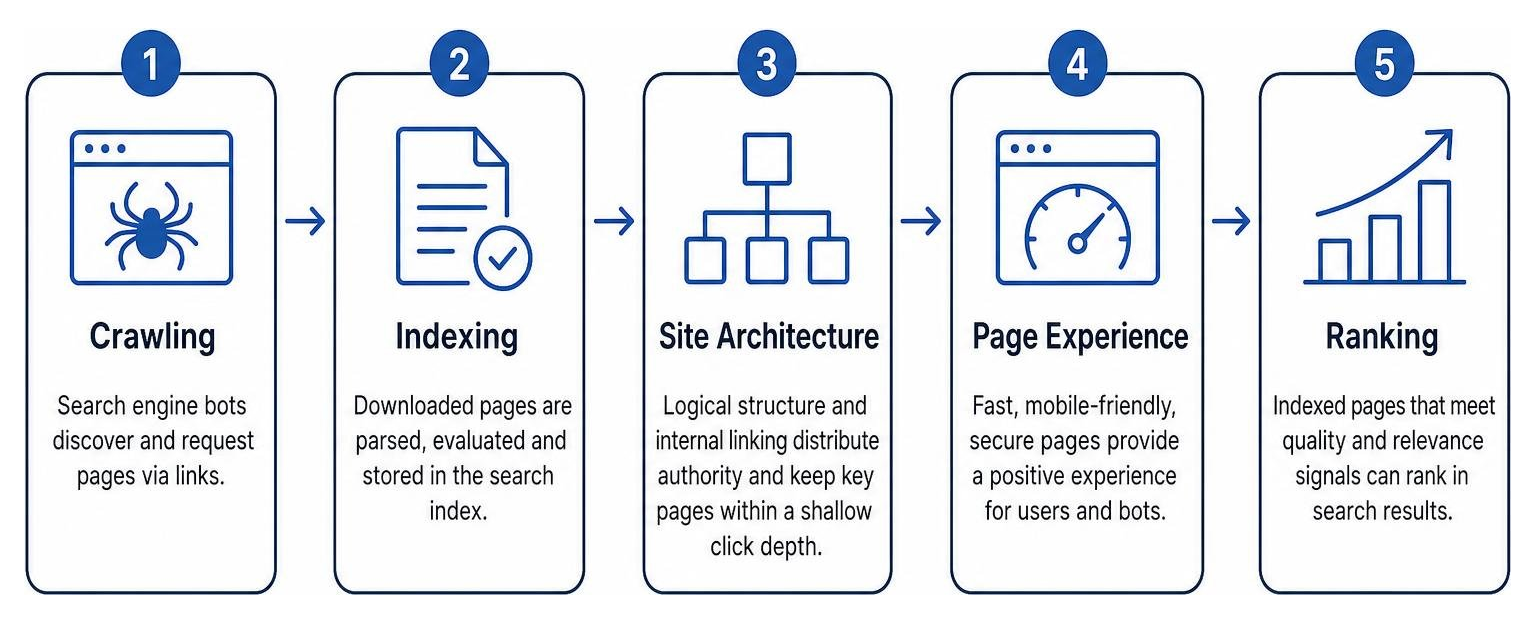
- A logical website architecture with clear internal linking distributes authority and keeps key pages within a shallow click depth.
- Core technical configurations such as XML sitemaps, robots.txt directives, canonical tags and HTTPS security protect your site against crawl waste and indexation conflicts.
- Aligning your technical setup with our professional SEO services helps identify foundational issues and supports steady organic discovery.
The Core Pillars of Crawling, Indexing, and Site Architecture
Search engines do not view websites the way human visitors do. When someone navigates your website, their browser renders visual assets and layouts instantly. Search engine bots operate through systematic data pipelines. They request code, follow hyperlinks, assess file permissions, render scripts and store textual information inside databases.
While on-page and off-page efforts focus on topic relevance and external authority, technical SEO ensures your digital assets are machine-readable and structurally sound.
| Discipline | Primary Focus Area | Core Activities & Techniques | Main Outcome |
|---|---|---|---|
| Technical SEO | Website infrastructure, crawl efficiency, server health, indexation | Managing robots.txt, XML sitemaps, canonical tags, HTTPS, page speed, mobile usability, structured data | Enables search engines and AI models to discover, crawl, render and index pages without errors. |
| On-Page SEO | Content quality, keyword targeting, metadata, user intent | Optimising title tags, headings, body copy, image alt text, search intent matching | Helps search engines understand what a page is about and how relevant it is to specific search queries. |
| Off-Page SEO | Domain authority, external trust, brand reputation | Earning backlinks, digital PR, brand mentions, managing directory citations | Builds site authority and trust signals across the broader web ecosystem. |
Crawlability and Indexability: Technical SEO Fundamentals Explained
Crawling is the discovery process where search engine bots request and download pages across the web. Indexing is the subsequent stage where downloaded pages are parsed, evaluated and stored in the search engine's index to be considered for search queries.
A page must be crawled before it can be indexed, but crawling does not ensure indexation. Search engines evaluate whether a page offers sufficient unique value, adheres to quality guidelines and presents clean code before storing it.
When search engine bots encounter complex client-side scripts, they dedicate computing resources to execute the code. If server responses are slow or scripts fail during execution, crawlers may encounter an empty page. Following official Google technical documentation helps keep your code accessible. Addressing common technical SEO issues early prevents discovery bottlenecks and ensures pages remain eligible for indexation.
Site Architecture, Internal Linking, and URL Structure
Your website architecture defines how pages are organised. A clean, shallow architecture ensures visitors and automated crawlers reach any public page within three clicks from the homepage. Deep site structures bury important pages under multiple subdirectories, making them harder to discover.
To maintain a healthy site structure:
- Organise related content into clear topic clusters linking to primary service or category pages.
- Use descriptive, human-readable URLs separated by hyphens rather than dynamic query parameters.
- Deploy visible breadcrumb navigation on category and sub-pages to reinforce hierarchy.
- Establish strategic internal linking with natural anchor text to pass authority between articles.
- Review internal link pathways to resolve overlapping topics and apply keyword cannibalisation solutions before pages compete against each other.
Controlling Crawlers with Sitemaps, Robots.txt, and Canonical Tags
Automated crawlers need instructions regarding which sections to prioritise and which to bypass:
- XML Sitemaps : An XML sitemap acts as an inventory of canonical, indexable URLs, helping search engines discover content promptly.
- Robots.txt Directives : Residing at the root domain, robots.txt tells crawlers which paths they may fetch. Use it to block staging or checkout areas, but never block CSS or core JavaScript files needed for rendering.
- Canonical Tags (
rel="canonical") : When multiple URLs contain similar content, a canonical tag signals which URL represents the master version.
Implementing effective technical SEO strategies ensures crawl budgets are used efficiently, directing bots toward high-value content.
Practical Maintenance, Auditing, and Future-Proofing for Modern Search

Technical SEO requires ongoing monitoring. As websites publish content, update plugins and modify site structures, technical errors can emerge over time. Regular maintenance helps Australian businesses maintain strong digital health across their assets.
When auditing and optimising a website, focus on these primary areas:
- Server response times, hosting stability and uptime reliability
- Mobile design responsiveness and touch element spacing
- HTTPS certificate validity and elimination of mixed content
- Broken internal links, external links and circular redirect chains
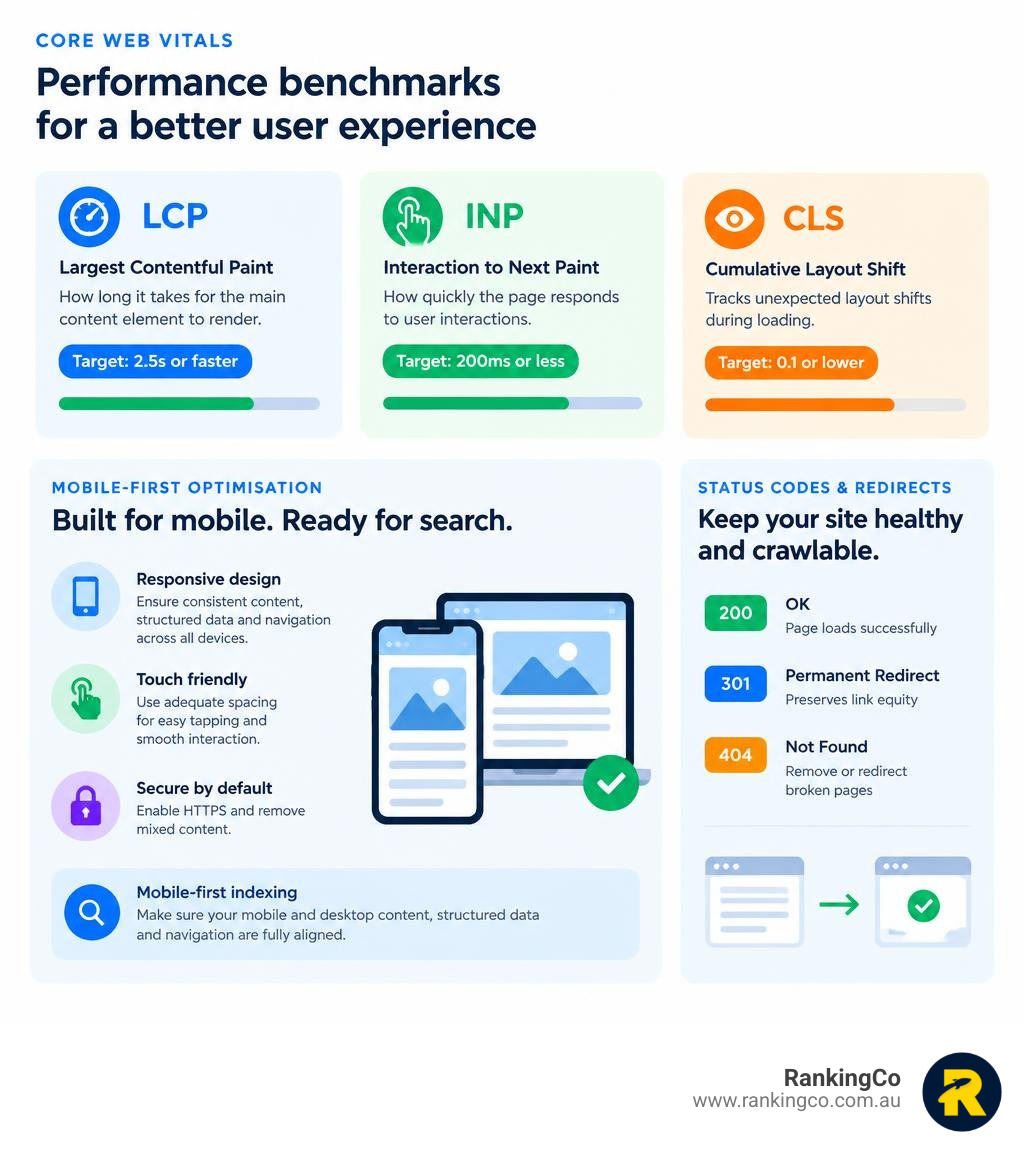
- Status code accuracy across 200 (OK), 301 (Permanent Redirect) and 404 (Not Found) responses
- Structured data implementation using Schema.org JSON-LD formatting
Organic SEO results and delivery timelines vary depending on budget, industry competitiveness, targeting and external market factors outside an agency's control. If you would like to discuss your site's technical health, you can contact RankingCo for practical guidance.
Applying Technical SEO Fundamentals to Page Speed, Mobile-First Indexing, and Security
Google evaluates web pages using Core Web Vitals to measure loading speed, visual stability and interactivity:
- Largest Contentful Paint (LCP) : Measures perceived loading speed by recording how long the main content element takes to render. Target: 2.5 seconds or faster.
- Interaction to Next Paint (INP) : Measures page responsiveness to user interactions like button clicks. Target: 200 milliseconds or less.
- Cumulative Layout Shift (CLS) : Measures visual stability by tracking unexpected layout shifts during load. Target: 0.1 or lower.
Because significant traffic occurs on handheld devices, search engines rely primarily on mobile versions for indexing. Reviewing Google mobile-first indexing updates helps ensure parity between mobile and desktop content, structured data and menus.
Pairing these technical benchmarks with targeted on-page SEO services ensures landing pages load swiftly and display clearly across modern screens.
Handling Duplication, Error Codes, Redirects, and AI Search Visibility
Managing status codes and URL redirection prevents wasted crawl budget and preserves link equity across your domain:
- 301 Permanent Redirect : Passes established search signals to the new destination URL. Avoid redirect chains that dilute crawl efficiency.
- 404 Not Found : Indicates that a requested page no longer exists. Ensure missing pages return a true 404 status code rather than a soft 404.
- 410 Gone : Explicitly signals that a page is permanently deleted and should be removed from the index promptly.
Technical SEO is also essential for Artificial Intelligence (AI) search engines and Large Language Models (LLMs). Platforms such as Google AI Overviews, ChatGPT Search and Perplexity retrieve information directly from accessible websites. Delivering clean, server-rendered HTML and clear Schema.org structured data makes it easier for LLMs to extract, verify and cite content.
Conducting a Technical Audit and Prioritising Fixes
A technical SEO audit identifies errors that prevent pages from achieving organic visibility. Prioritise issues based on impact:
- Critical Indexing Blockers
: Resolve accidental
noindextags on priority pages, remove blanketdisallowdirectives blocking vital assets, and repair 5xx server errors. - Crawl Efficiency Barriers : Eliminate redirect loops, repair high-traffic 404 links, update broken XML sitemaps and resolve duplicate canonical tags.
- Performance and Page Experience : Optimise uncompressed images, implement server-side caching, resolve Cumulative Layout Shift issues and enforce HTTPS.
- Semantic Enhancement : Implement structured data (such as LocalBusiness, Organization or Article schema) to clarify entity identity.
Review your setup systematically, or partner with our team for comprehensive technical SEO services.
Practical Next Steps for Your Website
To begin improving your site's technical foundation today:
- Inspect primary landing pages using Google Search Console's URL Inspection tool to confirm they are crawled and indexed without errors.
- Run a site speed test on commercial templates using Google PageSpeed Insights and identify unoptimised image files or heavy scripts.
- Check your robots.txt file at
yourdomain.com.au/robots.txtto confirm important resources are accessible. - Review your mobile experience on a smartphone, checking button spacing and text legibility.
- Explore Our Services to see how our experienced team can assist your business with sustainable digital marketing.
Closing Summary and Next Steps
Establishing sound technical SEO fundamentals gives your website a reliable foundation for long-term organic growth. By maintaining clean site architecture, ensuring rapid page speeds, managing crawler directives and securing your infrastructure with HTTPS, you remove the barriers that prevent search engines and modern AI systems from discovering your business online.
At RankingCo, we support Australian small and medium-sized businesses across Brisbane, Sydney, Melbourne and the Gold Coast with transparent, data-driven digital marketing solutions. As a verified Google Premier Partner 2026, Meta Business Partner and Shopify Partner, our team is dedicated to building sustainable growth strategies tailored to your commercial objectives.
Ready to improve your website's performance and visibility? Explore our specialised solutions:
- Learn more about our data-driven technical SEO services to resolve crawl barriers and improve indexation.
- Explore Our Services designed to support lead generation and eCommerce sales across multiple channels.
- Contact RankingCo today to discuss your digital marketing goals with our friendly team.
Frequently Asked Questions About Technical SEO Fundamentals
What is the main difference between crawling and indexing in technical SEO?
Crawling is the initial discovery phase where search engine bots request, read and download the code and assets of a webpage. Indexing is the subsequent analysis and storage phase where the search engine evaluates the downloaded content, determines its topic and quality, and saves it in its central database. A page must be successfully crawled before it can be considered for indexing, but being crawled does not guarantee that search engines will choose to index the URL.
How does site architecture affect my crawl budget?
Site architecture dictates how easily search engine bots can navigate from your homepage to your deeper pages. A clean, shallow architecture with clear internal links ensures crawlers discover your important pages quickly without wasting requests on duplicate, orphaned or broken URLs. When site architecture is confusing or unnecessarily deep, automated crawlers may exhaust their allocated request limits before discovering your newest or most valuable commercial content.
Why is HTTPS considered a fundamental technical SEO requirement?
HTTPS encrypts the communication between a visitor's browser and your web server, protecting sensitive information like login credentials and contact form submissions from interception. Google confirmed HTTPS as a lightweight ranking signal, and major web browsers flag plain HTTP websites as insecure in the address bar. A valid security certificate establishes basic consumer trust and ensures modern search engines can index your site securely.
What is the purpose of a canonical tag, and when should I use one?
A canonical tag is an HTML link element placed in the header of a webpage that specifies the preferred master version of a URL to search engines. You should use canonical tags whenever similar or identical content exists across multiple web addresses, such as eCommerce product pages accessible through various category filters, search parameters or tracking codes. Canonical tags prevent split link equity and help avoid duplicate content issues.
How does technical SEO impact my visibility in AI search engines and LLM responses?
AI search platforms and Large Language Models rely on automated web crawlers to collect and verify information across the internet. If a website relies heavily on unrendered client-side code, suffers from broken server configurations, or lacks structured data, AI systems may struggle to retrieve and interpret its content. Clean HTML code, fast server response times and descriptive Schema.org structured data make it easier for AI models to extract accurate information and cite your brand as an authoritative source.



Share online