How to Run Google Ads for Wellness Businesses Without Policy Headaches
Google Ads for Wellness Businesses: A Guide to Local Lead Generation

Google Ads can help wellness businesses appear when nearby people search for a specific service, practitioner, class or location. The most effective approach is usually a focused campaign structure, a landing page that matches the search, clear conversion tracking and advertising copy that remains compliant with platform and Australian consumer requirements. Results vary with budget, local competition, targeting, service demand and the quality of the booking experience.
I am Kerry Anderson, Co-Founder of RankingCo, a Brisbane-based digital marketing agency that supports Australian small and medium-sized businesses with paid advertising and online growth. This guide draws on practical campaign-planning principles for wellness clinics, studios and allied health practices. It is designed to help readers assess local search intent, campaign structure, enquiry tracking and compliance considerations without relying on unsupported claims or promised outcomes.
Key Takeaways
- Build separate campaigns or ad groups around the treatments, classes and locations your business actually offers.
- Match each ad to a dedicated landing page with a clear next action, such as calling, enquiring or booking online.
- Use compliant, evidence-based language and review Google policy requirements before ads go live.
- Track calls, forms and bookings so decisions are based on meaningful enquiries, not clicks alone.
- Explore Google Ads Leads Management for support with lead-focused Google Ads campaigns.
1. Plan Google Ads Campaigns Around Wellness Search Intent
People looking for wellness services often search with a service and location in mind, such as "yoga classes Brisbane", "remedial massage near me" or "wellness clinic Sydney". Google Ads for wellness businesses should reflect that intent rather than sending every search to one generic campaign. In Google and Ipsos research of United States consumers, four in five people used search engines to find local information. For Australian businesses, the practical takeaway is to make local service information easy to find, while recognising that local demand and behaviour vary by market.
Choose Google Ads Campaign Themes, Keywords and Locations
Start with the services that matter most to your business and group closely related searches together. A clinic may separate consultations, classes, practitioner-led services and branded searches, then use location modifiers only where the service is genuinely available. This makes it easier to write relevant ads, set sensible budgets and understand which enquiries each service line generates. For hands-on support with this structure, explore Google Ads.
Use keyword match types and negative keywords to reduce irrelevant traffic. For example, a business that does not provide training might exclude searches for courses, certification or jobs. Search term reviews can reveal new negative keywords as well as high-intent phrases worth adding to the account. Review these terms alongside enquiry quality, not clicks alone, so the account continues to prioritise searches that are relevant to the services offered.

2. Build Compliant, Conversion-Focused Landing Pages
A click is only the start of the customer journey. Send each high-value campaign to a page that confirms the service, location and next step promised in the ad. A dedicated landing page can give prospective clients the details they need, including practitioner information, service suitability, location, consent-aware forms and booking options. Keep the path to contact simple, especially on mobile devices.
Use Compliant Messages and Trust Signals
Wellness advertising should avoid unsubstantiated therapeutic claims, guaranteed outcomes and misleading testimonials. Google’s Healthcare and medicines policy can apply to health-related advertising, while Australian Consumer Law guidance from the ACCC explains the importance of truthful, substantiated representations under Australian Consumer Law. Because obligations vary by service and qualification, seek independent legal advice for specific compliance questions. For broader digital marketing support, explore Our Services or Contact RankingCo.

Decide Whether Search Ads or Local Services Ads Fit
Standard Google Search campaigns offer detailed control over keywords, ads, landing pages and conversion actions. They can suit wellness businesses that need to explain services, build trust or direct visitors to an online booking path. Local Services Ads may be available for selected categories and locations, but eligibility, verification and lead handling requirements vary. Confirm current availability before including them in a growth plan.
| Consideration | Google Search Ads | Local Services Ads |
|---|---|---|
| Payment model | Pay-Per-Click (PPC) auction | Pay-per-lead model where available |
| Destination | Website or dedicated landing page | Direct contact or a platform-led contact flow |
| Control | Detailed keyword, ad and landing-page control | More automated matching based on approved service categories |
| Best use | Businesses that need tailored messages and measurable website conversions | Eligible local services seeking direct leads |
Set Budgets Around Learning, Not Assumptions
Avoid splitting spend evenly across every service from day one. Begin with the services that have clear commercial value, sufficient search demand and a booking process your team can support. Review enquiry quality alongside cost, then adjust budgets gradually. Google Ads management can help structure this review around your actual service mix and local priorities. For advertising compliance, review Australian Consumer Law guidance from the ACCC.
Configure Tracking Before Scaling Spend

Track meaningful actions such as phone calls, enquiry forms and completed bookings. Where your privacy obligations permit, connect campaign data with your customer relationship management system so your team can assess lead quality and booked consultations rather than relying only on clicks. Use clear consent language and secure processes when handling personal information.
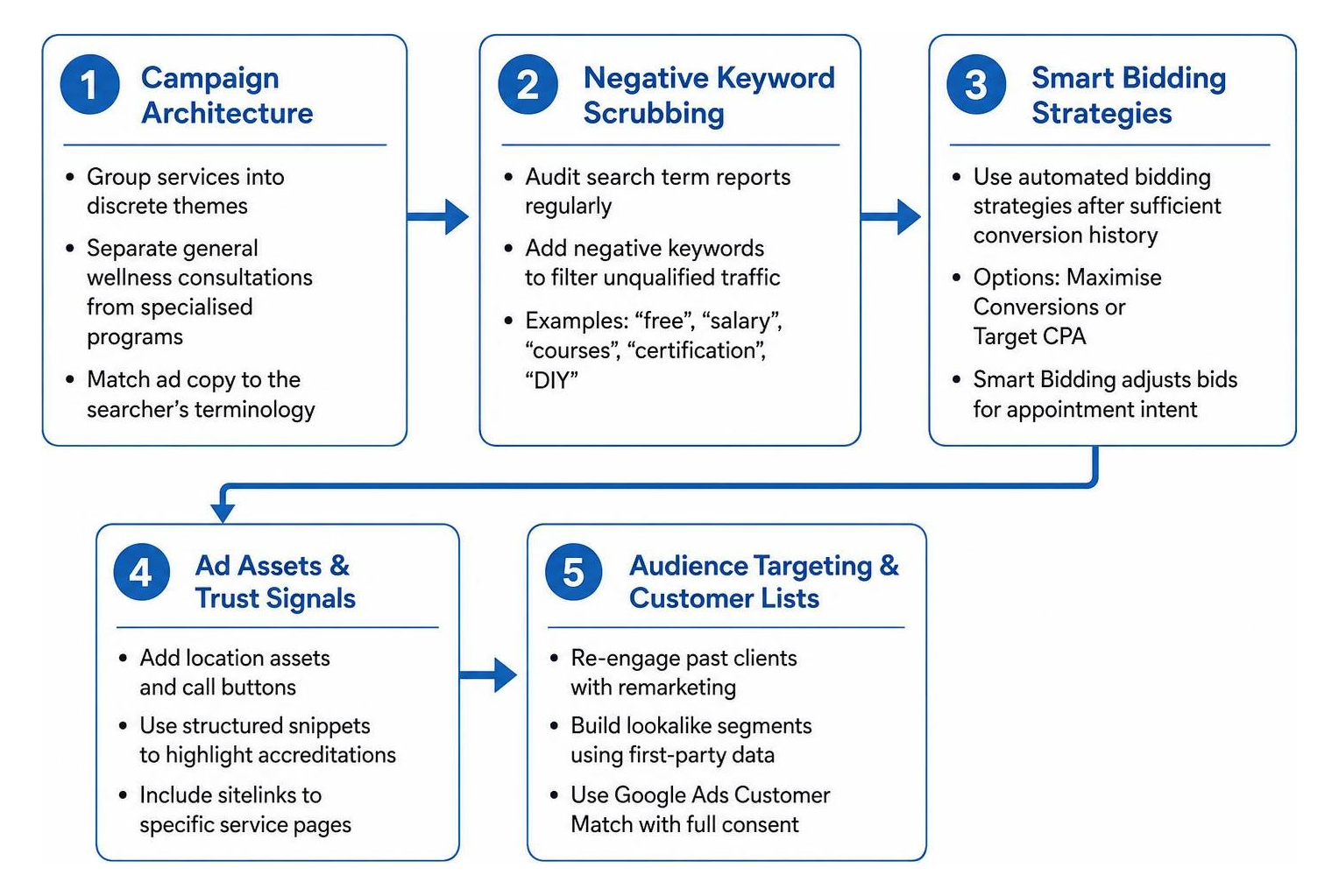
- Campaign architecture : Group closely related services and locations so the ad message matches the search.
- Negative keyword review : Exclude searches that do not indicate a likely customer need.
- Conversion tracking : Record calls, forms and completed online bookings before relying on automated bidding.
- Ad assets : Use location assets, call options and sitelinks to make contacting the business easier.
- First-party audiences : Use customer data only with appropriate consent and in line with privacy requirements.
- Ongoing review : Check search terms, lead quality and booked outcomes regularly, then refine the campaign. Google Ads Leads Management can provide practical support with ongoing lead-focused campaign management.
3. Measure Leads and Improve Campaign Quality Over Time
Google Ads performance is more useful when it is tied to business outcomes. A campaign with a low cost per click may still be unhelpful if it produces enquiries that do not become suitable appointments. Define the actions that matter before launch, then compare campaign results against those actions over time.
Use a Practical Measurement Framework
Track direct phone calls, online enquiry forms and completed bookings separately where possible. Record the service or campaign that generated each lead, then ask whether the enquiry was relevant, contacted promptly and converted into a booked consultation. This gives the business a clearer view of return on investment (ROI) than click volume alone.
Review Search Terms, Lead Quality and Budget Allocation
Use routine reviews to identify patterns: which services attract qualified enquiries, which locations are expensive, and which search terms need exclusion. Changes should be measured carefully because seasonal demand, competition, targeting, landing-page changes and Google’s systems can all influence results. Refining one variable at a time makes the next decision easier to interpret.
Practical Next Steps for Wellness Businesses
- Audit your services : Prioritise treatments or classes with clear commercial value and a strong client experience.
- Check ad and landing-page alignment : Ensure the wording, service details and booking action match the searcher’s likely intent.
- Review compliance : Confirm that claims are substantiated and that consent, privacy and testimonial practices are appropriate for your business.
- Set up conversion tracking : Measure calls, forms and bookings before making large budget decisions.
- Optimise consistently : Review search terms, lead quality and campaign budgets on a regular schedule.
A focused Google Ads strategy can help Australian wellness businesses connect with people searching for relevant local services, but performance varies with the market, budget, offer, targeting and website experience. RankingCo supports small and medium-sized businesses with transparent reporting and practical paid-search strategy tailored to genuine business goals. A thoughtful approach to campaign structure, compliant messaging and conversion tracking gives decision-makers a clearer basis for ongoing improvements. To discuss your next steps, Contact RankingCo, explore Our Services, or learn about Google Ads Leads Management.
Frequently Asked Questions About Google Ads for Wellness Businesses
How much do Google Ads for wellness businesses typically cost?
There is no fixed minimum budget required to advertise on Google. Total costs depend on your chosen daily budget, local competition, and keyword bidding dynamics across your service area. Bids for competitive wellness terms vary between suburban and central metropolitan areas in cities like Sydney, Melbourne, and Brisbane. Adopting a pay-per-lead approach through Local Services Ads or a cost-per-click approach via standard Search allows businesses to control spend while scaling budgets based on performance.
What health claims and policies apply to wellness advertising on Google?
Google maintains strict policies regarding healthcare and medicines, prohibiting ads that promote unapproved pharmaceuticals, speculative medical treatments, or unrealistic health outcomes. In Australia, advertisers must also adhere to Australian Consumer Law by ensuring all representations are truthful, substantiated, and free from misleading statements. Mandatory disclaimers may be required for certain therapeutic services. Because regulations vary across wellness modalities, businesses should seek independent legal advice regarding their specific promotional compliance obligations.
How do Local Services Ads differ from standard Google Search campaigns?
Google Local Services Ads operate on a pay-per-lead model where businesses are charged only when a prospective client calls or messages directly through the ad listing. Standard Google Search campaigns operate on an auction-based Pay-Per-Click model, directing users to an external website or landing page. Additionally, Local Services Ads appear at the very top of search engine results pages and may feature a Google Screened or Verified badge once the practice completes identity and license verification.
How quickly can a wellness clinic see appointment enquiries from ads?
Paid search campaigns can begin displaying ads and attracting visitor traffic immediately upon review and approval. While initial enquiries can occur within the first few days of campaign activation, machine learning algorithms typically require several weeks of consistent data to navigate the initial learning phase and stabilise performance. The speed of client acquisition varies depending on local demand, offer clarity, geographic targeting, and website conversion design.
How should wellness businesses track conversions and measure ROI?
Accurate measurement relies on tracking multiple interaction types, including direct telephone calls, submitted web enquiry forms, and completed online bookings. Integrating call-tracking software with your analytics platform and practice management CRM allows your team to connect advertising spend directly to booked consultations and ongoing client lifetime value. Ensure all tracking implementations comply with the Privacy Act 1988 (Cth) and obtain appropriate consent before handling personal data.





Share online