AI SEO Automation: Work Smarter, Not Harder
Is Your SEO Strategy Ready for the Age of AI Search?

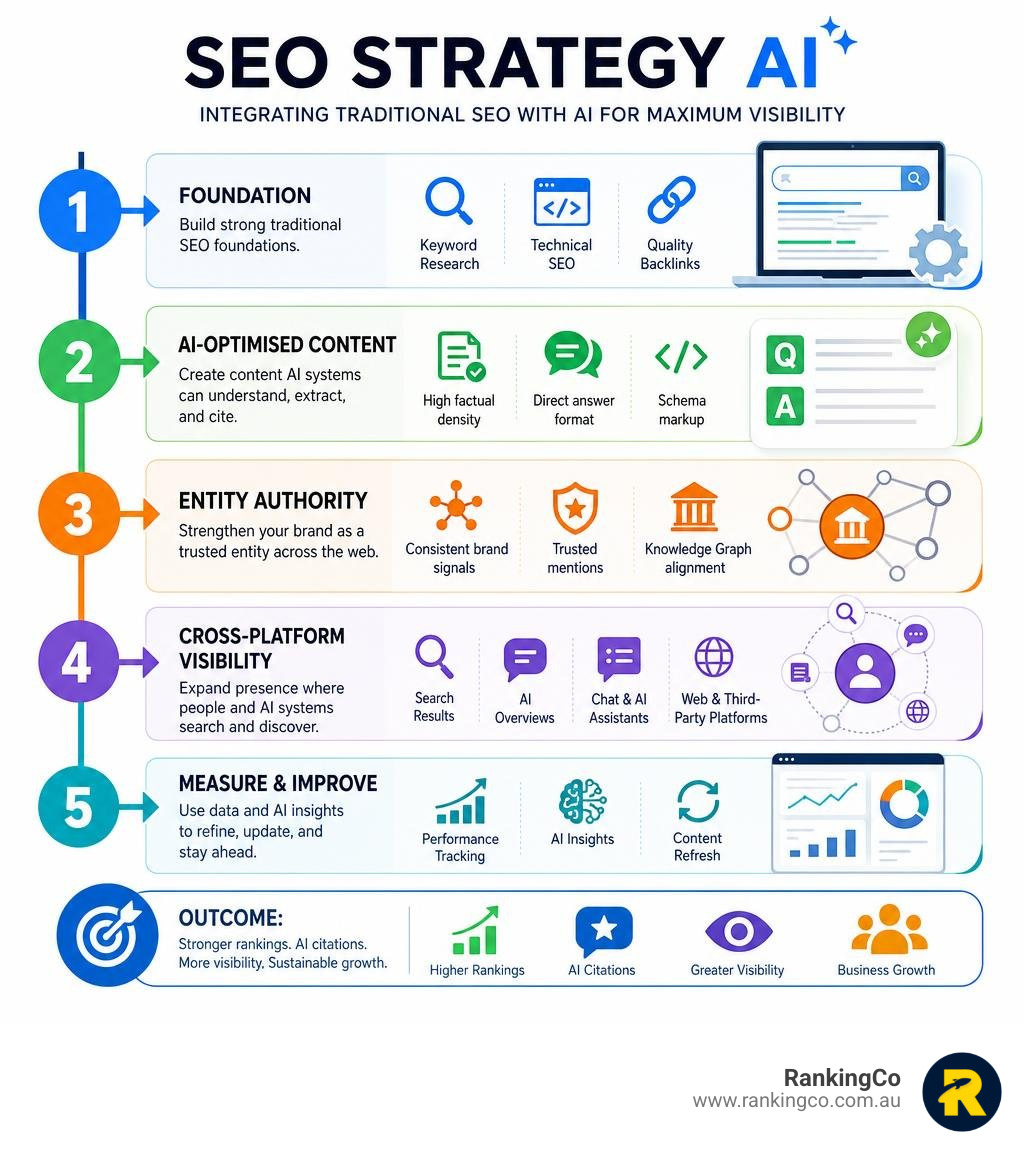
A smart SEO strategy AI integration is no longer a competitive advantage reserved for big brands with deep pockets. It is quickly becoming the baseline for any business that wants to stay visible online as search behaviour shifts in ways that are genuinely unprecedented.
Here is a quick answer to what an AI-integrated SEO strategy actually involves:
| Element | What It Means in Practice |
|---|---|
| AI-ready content | Structured, direct-answer content that AI systems can extract and cite |
| Technical foundations | Crawl access, schema markup, and clean site architecture for both Google and AI crawlers |
| Entity authority | Consistent brand signals across your website, directories, and third-party platforms |
| Dual-surface visibility | Optimising for both traditional search rankings and AI-generated responses simultaneously |
| Ongoing content freshness | Regular updates so content remains eligible for AI citations over time |
Search has always evolved. Google introduced algorithm updates, then mobile-first indexing, then featured snippets. Each shift created winners and losers. But the rise of AI Overviews, ChatGPT, Perplexity, and conversational search represents something more structural. AI systems do not simply rank pages. They synthesise answers from multiple sources and decide whose content gets referenced and whose gets ignored entirely.
For small and medium-sized Australian businesses, this creates a real and pressing challenge. The tactics that built solid rankings two or three years ago are not sufficient on their own anymore. Ranking on page one still matters. But now there is a second game running simultaneously, one where your content either gets cited by AI systems or it does not.
At RankingCo, we are committed to helping small and medium-sized businesses navigate this rapidly shifting digital landscape. With locations in Brisbane QLD, Sydney NSW, and Melbourne VIC, we integrate advanced AI technologies to enhance the efficacy of our digital marketing strategies, allowing us to analyse market trends accurately and create highly effective campaigns for our clients. We believe that every business deserves a digital marketing partner that genuinely cares about their growth and treats their goals as its own. By combining our strategic expertise with certified partner statuses, we ensure your business remains at the forefront of digital performance.
Key Takeaways
- Optimising for both traditional search rankings and AI-generated responses is essential for modern businesses, which you can read more about on our SEO Services page.
- High factual density, direct-answer content architecture, and structured schema markup are vital to secure citations in AI Overviews and chatbots.
- Consistently feeding entity signals to the Google Knowledge Graph builds a long-term moat against algorithm volatility.
- Partnering with an expert team ensures your tech stack is streamlined and your marketing strategy is future-proofed.
Why an SEO Strategy AI Approach Cannot Be Ignored
Ignoring the transition to an AI-driven search landscape carries serious visibility risks. Traditional Search Engine Optimisation (SEO) still matters, but it now works alongside AI answer engines such as Google AI Overviews, ChatGPT, Perplexity, and other conversational search tools. These systems do not simply list pages; they summarise information, compare sources, and decide which brands are credible enough to reference.
A practical SEO strategy AI approach helps your website become easier for both search engines and AI systems to understand. That means publishing clear answers, maintaining crawlable technical foundations, using structured data, and building consistent entity signals across your website and trusted third-party sources. Google Search Central explains how content can appear in AI features and how site owners can use standard Search controls in its guidance on AI features and your website. You can also read more about this shift in our guide on Google's Generative Search: What You Need to Know About AI Overviews.
Traditional SEO vs AI SEO
| Area | Traditional SEO | AI SEO / GEO |
|---|---|---|
| Main goal | Rank pages in search results | Become a cited or summarised source in AI answers |
| Content format | Long-form pages targeting keywords | Direct, self-contained answers supported by detail |
| Authority signals | Backlinks, topical relevance, engagement | Entity consistency, source trust, factual clarity, citations |
| Technical focus | Crawlability, indexation, speed, schema | Same foundations plus AI-readable structure and answer extraction |
| Measurement | Rankings, clicks, impressions, conversions | Rankings plus AI citations, brand mentions, and answer visibility |
Traditional SEO earns visibility in search results. AI SEO helps your content become useful enough for answer engines to quote, summarise, or recommend. The strongest strategy combines both.
Signs Your SEO Strategy Is Not AI-Ready
Your website may need an AI-focused SEO update if:
- Important service pages answer questions indirectly or bury the answer several paragraphs down.
- Content relies on broad claims without definitions, examples, data, or source references.
- Pages lack schema markup for services, FAQs, articles, products, reviews, or local business details.
- Your brand information is inconsistent across your website, Google Business Profile, directories, and social profiles.
- Competitors are being mentioned in AI-generated answers while your brand is absent.
- Existing content targets keywords but does not explain concepts in a way a chatbot can easily extract.
AI systems favour content that is specific, well-structured, and easy to verify. If your pages are vague, overly promotional, or technically hard to crawl, they are less likely to be used as supporting sources.
Checklist: 5 Foundations of AI SEO
- Direct-answer content: Start important sections with a concise answer before adding detail.
- Structured headings: Use question-led headings and descriptive subheadings that match real search intent.
- Schema markup: Add appropriate structured data to clarify page type, business details, services, products, FAQs, and reviews.
- Entity consistency: Keep names, locations, services, authorship, and business details consistent across trusted sources.
- Freshness and evidence: Update pages regularly with accurate examples, current terminology, and useful source links.
These foundations help search engines and AI systems understand what your business does, who it serves, and why the information on your website should be trusted.
Common Challenges in Developing an SEO Strategy AI
Many business owners and marketing managers find the transition to AI-powered search complex because it combines content, technical SEO, analytics, and brand authority. One common challenge is a disconnected marketing tech stack. If search data, website analytics, CRM data, and content planning are not aligned, it becomes difficult to know which topics drive visibility and leads.
Another challenge is overusing AI-generated copy without adding expertise. Publishing generic automated content can make pages less useful, not more competitive. AI-assisted content still needs human review, original insight, clear examples, and accurate local context.
Technical barriers also matter. Googlebot, AI crawlers, and answer engines need to access and interpret content without unnecessary friction. Blocked resources, thin service pages, duplicate content, missing schema, or unclear internal linking can all weaken your ability to appear in AI-influenced discovery.
For service-based businesses looking to capture local enquiries, our Leads SEO services focus on building clear local signals and conversational authority. For online retailers, our eCommerce SEO strategies help product feeds, category pages, and structured data support commercial search queries.
What Structured AI-Ready Content Looks Like
AI-ready content usually follows a simple pattern: answer first, explain second, support third. For example, instead of opening a service page with a broad marketing statement, a stronger section might begin with: “AI SEO is the process of structuring content, technical signals, and brand authority so search engines and AI answer tools can understand, trust, and cite your business.”
After that direct answer, the page can expand with examples, steps, comparison tables, FAQs, internal links, and source references. This structure helps readers scan quickly and gives AI systems a clean passage to extract.
Useful AI-ready content often includes:
- Definitions written in plain language.
- Short paragraphs that answer one idea at a time.
- Examples of implementation, such as FAQ schema or local business schema.
- Tables comparing options, processes, or mistakes.
- Clear explanations of who the advice applies to.
- Internal links to related service and educational pages.
How AI Search Chooses Sources
AI search systems generally look for content that is accessible, relevant, clear, and supported by broader trust signals. A page is more likely to be useful to AI search when it directly answers the query, aligns with other credible sources, and belongs to a site with consistent topical authority.
For example, if someone asks whether a local business needs schema markup, an AI system may compare search documentation, agency guides, local SEO resources, and pages that clearly define schema use cases. A website that explains the concept clearly, shows practical examples, and has consistent business details is easier to evaluate than a page that only says “we are the best SEO agency.”
This is why an effective SEO strategy AI approach should reduce generic claims and increase factual density. The content should show what to do, why it matters, and how it connects to measurable search visibility.
Common AI SEO Mistakes
| Mistake | Why It Hurts Visibility | Better Approach |
|---|---|---|
| Publishing vague AI-generated articles | They add little original value and are hard to trust | Add expert review, examples, and business-specific insight |
| Ignoring technical SEO | AI systems still need crawlable, indexable pages | Fix crawl access, speed, internal links, and schema |
| Burying answers | AI tools may miss the most useful passage | Put concise answers near the top of each section |
| Treating AI SEO as separate from SEO | It creates fragmented strategy and reporting | Optimise for search rankings and AI citations together |
| Over-promoting the brand | Promotional copy can dilute topical authority | Lead with education, then include relevant CTAs |
When Should You Invest in AI SEO?
You should consider investing in AI SEO when organic search is an important lead or sales channel, your competitors are being mentioned in AI answers, or your content no longer reflects how people search today. It is especially important for businesses in competitive service, eCommerce, professional, local, and high-consideration markets.
AI SEO is also useful when your website already has a solid SEO foundation but needs to become more extractable, better structured, and more authoritative. If your pages rank but do not clearly answer buyer questions, there may be an opportunity to improve both search performance and AI visibility.
At RankingCo, we help small and medium-sized Australian businesses connect technical SEO, content strategy, and AI visibility into one practical growth system. Our Onsite SEO and Technical SEO services work together to strengthen crawlability, structure, and authority signals.
What to Expect When Working With RankingCo
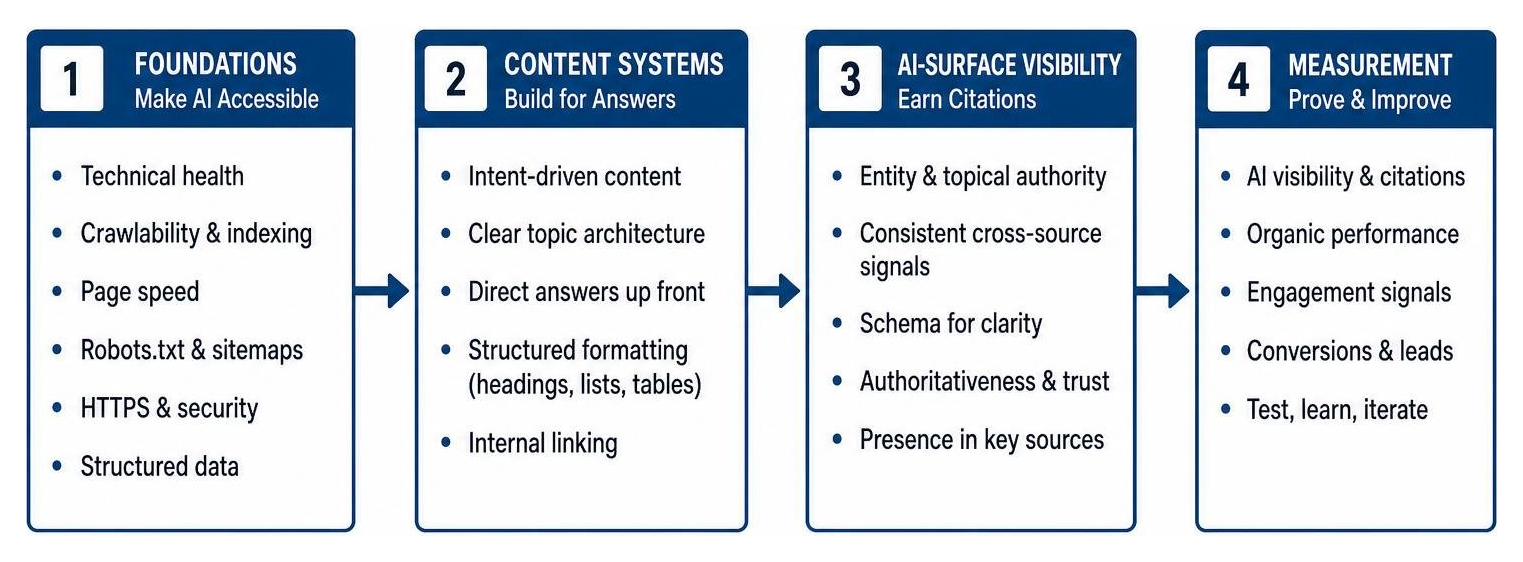
A strong AI SEO engagement should begin with diagnosis, not guesswork. The first step is usually a review of technical crawlability, indexation, current rankings, content quality, structured data, entity signals, and how the brand appears across AI-influenced search surfaces.
During an initial onboarding phase, a practical roadmap may include:
- Auditing website crawlability, page speed, internal links, and structured data.
- Mapping priority queries across traditional search, AI Overviews, and conversational search.
- Reviewing service pages, blog content, Google Business Profiles, directory listings, and product feeds.
- Identifying content gaps where competitors are better positioned to answer high-intent questions.
- Creating reporting benchmarks for rankings, organic traffic, conversions, brand mentions, and AI citations.
As a certified partner across major digital platforms, including Google Premier Partner, Meta Business Partner, and Microsoft AI Partner status, RankingCo can connect SEO improvements with broader channels such as Google Ads and Social Media advertising.
When to Get in Touch or Take Action
If your organic traffic has declined, your content feels outdated, or your brand is missing from AI-generated answers in your category, now is the right time to review your strategy. Waiting until competitors dominate both search results and AI answers makes it harder to regain visibility.
Start by reviewing your most important service or product pages. Check whether each page answers the main buyer question clearly, includes relevant schema, links to supporting resources, and reinforces consistent brand information. If those foundations are weak, improving them can make your website easier for both people and AI systems to trust.
Evolving Your Digital Strategy for Long-Term Success
Embracing a modern SEO strategy AI approach is about more than just keeping up with technology; it is about securing the future of your business. By structuring your content for direct answers, maintaining clean technical foundations, and building strong entity authority, you can ensure that your brand remains visible, trusted, and highly recommended across all search surfaces.
At RankingCo, we are passionate about helping small and medium-sized Australian businesses thrive in this new era of digital marketing. We treat your business goals as our own, providing the strategic expertise, transparent reporting, and hands-on management you need to succeed.
If you are ready to future-proof your online presence and explore how a personalized strategy can support your growth, we invite you to reach out to our team today. Let's work together to build a resilient, highly visible digital presence for your brand.
- Contact RankingCo: Get in Touch with Our Team
- Our Services: Explore Our Full Range of Digital Marketing Services
- SEO Services: Learn More About Our Specialized SEO Solutions
- Websites: Discover Our Custom Website Design and Development
- Content Creation: Explore Our High-Quality Content Creation Services
- ChatGPT Advertising: Learn About Our ChatGPT Advertising Solutions
Frequently Asked Questions About AI Search
What is an AI SEO strategy?
An AI SEO strategy is a plan for making your website easier for search engines and AI answer tools to understand, trust, and cite. It combines traditional SEO foundations with direct-answer content, structured data, entity authority, and regular content updates. The goal is not only to rank in Google search results, but also to appear in AI Overviews, ChatGPT-style responses, Perplexity answers, and other conversational discovery experiences.
How is AI SEO different from traditional SEO?
Traditional SEO focuses on improving rankings, organic clicks, and page visibility in search engine results. AI SEO also considers whether your content can be extracted, summarised, and cited by AI systems. That means pages need concise answers, clear headings, schema markup, consistent brand information, and enough factual depth to be useful as a source. The two approaches work best together rather than separately.
Can AI SEO help my business appear in ChatGPT and AI Overviews?
AI SEO can improve your chances of being referenced in AI-generated answers, but no agency can guarantee inclusion. ChatGPT, Google AI Overviews, and similar tools choose sources based on relevance, accessibility, authority, and how confidently they can interpret the information. Well-structured pages, strong topical coverage, accurate business details, and trusted third-party signals all make your brand easier for AI systems to evaluate.
Do I need schema markup for AI search?
Schema markup is not the only requirement for AI search visibility, but it is an important technical signal. It helps search engines understand the type of page, the business behind it, the services offered, FAQs, products, reviews, and other structured details. Schema will not compensate for thin content, but when paired with useful answers and strong authority signals, it can make your website easier to interpret.
What are entity signals in AI SEO?
Entity signals are consistent clues that help search engines and AI systems understand who your business is, what it offers, where it operates, and why it should be trusted. Examples include your business name, location, services, author profiles, Google Business Profile, directory listings, reviews, social profiles, backlinks, and mentions on reputable websites. Strong entity signals reduce ambiguity and support brand credibility.
What content format works best for AI search?
The best content format for AI search is clear, specific, and easy to extract. Use question-based headings, short answer-first paragraphs, comparison tables, checklists, examples, and FAQs. Each section should answer one intent clearly before expanding with supporting detail. Avoid long promotional blocks that make it hard to identify the practical answer. AI systems tend to favour passages that are concise, factual, and self-contained.
What are the most common AI SEO mistakes?
Common AI SEO mistakes include publishing generic AI-written content, ignoring technical SEO, using inconsistent business information, burying answers deep in long paragraphs, and focusing only on rankings instead of AI citations or brand mentions. Another mistake is over-promoting the business instead of explaining the topic clearly. Strong AI SEO balances helpful education, technical clarity, original insight, and relevant calls to action.
When should a business invest in AI SEO?
A business should invest in AI SEO when search visibility is important to lead generation, sales, or brand trust. It is especially useful if competitors appear in AI answers, organic traffic is declining, or existing pages rank but do not clearly answer buyer questions. Businesses in competitive local, professional service, eCommerce, and high-consideration markets can benefit from making their content more structured, current, and authoritative.





Share online