Why Is Your BigCommerce SEO Optimisation Falling Behind in Search?
BigCommerce SEO optimisation, often searched as “BigCommerce SEO optimization”, helps eCommerce businesses make product, category and supporting content easier for search engines and AI-powered search tools to interpret. A strong foundation combines clean technical settings, useful commercial-page content, accurate product information and clear internal pathways so shoppers can find the most relevant pages.

I’m Kerry Anderson, Co-Founder of RankingCo. I help shape practical SEO and digital marketing guidance for Australian eCommerce teams, with a focus on clear priorities, transparent reporting and sustainable improvement rather than unsupported promises. This guide explains the BigCommerce SEO decisions that can support search visibility as a catalogue grows, including the queries commonly phrased as “BigCommerce SEO optimization”.
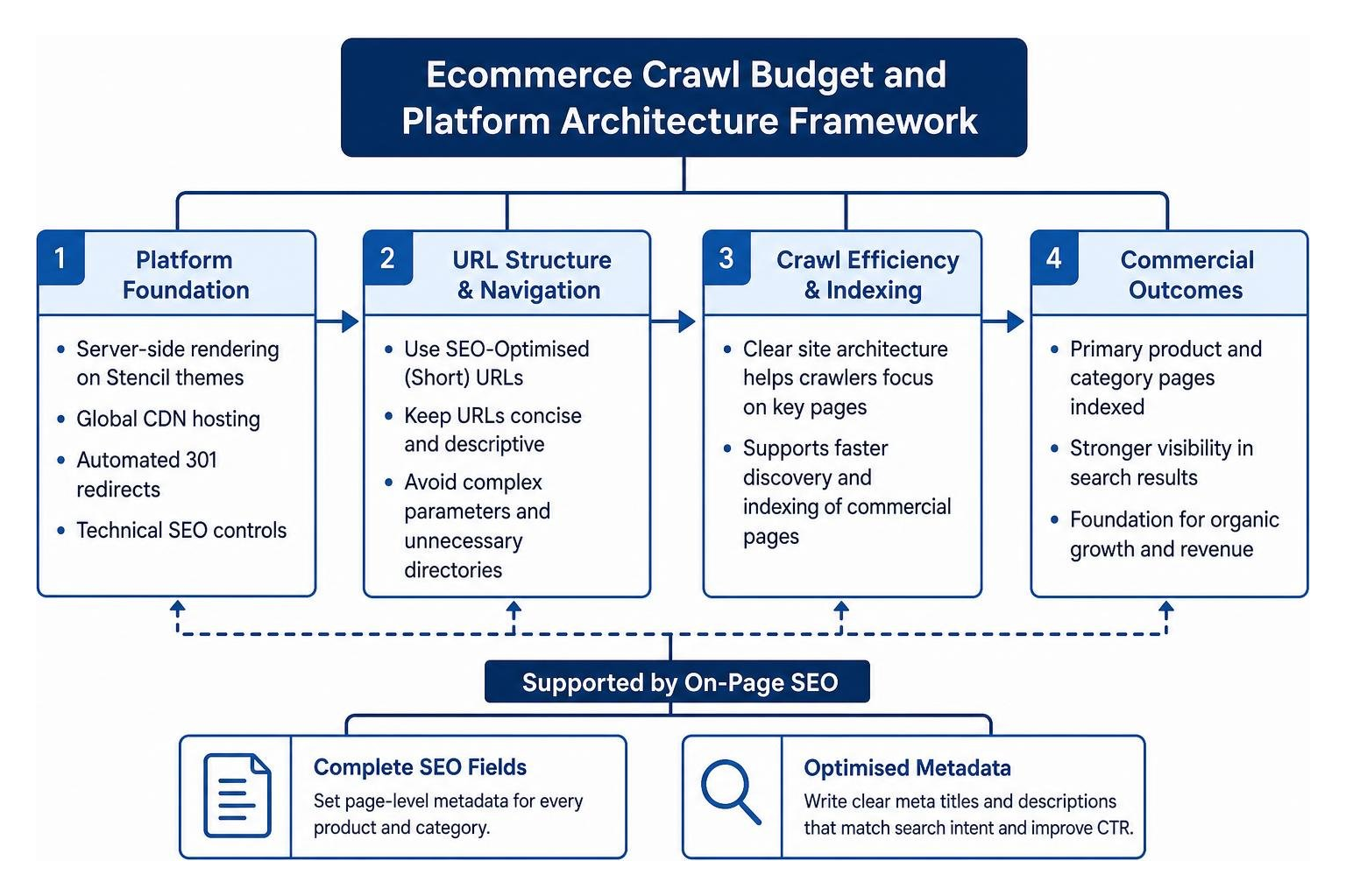
BigCommerce includes server-side rendering on Stencil themes, content delivery network hosting, automated redirects when URLs change and technical SEO controls. Start by reviewing your URL structure and ensuring each indexable page has one clear, permanent destination. Concise, descriptive URLs can help shoppers and search systems understand a page before they open it.
Key Takeaways
- Set clear URLs, redirects and canonical signals so search engines can identify your preferred product and category pages.
- Give category and product pages distinct metadata, useful copy and clear, accessible visual descriptions that match shopper intent.
- Control faceted navigation, media weight and scripts to reduce avoidable crawling and performance issues.
- Connect buyer guides and commercial pages with contextual internal links that help shoppers and search systems understand the catalogue.
- Keep product feeds, availability and structured product details accurate to support Google Shopping, rich results and AI search discovery.
On-Page BigCommerce SEO Optimisation for Product and Category Pages
Category and product pages represent the primary commercial revenue drivers for online retail. Optimising these pages, which is a central part of “BigCommerce SEO optimization”, requires a balance of search intent matching, precise metadata formatting, and conversion-focused design.
In BigCommerce, page-level metadata can be managed under the storefront and catalogue sections. Complete the native SEO Fields for every live product and category, then make each title and description reflect the page’s specific search intent. For example, a category page should answer what the collection is, who it suits and the key buying considerations, while a product page should clarify the model, use case, specifications and availability. This approach supports both search snippets and clearer product understanding for AI systems. For hands-on assistance, explore our eCommerce SEO services.

| BigCommerce Native SEO Field | Recommended Approach | Best Practice Implementation |
|---|---|---|
| Page Title | Clear and concise | Lead with the target topic and add the brand where useful |
| Meta Description | Specific and helpful | Summarise the page benefit and give a reason to visit |
| Product H1 Heading | Descriptive product name | Keep it distinct from the meta title and prioritise clarity |
| Category Description | Original, useful copy | Explain the range, use cases and relevant buying considerations |
| Accessible visual description | Brief and specific | Describe visible content naturally and avoid keyword stuffing |
For businesses researching “BigCommerce SEO optimization”, category pages frequently drive higher organic discovery than individual product listings because they capture broad, high-volume search queries. Write original, helpful introductory text for each category rather than relying solely on a grid of product cards. On individual product pages, replace generic manufacturer descriptions with unique copy that answers common buyer questions, details sizing or technical specifications, and outlines practical benefits.
Technical BigCommerce SEO Optimisation: Faceted Navigation and Site Speed
As catalogues expand, faceted navigation (product filtering by size, colour, price, or brand) can inadvertently generate thousands of parameter-based URLs. If search engines crawl and index all these parameter combinations, it can dilute domain authority and lead to duplicate content challenges.
To manage faceted search effectively, review canonical tags, indexation rules and the filters that create crawlable URLs. BigCommerce outputs canonical tags on standard product pages, pointing variations back to the primary URL. For complex filtering systems, use robots.txt controls carefully and assess whether filter combinations offer unique shopper value before allowing them to be crawled. This keeps search-engine attention focused on valuable commercial pages and is a practical priority within technical SEO services.
Site performance is a fundamental technical requirement because slow, unstable pages can make shopping harder and reduce the usefulness of a page for search visitors. BigCommerce themes use CDN delivery and responsive media delivery through the srcset
attribute, but merchants should still audit uploaded media, unnecessary apps and third-party scripts. Compress product visuals before upload, use WebP where supported and test important product and category templates on mobile.
Strategic Internal Linking and Content Creation for Australian Retailers
Developing strong topical relevance requires connecting your informational content directly to commercial pages. Crafting informative buyer guides, product comparisons, and maintenance articles allows you to capture top-of-funnel search intent and guide shoppers seamlessly toward product categories.
When creating supporting content, maintain an organised URL structure and answer one clear question per page. Helpful topics include choosing the right product type, comparing materials, sizing guidance, maintenance advice and delivery considerations. BigCommerce’s blog can sit in a subfolder rather than an isolated subdomain, helping earned authority remain connected to the main site. Use keyword-rich content guidance to incorporate relevant terms naturally rather than repeating the same phrase.

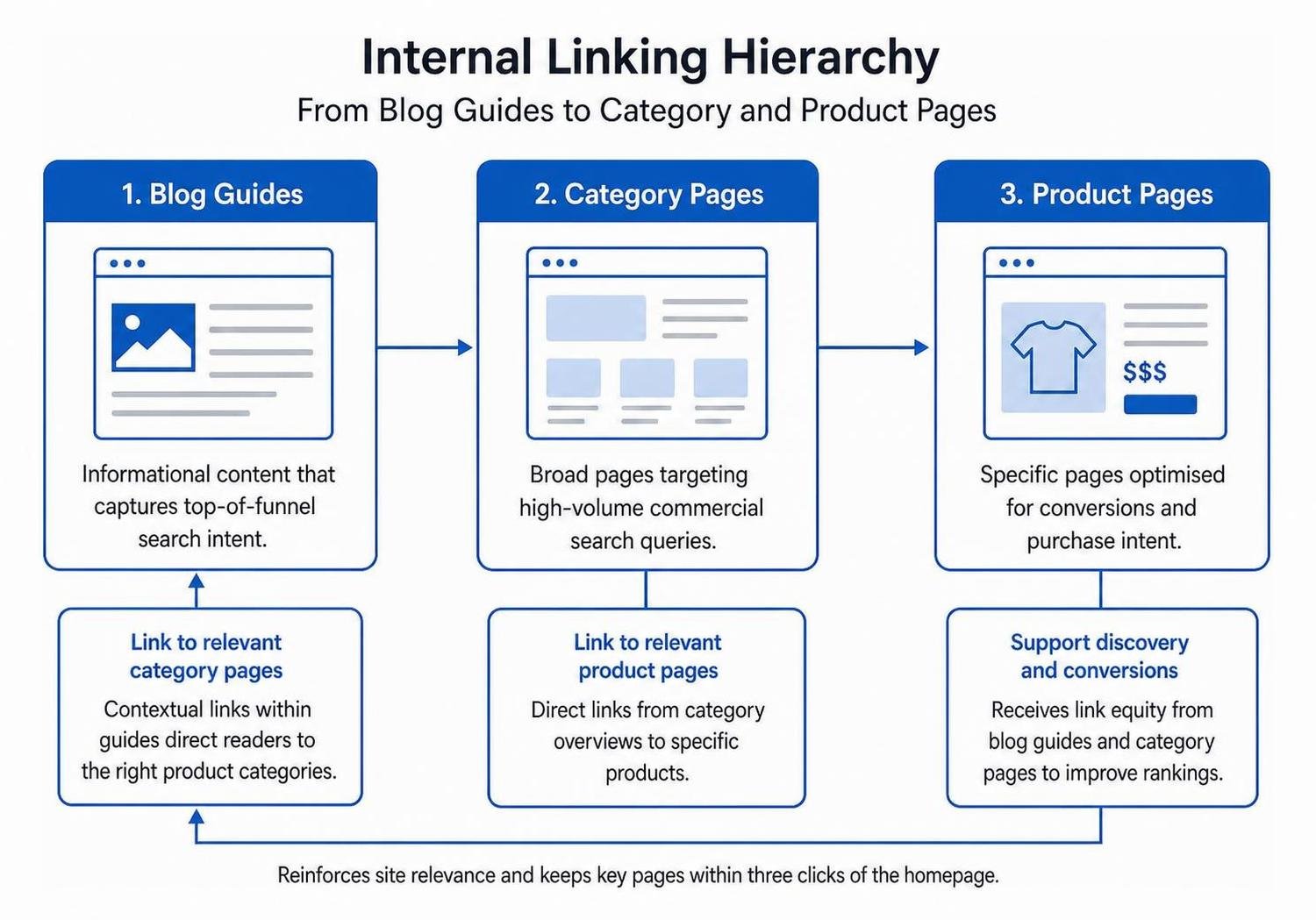
A structured internal-linking strategy should also maintain shallow catalogue depth. Keep key categories and priority products within a few logical steps of the homepage, use breadcrumb navigation across templates and add contextual links from buyer guides to the most relevant category or product page. This can make the catalogue easier for shoppers to navigate and easier for search systems to understand. Our eCommerce website services can help businesses align site structure with commercial goals.
Product Data and AI Search Readiness for BigCommerce
Search engines and AI-powered discovery tools rely on clear product information to interpret what a store sells, who each item suits and whether the information is current. Structured data, consistent product attributes and direct answers on commercial pages can help systems connect products with relevant queries. This is another practical priority for businesses searching for “BigCommerce SEO optimization”, even when their store uses Australian English elsewhere. For businesses that need strategic support, RankingCo provides eCommerce SEO services for Australian retailers.
Product Data, Merchant Listings and AI Search Visibility
An optimised product feed can support organic product listings, Google Shopping visibility and clearer product matching across search experiences. The most useful feeds use the same accurate names, descriptions, identifiers, images, pricing and availability that shoppers see on the landing page. When feed data and page content disagree, eligibility and trust can be affected.
Ensure your BigCommerce catalogue integrates cleanly with feed-management tools. Populate critical identifiers such as Global Trade Item Numbers (GTINs), Manufacturer Part Numbers (MPNs), brand attributes and precise stock status when they apply. Also review product titles, variant data and landing-page URLs so each record provides a consistent answer to common shopping queries. Accurate synchronised data can reduce avoidable Merchant Center issues and support both organic and paid eCommerce campaigns, including eCommerce Google Ads.
A Practical BigCommerce SEO Optimisation Workflow
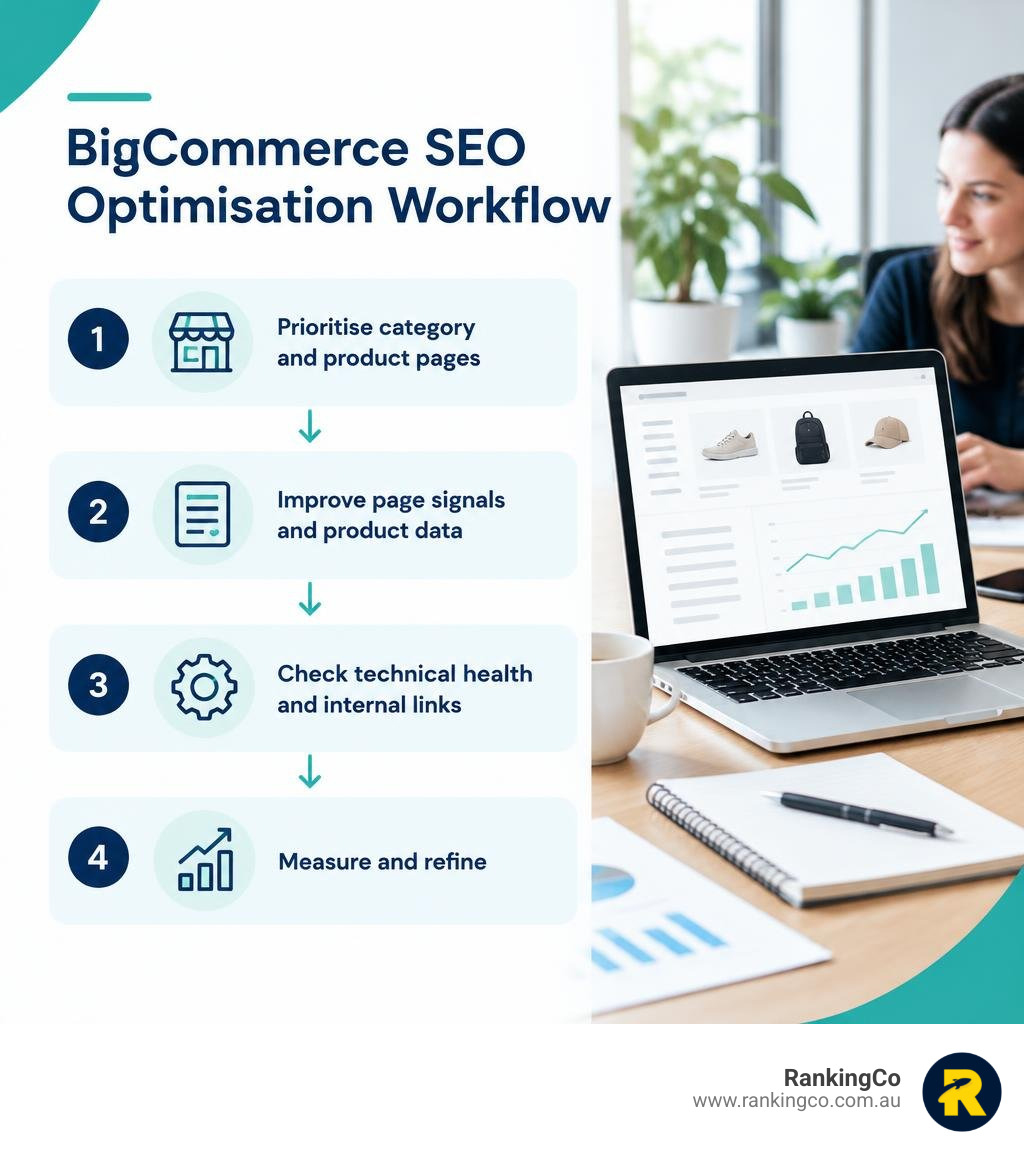
A useful BigCommerce SEO workflow starts with the pages most likely to influence how shoppers discover and assess the catalogue. Begin by listing priority categories, best-selling product ranges and pages that answer high-intent buying questions. For each page, check whether the page title, main heading, opening copy, internal links, product attributes and availability information describe the same commercial purpose. This creates a clearer signal for shoppers, search engines and AI-powered answer tools.
Next, separate quick fixes from changes that need ongoing ownership. Quick fixes can include correcting duplicate titles, adding missing category introductions, compressing oversized images and resolving broken internal links. Ongoing work may include updating seasonal collections, reviewing discontinued products, improving product specifications and publishing buyer guidance that links to relevant category pages. Assign a responsible team member and a regular review point so useful improvements do not disappear as the catalogue changes.
Finally, measure the outcome with context. Search visibility can change for many reasons, including demand, competition, product availability, site changes and how search platforms present results. Compare relevant categories and product pages over time, then use the findings to refine priorities rather than treating one ranking movement as proof that a single change caused the result. This practical approach to BigCommerce SEO optimisation supports more reliable decision-making and keeps optimisation aligned with eCommerce goals.
How to Handle Out-of-Stock and Discontinued BigCommerce Products
Inventory fluctuations are a natural part of running an online retail business. However, mishandling out-of-stock, seasonal, or discontinued items can lead to broken user journeys and lost search equity.
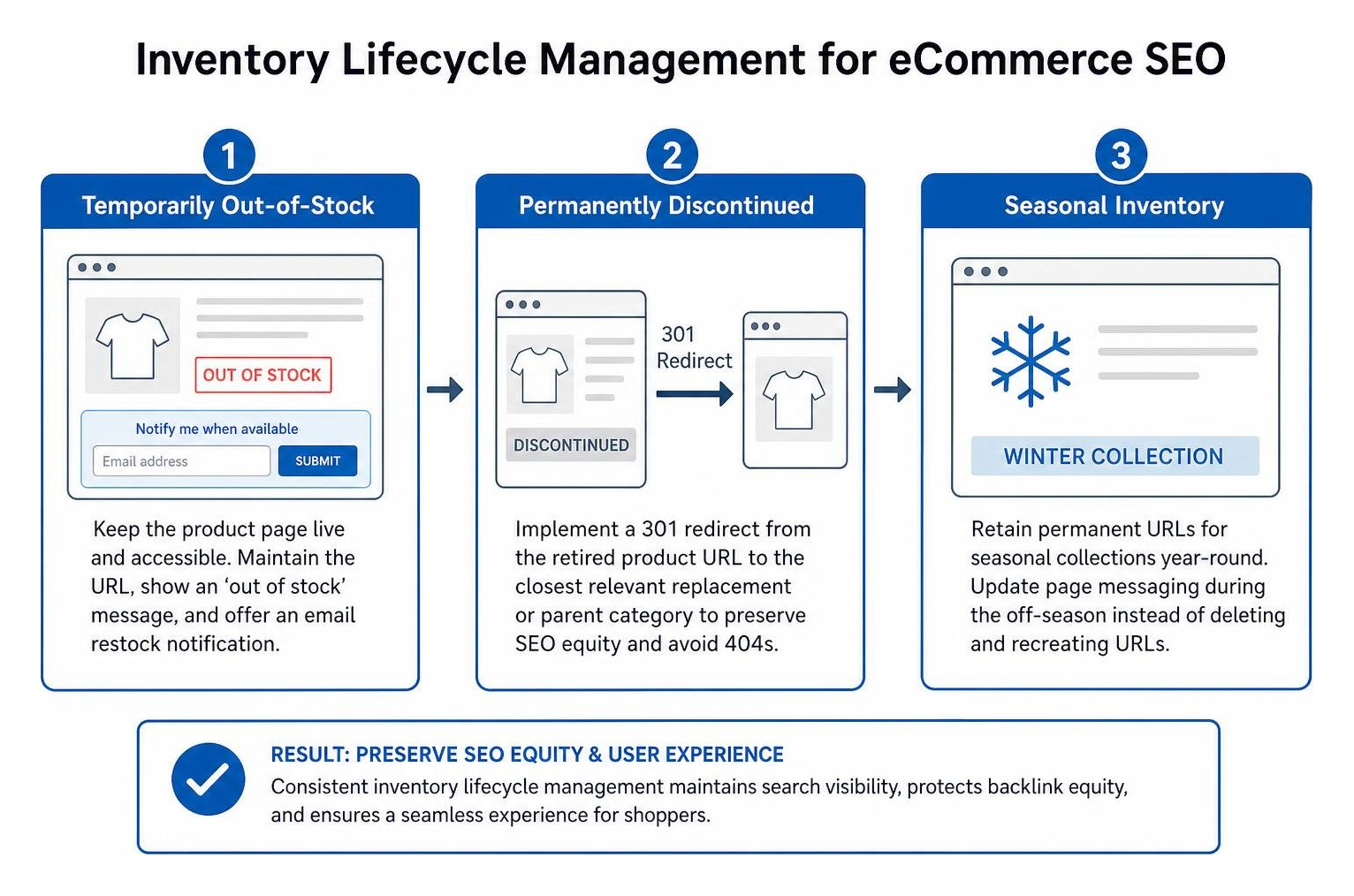
- Temporarily out-of-stock items: Keep the product page live when a return is expected. Retain the URL, explain availability clearly and offer a suitable restock notification or alternative.
- Permanently discontinued items: Redirect the retired URL to the closest relevant replacement or immediate parent category when one genuinely exists. If there is no relevant alternative, give shoppers a helpful explanation rather than sending them to an unrelated page.
- Seasonal inventory: Keep recurring collection URLs for returning seasonal ranges, update the page when the season changes and retain useful supporting information where it remains relevant.
Build a Sustainable BigCommerce SEO Plan
Achieving sustainable organic momentum takes deliberate planning and ongoing maintenance. Review technical foundations, page quality, internal links and product data as part of one connected process rather than isolated tasks. Search Engine Optimisation (SEO) outcomes and timelines vary with catalogue size, competition, demand, site history and changes in search technology, so regular measurement and prioritisation are essential.
RankingCo works in genuine partnership with Australian small and medium-sized businesses, offering transparent reporting and practical support across SEO, Google Ads, social media advertising, website development and content creation. Our team brings verified platform partnerships including Google Premier Partner, Meta Business Partner, Microsoft AI Partner, LinkedIn Partner, Shopify Partner, TikTok Marketing Partner and Wix Legend Partner.
A focused BigCommerce SEO plan can make it easier to improve technical foundations, support product discovery and build useful content pathways over time. When you are ready for tailored support, Contact RankingCo, explore Our Services or learn more about our eCommerce SEO services.
Frequently Asked Questions About BigCommerce SEO
How long does BigCommerce SEO take to show measurable results?
Search Engine Optimisation (SEO) is an ongoing process rather than a quick fix. After technical corrections, search engines still need to recrawl, process and reassess the affected pages. The time needed for meaningful visibility changes varies with the store’s catalogue, competition, site history, demand and the scale of the updates. Prioritise improvements that make product and category pages clearer and more useful for shoppers first.
Does BigCommerce automatically generate XML sitemaps?
Yes, BigCommerce automatically creates and updates an XML sitemap for your store, located at your primary domain followed by /xmlsitemap.php
. This file dynamically includes your live product pages, category structures, brand listings, and content pages. As you add or remove inventory, the platform updates the sitemap automatically, simplifying the submission process within Google Search Console and Bing Webmaster Tools.
How should I handle variant URLs to prevent duplicate content?
BigCommerce typically manages product variations (such as different sizes or colours) on a single canonical product URL using dynamic scripts. If your store setup generates unique URLs for specific variant combinations, ensure each variant page includes a canonical tag pointing back to the main parent product URL. This signals to search engines which primary page to index while allowing shoppers to view specific SKU details.
Is BigCommerce SEO optimization different from BigCommerce SEO optimisation?
No. “BigCommerce SEO optimization” and “BigCommerce SEO optimisation” describe the same core work: improving how a BigCommerce store is crawled, understood and found. Australian businesses can use Australian English across their customer-facing content while recognising that searchers may use either spelling. The priority is clear, helpful copy that matches the purpose of each product, category or supporting page.
Why is an optimised product feed important for organic discovery?
An optimised product feed contains accurate product titles, descriptions, images, prices, availability and identifiers such as GTINs and MPNs where applicable. These details help search systems match products with suitable shopping queries and support free listings, merchant experiences and richer product presentation. Keep feed data aligned with the live landing page so shoppers receive consistent information.
Can I migrate my existing store to BigCommerce without losing SEO rankings?
A carefully managed migration can protect your existing organic visibility. Prior to launch, map every existing URL to its corresponding new URL on BigCommerce. Once the new store goes live, implement permanent 301 redirects using the native 301 Redirects manager in your control panel to transfer search equity and avoid 404 crawl errors. Maintaining matching metadata, on-page copy, and structured data during migration further supports ranking continuity.




Share online