Connect with High-Intent Local Shoppers Using Practical Search Strategies
What Is Local SEO Strategy: A Practical Guide to Growing Nearby Search Visibility

A local Search Engine Optimisation (SEO) strategy helps a business become easier to find when people search for nearby products or services on Google Search and Google Maps. It combines an accurate Google Business Profile, consistent contact details, locally relevant website pages, customer reviews, and trusted local signals. This guide outlines how these elements work together, the practical priorities to address first, and ways to monitor progress over time.
For small and medium-sized businesses, the most effective approach is to focus on the information and actions that help nearby customers choose with confidence. This guide explains how to strengthen Google Maps visibility, improve local search results, maintain a useful Google Business Profile, create genuinely helpful location pages, and measure enquiries that matter to the business.
I'm Kerry Anderson, co-founder at RankingCo. Here, we draw on practical experience supporting Australian businesses with local search optimisation, website visibility, and digital marketing strategy. We framed this guide around the decisions business owners and marketing managers can act on, while recognising that local SEO outcomes depend on competition, location, website quality, and consistent implementation.
Key Takeaways
- A local SEO strategy combines Google Business Profile optimisation, relevant website content, citations, reviews, and local authority signals.
- Relevance, distance, and prominence can influence how businesses appear in nearby search results.
- Consistent business information and accurate location targeting may improve local search visibility.
- Results vary according to industry, competition, budget, algorithm changes, and the quality of implementation.
- Discover how our team at RankingCo can help you improve local search visibility across key Australian markets through our SEO services.
What Are the Key Elements of a Local SEO Strategy?
Local search optimisation uses the same core principles as broader Search Engine Optimisation (SEO), including useful content, trustworthy links, sound website structure, and a clear understanding of customer intent. The difference is emphasis: local SEO focuses more closely on geographic relevance and the actions people take when they need a nearby provider, such as finding a business on Google Maps, calling, requesting directions, or visiting a location.
For an Australian business, the goal is to make it easier for potential customers to understand what the business offers, where it operates, and why it is a credible local choice. That means keeping business information accurate, creating helpful location-focused content, and building a positive reputation across local search results.
| Area | Broader SEO focus | Local SEO emphasis |
|---|---|---|
| Audience | People searching nationally, regionally, or globally | People whose search has local intent or a geographic connection |
| Google surfaces | Website pages in organic search results | Website pages, Google Business Profile, Google Maps, and the Map Pack |
| Core signals | Helpful content, technical quality, authority, and relevance | The same SEO foundations, plus business details, geographic relevance, reviews, and local citations |
| Search intent | Research, comparison, or online transactions | Nearby services, directions, calls, bookings, and location-specific research |
| Business outcome | Relevant website traffic and enquiries | Greater local search visibility and easier discovery by nearby customers |
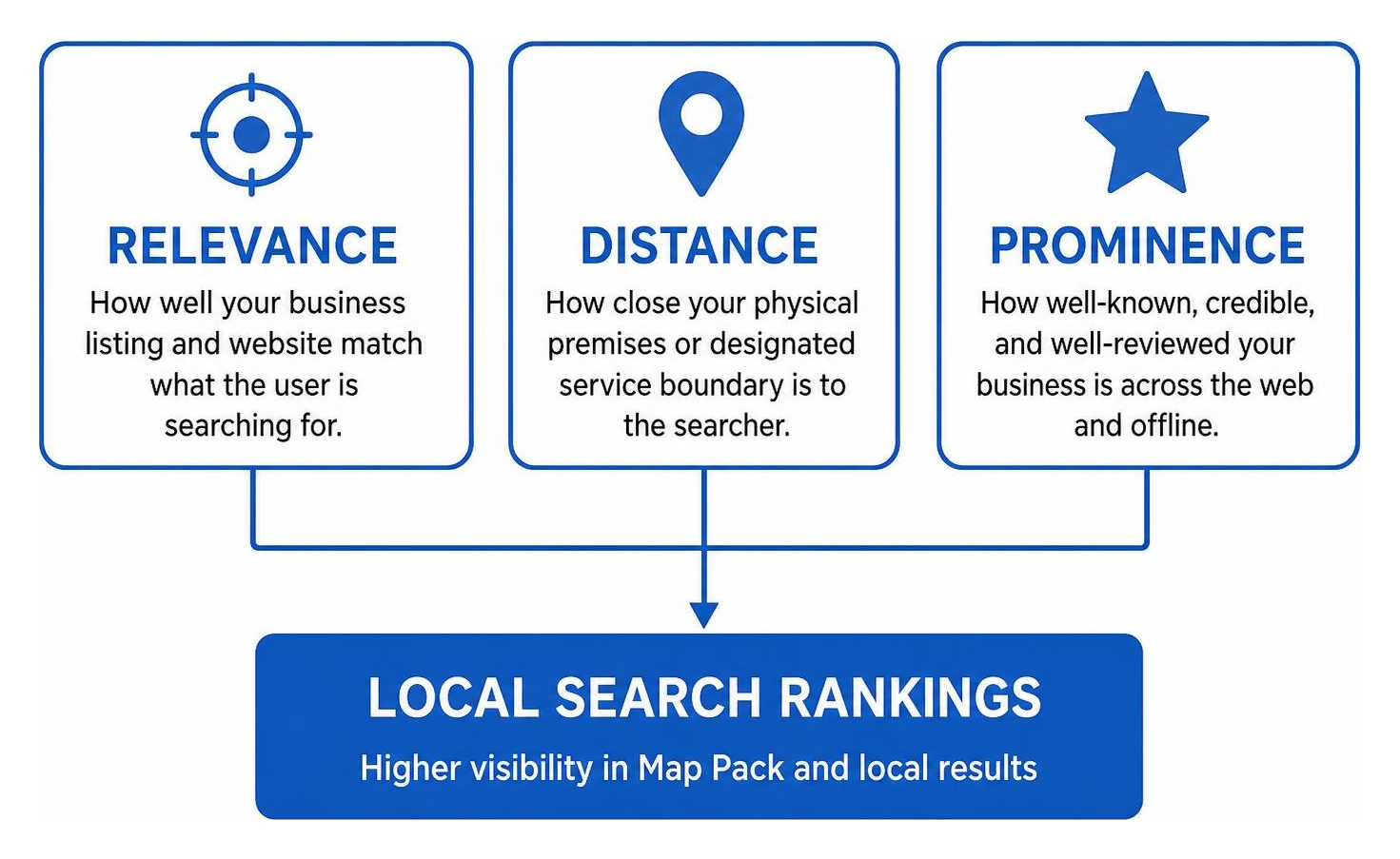
Google's local ranking guidance explains that local results are shaped by relevance, distance, and prominence. In practice, this means the business information should match the search, the service area or location should be clear, and the business should demonstrate a credible presence online through accurate details, customer reviews, and useful website content.
- Relevance : How well the business listing and website match what a person is searching for.
- Distance : How closely the business location or service area relates to the searcher's location.
- Prominence : How well-known and trusted the business appears across the web, supported by reviews, local citations, links, and reputation.
How Do Google Business Profile and Local Citations Support Visibility?
A complete Google Business Profile gives prospective customers practical information before they visit the website, including the services offered, opening hours, contact options, and location or service area. Choosing accurate business categories and maintaining current details can help the profile appear for relevant Google Maps and Map Pack searches.
The same consistency matters wherever the business is listed online. Name, Address, and Phone Number (NAP) details should match across credible directories, maps, and social profiles so customers and search engines receive the same information. Our guide to local SEO for small businesses explains how these foundations can support local search visibility.

How Do Website Content and Local Authority Affect SEO?
The website gives search engines and customers the context that a business profile alone cannot provide. Useful location pages can explain the services available in a suburb, city, or service area, answer common local questions, and provide clear ways to make contact. Each page should offer genuinely useful information rather than swapping place names into identical copy.
Structured data can also help search engines interpret key business details. For most owners, the practical benefit is clearer communication of information such as business type, opening hours, address, and services. A developer can implement this using LocalBusiness
schema, but the underlying details still need to be accurate and consistent.
Customer reviews and trusted local links can further strengthen local authority. Responding professionally to feedback, participating in relevant community partnerships, and earning mentions from credible local organisations can help customers assess whether the business is a reliable option.
How Do You Measure Local SEO Performance?
Measurement should focus on actions that indicate genuine customer interest, not only on keyword positions. Depending on the business model, useful indicators can include phone enquiries, website visits from local search results, direction requests, bookings, and qualified lead form submissions.
Key indicators may include:
- Google Business Profile interactions : Phone calls, website clicks, and direction requests from Google Maps and the Map Pack.
- Google Search Console queries : Local search impressions and Click-through rate (CTR) trends for relevant terms.
- Conversion tracking : Phone enquiries, booking requests, and lead form submissions that show whether local search interest becomes a business opportunity.
- Review activity : The quality, recency, and responsiveness of customer reviews over time.
Common problems include inaccurate business details, duplicate listings, overly broad location pages, and unattended customer feedback. A step-by-step local SEO audit guide can help identify the areas that need attention first.
What Should Service-Area and Multi-Location Businesses Prioritise?
Local SEO can be adapted to different operating models. A shopfront may need clear location details, directions, opening hours, and imagery that helps people plan a visit. A service-area business, such as a plumber or mobile provider, instead needs to define where it travels and ensure its profile and website accurately describe those service areas.
Service-area businesses that operate from a residential address should follow Google's requirements for hiding that address from public view where appropriate. The business can still build Google Maps visibility by maintaining an accurate profile, describing its services clearly, and publishing helpful pages for the areas it genuinely serves.
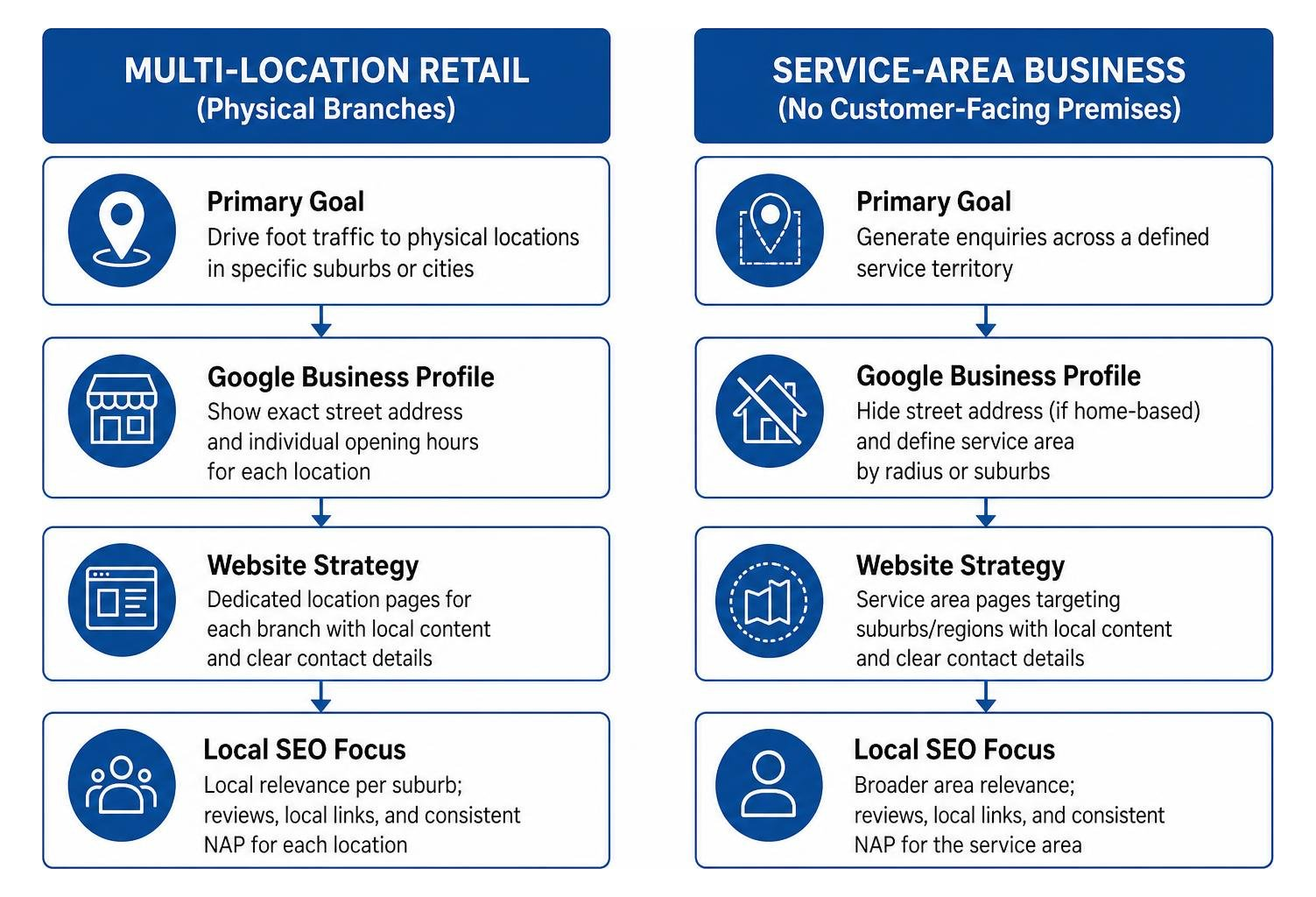
Businesses with multiple locations benefit from a clear connection between each location page and the relevant services offered there. Our practical guide to improving local search visibility outlines how location-focused content can support this approach, while this guide to local SEO for service businesses covers considerations for mobile operators and other service-area businesses.
What Are the Practical Next Steps for Building a Local SEO Strategy?
Building local search visibility requires steady, methodical work. The following steps can help establish a practical foundation:
- Review your Google Business Profile : Choose the most accurate primary category, confirm trading hours and contact details, and make sure the profile clearly reflects the services the business provides.
- Check business details across the web : Review the business name, address, service areas, and contact numbers on important Australian directories, maps, and social profiles to correct outdated or conflicting information.
- Improve location pages : Add useful, location-specific content that explains the services available in each area and gives customers a clear next step on mobile and desktop.
- Help search engines interpret business information
: Confirm that key details such as business type, opening hours, address, and services are accurate.
LocalBusinessstructured data can support this when it is correctly implemented. - Create a practical review process : Invite genuine customer feedback after a completed service or purchase, then respond professionally and consistently to reviews.
- Track meaningful enquiries : Configure call tracking, lead form events, booking actions, and Google Search Console so the business can see which local search activities are contributing to enquiries and Return on investment (ROI).
Local SEO Strategy Next Steps for Australian Businesses
A practical local SEO strategy gives small and medium-sized businesses a clearer way to appear in relevant local search results, Google Maps, and the Map Pack. By keeping business information accurate, improving location pages, earning genuine customer reviews, and tracking meaningful enquiries, businesses can build a more useful and credible local search presence over time.
For tailored support, RankingCo helps Australian businesses turn local search priorities into an achievable SEO plan with transparent reporting and practical recommendations. Explore the next step that best suits your business goals:
Frequently Asked Questions About Local SEO Strategy
When Should a Business Refresh Its Google Business Profile?
Review the profile whenever there is a change to trading hours, contact details, service offerings, service areas, or business locations. It is also useful to check the profile regularly for customer questions, new reviews, and outdated photos or posts. Keeping this information current helps customers make decisions with confidence.
Can local SEO work for a business that serves customers at their homes?
Yes. Service-area businesses can use local search optimisation to explain where they operate, what services they provide, and how customers can contact them. The profile and website should accurately describe genuine service areas, while the business follows Google's requirements for address visibility.
Does local SEO work without a physical shopfront?
A physical shopfront is not required for every business. Mobile providers, home service businesses, and businesses that visit customers can still improve their local search presence through a properly configured Google Business Profile, useful service-area content, local citations, and customer reviews.
Why do customer reviews matter for local search visibility?
Reviews can influence how prospective customers assess a business before making contact. A consistent approach to requesting genuine feedback and responding professionally can build trust, surface useful service information, and demonstrate active customer care.
Why are location pages important for local search results?
Location pages help customers understand whether a business serves their area and what support is available there. The most useful pages contain original information about the relevant services, local considerations, contact options, and next steps rather than repeating the same wording for every suburb.
How long does local SEO take to show results?
Local SEO typically requires ongoing work rather than a one-off change. The timeline depends on competition, the accuracy of existing business information, website quality, customer review activity, and how established the business is online. Consistent improvements can support stronger visibility over time, but results vary by industry, location, and implementation quality.





Share online