Google Ads ROI: How to Know If Your Campaigns Are Really Paying Off
Google Ads ROI: A Practical Measurement Guide
Google Ads return on investment (ROI) tells you whether the sales or leads attributed to advertising produce a worthwhile return after the relevant costs are taken into account. Getting to that answer starts with trustworthy conversion records, sensible values for those conversions and a defined cost base.
eCommerce businesses normally calculate from transactions and margins, adjusting for refunds, discounts and fulfilment. For lead generation, the focus is on the commercial value of qualified enquiries and the share that become customers. This guide sets out a straightforward way to assess both.
At RankingCo, we combine practical Google Ads experience with transparent reporting to help small and medium-sized businesses connect advertising activity with the commercial outcomes that matter, including lead quality, customer value, margins and payback period.
Key Takeaways
- ROI measures profitability relative to investment, while ROAS measures revenue generated from ad spend.
- Accurate ROI relies on reliable conversion tracking and realistic conversion values.
- eCommerce and lead-generation businesses need different methods for assigning conversion value.
- Campaign costs should match the costs included in the chosen ROI calculation.
- Break-even ROAS helps establish the advertising efficiency needed to cover variable costs.
Google Ads ROI vs ROAS: What Is the Difference?

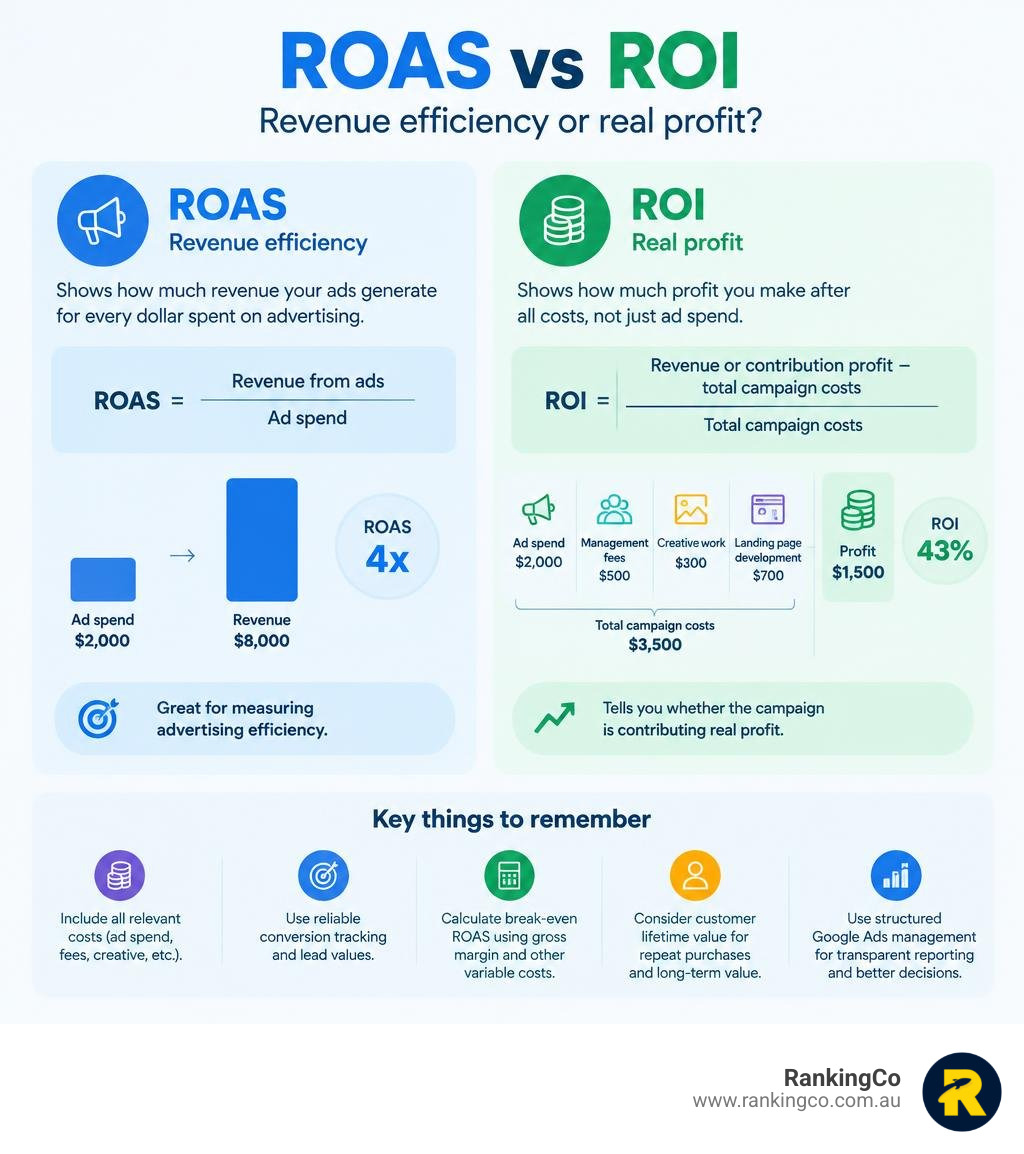
Google Ads ROI and ROAS answer different questions. ROAS shows how much revenue advertising generated relative to ad spend. ROI looks at the profit remaining after the costs included in your model, compared with the investment required to generate it.
Google Ads Help explains ROI as a way to assess profitability in relation to costs. Use the following comparison to keep ROI and ROAS separate in reporting:
| Metric | What it measures | Costs included | Best used for |
|---|---|---|---|
| ROAS | Revenue generated from ad spend | Primarily ad spend | Advertising efficiency |
| ROI | Return relative to total investment | Broader campaign and business costs selected for the model | Profitability |
What Is Google Ads ROI?
Google Ads ROI is the return generated after the relevant costs in your model are deducted from the value attributed to advertising. It is most useful when the business needs to assess profitability, rather than revenue alone.
What Is Google Ads ROAS?
ROAS divides attributable revenue by advertising spend. It is useful for comparing campaign efficiency, but it does not automatically account for margins, fulfilment, management or creative costs.
Why a High ROAS Does Not Always Mean High ROI
A high ROAS does not automatically mean a profitable campaign. A sale may generate substantial revenue while leaving little contribution profit after product costs, delivery, management fees or campaign production costs. Conversely, a lower ROAS may still support a viable return where margins are stronger and the cost base is lower.
For more context on interpreting campaign data alongside commercial outcomes, see our guide to turning Google Ads data into useful business insight.
Keep ROAS and ROI in the same report, but use them for their intended purpose: ROAS for advertising efficiency and ROI for a broader profitability assessment.
How to Calculate Google Ads ROI
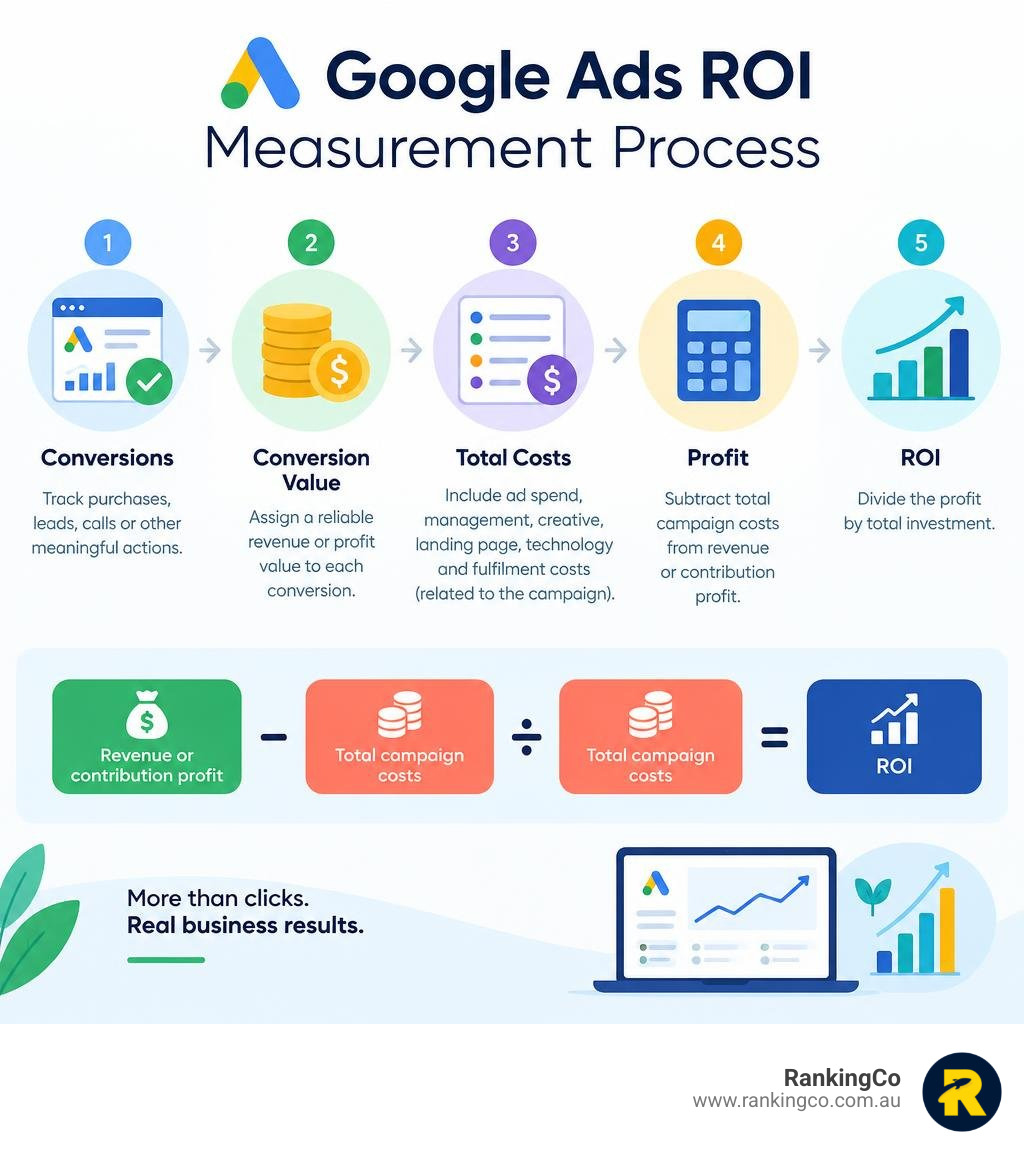
Accurate Google Ads ROI starts with a measurement process that links advertising activity to real business value. Track the conversions that matter, assign a defensible value to each one, include the relevant costs and review the calculation against actual sales and financial data.
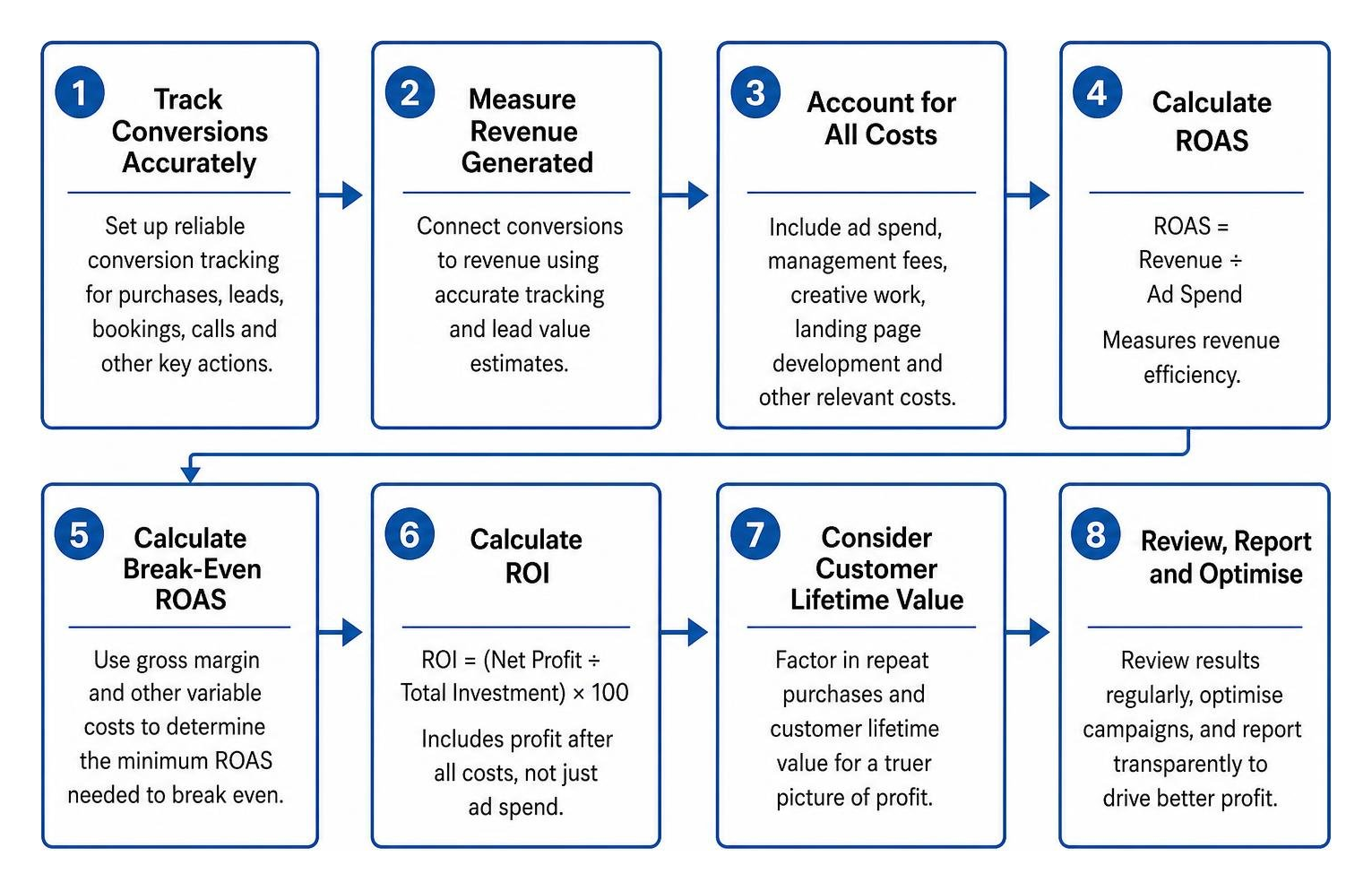
Use the following framework to make the calculation more reliable:
Set Up Conversion Tracking
Measurement starts with data quality. Track purchases, enquiry forms, bookings and meaningful phone calls, then separate primary conversions from secondary engagement signals. Check for duplicate conversion recording, distinguish qualified from unqualified leads and reconcile purchase values, refunds and cancellations. A Google Ads Checkup can help identify tracking gaps before they affect ROI reporting.
For lead generation, Google Ads data becomes more useful when CRM or offline conversion data shows which enquiries became customers. Attribution will not be perfect, but consistent definitions and regular reconciliation help create a more credible ROI view. Our overview of conversion tracking explains the foundations in more detail.
Google Ads may record a conversion before a sale is completed, particularly when an enquiry begins a longer decision process. For lead generation, use CRM or offline conversion data to connect enquiries with customers. Customers may also interact with other marketing channels before converting, so reconcile platform-reported revenue and conversions with actual sales data where possible.
Assign Conversion Values
The value assigned to a conversion depends on the operating model:
| Measurement factor | eCommerce | Lead generation |
|---|---|---|
| Primary conversion | Completed purchase | Qualified form enquiry, call or booking |
| Value input | Purchase value less refunds, discounts and relevant costs | Expected customer profit based on qualified lead and sales data |
| Costs to review | Cost of goods sold, shipping, fulfilment and product margin | Sales time, consultation time, proposal work and relevant delivery costs |
| Data source | Store and payment data | CRM and offline conversion data |
| Timing | Often immediate | May extend across a longer sales cycle |
For service businesses, lead value depends on the definition of a qualified lead, the lead-to-sale conversion rate, the average customer value and the profit associated with the work. As a hypothetical illustration, if a completed project produces $5,000 in gross profit and one in five qualified enquiries becomes a client, the estimated contribution value per qualified lead is $1,000 . Treat that estimate as a starting point and update it as CRM data improves.
Include Relevant Costs
Define the cost base before calculating ROI. Advertising costs may include Google Ads spend. Campaign costs may also include management fees, creative production, landing pages, call tracking and other technology. A broader business model may additionally include fulfilment or sales costs that form part of your cost base.
Use the same cost definition whenever you compare campaigns. Conversion rate optimisation (CRO) activity, for example, should only be included where it is part of the investment model being evaluated.
A documented cost model makes results easier to interpret and explain. It also prevents a campaign from appearing stronger or weaker simply because the inputs changed between reporting periods.
Calculate Your ROI

Once conversion value and costs are defined, calculate the return using the same model. A complete example is useful because it keeps revenue, profit and investment separate.
As a hypothetical illustration, a business attributes $20,000 in revenue to Google Ads. After the relevant product or service costs, management fees, creative costs and ad spend are accounted for, $5,000 remains as profit. If the defined advertising and campaign investment is $10,000 , the ROI is 50% . The calculation is: $5,000 profit ÷ $10,000 investment × 100 = 50% . Google Ads' ROI guidance provides further context on using costs and profit to assess return.
For lead-generation campaigns, start with the number of qualified enquiries rather than every platform-recorded action. Apply a documented expected profit value to those qualified enquiries, total that estimated value, and subtract the advertising and campaign costs included in the model. Reconcile the estimate with CRM outcomes and completed sales so the ROI calculation reflects commercial results rather than lead volume alone.
The result is only as useful as the conversion values and costs behind it. Review the inputs whenever pricing, margins, fulfilment costs or sales processes change.
Cost per acquisition (CPA) and conversion rate can help diagnose why ROI changes. Click-through rate (CTR) may provide supporting context on ad engagement, but it is not a profitability measure. Keep these diagnostics secondary to the core ROI inputs: attributable value, relevant costs and resulting profit.
How to Use Break-Even ROAS
Contribution margin is the revenue remaining after the variable costs included in the calculation are deducted. A simple break-even ROAS formula is: Break-even ROAS = 1 ÷ contribution margin expressed as a decimal .
This is an advertising threshold, not necessarily the same as fully loaded business ROI. Management fees, creative production and other costs may sit outside a simple contribution-margin calculation. A campaign can therefore meet a break-even ROAS threshold while producing a different overall ROI once broader costs are included.
For perspective on setting context-specific targets, see our guide to Google Ads ROI benchmarks in Australia.
Practical Next Steps for Measuring Google Ads ROI
Use this concise process to connect Google Ads activity with business outcomes:
- Check conversion tracking: Confirm that purchases, forms, calls and bookings are recorded without duplicate counts.
- Confirm meaningful conversions: Separate qualified leads and completed sales from secondary engagement actions.
- Validate conversion values: Review purchase data, refunds, lead values, close rates and profit assumptions.
- Calculate relevant costs: Document the ad spend, campaign costs and any broader costs included in the model.
- Calculate ROI and ROAS: Use each metric for its intended purpose.
- Set break-even and target thresholds: Base them on the contribution margin and costs included in the calculation.
- Review against actual business results: Reconcile platform data with sales, finance and CRM information regularly.
Ready to Make Your Google Ads Reporting More Useful?
Google Ads reporting should help you understand what advertising is contributing to the business, not simply how many clicks or conversions the platform recorded. We can help you review tracking, conversion values and reporting against the commercial outcomes that matter.
Frequently Asked Questions About Google Ads ROI
What is the difference between Google Ads ROI and ROAS?
ROAS measures revenue relative to ad spend, while ROI measures profit relative to the investment included in your calculation. ROAS is useful for advertising efficiency, whereas ROI gives a broader view of profitability after the relevant costs are considered.
How do you calculate Google Ads ROI for lead generation?
Calculate lead-generation ROI by estimating the value of qualified leads from sales and profit data, then deducting the costs included in your model. CRM or offline conversion data helps show which enquiries became customers, making the estimate more reliable over time.
What costs should be included when calculating Google Ads ROI?
Include the costs that match the purpose of your ROI model. These may include Google Ads spend, management fees, creative, landing pages, tracking technology, fulfilment and sales costs. Document the definition so comparisons remain consistent.
How do you calculate break-even ROAS?
Divide one by the contribution margin expressed as a decimal to calculate a simple break-even ROAS threshold. This threshold shows the advertising efficiency needed to cover the variable costs represented in the margin, not necessarily every broader campaign or business expense.
Can Google Ads have a positive ROAS but negative ROI?
Yes. A campaign can generate more revenue than its ad spend and still have a weak or negative ROI if margins are low or other relevant costs consume the return. Review product or service costs, fulfilment, management and creative costs alongside ROAS.
Should customer lifetime value be included in Google Ads ROI?
Customer lifetime value can be included when repeat purchases or ongoing service revenue are supported by reliable historical data. Use a conservative, documented assumption and separate immediate return from longer-term value where that distinction matters.






Share online