A Quick Start Guide to Combining Google Ads and SEO for Doctors
How Can Doctors Combine Google Ads, SEO and AI Search to Attract More Patients?

Patients rarely follow one neat, linear search journey before choosing a doctor. A person may first notice a Google Ads result, compare providers in organic search, check Google Maps, ask an AI search tool a follow-up question, read practice information, then return to Google before booking. For medical practices, visibility is no longer only about appearing in one result. It is about being clear, credible and easy to evaluate across paid search, organic results, local listings and AI-assisted answers.
Google Ads and Search Engine Optimisation (SEO) serve different purposes, but they become stronger when they inform the same search strategy. Pay-Per-Click (PPC) campaigns can show which services, locations and appointment-focused searches are already attracting enquiry intent. SEO can use those insights to strengthen service pages, useful medical content, local search visibility and structured information that supports long-term trust. Answer Engine Optimisation (AEO) should sit inside that broader strategy. It is not a shortcut or a separate AI gimmick. It is a practical content and information-structuring approach that helps make a practice's expertise, services, locations, practitioner information and patient pathways clearer for search engines, patients and AI-assisted search experiences.
The practical question is how these channels inform each other. Paid search can reveal useful samples of demand quickly, within the limits of campaign targeting, match types, budget and search volume. Organic search can build authority over time. Local search can help patients connect a provider with a real location. AI-assisted search can change how people compare options and ask follow-up questions. When those signals are reviewed together, a practice can make better decisions about which services need clearer pages, which patient questions deserve detailed answers and which enquiry pathways need improvement.
This guide uses a Google Ads for doctors SEO outline to answer three connected questions:
- How can Google Ads data reveal useful examples of what patients search for and help shape SEO and AEO?
- How should medical practices structure content and authority signals for Google, local search and AI-generated answers?
- How do you turn visibility across search and AI platforms into measurable patient enquiries and bookings?
The aim is to help doctors think beyond isolated rankings or ad clicks. A stronger strategy connects observed search behaviour with authoritative content, local trust signals, relevant landing pages and practical measurement, so visibility has a clearer path to patient enquiries.

How Can Google Ads Data Improve SEO and AEO for Medical Practices?
Search data becomes useful when it is interpreted as evidence of patient intent, not simply as a list of keywords. The better question is not, "What keyword should the practice rank for?" A more useful question is, "What is the patient trying to accomplish with this search?" That distinction matters because two people can use similar words while needing very different answers, pages or booking pathways.
For medical practices, search intent usually falls into practical categories:
- Transactional intent: The patient is ready to book, call or contact a doctor, such as searches for a specialist, clinic or appointment in a specific area.
- Commercial investigation: The patient is comparing providers, treatments, costs, risks, suitability or available options before deciding what to do next.
- Informational intent: The patient wants explanations about symptoms, conditions, treatment steps, recovery expectations or preparation advice.
- Local intent: The patient is looking for care in a particular suburb, city or "near me" location, often alongside Google Maps results and local business profiles.
- Conversational or question-based intent: The patient asks a detailed question, comparison or follow-up prompt that may be answered directly by an AI search tool, search overview or featured response.
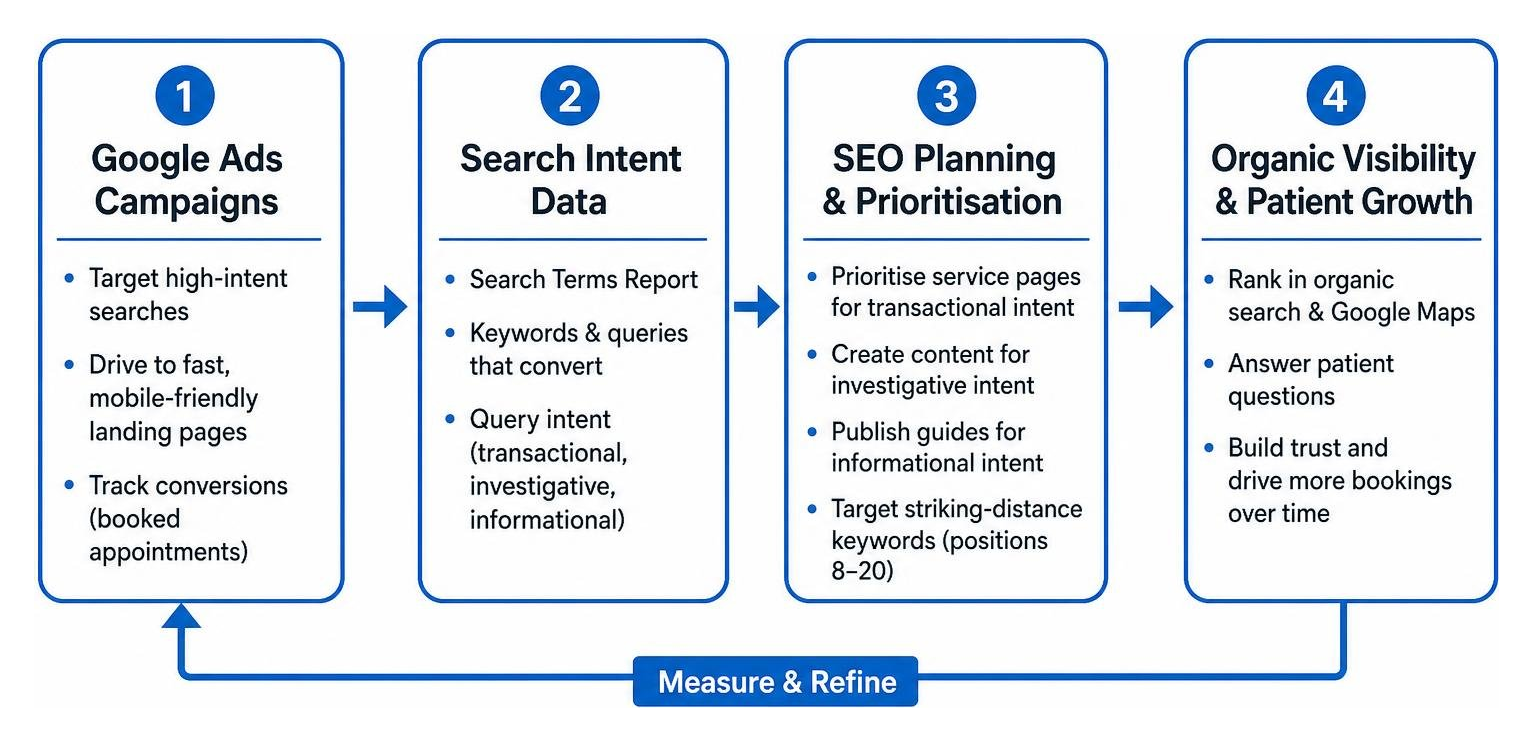
Through our Google Ads lead generation frameworks, search-term data is reviewed as part of a full decision path: search query, intent, ad interaction, landing page visit, enquiry and booked patient. That sequence matters because a high-volume keyword is not automatically a high-value opportunity. Conversion data can show which searches lead to qualified enquiries, which terms create irrelevant traffic and which patient questions deserve more detailed organic content.
Google Ads search-term data can provide a useful sample of the language and intent appearing in paid search, which can then inform SEO and AEO planning. It should still be interpreted in context because the data can be affected by campaign targeting, keyword match types, budget, ad copy, location settings and available search volume. Used carefully, it can help identify recurring patient language, high-intent queries, service-specific demand, questions worth answering organically, irrelevant searches to exclude and terminology patients use that may differ from clinical terminology. For example, a patient might search for "cloudy vision surgery" while a clinic describes the service as cataract surgery. Good content needs to bridge that gap without sacrificing clinical accuracy.
AEO adds another consideration because AI-assisted and conversational search often involves detailed questions, comparisons and follow-up prompts. The same paid and organic search patterns can help identify which questions need clear, structured answers. A cataract clinic, for example, might see searches such as:
- "What is cataract surgery?"
- "How long does cataract surgery take?"
- "Is cataract surgery painful?"
- "How much does cataract surgery cost?"
- "Who is the best cataract surgeon near me?"
Each question reflects a different level of intent. A definition-style question may suit an educational condition guide. A recovery or discomfort question may need a clinically reviewed Frequently Asked Question. A cost question should use careful, compliant language about the factors that influence fees. A "near me" query needs strong local landing pages, Google Business Profile signals and clear practitioner information. Mapping each question to the right content type helps doctors support both traditional search visibility and AI-assisted discovery without assuming there is a guaranteed formula for appearing in AI-generated answers.
Effective search strategies should not treat Google Ads, SEO and AEO as isolated channels. Paid search can reveal demand. SEO can build durable visibility. AEO can make expertise easier to access in conversational search. Conversion data shows whether that visibility is contributing to real enquiries and booked patients.
Practically, this shared structure should be reviewed on a regular campaign cycle. If a Google Ads search term repeatedly produces booked consultations, it can inform the SEO roadmap as a service-page section, Frequently Asked Question or dedicated condition guide. If an organic page starts ranking for a high-value treatment query but produces weak enquiries, the page may need clearer booking prompts, revised clinical copy or stronger local trust signals.
| Strategy Component | Pay-Per-Click (PPC) Google Ads | Search Engine Optimisation (SEO) | Answer Engine Optimisation (AEO) |
|---|---|---|---|
| Primary Objective | Immediate patient enquiries for high-intent queries | Long-term organic visibility and clinical trust | Clear answers for conversational and AI-assisted discovery |
| Intent Focus | Transactional, local and urgent treatment terms | Informational, investigative and service-page queries | Question-based, comparison and explanation-led searches |
| Data Contribution | Reveals high-converting search terms rapidly | Builds topical authority and supports local relevance | Structures expertise so answers are easier to interpret and use |
| Best-Fit Content | Service-specific conversion landing pages | Comprehensive service pages, condition guides and FAQs | Clear answers, structured information, practitioner information and relevant structured data where supported |
How Should Doctors Optimise Their Content for Google Search and AI Answers?
Answer Engine Optimisation (AEO) means shaping website information so it can answer specific patient questions clearly, accurately and in context. Search Engine Optimisation (SEO) helps pages become discoverable and competitive in search results. AEO is best treated as a practical way to structure useful information for answer-based and conversational search experiences, rather than as a separate ranking formula.
For healthcare providers, that does not mean chasing a shortcut or assuming one technical feature will make an AI system surface a page. Different AI search systems use different retrieval, ranking and generation processes. Medical content can still benefit from clear entities, topical relationships, trustworthy sources and clearly expressed information because these elements make the practice, service and clinical context easier for people and search systems to interpret.
A strong healthcare content ecosystem should clearly communicate:
- who the practitioner is
- qualifications and professional expertise
- areas of specialisation
- services and procedures offered
- locations served
- conditions treated
- who a treatment may or may not be suitable for
- what patients can expect before, during and after care
- risks, limitations and alternatives
- costs or pricing information where appropriate
- appointment and referral information
- credible supporting sources
This connects with Experience, Expertise, Authoritativeness and Trustworthiness (E-E-A-T), principles reflected in Google's Search Quality Rater Guidelines for assessing the quality and credibility of content, particularly for topics that can affect people's health. In practical terms, a page should not only describe a treatment. It should make the practice's clinical context, practitioner credentials, review process and patient pathway easy to understand.

This structure works because it gives patients the immediate answer they came for, then supports that answer with enough detail to make an informed enquiry. It also helps search systems understand the relationship between the question, the service, the practitioner, the location and the next action a patient can take.
Topical authority is equally important. One isolated blog post about a treatment is unlikely to demonstrate comprehensive expertise on its own. A stronger approach is to build a connected topic cluster around a clinical area, such as:
- core service page
- treatment guide
- condition information
- eligibility questions
- preparation questions
- recovery questions
- risks and limitations
- cost questions
- comparison questions
- Frequently Asked Questions
This demonstrates depth rather than volume. For example, a specialist clinic might have one core cataract surgery service page supported by preparation guidance, recovery expectations, cost considerations, suitability information, local appointment pages and clinically reviewed Frequently Asked Questions. Each page should serve a clear patient need while reinforcing the practice's overall expertise.
Local search also belongs in the AEO discussion. A medical practice needs consistent information across its website, Google Business Profile and other reputable local references. Important details include the practice name, location, services, practitioner information, opening information, contact details, reviews, reputation signals, relevant local directories, professional profiles and reputable third-party references. Consistency helps patients evaluate the practice and helps search engines understand the business and its location.
At RankingCo, we assess healthcare search strategy by looking at the relationship between search behaviour, content gaps, service intent, authority, local visibility and conversion opportunities. The goal is not simply to produce more content or sell "AI SEO" as a standalone product. The goal is to make the practice easier to discover, easier to understand and easier to contact across Google Search, Google Maps and AI-assisted search experiences.
How Do You Turn Search and AI Visibility Into More Patient Enquiries?
Visibility is valuable only when it supports patient acquisition. A medical practice may gain impressions, rankings and clicks, but those signals do not automatically mean more booked appointments. The commercial question is whether search activity is producing calls, form submissions, qualified enquiries, bookings and actual patients. For that reason, a Search Engine Optimisation (SEO) or Answer Engine Optimisation (AEO) strategy should not be judged purely by ranking movement or traffic volume.
The journey from answer to action should be deliberately designed. A patient may begin with an AI-assisted or traditional search question, read informative content, move to a relevant service page, review practitioner trust signals, then use a clear call to action to enquire or book. This matters because an AI-generated answer may satisfy part of the patient's initial informational need before they ever visit a website. The practice website then needs to offer the next logical step once the patient is ready to compare, contact or book.
Landing-page relevance is central to that journey. A patient searching for "orthopaedic specialist Brisbane" should not simply arrive on a generic homepage and be expected to work out the next step alone. The destination page should make the relevant service, practitioner expertise, location, trust signals and booking pathway immediately clear. A strong landing page connects the intent behind the search with useful content, local relevance, clear clinical context and straightforward enquiry options.
This is where Conversion rate optimisation (CRO) becomes part of the search strategy rather than a separate afterthought. CRO means improving the page experience and enquiry pathway so more suitable visitors can take the next step. Clear click-to-call buttons, concise appointment pathways, visible contact options, useful service information and responsive intake processes can all help turn interest into enquiry. When a patient submits a form or calls the clinic, the practice also needs a reliable process for responding quickly and tracking the outcome.
Measurement should assess the full search journey. Useful indicators can include cost per qualified enquiry, conversion rate, booked appointments, phone enquiries, organic conversions, paid conversions, landing-page performance, local visibility, high-value search terms and content engagement. AI visibility should be evaluated carefully as one part of this broader discovery journey, rather than treated as a channel where every conversion can always be directly attributed.
A practical strategic model brings the major parts together:
| Pillar | Role in patient acquisition |
|---|---|
| Google Ads | Learn what converts by testing high-intent searches, service demand and enquiry pathways quickly. |
| Search Engine Optimisation (SEO) | Build durable search visibility through service pages, helpful content, local relevance and authority signals. |
| Answer Engine Optimisation (AEO) | Make practice expertise clearer and easier to use in answer-based and AI-assisted search experiences. |
| Conversion rate optimisation (CRO) and measurement | Turn visibility into patient acquisition by improving landing pages, enquiry pathways, tracking and follow-up. |
Medical search is no longer just about getting a practice onto Google's first page. Doctors now need a connected strategy that uses real search and conversion data to understand patient intent, builds authoritative answer-focused content for search, local results and emerging AI experiences, and connects visibility to relevant landing pages, enquiries, bookings and measurable commercial outcomes.
RankingCo brings these disciplines together through paid search insight, Search Engine Optimisation (SEO), local visibility, Answer Engine Optimisation (AEO), Conversion rate optimisation (CRO) and performance measurement.
- Explore RankingCo's SEO services to see how an integrated organic search strategy can build long-term visibility.
- Explore Google Ads lead generation to understand how paid search can capture high-intent patient demand.
- Contact RankingCo to discuss a search strategy that brings SEO, paid search, local visibility and AI search considerations together.
Frequently Asked Questions About Combining Google Ads, SEO and AEO for Doctors

What is AEO for medical practices?
Answer Engine Optimisation (AEO) for medical practices means structuring website information so it can clearly answer patient questions in search and AI-assisted experiences. It complements Search Engine Optimisation (SEO) by helping useful clinical, service, practitioner and location information become easier to understand and evaluate. For doctors, AEO should support accurate patient education rather than replace strong service pages, local visibility or compliant healthcare content.
How is AEO different from SEO?
Search Engine Optimisation (SEO) focuses on helping pages become discoverable and competitive in traditional search results, while Answer Engine Optimisation (AEO) focuses on making information suitable for answer-based and conversational search experiences. SEO often considers rankings, technical performance, relevance, links, content quality and local search signals. AEO places extra emphasis on direct answers, clear structure, trusted context, entity clarity and question-led information that can help patients understand the next step.
Can Google Ads data help with AEO?
Yes, Google Ads data can help with AEO by revealing a useful sample of the language, questions and intent patients use before they enquire. Search query patterns can show whether people are looking for a doctor, comparing treatment options, checking costs, asking about recovery or searching by location. Those insights can then inform service pages, Frequently Asked Questions, condition guides and answer-focused content that reflects observed patient demand, while still being checked against broader SEO research and clinical priorities.
What type of medical content performs well in AI search?
Medical content is better suited to AI-assisted discovery when it provides clear answers, comprehensive topic coverage, practitioner expertise, trustworthy sources and structured information. A strong page should explain the condition or service, who the care may suit, what patients can expect, relevant risks or limitations, location context and the appropriate next step. This does not guarantee AI visibility, but it gives both patients and search systems clearer information to interpret.
Does ranking on Google mean a medical practice will appear in AI search?
No, ranking on Google does not guarantee that a medical practice will appear in AI search results, citations or summaries. Traditional rankings and AI visibility can both be influenced by authority, relevance, trust signals and content clarity, but they are not the same outcome. A practice may perform well in organic search while still needing stronger entity clarity, answer-focused content, local consistency or source credibility to support AI-assisted discovery.
How should doctors measure whether SEO and AEO are working?
Doctors should measure SEO and AEO by looking at qualified enquiries, bookings, relevant organic visibility, useful search demand and traffic quality rather than rankings alone. Helpful indicators can include calls, form submissions, booked appointments, landing-page engagement, local visibility, high-intent search terms and the quality of patient enquiries. AI visibility should be reviewed as part of the broader discovery journey, not treated as a channel where every conversion can always be directly attributed.
Should a medical practice invest in Google Ads, SEO or AEO?
A medical practice should choose Google Ads, SEO and AEO based on its goals, competition, services and patient acquisition needs. Google Ads can help test demand and generate timely enquiries, Search Engine Optimisation (SEO) can build durable visibility, and Answer Engine Optimisation (AEO) can make expertise clearer for conversational search experiences. In many cases, an integrated approach is more effective because paid search data, organic content, local visibility and conversion measurement can inform each other.




Share online