How Long Does Google Ads Take to Become Profitable?

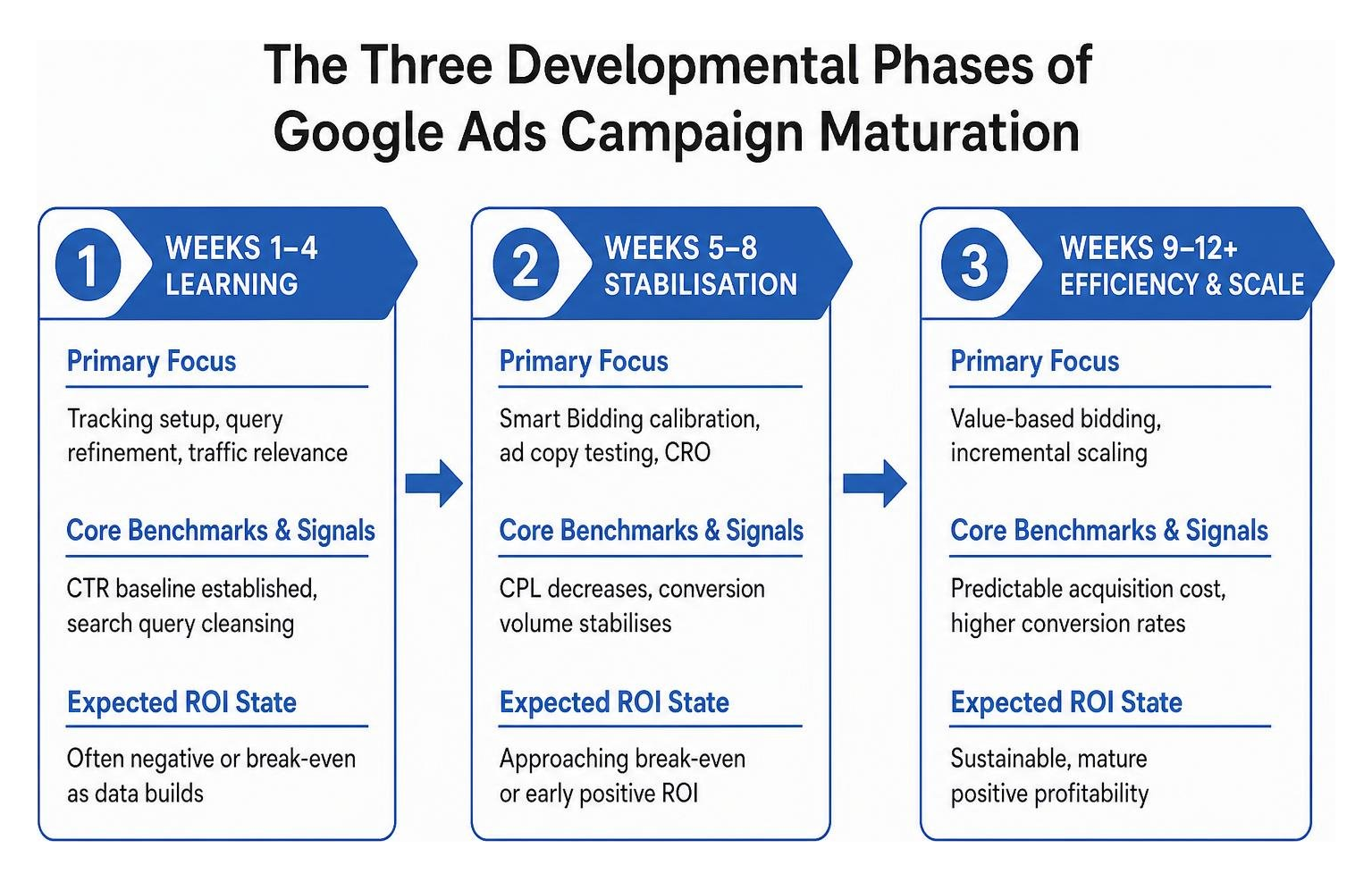
At RankingCo, we assess Google Ads profitability by campaign stage, not a countdown. Where your campaign is now matters more than how long it has been running.
Clicks and early conversions are not the same as consistent profit. Cost Per Click (CPC), conversion rate, customer value, gross margin, search intent, landing-page experience and Pay-Per-Click (PPC) optimisation shape the outcome. Start by identifying your campaign stage, then focus on the commercial constraint in front of you.
Key Takeaways
- Campaign stage and business economics matter more than account age.
- Cost Per Acquisition (CPA), conversion rate, customer value and gross margin matter more than clicks alone.
- Accurate conversion tracking is essential, particularly for lead-generation campaigns.
- Judge performance on qualified leads, customers and revenue, not form submissions, Return on Ad Spend (ROAS) or Return on investment (ROI) alone.
Not Sure What’s Holding Your Google Ads Back? Start Here.
| If you are seeing this | What it usually points to | Check this next |
|---|---|---|
| Not enough relevant traffic | Targeting, keywords or limited search demand | Search terms, keyword targeting, negative keywords and whether the searches are commercially relevant |
| Traffic but few conversions | A gap between search intent, the ad and the landing page | Offer clarity, ad-to-page alignment, page friction and conversion rate optimisation (CRO) |
| Leads but poor customers | Lead quality or the sales process is the real constraint | Qualification criteria, follow-up speed, Customer Relationship Management (CRM) data and lead-to-customer rate |
| Sales but weak profit | Customer economics do not support the acquisition cost | Cost Per Acquisition (CPA), gross margin, fulfilment costs, pricing and customer value |
| Unclear performance | Tracking is not showing the commercial outcome | Conversion actions, offline conversion tracking and the path from lead to revenue |
Use this as a quick diagnosis. Once you can see the constraint, the next step becomes clearer.
How Long Does Google Ads Take to Be Profitable? Start With Your Campaign Stage
Find the description that best matches your campaign before changing budgets or chasing another metric. Each stage points to a different problem and next step.
Just Launched
Start with technical validation, not a profitability verdict. Check that ads appear for relevant searches, conversion tracking records meaningful actions and landing pages match the offer. Review search terms early and exclude obvious waste.
Click-through rate (CTR), search relevance and initial conversion actions are useful signals. Confirm the foundations before drawing commercial conclusions from limited activity.
Getting Clicks but No Conversions
Traffic without action usually means there is a gap between search intent, the ad promise and the landing-page experience. Fix relevance before expanding the campaign.
Check the search terms bringing visitors in, whether the offer is clear and whether the page makes the next step easy. Purpose-built landing pages can better match the page to the search that brought the person there.
Getting Leads or Sales but Not Profitably
This is where businesses get caught out. A strong-looking ROAS, low Cost Per Lead (CPL) or plenty of form submissions does not automatically mean the campaign is making money.
More leads sound good. More leads are not always good. We would rather see qualified leads at a sustainable acquisition cost than cheap enquiries that never reach sales. Compare CPA with the gross profit each customer produces, then check whether leads become customers.
Already Profitable and Trying to Scale
Scale only when relevant search demand and marginal CPA support it. More budget can increase exposure and data, but it does not guarantee more profitable demand.
Substantial changes to budgets, bidding, targeting or structure can affect performance and may trigger a learning period. Make considered changes and measure the commercial result.
Use the Five Profitability Checks That Match Your Stage
Once you know where the campaign is, work through these checks to isolate the actual constraint.
Are You Attracting People Who Actually Want to Buy?
High CPC is not automatically a problem if the click comes from someone ready to buy. The real issue is paying for broad or irrelevant searches with little commercial intent. Relevant demand, tightly managed keywords and negative keywords help attract people more likely to act.
Google Ads captures active search demand, while Meta Ads can help businesses reach audiences earlier in their decision-making. Either way, the campaign needs a clear offer and meaningful conversion measurement.
Check:
- Are your search terms commercially relevant to the service or product you sell?
- Have you excluded irrelevant queries with negative keywords?
- Are the people clicking likely to have the intent, budget and need to buy?
Is Your Acquisition Cost Sustainable for Your Margins?
A viable CPA depends on customer value and the profit left after delivery costs. A high-value customer with a healthy margin can support a higher acquisition cost than a low-margin transaction. eCommerce businesses may see purchase data quickly, while Business-to-Business (B2B) and high-ticket services often need to follow leads through quotes, sales conversations and closed revenue.
Check:
- What is your current Cost Per Acquisition (CPA), and what is the highest CPA your margin can support?
- Does your average customer value justify the cost of acquiring that customer?
- Are you assessing gross profit after delivery costs, not revenue alone?
Does the Landing Page Turn Relevant Traffic Into Action?
A good ad cannot rescue a weak page. Clear offers, relevant messages, proof and straightforward next steps help turn qualified traffic into enquiries or purchases. Conversion rate optimisation (CRO) improves that journey.
CRO works alongside Search Engine Optimisation (SEO): SEO builds organic visibility, while Google Ads helps test paid-search demand and offers. Improve a page that is not converting before scaling spend.
Check:
- Does the landing page clearly match the promise and intent behind the ad?
- Is the offer easy to understand and the next step straightforward?
- Are relevant visitors dropping out before they enquire or purchase?
Are You Measuring Customers and Revenue, Not Just Leads?
Track purchases, qualified enquiries and booked consultations rather than every button click. For lead-generation businesses, connecting Customer Relationship Management (CRM) data to Google Ads can reveal the path from click to revenue.
This is one of the first things we look at in an account: are we generating conversions, or conversions that turn into revenue?
Lead → qualified lead → sales opportunity → customer → revenue
Check:
- Are you tracking purchases, qualified enquiries or booked consultations rather than low-value actions?
- Can you see which leads become sales opportunities, customers and revenue?
- Does your CRM data show whether the campaign is attracting the right prospects?
Are Optimisation Decisions Based on Useful Data?
Review search terms, ads, landing pages, bids and conversion actions regularly. Stronger ad relevance and landing-page experience can improve Ad Rank and may contribute to more efficient CPCs, although competition and auction conditions still matter.
Check:
- Which search terms, ads, landing pages or conversion actions are underperforming?
- Are you making considered changes based on meaningful data rather than reacting to one bad day?
- Have substantial changes to budgets, bidding, targeting or structure been measured against qualified leads, sales and margin?
How Do You Know If Google Ads Is Profitable?
The blunt answer is simple: a campaign is profitable when the cost of acquiring a customer is lower than the gross profit that customer produces after relevant costs.
A lot of businesses see a strong ROAS or cheap CPL and assume the campaign is making money. Not necessarily. ROAS compares revenue with ad spend, but it does not include product costs, fulfilment, refunds, discounts, fees or overheads. ROAS can look great while the business is still losing money.
Maximum profitable CPA = average customer revenue × gross profit margin × lead-to-customer conversion rate
Work out gross profit from an average customer, then multiply it by the proportion of leads that become customers. The result is the maximum CPA the business can support before acquisition costs exceed gross profit. It is a planning calculation, not a guarantee.
Google’s Smart Bidding guidance explains why meaningful conversion signals matter for automated bidding. Low-quality or poorly tracked conversions can push optimisation in the wrong direction.
Use the Diagnosis to Decide What to Do Next
| If you are seeing this | Check this next |
|---|---|
| Not enough relevant traffic | Targeting, keywords, negative keywords and search demand |
| Traffic but few conversions | Offer, ad-to-page alignment and landing-page CRO |
| Leads but poor customers | Lead qualification, sales follow-up and CRM data |
| Sales but weak profit | Margin, pricing, fulfilment costs and viable CPA |
| Unclear performance | Conversion tracking and offline revenue measurement |
Match the next step to the campaign stage you are actually in.
If you cannot tell whether your budget can support a viable CPA, speak with our team or view our services for help assessing campaign tracking, customer economics and PPC priorities.
Common Mistakes That Delay Google Ads Profitability
The biggest mistakes are not always obvious in the ad account. Businesses often change too many settings at once, judge results from a handful of leads, or optimise toward a conversion action that has little connection to revenue.
Avoid treating a low CPL as a win before checking lead quality, raising budgets before search terms are under control, or copying a bidding approach without considering your sales cycle and margins. If the numbers do not work after structured testing, waiting longer is not a strategy. Change the constraint that is holding the campaign back.
How to Improve Google Ads Profitability
Target higher-intent searches, remove wasted spend from irrelevant queries, improve ad relevance, align landing pages with search intent and track actions that reflect genuine business value.
For service businesses, a well-built lead-generation site can turn paid traffic into enquiries that progress. For retailers, an effective eCommerce website is just as important as campaign structure.
Change one meaningful variable where possible, measure the result and connect it back to qualified leads, sales and margin. If the numbers do not work, they do not work.
What Should You Do Next?
Use your campaign stage as the starting point. Just launched? Validate tracking and relevance. Getting traffic but no action? Review search intent and the landing page. Getting leads but not profit? Check lead quality, sales follow-up, margins and CPA. Already profitable? Scale only when the next dollar of spend still makes commercial sense.
Profitability comes from acquiring customers at a commercially sustainable cost and proving it with reliable data.
Match the Problem to the Right RankingCo Service
The diagnosis should lead to a practical next move, not another generic checklist.
- Your paid-search performance needs work: Google Ads management can help improve targeting, bids, conversion tracking and acquisition costs.
- You need more qualified traffic: Search Engine Optimisation (SEO) services can build longer-term visibility for the searches that matter to your business.
- Traffic arrives but enquiries are weak: Review your landing pages to improve message match, clarity and the path to enquiry.
- Your lead flow needs a stronger foundation: A purpose-built lead-generation website can help turn paid traffic into enquiries your sales team can work with.
- eCommerce sales are the weak point: An eCommerce website can be as important as campaign structure when customers are not completing purchases.
If you still cannot see the constraint, contact the RankingCo team. We can assess the full commercial picture, from search demand and conversion tracking to lead quality, sales process and profitable acquisition cost.
Frequently Asked Questions About Google Ads Profitability Timelines
How long does Google Ads take to start working?
Ads can begin showing and generating traffic soon after launch. The useful question is whether that traffic is relevant, converts and leads to valuable business outcomes.
Can Google Ads be profitable in the first month?
It can be, particularly where demand is strong, the offer is clear and the sales cycle is short. Treat early performance as validation of targeting, tracking and page quality, not a blanket promise.
How much should I spend on Google Ads?
Budget should reflect CPC, expected conversion rate, customer value, gross margin and the data needed to make a sound decision. Throwing more money at poorly targeted traffic only makes the waste more expensive.
What is a good ROAS for Google Ads?
The required ROAS depends on gross margin and operating costs, and a strong ROAS can still leave a business unprofitable.
Why are my Google Ads getting clicks but no sales?
The traffic may not match buyer intent, the offer may be unclear, the landing page may create friction or the sales process may be losing otherwise viable leads. Check the full path, not just the ad account.
How long should I run Google Ads before deciding if it works?
Assess whether you have enough meaningful data to judge targeting, conversion quality and viable CPA. If one of those areas is clearly weak, fix it rather than letting the same problem continue.




Share online