
How to Build an Effective Full-Funnel Marketing Strategy
Full-Funnel Marketing Strategy: How to Turn Awareness into Conversions

A full-funnel marketing strategy connects the marketing activities that help people discover a business, compare their options, make an enquiry or purchase, and remain customers afterwards. Rather than treating Search Engine Optimisation (SEO), Google Ads, social media advertising, website content and follow-up communications as separate campaigns, it gives each channel a clear role in the customer journey.
Kerry Anderson, Co-Founder of RankingCo, works with Australian businesses to connect practical digital marketing activity to the way customers research and choose suppliers. A coordinated approach helps teams see how their content, paid campaigns and website experience support the next useful step for a prospective customer.
For small and medium-sized businesses, the aim is not to be active on every channel. It is to use the channels that fit the audience, budget, sales cycle and buying behaviour, then review performance regularly. Results and timelines vary with competition, targeting, budget, website experience and campaign management, so clear reporting and ongoing optimisation are essential.
Key Takeaways
- A full-funnel marketing strategy aligns messages and channels with awareness, consideration, conversion and retention needs.
- Customers may move between stages, so marketing funnel stages are a practical planning framework rather than a rigid path.
- SEO, Google Ads, Meta Ads, content, landing pages, email and remarketing can reinforce one another when each has a defined purpose.
- Useful performance indicators change by stage, from relevant visibility and engagement to qualified leads, conversion quality and repeat business.
- Regular reporting helps businesses identify gaps, improve the customer journey and make sensible budget decisions.
What Is a Full-Funnel Marketing Strategy?
A full-funnel marketing strategy is a coordinated plan for helping prospective customers move from early research to action and, where relevant, ongoing loyalty. It combines marketing activity across the customer journey so that a helpful article, an ad, a service page, an enquiry form and post-purchase communication work towards the same business goal.

Focusing only on lead generation or immediate sales can overlook people who are still learning about a problem or comparing providers. A full-funnel approach creates useful opportunities to reach those audiences earlier, answer their questions as their intent develops and make the conversion path straightforward when they are ready. Customers do not always follow a linear route, but the funnel remains a useful way to organise content, messages and measurement.
Full-Funnel Marketing Compared with Performance-Only Campaigns
| Strategic focus | Performance-only activity | Full-funnel marketing strategy |
|---|---|---|
| Primary goal | Capture immediate demand | Support discovery, evaluation, conversion and retention |
| Audience | People ready to act now | Future prospects, active evaluators and existing customers |
| Channel role | Individual campaigns work in isolation | Channels reinforce one another across the customer journey |
| Measurement | Short-term clicks and conversions | Stage-appropriate indicators alongside business outcomes |
| Long-term approach | Relies on the current pool of demand | Builds visibility, trust and a healthier pipeline over time |
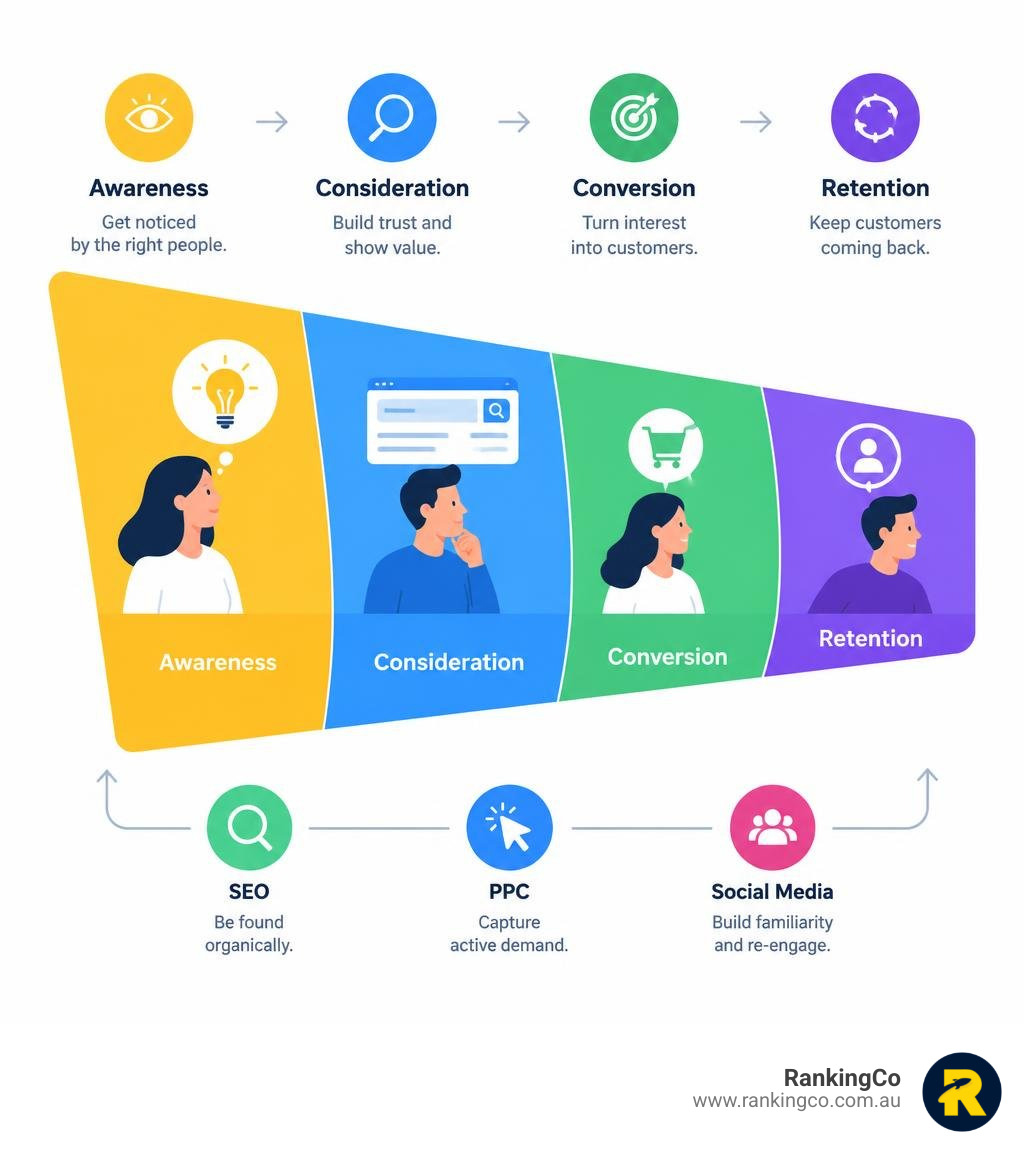
The Four Stages of a Full-Funnel Marketing Strategy
A practical full-funnel plan starts by identifying what a customer is trying to achieve at each point, then choosing the content and channels that can help. The right mix will differ by business model, budget and sales cycle.

| Funnel stage | Customer intent | Suitable channels and content | Useful performance indicators |
|---|---|---|---|
| Awareness | Understand a problem or discover options | SEO, educational content, Google Ads, Meta Ads and social media advertising | Relevant visibility, engaged visits and new audience reach |
| Consideration | Compare approaches or providers | Service pages, guides, reviews, demonstrations, email follow-up and remarketing | Content engagement, returning visits and qualified enquiries |
| Conversion | Take meaningful action | Landing pages, product or service pages, calls to action, forms and booking paths | Lead quality, conversion rate and completed enquiries or purchases |
| Retention | Continue the relationship | Helpful customer communication, email, support content and relevant remarketing | Repeat purchases, retained customers and referral activity |
Awareness: Help Potential Customers Discover Your Business
Top-of-funnel marketing helps a business become visible when people are researching a need rather than actively seeking a specific supplier. Educational content, relevant social media advertising and carefully targeted campaigns can introduce a useful point of view without forcing an immediate sales message. Strong SEO services can also help a website appear for questions that prospective customers ask during their early research.
The goal is relevance. A local service business may focus on common problems and location-based searches, while an eCommerce business may use product education, category pages and audience-led advertising. The message should match the question being asked and guide the reader to a useful next step.
Consideration: Build Trust and Help Customers Evaluate Their Options
Middle-of-funnel marketing helps people judge whether a solution is right for them. This can include detailed service pages, practical comparisons, case-study-style explanations that do not reveal client information, demonstrations, reviews and follow-up content that addresses common concerns.
At this stage, consistency matters. The promise made in an ad or search result should be supported by the page a visitor reaches. Google Ads management, social media advertising and useful website content can work together when their targeting, offer and message are aligned.
Conversion: Turn Interest into Meaningful Action
Bottom-of-funnel marketing is where a prospective customer decides whether to enquire, book, request a quote or make a purchase. The conversion path should be clear and proportionate to the decision. A simple contact form may suit an initial enquiry, while a higher-consideration service may need a consultation request, clear service information and reassurance about what happens next.
Conversion rate optimisation (CRO) focuses on removing avoidable friction from that path. Clear calls to action, fast and mobile-friendly pages, helpful proof points and focused conversion landing pages can support stronger decision-making without making unrealistic promises.
Retention: Encourage Repeat Business and Long-Term Relationships
Retention activity supports customers after their first conversion. Depending on the business, this may involve onboarding emails, practical support content, relevant product reminders, customer service follow-up or remarketing that reflects a genuine need. Retention should add value, not simply repeat a sales message.
For many businesses, better customer communication also produces useful insight. Questions from existing customers can reveal where website content, service explanations or follow-up processes need improvement.
How to Build and Measure an Effective Full-Funnel Marketing Strategy
Map the Customer Journey and Identify Gaps
Start by listing the questions customers ask before choosing a provider, the actions they take on the website and the points where they commonly pause or leave. Review whether each important question has a useful answer, whether each campaign leads to a relevant page and whether the next action is easy to understand. Gaps often appear where early-stage content has no clear route to a service page, or where high-intent visitors reach a generic page instead of a focused offer.
Match Channels and Content to Each Stage
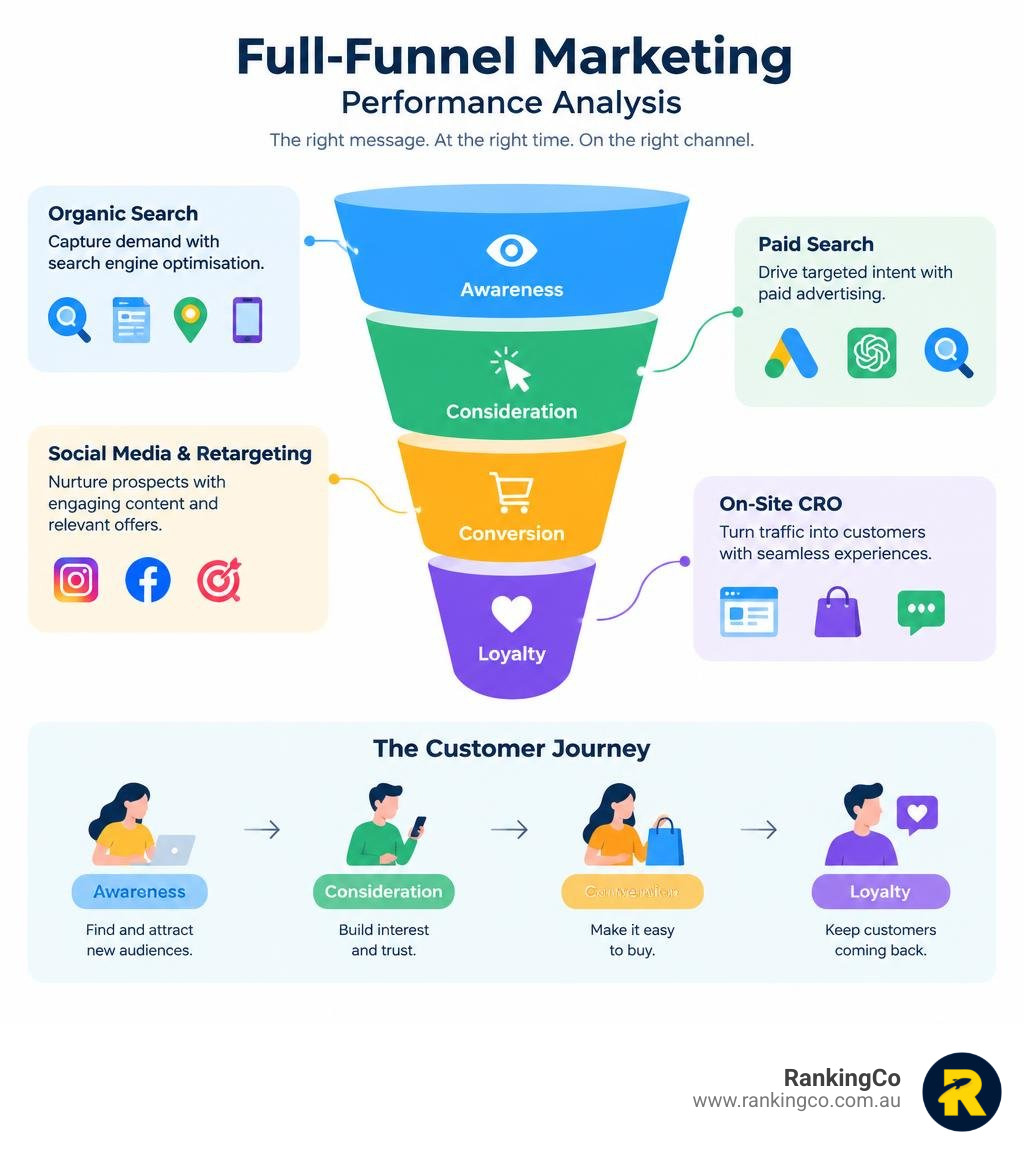
Channel alignment does not mean every business needs every platform. SEO can build ongoing visibility for helpful information and commercial searches, while Google Ads may capture immediate demand for priority services. Meta Ads can support targeted awareness or remarketing, and email can continue a conversation once consent has been obtained. Our Services can help teams assess which combination best supports their goals.

Set KPIs That Reflect Business Goals
The most useful key performance indicators depend on the stage and the business objective. Awareness activity may be assessed through relevant reach and engaged visits, consideration through returning visitors and qualified enquiries, and conversion through completed forms, bookings, purchases and lead quality. Retention can be reviewed through repeat activity and ongoing customer engagement.
Avoid treating clicks or impressions as a complete picture of performance. They can be useful diagnostic measures, but a business should also consider whether campaigns are attracting the right audience and supporting meaningful outcomes.
Use Data to Find and Fix Funnel Weaknesses
Review where visitors drop out of a journey. A high volume of visits with few enquiries can indicate that the landing page, offer, form or message needs attention. Poor lead quality may suggest a mismatch between targeting and the service being promoted. Test one clear improvement at a time, then compare the resulting behaviour with the original goal.
Attribution is not perfect, especially when customers use several devices or return through different channels. Looking at the overall journey, alongside channel-level reporting, gives a more balanced view of what may be contributing to growth.
Refine the Strategy as Customer Behaviour Changes
Customer needs, competitors, platform features and search behaviour change over time. Regular reviews allow a business to adjust content, budget and campaign settings without assuming it will continue to perform well without oversight. RankingCo takes a collaborative approach to this work, combining transparent reporting with practical recommendations. Businesses can Contact RankingCo to discuss a full-funnel approach suited to their goals.
Practical Next Steps for a More Connected Marketing Strategy
A full-funnel approach becomes manageable when it is built in stages rather than launched as a large, disconnected project.
- Review current activity: List the campaigns, web pages, content and follow-up communications already in place. Identify which funnel stage each asset serves and where there is no useful next step.
- Prioritise the biggest gap: A business that already attracts relevant visitors may need stronger conversion paths, while a business with limited visibility may need more awareness content and search coverage first.
- Connect messages and destinations: Make sure ads, social posts and search listings lead to pages that answer the promise made in the original message.
- Choose a small set of stage-appropriate KPIs: Track measures that relate to the job of that activity, then connect them to qualified leads, sales or repeat business where possible.
- Review and improve regularly: Use reporting to spot drop-off points, test practical changes and adjust activity as customer behaviour or business priorities change.
A connected strategy can make marketing decisions clearer because each channel has a defined role. It also helps teams avoid investing in activity that attracts attention but does not support the wider customer journey.
Build a More Connected Marketing Strategy
A full-funnel marketing strategy helps Australian businesses connect the activities that attract attention, build confidence, encourage action and support customer retention. The most effective mix depends on the audience, sales cycle, budget and website experience, but a clear customer journey and regular measurement give every channel a more useful role. RankingCo can help businesses plan and refine an integrated approach through Contact RankingCo, explore Our Services, or strengthen organic visibility with SEO services.
Frequently Asked Questions About Full-Funnel Marketing Strategy
What is the difference between full-funnel marketing and traditional marketing?
Full-funnel marketing is a way of connecting marketing activity to different customer needs, from early research through to conversion and retention. Traditional marketing can also support these goals, but a full-funnel approach makes the role of each channel, message and website page more deliberate across the customer journey.
Which marketing channels work best at each funnel stage?
The best channels depend on the business and its customers. SEO, educational content, Google Ads and social media advertising can support discovery, while service pages, comparison content, email and remarketing can help with evaluation. Landing pages and clear calls to action support conversion, and useful customer communications can help with retention. Not every business needs every channel.
Is full-funnel marketing suitable for small businesses?
Yes. Small businesses can apply the same principle without running a large number of campaigns. A practical starting point is to identify the most important customer questions, ensure the website provides useful answers and make it easy for interested visitors to take the next step. Investment should reflect the available budget, sales cycle and business priorities.
How do you measure the success of a full-funnel marketing strategy?
Measure success through indicators that fit the stage and the business goal. Relevant traffic, content engagement and returning visitors can help assess early and middle stages, while qualified enquiries, purchases, conversion rate and repeat business provide stronger insight into outcomes. Review these measures together rather than relying on one platform metric.
How long does it take to see results from full-funnel marketing?
Timelines vary. Paid campaigns may produce early response data once they are active, while SEO and content often require sustained work before they contribute consistently. Results depend on budget, industry competition, targeting, website quality, campaign management and how quickly customers typically make decisions.
Can SEO and Google Ads work together in a full-funnel strategy?
Yes. SEO can support long-term visibility for informational and commercial searches, while Google Ads can help a business appear for priority searches or test demand more quickly. Using both together can provide broader coverage when the message, landing page and measurement approach are aligned.



Share online


