Digital Marketing for Local Businesses: How to Get Found and Grow in 2026
How Does Digital Marketing Help Local Businesses Get Found?

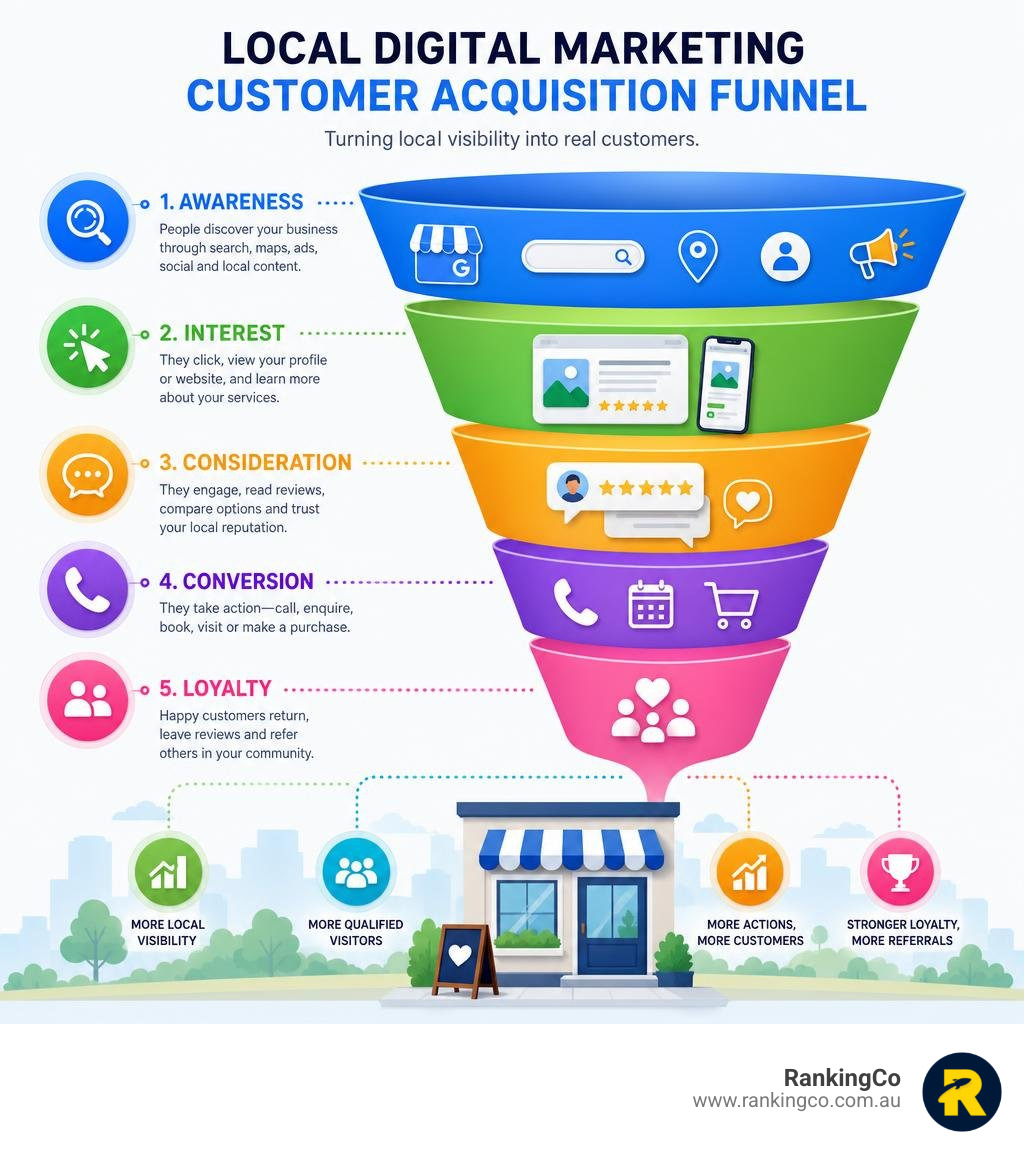
Local digital marketing has changed. Customers now discover and compare nearby businesses across Google Search, Google Maps, AI-generated search results, social platforms and online reviews, often before they ever visit a website.
For local businesses, the practical goal is not to be active on every platform. It is to be visible where customers are already searching, credible enough to be chosen, and set up to turn that visibility into measurable enquiries, bookings, calls or eCommerce sales.
RankingCo helps local businesses build that connected system with Search Engine Optimisation (SEO), Google Ads, Meta Ads, useful content, review signals and clear performance tracking. As a Google Premier Partner, Shopify Partner and Microsoft AI Partner, we can help connect visibility, advertising, eCommerce and AI search considerations into a practical growth strategy. This article explains how to strengthen three areas that matter most for sustainable local growth:
- Local and AI search visibility: Help nearby customers find your business in Google Search, Google Maps and emerging AI-generated results.
- Converting visibility into enquiries and customers: Make it easier for people to call, enquire, book or buy once they find you.
- Measuring and improving marketing performance: Track Return on investment (ROI), Click-through rate (CTR), Conversion rate optimisation (CRO) opportunities and other meaningful actions so each campaign becomes easier to refine.
The sections ahead explain how to build those foundations, choose the right channels and measure what is working.
How Can Local Businesses Get Found in Google and AI Search?
Local search visibility now depends on how clearly a business presents the same trustworthy information across its Google Business Profile, website, reviews and other public signals. Search engines and AI-generated results need to understand what the business does, where it operates, who it serves, which services it provides and why customers should trust it.
For local businesses, this means visibility is not built from one isolated tactic. A complete Google Business Profile can help customers find accurate details quickly. Clear service pages can support local relevance. Genuine reviews can strengthen trust. Structured data can help search engines interpret important business information. Together, these signals make it easier for customers to move from discovery to confidence to action.
Keep Google Business Profile accurate and useful
A Google Business Profile is often one of the first places a nearby customer sees a local business. It should clearly reflect the services offered, the areas served and the practical details customers need before making contact.
Important profile elements include:
- An accurate primary business category
- Relevant service listings and descriptions
- Correct opening hours, including public holiday updates where needed
- Clear location or service-area information
- Recent, authentic photos that show the business, team, work or service environment
- Genuine customer reviews and professional responses
- Up-to-date phone, website, booking and contact details
Keeping this information current helps search engines understand the business and gives customers fewer reasons to hesitate before calling, enquiring or booking.
Build website signals that support local relevance
The website should reinforce the same business information that appears in search listings, maps, ads, directories and social platforms. Clear service pages, helpful local context and consistent contact details all support a stronger local presence.
Local businesses should focus on:
- Clear pages for core services
- Location-specific information where it genuinely helps customers choose the right provider
- Mobile usability for people searching on the go
- Fast page experience and simple navigation
- Clear contact, booking or enquiry options
- Consistent business name, address and phone details across key public listings
- Structured data where it accurately reflects real business information
Structured data does not guarantee rankings, but it can help search engines understand business details more clearly when implemented accurately. The same applies to citation consistency. Accurate business information across reputable listings supports local relevance and reduces confusion for both customers and search systems.
What local customers need to see before choosing a business
Most local customers follow a practical journey. They first discover a business in Google Search, Google Maps, AI-generated results, social platforms, ads, referrals or review sites. They then look for trust signals before deciding whether to take action.
Before choosing a business, customers often need to see:
- A clear explanation of the services available
- Evidence that the business serves their location or problem
- Easy ways to call, enquire, book or buy
- Recent and genuine reviews from real customers
- Professional responses to feedback
- Consistent details across the website, search profile and other public listings
- Helpful content that answers common questions before they contact the business
This is why local visibility and conversion should be planned together. Being found is only the first step. The business also needs to appear credible, relevant and easy to contact once the customer arrives.
Use reviews and reputation signals responsibly
Reviews help customers assess reliability, service quality and fit. A healthy review profile is built through genuine customer experiences, consistent review requests and professional responses, not manipulation.
Local businesses should avoid fake reviews, review swapping or incentives that distort customer feedback. Instead, they should make it easy for real customers to leave honest reviews, respond respectfully to positive and negative feedback, and use recurring themes from reviews to improve service quality.
Review recency and consistency can strengthen customer confidence, but no specific review count should be treated as a guaranteed ranking factor. The safer goal is to build an authentic reputation that supports both visibility and trust.
Prepare for AI and generative search visibility
AI search systems depend on clear, reliable and easy-to-understand information. A business is easier to interpret when its website, Google Business Profile, service pages, reviews and public listings all tell a consistent story.
To support AI and generative search visibility, local businesses should make sure their digital presence clearly explains:
- What the business does
- Where it operates
- Who it serves
- What services it provides
- What makes the business credible and trustworthy
- How customers can take the next step
RankingCo helps local businesses connect these visibility signals through Search Engine Optimisation (SEO), Google Ads, Meta Ads, content, review signals and practical performance tracking. For businesses that want a clearer local search foundation, our SEO services can help align search visibility with measurable enquiries, bookings and sales.
How Can Local Businesses Turn Online Visibility Into More Leads and Sales?
Being found online only creates value when the next step is clear. After someone discovers a local business through search, maps, social media, reviews or paid advertising, they usually want quick confirmation that the business can solve their problem, serves their area and is easy to contact.
That conversion journey should be planned before investing more heavily in traffic. A business can attract the right visitors but still lose enquiries if service information is vague, calls to action are buried, forms are too long, pages are slow on mobile or trust signals are hard to find.
Make it easy to take the next step
Local customers often search while they are ready to act. The website should make it simple to call, enquire, book or buy without asking the visitor to work too hard.
Strong conversion points can include:
- Clear service and location information on relevant pages
- Prominent calls to action for calls, enquiries, bookings or quotes
- Click-to-call functionality for mobile visitors
- Simple enquiry forms that ask only for useful information
- Online booking where it suits the service model
- Fast, mobile-first page layouts with clear navigation
- Trust signals such as reviews, qualifications, guarantees and project examples
- Landing pages that match the promise of paid campaigns
These elements reduce friction. They also help visitors feel confident that they have found a business that understands their need and can respond in a practical way.
Match the message to local intent
Not every local searcher is ready to make the same decision. Someone searching for “plumber near me” usually has a more immediate need than someone reading general plumbing maintenance advice. The first visitor may need a fast call option, service-area confirmation and emergency availability. The second may need a helpful explanation, practical next steps and a reason to remember the business later.
Local digital marketing works better when service pages, landing pages and content reflect those different levels of intent. High-intent visitors should see direct contact options and strong reassurance. Research-stage visitors should find useful answers, relevant internal links and a simple path to enquire when they are ready.
Use paid advertising strategically
Paid marketing can help local businesses capture existing demand or accelerate visibility while organic search visibility develops. It should support the wider customer journey rather than sit apart from the website, reviews and service information.
Google Ads can be useful for high-intent searches where customers are actively looking for a nearby provider. Meta Ads can support awareness, retargeting and demand generation, especially when the offer, creative and audience are aligned with the business goal.
Important paid advertising foundations include:
- Geographic targeting that reflects the real service area
- Search terms and ad copy aligned with high-intent services
- Negative keywords to reduce irrelevant clicks
- Retargeting for visitors who were interested but not ready to enquire immediately
- Landing-page relevance between the ad promise and page content
- Conversion tracking for calls, forms, bookings and other meaningful actions
This makes paid advertising easier to evaluate. Instead of judging campaigns only by clicks or impressions, the business can assess whether each channel is helping create qualified enquiries, bookings or sales.
Build relationships after the first enquiry
Some local customers buy immediately. Others compare options, wait for timing to improve or need several interactions before deciding. For businesses with repeat purchases, maintenance services or longer buying cycles, follow-up can be just as important as the first website visit.
Email, customer relationship management workflows and automated follow-ups can help businesses respond faster, send useful reminders, request reviews after completed work and stay visible between purchases. These systems should be helpful and permission-based, with clear relevance to the customer's enquiry or service history.
When conversion, paid marketing and follow-up are connected, local businesses can turn visibility into a more reliable growth system. RankingCo's Google Ads and Meta Ads support can help businesses align campaigns, landing pages and tracking with the actions that matter most.
How Should Local Businesses Measure Digital Marketing Results?
Traffic, impressions and rankings can help show whether a business is becoming more visible, but they are not the same as business results. A local business also needs to understand whether its marketing is creating qualified enquiries, bookings, calls, quote requests, purchases or repeat customers.
The most useful measurement approach connects visibility to action. A campaign may increase website visits, but if those visits do not lead to meaningful customer activity, the business needs to look deeper at intent, landing-page relevance, calls to action, tracking setup and follow-up.
Understand the different types of marketing metrics
Local businesses often need to review several metric types together rather than relying on one number in isolation.
Visibility metrics show whether the business is being discovered. These can include:
- Search impressions
- Rankings for relevant local searches
- Google Business Profile interactions
- Website traffic from search, maps, paid campaigns, social media and referrals
Engagement metrics show whether people are taking useful steps after they find the business. These can include:
- Click-through rate (CTR)
- Pages visited during a session
- Phone calls from mobile or website buttons
- Form completions
- Bookings or appointment requests
Commercial metrics show whether marketing activity is supporting the business outcome. These can include:
- Qualified leads
- Cost per lead
- Conversion rate
- Customer acquisition cost
- Revenue generated
- Return on advertising spend where applicable
- Return on investment (ROI)
A balanced view helps prevent businesses from judging performance purely by rankings, impressions or website visits. Those numbers matter, but they should be connected to actions that show real customer interest.
Track meaningful actions, not just traffic
For many local businesses, the most useful actions are calls, quote requests, booking enquiries, online bookings, purchases and contact form submissions. These actions give clearer insight into whether marketing is helping the business attract people who are likely to become customers.
Tracking should be set up carefully across the website, Google Business Profile, paid campaigns and booking or eCommerce systems where relevant. Call tracking, form tracking, booking tracking and purchase tracking can help show which channels and pages are contributing to enquiries and sales.
The goal is not to collect every possible number. It is to collect the right information consistently enough to make better decisions about budget, content, service pages, landing pages and follow-up.
Account for non-linear customer journeys
Attribution is important because customers rarely move in a perfectly straight line from first discovery to enquiry. A customer may discover a business through Google Search, return later through a branded search, read reviews, visit a service page and finally call after seeing a retargeting ad.
If the business only credits the final interaction, it may undervalue earlier touchpoints that helped build trust. If it only looks at first discovery, it may miss the channel that encouraged the customer to take action. A practical attribution approach looks for patterns across the whole journey while accepting that some customer decisions involve several interactions.
This is especially important when Search Engine Optimisation (SEO), Google Ads, Meta Ads, email and retargeting are working together. Each channel can support a different stage of the decision, so measurement should focus on how the combined system contributes to qualified enquiries, bookings and sales.
Use the Set, Track, Compare and Improve framework
A simple measurement framework can help local businesses turn reporting into practical decisions.
- Set: Define the action that matters most, such as calls, quote requests, bookings, purchases or qualified leads.
- Track: Make sure calls, forms, bookings, purchases and other meaningful actions are recorded accurately.
- Compare: Review channels, campaigns and pages against cost, intent, lead quality and commercial outcomes.
- Improve: Put more effort into the activities producing qualified customers, then refine pages, ads, content and follow-up where results are weaker.
This framework keeps measurement focused on business value rather than vanity metrics. RankingCo's digital marketing services can help local businesses align Search Engine Optimisation (SEO), Google Ads, Meta Ads and reporting so performance is easier to understand and improve.
How to Build a Digital Marketing Strategy That Grows Your Local Business
A practical local digital marketing strategy brings three priorities together. First, get found by strengthening local and AI search visibility through your Google Business Profile, website, reviews and useful local content. Second, convert attention by making it easy for visitors to call, enquire, book or buy, and by using paid campaigns strategically where they can accelerate qualified demand. Third, measure and improve by tracking meaningful customer actions, then using that data to refine channels, campaigns and conversion points.
The best next step is to assess where your current customer journey is weakest. Effective digital marketing is an ongoing process, not a one-off campaign, so look for the gap that most affects growth now: visibility, trust, conversion, follow-up or measurement.
If you're ready to strengthen your local marketing, these resources can help you decide what to tackle next:
- Improve your local search visibility
- Learn how to choose the right SEO agency
- Explore Brisbane local SEO strategies
- Explore digital marketing services
- Understand our Google Premier Partner status
- See how our Shopify Partner experience supports eCommerce growth
- Explore our Microsoft AI Partner capability
RankingCo can help you review your current visibility, identify practical gaps and build a measurable digital marketing strategy that supports the way your customers actually search, compare and take action.
Frequently Asked Questions About Digital Marketing for Local Businesses

What is the best digital marketing strategy for a local business?
There is no single best channel for every local business. A practical strategy usually starts with local search visibility, so customers can find accurate information through Google Search, Google Maps and AI-generated search experiences. From there, the website needs clear service information, strong calls to action and a simple enquiry or booking path. Paid advertising, retargeting, email and follow-up systems can then be added based on customer behaviour, competition, budget and sales capacity.
How can my local business appear in Google Maps?
Google Maps visibility starts with a complete and accurate Google Business Profile. The profile should use the most relevant business category, list real services, show correct opening hours, include accurate location or service-area details, and keep phone, website and booking information up to date. Reviews, relevance, proximity, website signals and consistent business details across reputable listings can all support local visibility, but no single activity can guarantee a specific ranking.
How can local businesses appear in AI search results?
AI search systems need clear, trustworthy and accessible information to understand a business. Local businesses can support AI visibility by publishing clear service pages, keeping business information consistent, explaining where they operate, creating locally relevant content, earning genuine reviews and making website content technically accessible for search systems. The aim is to make it easy for AI-generated results to understand what the business does, who it serves and why customers can trust it.
Is Search Engine Optimisation or Google Ads better for a local business?
Search Engine Optimisation (SEO) and Google Ads serve different roles. Search Engine Optimisation can build longer-term organic visibility across service pages, local content and map-related signals. Google Ads can provide immediate paid visibility for high-intent searches while organic visibility is still developing. Many local businesses benefit from using both strategically, especially when paid campaigns, landing pages and conversion tracking are aligned with real enquiries, bookings or sales.
How much should a small business spend on digital marketing?
There is no useful universal percentage or fixed dollar amount for every small business. A sensible budget depends on the competitiveness of the market, the value of each customer, the geographic area being targeted, the length of the sales cycle and the business's capacity to handle new leads. Instead of starting with an arbitrary number, businesses should define the outcomes they want, estimate what a qualified lead or sale is worth, and review spend against measurable commercial results.
How long does local Search Engine Optimisation take to work?
Local Search Engine Optimisation usually takes time because search visibility depends on competition, existing website authority, technical quality, content depth, Google Business Profile strength, reviews and consistency across local signals. Some improvements, such as profile updates or clearer contact paths, may help customers quickly. Broader organic visibility often builds more gradually as search engines process website, content and reputation signals. Results vary, so progress should be measured through rankings, Google Business Profile interactions, enquiries and qualified leads.
How do I know whether my digital marketing is working?
Digital marketing is working when it contributes to meaningful business actions, not just higher traffic or more impressions. Local businesses should review calls, qualified enquiries, bookings, sales, customer acquisition cost, cost per lead and revenue alongside visibility metrics. Rankings and website visits are useful indicators, but they should be connected to actions that show whether the marketing is attracting people who are likely to become customers.
Can AI help a local business with digital marketing?
AI can help local businesses with practical marketing tasks such as content research, idea generation, customer-service workflows, reporting summaries, draft review responses and administrative automation. It should still be used with human review. Business information, claims, tone, legal compliance and brand consistency need to be checked before AI-assisted content or workflows are published. Used carefully, AI can support efficiency without replacing the judgement needed to communicate accurately with customers.
For help turning local visibility into measurable enquiries, explore our digital marketing services or contact RankingCo to discuss the right mix of Search Engine Optimisation, Google Ads, Meta Ads and reporting for your business.



Share online