
The Ultimate Guide to Effective Social Media Advertising in 2026
Is Your Social Media Advertising Actually Working?
Effective social media advertising is the practice of using paid placements across platforms like Facebook, Instagram, TikTok, and LinkedIn to reach the right audience, with the right message, at the right moment in their buying journey. When it works, it delivers measurable returns across every stage of the funnel.
Here is a quick snapshot of what makes social media advertising effective in 2026:
- Clear goal alignment: every campaign maps to a specific business outcome (awareness, leads, or sales)
- Precise audience targeting: using first-party data, custom audiences, and lookalike modelling
- Platform-native creative: short-form video and UGC-style content built for the feed it runs in
- Full-funnel structure: separate campaigns for cold, warm, and retention audiences
- Consistent measurement: tracking blended ROAS, CPA, and conversion data, not just likes and reach
- AI-assisted optimisation: automated bidding and creative testing to improve performance over time
The numbers behind social ads in 2026 are hard to ignore. According to industry data, the average return on social media advertising sits at around $5.20 for every $1 spent. Meanwhile, 83% of marketers report that social media gave their business more exposure, and 73% say it increased website traffic. These are not vanity metrics; they reflect a channel that, when managed well, consistently drives real business outcomes.
But here is the honest reality: most small and medium businesses are not getting those returns. The gap is rarely a budget problem. It is almost always a strategy problem. Campaigns run without a defined funnel, creative assets get reused across platforms without adaptation, and performance gets measured by the wrong signals.
Social media advertising has also grown considerably more complex. Privacy changes have reshaped how audiences are tracked and targeted, while AI-driven tools like Meta's Advantage+ have shifted how campaigns are managed. Short-form vertical video has become the dominant format. With over 90% of social ad clicks happening on mobile devices, the experience from ad to landing page must be seamless.
This guide cuts through that complexity. It covers platform selection, creative strategy, targeting, budgeting, AI tools, and a practical 30-day launch playbook, providing everything you need to build a social media advertising system that actually performs.
I'm Kerry Anderson, co-founder of RankingCo and a digital marketing strategist with over 15 years' experience helping businesses build effective social media advertising campaigns that connect to broader SEO, Google Ads, and content strategies. I have worked across industries from nimble startups to established enterprises, and what I have learned is that sustainable growth comes from building connected systems, not running isolated campaigns.
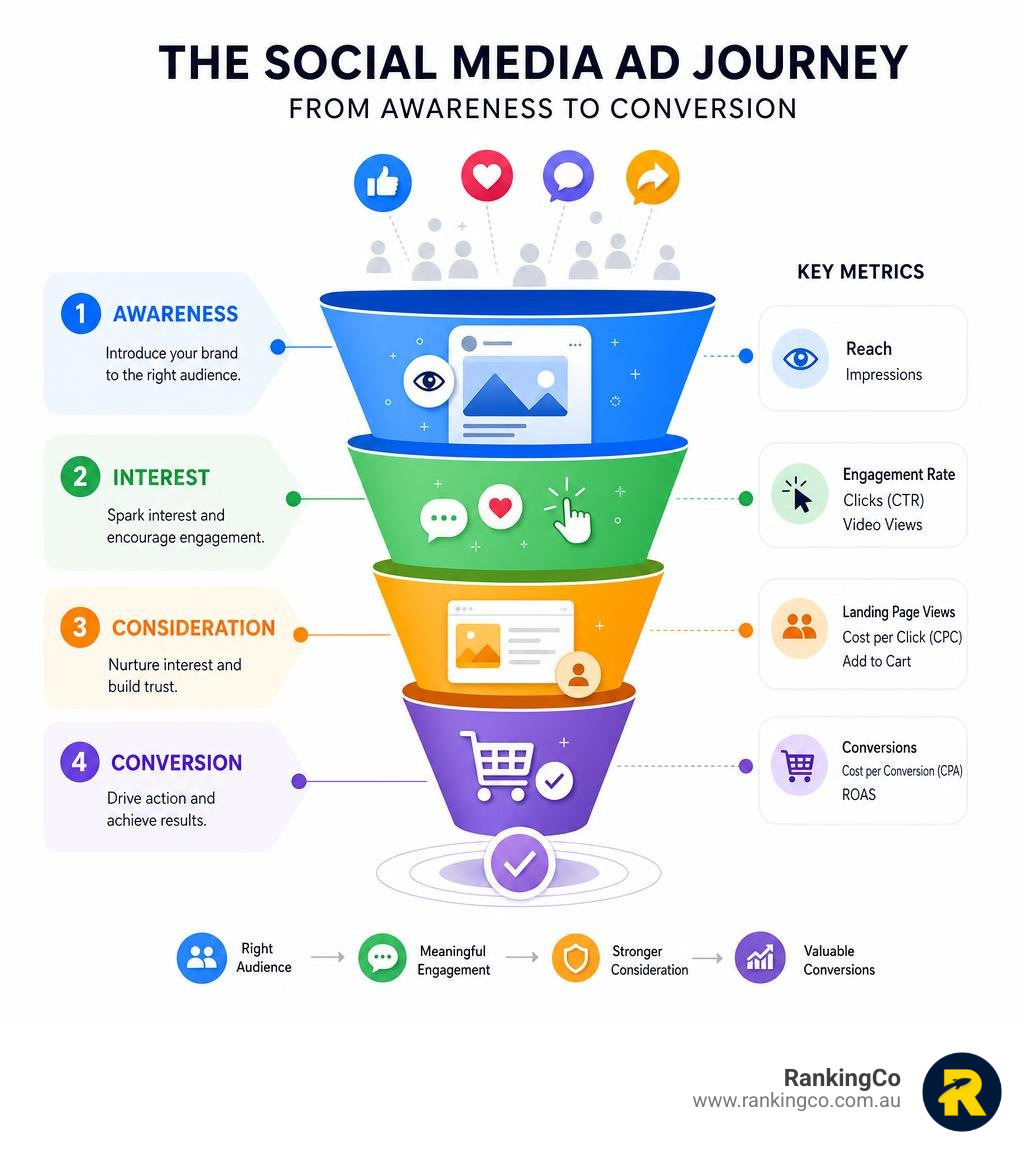
Important effective social media advertising terms:
The Blueprint for Effective Social Media Advertising
To build a social ad engine that actually moves your bottom line, we must first look at how we capture and process user intent. In 2026, the brands winning the paid social game do not view Facebook, Instagram, or TikTok as isolated channels. Instead, they treat paid social as part of a connected growth system, working in perfect harmony with search engine optimisation (SEO) and high-intent Google Ads.
When a user sees your ad on Instagram, they might not purchase immediately. They might jump onto Google a few hours later to search for your brand name or look up reviews. If your search presence is non-existent, that social ad spend is essentially wasted.
Furthermore, the mechanics of tracking have shifted dramatically. Relying solely on basic browser-based tracking pixels will leave massive blind spots in your data due to privacy regulations and cookie restrictions.
To run profitable campaigns today, we must implement server-side tracking via Conversion APIs (CAPI). By passing conversion events directly from your server to the advertising platform, you preserve critical signal strength. This first-party data strategy ensures the machine learning algorithms have the clean data they need to optimise your campaigns and find your ideal customers.
The Core Components of Effective Social Media Advertising
Every high-performing social ad is built on four core pillars: thumb-stopping creative, highly persuasive copy, a single clear call-to-action (CTA), and strategic targeting.
When we design a campaign, we think about "creative-first targeting." Because modern ad platform algorithms are incredibly smart, your creative asset itself does the targeting. The visual hook and the first three seconds of a video signal to the algorithm exactly who is interested, allowing the system to serve your ad to similar users.
For a deep dive into structuring these workflows, the Paid Social Media Strategy: Practitioner's Guide to Building and Scaling outlines how to establish a robust testing engine rather than a random creative rotation.
To help you understand how different formats perform across these pillars, we have compiled the following comparison based on active 2026 campaign data:
| Creative Format | Primary Funnel Stage | Ideal Hook Style | Average CTR Benchmarks |
|---|---|---|---|
| Short-Form Vertical Video | Cold Prospecting (Top of Funnel) | Visual pattern interrupt in first 2 seconds | 1.8% to 2.5% |
| User-Generated Content (UGC) | Consideration (Middle of Funnel) | Problem-centric or "relatable struggle" start | 1.5% to 2.2% |
| Dynamic Carousel | Conversion (Bottom of Funnel) | High-contrast product showcase with pricing | 1.2% to 1.8% |
| Single Image / Static Graphic | Retargeting & Retention | Direct offer, social proof, or bold comparison | 0.9% to 1.4% |
While paid social captures attention and builds desire, capturing that active search demand is where search marketing shines. To ensure your business is visible when users search for you locally after seeing your ads, explore our tailored local SEO services.
Choosing the Right Platform for Effective Social Media Advertising
Not all platforms are created equal, and spreading your budget too thin across every channel is a fast track to mediocre results. The secret is matching your business model, target price point, and creative capacity to the platform where your audience actively hangs out.
Let's look at how the major networks stack up in 2026:
- Meta (Facebook & Instagram): Still the undisputed heavyweight. According to industry data, Meta captures roughly 38% of global social ad revenue. It is the best all-rounder for both lead generation and e-commerce. To learn more about tailoring your visual assets for this ecosystem, see our dedicated guide on Instagram Ads.
- TikTok: The playground for short-form vertical video and impulse-friendly products under $100. It offers highly competitive CPMs but demands a constant stream of fresh, creator-led content.
- LinkedIn: The premier choice for B2B brands. While cost-per-click is significantly higher, the ability to target by job title, company size, and industry makes it unmatched for high-value contracts.
- Pinterest: Functions more like a visual search engine. It is highly effective for home decor, fashion, and lifestyle brands targeting audiences with clear purchasing intent.
For a comprehensive breakdown of costs and network-specific performance, the resource Social Media Advertising: The Complete Guide for 2026 | rule1 offers excellent real-world benchmarks to guide your media mix. These benchmarks help you allocate your budget effectively across different channels.
Conclusion: Your 30-Day Playbook to Scale
At RankingCo, we don't believe in vanity metrics or isolated campaigns. True digital success happens when your paid social, Google Ads, and search engine optimisation work together as a single, connected growth system.
Co-founders Amber Porter and Kerry Anderson have built our Brisbane-based agency around this exact philosophy. As a Google Premier Partner, we combine deep practitioner experience with advanced AI tools to help businesses in Brisbane, Sydney, and Melbourne build campaigns that convert clicks into lasting revenue.
To get your campaign off the ground, here is our proven 30-day launch timeline:
- Days 1 to 7 (The Foundation): Install your Meta Pixel and Conversions API (CAPI). Build your custom audiences and set up your tracking dashboards.
- Days 8 to 14 (Creative Production): Produce 3 to 5 distinct creative variations, focusing heavily on vertical video and authentic, UGC-style hooks.
- Days 15 to 21 (Launch & Learn): Launch your campaigns using broad or interest-based targeting. Let the algorithm run without interference to gather initial data.
- Days 22 to 30 (Optimise & Scale): Identify your winning creatives, pause the underperforming assets, and gradually scale your budget on top-performing ad sets.
Ready to stop guessing and start scaling? Let our expert team handle the technical heavy lifting while you focus on running your business. We design integrated campaigns that deliver measurable growth for your brand.
Frequently Asked Questions
How much does social media advertising cost in 2026?
Social media ad costs vary based on your industry, target audience, and the platform you choose. On average, Meta platforms see CPMs ranging from $8 to $15, while LinkedIn CPMs can range from $30 to $65 due to highly precise professional targeting. To manage your budget efficiently, we recommend the 70/20/10 rule: allocate 70% of your budget to proven, conversion-focused campaigns, 20% to scaling middle-of-funnel consideration, and 10% to testing new creative concepts.
Which social media platform delivers the best ROI?
For most business-to-consumer (B2C) and e-commerce brands, Meta Ads (Facebook and Instagram) continue to deliver the highest and most consistent return on investment. For business-to-business (B2B) brands with high average contract values, LinkedIn Ads frequently yield the best ROI despite higher initial costs. At RankingCo, we help Brisbane businesses identify the ideal platform mix by looking at blended ROAS across all paid channels to measure true business growth.
How do AI tools improve social ad performance?
Modern AI tools, such as Meta's Advantage+ campaigns, use machine learning algorithms to automate audience targeting, budget distribution, and creative variations. This automation reduces the learning phase of your campaigns and allows the ad platforms to match your ads with users most likely to convert. According to platform data, campaigns leveraging AI-driven bidding and automated targeting can see up to an 18% improvement in return on ad spend compared to manual setups.
What is the 70/20/10 budget rule for social ads?
The 70/20/10 rule is a budget allocation framework designed to balance stable performance with continuous testing. Under this model, 70% of your budget goes to proven, top-performing creative assets and audiences that consistently drive conversions. 20% is dedicated to testing variations of those winners (such as new hooks or headlines), and the remaining 10% is reserved for wild-card testing, like exploring entirely new platforms or radical creative concepts.
Why do we need server-side tracking and Conversion APIs?
Traditional browser-based tracking pixels are increasingly blocked by modern web browsers, ad-blockers, and mobile operating system privacy settings. Conversion APIs (CAPI) solve this by sending conversion data directly from your website's server to the ad platform's server. This server-side integration ensures accurate tracking, prevents data loss, and feeds the ad platform's AI with the high-quality data it needs to optimise your ad delivery.



Share online


