
How Machine Learning B2B Marketing is Saving Your Ad Budget
B2B businesses can spend heavily on clicks, leads, and website traffic that never become real sales opportunities. The challenge is not simply generating more enquiries. It is understanding which advertising activity is actually contributing to revenue, pipeline quality, and meaningful sales conversations.
Machine learning in B2B marketing uses customer, campaign, and sales data to identify patterns that help advertising platforms prioritise higher-quality prospects and optimise towards better commercial outcomes.
B2B campaigns can no longer rely only on surface-level metrics such as clicks, impressions, and basic conversion volume. Machine learning B2B marketing helps campaigns process larger amounts of behavioural and conversion data to identify patterns linked with higher-quality prospects. This is especially useful when buying cycles are longer, several decision-makers are involved, and an initial enquiry may be very different from a qualified sales opportunity.
This article explains how machine learning can reduce wasted ad spend, improve lead quality, and connect advertising optimisation more closely to actual sales outcomes.

Key Takeaways
- Reduce Ad Spend Waste: By moving beyond simple click counts, machine learning algorithms analyse historical customer data to target high-intent prospects, reducing low-quality lead costs.
- Dynamic Audience Orchestration: Continuous data processing ensures your paid campaigns adapt to changing B2B buyer habits in real time.
- Data Unification is Essential: Predictive algorithms require clean, centralised data from Customer Relationship Management (CRM) platforms to accurately evaluate sales pipelines.
- Human Expertise Remains Vital: Automated tools scale campaign efficiency, but human strategic oversight ensures brand authenticity and tone.
To explore how these capabilities enhance overall campaign performance, discover our B2B lead generation optimisation strategies.
Machine learning is most valuable when it is applied to commercial decisions rather than treated as a standalone technology. For Australian small and medium-sized businesses, this means using data to answer practical B2B questions: which enquiries are likely to become qualified opportunities, which campaigns are attracting poor-fit traffic, which audiences need more education before speaking with sales, and which channels should receive the next dollar of budget. A manufacturer might want to prioritise enquiries from businesses requesting specifications or quotes instead of general product-page visitors. A professional services firm may need to distinguish a high-value consultation request from a low-intent contact-form submission. A B2B software company might use trial behaviour, demo requests, and sales-qualified opportunities to guide campaign optimisation.
How Machine Learning B2B Marketing Stops Budget Waste and Improves ROI
B2B buying paths are rarely direct. Decision-making processes often involve multi-member committees, long research periods, and complex evaluation criteria. When paid advertising campaigns target generic job titles or rely on broad keyword matching, ad budgets are often spent on low-intent traffic. Research shows that 73% of B2B marketing teams are using generative Artificial Intelligence (AI) to streamline their workflows and better understand buyer behaviour.
Machine learning B2B marketing addresses this inefficiency by unifying marketing platforms with actual sales outcomes. Traditional campaign optimisation frequently asks, "Which keywords generate the most leads?" That question is useful, but it can still reward volume over quality. A machine-learning-led approach asks a more commercially useful question: "Which combinations of search behaviour, audience signals, and conversion data are most associated with qualified opportunities and revenue?" Machine Learning (ML) models evaluate post-click behavioural data, historical sales updates, and interaction patterns to identify signals that indicate genuine purchasing intent.
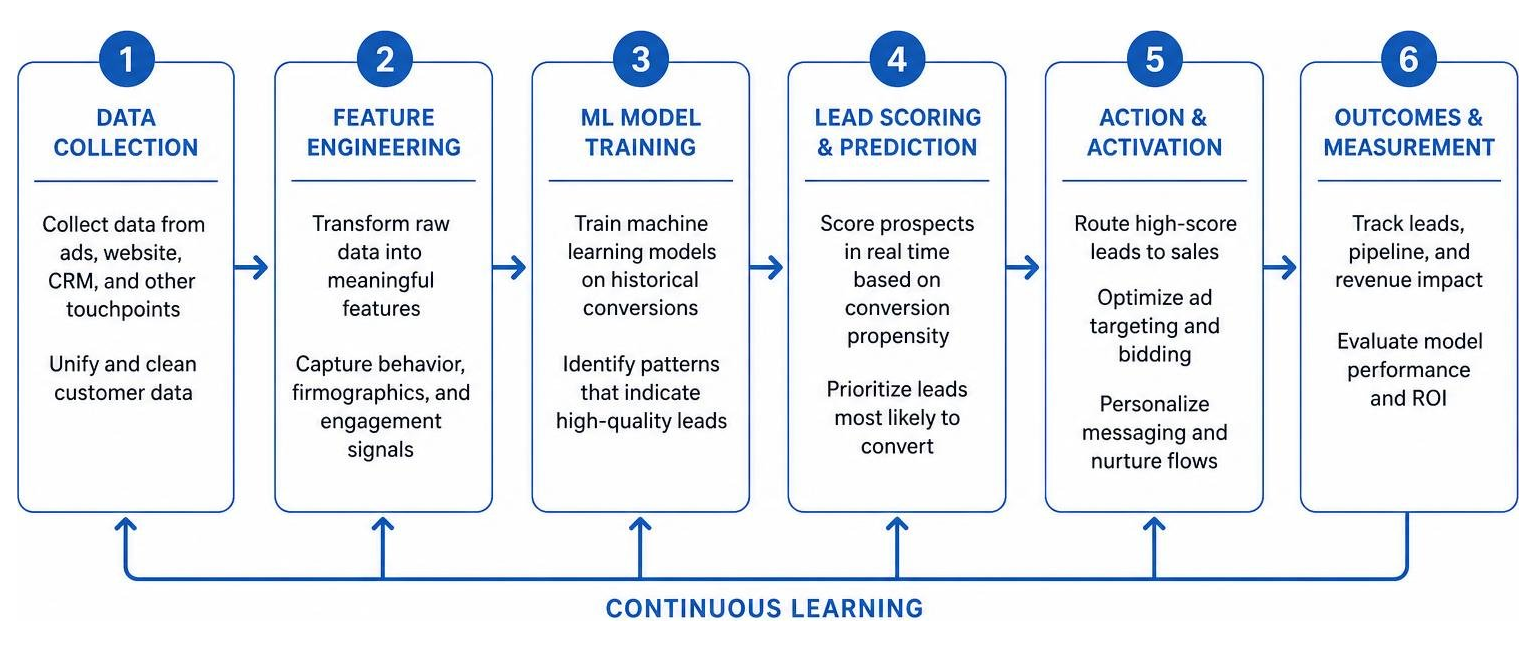
Machine learning models continuously adjust bidding strategies based on conversion propensity rather than static rules. For instance, if data indicates that website visitors who view specialised technical pages, return through branded search, and submit a specification request are more likely to become Marketing Qualified Leads (MQLs), bidding parameters can adjust to capture similar user profiles. For a manufacturer, this may mean giving stronger optimisation weight to quote requests, downloadable specification sheets, or repeat visits from trade buyers, rather than treating every product-page visit as equal. By connecting initial touchpoints directly to pipeline metrics, machine learning reduces ad budget waste on disengaged traffic and gives marketers a clearer view of which campaigns are supporting sales conversations.
This matters because B2B campaign performance often looks stronger at the top of the funnel than it does inside the sales pipeline. A campaign may produce form submissions, webinar registrations, catalogue downloads, or trial sign-ups, but those actions only become commercially useful when they align with account fit, urgency, budget, and decision-maker engagement. For a professional services firm, one generic contact-form enquiry may be worth less than a consultation request from a business with a defined need, relevant location, and suitable budget. For a B2B software company, trial activity, product usage, demo attendance, and Sales Qualified Opportunity (SQO) progression may tell a more accurate story than the raw number of leads generated. Machine learning helps compare those signals at scale, while still leaving room for human review of lead quality, messaging, compliance, and brand suitability.
Our team combines these analytical capabilities across channels. Whether managing targeted search campaigns through our B2B Google Ads strategy services, building demand through Meta Ads and Microsoft Advertising, or refining organic positioning with our dedicated B2B SEO strategy services, applying predictive insights keeps your customer acquisition costs balanced. For a broader view of how we support paid media, Search Engine Optimisation (SEO), and campaign strategy, you can also explore our services or speak with us through the contact page.
Core Strategies for Implementing Machine Learning B2B Marketing in Paid Campaigns

Implementing AI and ML across digital advertising channels requires a structured framework that connects initial ad clicks to downstream sales revenue. Modern decision-makers consume multiple pieces of content across varied digital touchpoints before directly contacting sales teams. Relying solely on single-touch attribution models risks misallocating ad spend to top-of-funnel channels that generate clicks without driving deals.
To build an effective system, organisations should focus on four key operational pillars:
- Centralised Data Integration: Connect website analytics, CRM tools, and ad platform accounts into a clean data environment. Machine learning models depend on unified information to detect conversion patterns accurately.
- Intent Signal Tracking: Track specific user behaviour beyond basic pageviews, such as whitepaper downloads, pricing page visits, product video plays, quote requests, specification downloads, repeat target-account visits, or demo bookings to calculate engagement levels.
- Automated Audience Refresh Cycles: Move away from static target lists. Deploy algorithms that automatically update audience segments as prospects transition from initial research to evaluation phases.
- Unified Measurement: Combine short-term campaign metrics with longer-term evaluation frameworks. Advanced approaches like B2B Marketing Mix Modeling for Enterprises help measure channel impact alongside multi-touch attribution metrics.
Those pillars are useful only when they are translated into a practical operating sequence. For most Australian small and medium-sized businesses, the goal is not to deploy machine learning for its own sake. The goal is to make better budget decisions, identify stronger sales opportunities, and give advertising platforms clearer signals to optimise against.
How to Implement Machine Learning in B2B Advertising
A practical implementation journey usually follows this sequence:
- Define the business outcomes that matter. Start by deciding which commercial outcomes should guide campaign decisions, such as qualified enquiries, booked consultations, sales opportunities, repeat orders, trial-to-demo progression, specification requests, or closed revenue.
- Audit existing conversion tracking and CRM data. Review whether Google Ads, analytics, website forms, call tracking, and CRM stages are collecting accurate, consent-aware data that can be trusted.
- Separate low-value conversions from qualified leads. Distinguish between early interest actions, such as downloads or newsletter sign-ups, and higher-value actions, such as quote requests, technical enquiries, demo bookings, consultation requests, or sales-qualified leads.
- Connect qualified lead and sales data back to advertising platforms. Feed meaningful lifecycle data into Google Ads and other paid media systems so automation can learn from the enquiries that actually support pipeline growth.
- Build meaningful audience and intent signals. Use behaviour such as repeat visits, service page engagement, pricing or specification views, trial usage, target account interactions, and return visits from known business segments to improve segmentation and remarketing decisions.
- Let automation optimise against those signals. Once the data is clean and the conversion hierarchy is clear, allow bidding and audience tools to prioritise prospects that resemble stronger sales opportunities rather than simple form submissions.
- Review performance against actual pipeline and revenue. Compare campaign results with CRM outcomes so reporting reflects lead quality, sales progress, opportunity value, and revenue relevance, not only cost per click or form volume.
- Refine the model and campaign strategy over time. Revisit conversion definitions, negative keywords, landing pages, audience exclusions, and budget allocation as sales feedback reveals which signals are most useful.
This step-by-step approach makes machine learning more commercially useful because it gives automation the right inputs before expecting better outputs. It also keeps human expertise central. We still need to review data quality, campaign structure, message relevance, privacy settings, and sales feedback so the model supports real B2B decisions rather than blindly chasing short-term activity.
Common Machine Learning B2B Marketing Mistakes
When running Pay-Per-Click (PPC) campaigns, marketers often encounter ad fatigue and rising customer acquisition costs. Implementing high-intent marketing strategies and Conversion rate optimisation (CRO) allows campaign platforms to optimise for lead quality over pure lead volume. This can include importing qualified lead stages from the CRM into Google Ads, excluding existing customers from acquisition campaigns where appropriate, refining negative keyword lists, and tailoring landing pages to match the level of buying intent behind each search term.
The practical execution is just as important as the algorithm. A useful machine learning setup needs clear conversion definitions, consent-aware data handling, accurate tagging, and regular quality checks. It should also reflect the realities of a B2B sales cycle, where a first conversion may not represent a ready-to-buy lead. For example, a technical download might be valuable for nurturing, while a booked consultation, demo request, specification request, or sales-qualified opportunity may deserve stronger bidding priority. By separating these actions and feeding the right signals back into ad platforms, campaign automation becomes more commercially relevant.
As a leading Brisbane digital agency and Google Premier Partner, Meta Business Partner, and Microsoft AI Partner, we apply these advanced machine learning frameworks to elevate digital strategy. Australian businesses looking to improve their search visibility can leverage our specialised local Search Engine Optimisation (SEO) solutions to capture geographically relevant, high-intent market demand across Brisbane, Sydney, Melbourne, and other priority service areas.
To explore how these capabilities can transform your digital strategy, explore our services or get in touch through our contact page.
Frequently Asked Questions About Machine Learning B2B Marketing
How does machine learning B2B marketing lower cost per acquisition?
Machine learning lowers cost per acquisition by identifying real-time patterns in high-converting user traffic and dynamically reallocating ad spend away from low-performing channels. Rather than bidding uniformly across broad demographics, machine learning models evaluate intent signals, device types, time of day, search terms, and historical site engagement to adjust bids automatically. This helps your budget focus on target accounts most likely to become paying clients, while still allowing marketers to review performance, compliance, and lead quality before scaling campaigns.
How are AI and ML transforming lead quality across the B2B sales cycle?
Artificial Intelligence (AI) and Machine Learning (ML) improve lead quality by automating lead scoring using multi-stakeholder behavioural data. Machine learning models analyse engagement across touchpoints to score leads based on their true conversion propensity rather than arbitrary point systems. This allows sales teams to focus on accounts actively progressing through buying cycles while automated workflows nurture early-stage enquiries.
For example, a lead that has viewed a pricing page, returned through a branded search, downloaded a technical resource, and engaged with a comparison page will usually indicate a different level of intent from a single newsletter sign-up. Machine learning helps distinguish these patterns so sales and marketing teams can align follow-up timing, content, and channel investment.
What are the main pitfalls of relying too heavily on AI in B2B marketing?
Over-relying on automated platforms can lead to generic, repetitive content that fails to engage prospective buyers. Machine learning models require human editorial oversight, brand context, and qualitative strategic guidance. Furthermore, unverified input data can cause predictive engines to misinterpret target accounts. Human intuition is essential to maintain brand authenticity, protect customer trust, and ensure technical data quality.
Another common issue is optimising for the wrong conversion event. If a platform is told that every form submission has equal value, it may pursue volume instead of quality. A better approach is to define meaningful lifecycle stages, such as enquiry, qualified lead, opportunity, and closed revenue, then review how each campaign contributes to those stages over time.
How does machine learning support B2B advertising across multiple channels?
Machine learning supports B2B advertising across multiple channels by using behavioural and conversion signals to adjust audiences, bidding, and remarketing messages as prospects move through the buying cycle. Instead of treating search, social, email, and remarketing activity as disconnected campaigns, marketers can use shared intent signals to decide which prospects need education, comparison content, or a direct sales action.
In practical paid media terms, this can mean aligning Google Ads, Meta Ads, remarketing audiences, email nurture, and CRM lifecycle stages. A prospect who has already requested a quote should not keep seeing introductory awareness messaging, while an early-stage researcher may need educational content before being asked to book a consultation. Machine learning makes these audience transitions easier to manage while keeping the focus on qualified leads, sales pipeline quality, and reduced wasted ad spend.
How should B2B organisations prepare their data for machine-learning-led advertising?
Preparing for machine-learning-led advertising starts with clean, useful marketing and sales data. Organisations should audit website forms, call tracking, analytics, Google Ads conversions, and Customer Relationship Management (CRM) stages so advertising platforms can learn from meaningful outcomes instead of low-value activity. The most important step is separating early interest signals from qualified enquiries, opportunities, and revenue-linked events.
Australian businesses should also consider privacy and consent requirements when using first-party data across paid media, email workflows, remarketing audiences, and CRM integrations. Data collection should be configured with appropriate permissions and governance processes, especially when campaigns rely on customer lists, lead-stage imports, or behavioural audiences.
Next Steps for Improving B2B Advertising Performance
- Explore our B2B Google Ads strategy services to connect campaign optimisation with qualified lead and pipeline data.
- Review our B2B SEO strategy services to support stronger organic visibility alongside paid media activity.
- See our services for broader support across Google Ads, Meta Ads, Microsoft Advertising, Search Engine Optimisation (SEO), and campaign strategy.
- Speak with us through the contact page if you want help reducing wasted ad spend and improving lead quality.
Our team assists brands in refining conversion tracking, connecting qualified lead data to advertising platforms, and building campaign models that focus on sales relevance rather than simple lead volume.





Share online


