B2B SEO Strategy Services: From Keywords to Closed-Won Deals
What Are B2B SEO Services and How Do They Drive Pipeline Growth?

B2B SEO services are specialised Search Engine Optimisation (SEO) strategies designed specifically for businesses that sell to other businesses rather than directly to consumers. Unlike general SEO, B2B SEO focuses on attracting decision-makers, nurturing long sales cycles, and converting organic search traffic into qualified leads and measurable pipeline growth.
Here is what B2B SEO services typically include:
- Technical SEO : auditing and fixing site architecture, crawlability, Core Web Vitals, and structured data
- Content strategy : creating buyer-intent content mapped to every stage of the B2B funnel
- Keyword and intent mapping : targeting the specific queries your buying committee uses during research
- Link building and digital PR : earning authoritative, contextually relevant backlinks from industry sources
- AI and generative search optimisation : ensuring your brand appears in Google AI Overviews, ChatGPT, and Perplexity responses
- Analytics and pipeline attribution : connecting organic search activity directly to leads, opportunities, and revenue in your CRM
The core difference from standard SEO is where success is measured. B2B SEO is not about ranking for high-volume keywords or chasing traffic numbers. It is about making sure the right people find you at the right moment in a buying journey that can span weeks or months, and then tracking whether that visibility actually turns into closed-won deals.
B2B buyers do not make quick decisions. They research extensively, involve multiple stakeholders, compare vendors across several channels, and often consult AI tools like ChatGPT or Perplexity before they ever fill out a contact form. A B2B SEO strategy that ignores this reality is highly likely to generate traffic without generating revenue.
If your current SEO program is producing organic visits but not qualified leads, the problem is almost always a misalignment between your content strategy and your buyer's actual journey. That is the gap that purpose-built B2B SEO services are designed to help close.
I'm Kerry Anderson, co-founder of RankingCo and a digital marketing strategist with over 15 years of experience helping Australian businesses build sustainable growth through smart B2B SEO services and multi-channel digital strategy. The sections below walk through exactly what modern B2B SEO looks like, how to measure it properly, and how to choose the right partner to execute it well.
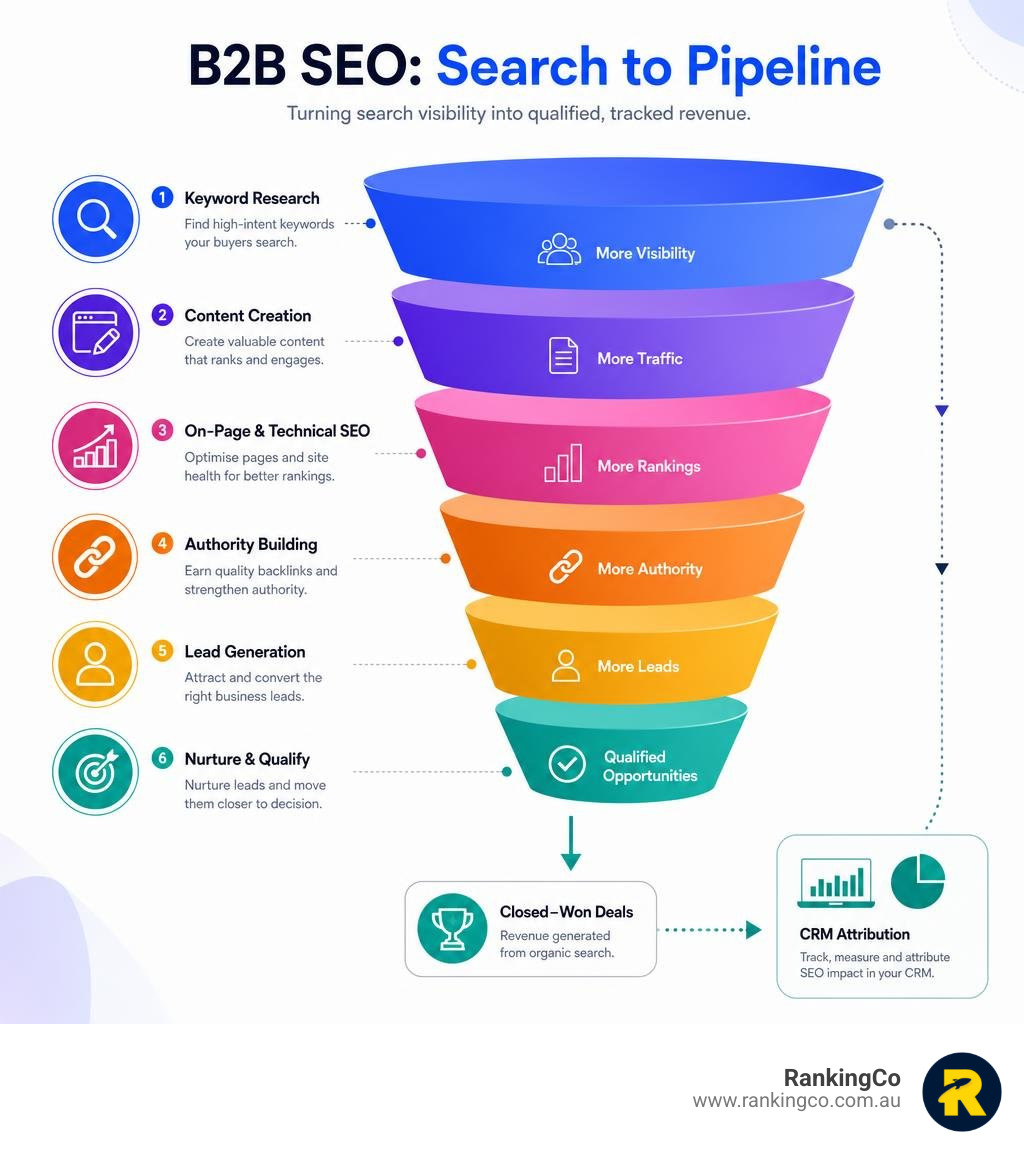
Driving Pipeline Growth with Professional B2B SEO Services
To succeed in the business-to-business space, organic search needs to be planned as a revenue channel, not just a traffic channel. Effective B2B SEO services connect search intent, content, technical performance, AI visibility, lead capture, CRM attribution, and sales follow-up into one measurable growth system.
When we optimise a B2B website, we look at the entire digital footprint. Traditional search tactics often focus on broad, high-volume keywords that bring irrelevant traffic. Stronger B2B SEO targets specific queries that reveal where a decision-maker is in the buying process, then builds content and conversion paths that support qualified lead generation, pipeline influence, and eventual revenue contribution.
Why Generic Search Strategies Fail in B2B Markets
The generalist SEO playbook often falls short in B2B because the buying journey is more complex than a single consumer search. A typical B2B purchase involves multiple stakeholders, a longer research period, higher perceived risk, and more internal comparison before anyone speaks to sales.
That does not mean every article needs to repeat the same buying-committee explanation. The practical point is simpler: your SEO strategy has to answer different commercial questions at different moments. Technical users want proof of capability. Financial stakeholders want ROI logic. Leadership wants confidence that the provider can create measurable business outcomes.
| Feature | B2C Search Dynamics | B2B Search Dynamics |
|---|---|---|
| Buyer Persona | Single consumer | Multi-stakeholder buying committee |
| Sales Cycle | Short, often instant | Longer research and approval process |
| Search Volume | High volume, broad terms | Lower volume, more specific queries |
| Content Focus | Emotional appeal, quick benefits | Education, technical proof, trust |
| Conversion Goal | Immediate checkout | Form submission, demo request, RFP, sales conversation |
If you want to understand why your current efforts might be falling short, our guide on Why Your B2B Marketing SEO Strategy Is Failing and How to Fix It explains how to realign your search presence with actual buyer behaviour.
A Modern B2B SEO Funnel: From Search Intent to Revenue
A strong B2B SEO program maps content to the full journey from first problem awareness to closed-won revenue. The goal is to give each buying-stage question a clear content destination, rather than relying on one broad article or service page to do everything.
| Stage | Buyer Question | SEO Content Type | Example Keyword Intent | CTA | Success Metric |
|---|---|---|---|---|---|
| Awareness | What problem do we have? | Educational guides, trend explainers, diagnostic content | “why organic leads are declining” | Read a related guide | Engaged organic sessions, returning visitors |
| Consideration | What options could solve it? | Comparison pages, frameworks, checklists, solution guides | “SEO vs paid search for B2B lead generation” | Download a checklist or view services | Assisted conversions, repeat visits |
| Decision | Who should we choose? | Service pages, case studies, pricing guidance, consultation pages | “B2B SEO agency Brisbane” | Book a discovery call | Demo requests, enquiries, SQLs |
| Revenue | Did the work create pipeline? | CRM attribution, sales feedback, lead quality analysis | Branded and direct follow-up searches | Speak with a strategist | Pipeline value, closed-won deals |
This structure helps SEO work support both human buyers and AI answer engines. AI systems are more likely to understand and surface a brand when service definitions, buyer questions, proof points, and commercial context are clearly organised across the site.
Examples of Informational vs Commercial B2B Keywords
B2B keyword strategy should separate research intent from buying intent. Both matter, but they should not be measured the same way.
| Keyword Type | Example Query | What It Usually Means | Best Content Format |
|---|---|---|---|
| Informational | “what is B2B SEO” | The buyer is learning the concept | Educational article or glossary-style guide |
| Problem-aware | “why is organic traffic not converting” | The buyer has a performance issue | Diagnostic guide or checklist |
| Comparison | “SEO agency vs in-house SEO team” | The buyer is evaluating delivery models | Comparison page or decision guide |
| Commercial | “B2B SEO services” | The buyer is considering a provider | Service page with proof, process, and outcomes |
| Local commercial | “B2B SEO agency Brisbane” | The buyer wants a regional partner | Location-relevant service page |
A practical strategy balances all of these. Informational content builds topical authority and reaches early-stage researchers, while commercial pages capture buyers who are closer to speaking with a provider.
Core Deliverables of Modern B2B SEO Services
A professional B2B SEO program requires interconnected deliverables. The strongest campaigns usually combine technical excellence, intent-mapped content, authority building, AI search optimisation, and pipeline reporting.
Technical SEO at Scale
Technical SEO is the foundation of search visibility. For larger B2B sites, complex architectures, product catalogues, gated resource portals, and legacy landing pages can create crawlability and indexation issues. A technical program should audit crawl paths, improve Core Web Vitals, remove duplication, strengthen internal linking, and implement structured data where it helps search engines understand the site. You can learn more about RankingCo's specific technical capabilities on our Technical SEO page.
Intent-Mapped Content Strategy
B2B content should be planned around buyer questions, not just keyword volume. A hub-and-spoke model is useful because pillar pages establish topical authority while supporting articles answer specific questions across awareness, consideration, and decision stages. Strong B2B content plans often include bottom-of-funnel comparison pages, use-case guides, integration articles, FAQs, and case studies. To explore how RankingCo builds these strategies, visit the primary SEO Services page.
High-Authority Link Building
Backlinks remain important, but B2B link building requires relevance and credibility. Shortcuts such as spammy placements or private blog networks can create long-term risk. A stronger approach focuses on contextual links from trusted industry publications, business directories, partner websites, local organisations, and high-quality digital PR opportunities.
For Australian B2B businesses, local relevance can also matter. A company targeting decision-makers in Brisbane, Sydney, Melbourne, or national markets should aim to earn signals that support both industry authority and geographic trust.
AI Search and Generative Engine Optimisation
AI search is now part of the B2B discovery process, not a separate tactic to bolt on later. Buyers increasingly use tools like ChatGPT, Perplexity, Claude, and Google AI Overviews to summarise options, compare providers, and clarify terminology before they visit a website.
This means modern B2B SEO services should also support Generative Engine Optimisation (GEO) and Answer Engine Optimisation (AEO). The goal is to make the brand, services, expertise, and proof points easy for AI systems to understand, retrieve, and cite.
To improve the chance of being surfaced in AI-generated answers, B2B websites should use:
- Clear service definitions that explain who the service is for, what is included, what outcomes it supports, and how success is measured
- Conversational content structure with concise question-and-answer sections for common buyer queries
- Entity-rich pages that consistently connect the brand with its services, industries, locations, people, and proof points
- Structured data markup to help search systems parse services, reviews, FAQs, and organisation details, supported by best-practice guidance such as Google Search Central's structured data documentation
- First-party expertise such as campaign learnings, original frameworks, checklists, and subject-matter commentary that generic competitors cannot easily copy
In practice, AI search optimisation strengthens the same foundations that make B2B SEO work: clarity, authority, specificity, and evidence.
Common B2B SEO Mistakes to Avoid
From managing B2B search campaigns, the same issues tend to appear repeatedly. The most common mistakes include:
- Targeting only high-volume keywords when the best B2B leads often come from lower-volume, higher-intent searches
- Publishing too much awareness content without enough decision-stage pages that help buyers take action
- Treating all leads as equal instead of reviewing lead quality, company fit, and sales progression
- Ignoring stakeholder-specific proof points by writing only for one persona while finance, technical, and executive stakeholders need different evidence
- Hiding useful information behind forms before buyers have enough trust to share their details
- Measuring SEO in isolation instead of connecting organic search to CRM outcomes and sales feedback
- Treating AI search as separate from SEO instead of making service, entity, and expertise signals clear across the whole website
Our practical recommendation is to start with the sales conversation, not the keyword list. If the sales team repeatedly hears the same objections, comparison questions, or pricing concerns, those themes should become SEO content because they reflect real buyer intent.
Measuring Success Beyond Traffic and Rankings
If an agency is only reporting on keyword rankings and organic traffic volume, it is missing the bigger picture. In B2B marketing, vanity metrics do not pay the bills. A successful SEO program should be measured by its contribution to lead quality, sales pipeline, and bottom-line revenue.
A practical attribution path might look like this:
- A facilities software buyer searches for an informational query and reads a guide.
- Two weeks later, the same company returns through a comparison article.
- A finance stakeholder searches the brand name plus “pricing” or “ROI”.
- The buyer submits a consultation request.
- The enquiry is captured in the CRM as an MQL.
- Sales qualifies it as an SQL after confirming fit, budget, and urgency.
- The opportunity is later marked closed-won, with organic search recorded as a sourced or influenced channel.
The useful metrics are therefore not just rankings. They include:
- Marketing Qualified Leads (MQLs) : visitors who engage with high-value content and indicate clear interest
- Sales Qualified Leads (SQLs) : prospects who request a demo, quote, consultation, or direct sales conversation
- Sourced and influenced pipeline : the total value of active sales opportunities generated or supported by organic search
- Lead-to-opportunity conversion rate : the percentage of organic enquiries that become real sales opportunities
- Customer Acquisition Cost (CAC) reduction : how organic search lowers acquisition costs over time compared with paid channels
For practical advice on how to build a high-performing organic strategy on a realistic budget, take a look at The B2B SEO Playbook High-Impact Strategies for Low Budgets.
B2B-Specific Criteria for Evaluating an SEO Partner
Selecting an SEO partner is a commercial decision, not just a marketing hire. The right provider should be able to show how organic search will support lead quality, sales conversations, and pipeline movement for your specific B2B market.
When assessing a provider, ask B2B-specific questions such as:
- Can they map keywords to awareness, consideration, decision, and revenue-stage outcomes?
- Do they understand the difference between traffic growth and qualified pipeline influence?
- Can they build content for technical, financial, operational, and executive stakeholders without making the site feel fragmented?
- Do they have a process for creating decision-stage assets such as comparison pages, service pages, use-case content, FAQs, and case-study support?
- Can they connect organic enquiries to CRM data, lead quality, sales feedback, and closed-won revenue?
- Do they understand how local and national search intent differs for Australian B2B businesses?
- Can they explain how technical SEO, structured data, entity clarity, and expert content support both traditional rankings and AI search visibility?
- Will they report on commercial progress in plain language that leadership and sales teams can use?
At RankingCo, this means combining technical SEO, content strategy, paid media awareness, local-market knowledge, and practical campaign management for Australian small and medium-sized businesses. The aim is not just to create more content, but to build a search presence that supports qualified conversations and measurable growth.
To explore how RankingCo can help your business grow, view the complete range of digital marketing solutions on Our Services page, or reach out directly through the Contact RankingCo page.
Practical Solutions and Reassurance
If your B2B SEO is attracting traffic but not enquiries, the next step is usually not “more blog posts.” It is a clearer connection between buyer intent, content depth, technical visibility, AI search readiness, and sales outcomes.
A more actionable roadmap looks like this:
-
Diagnose the gap between traffic and pipeline
Review which organic pages attract visits, which ones generate enquiries, and which enquiries become qualified sales opportunities. This shows whether the problem is visibility, conversion, lead quality, or sales alignment. -
Map keywords by buying stage
Separate search terms into awareness, consideration, decision, local-commercial, and post-enquiry intent. Prioritise high-intent B2B queries that indicate a buyer is comparing options or looking for a provider. -
Strengthen the pages closest to revenue first
Improve service pages, comparison content, case-study support, FAQs, internal links, and consultation CTAs before publishing more top-of-funnel articles. This gives existing organic traffic a clearer path to enquiry. -
Build educational depth around real buyer questions
Turn recurring sales objections, pricing questions, implementation concerns, and stakeholder-specific proof points into helpful content. This improves trust for human buyers and gives AI systems clearer source material to reference. -
Fix technical and entity signals
Address crawlability, indexing, page speed, internal linking, schema, location signals, and service definitions so search engines and AI tools can understand what the business does and who it helps. -
Measure outcomes in the CRM
Track enquiries, MQLs, SQLs, pipeline value, and closed-won deals from organic search. Use sales feedback to refine keyword priorities and content updates over time.
For many Australian B2B businesses, the biggest gains come from tightening the basics: clearer service pages, stronger proof points, better technical foundations, and content that answers the questions real buyers ask before they contact a provider.
Let's start with a simple conversation. RankingCo can review your current digital presence, identify crawl blocks or content gaps, and help you map out a clear path toward sustainable organic lead generation.
Frequently Asked Questions About B2B SEO Services
What is the difference between B2B SEO and B2C SEO?
B2B SEO targets business decision-makers, buying committees, and longer sales cycles, while B2C SEO usually targets individual consumers making faster purchase decisions. B2B keyword volumes are often lower, but the commercial value of each lead can be much higher. A strong B2B strategy focuses on education, trust, technical proof, comparison content, and CRM-tracked pipeline outcomes rather than traffic volume alone.
What should B2B SEO services include?
B2B SEO services should include technical SEO, intent-led keyword research, content strategy, on-page optimisation, internal linking, authority building, AI search optimisation, and performance reporting. The most effective programs also connect organic search data to enquiries, qualified leads, sales opportunities, and closed-won revenue so the business can see whether SEO is supporting real pipeline growth.
How do you measure ROI from B2B SEO?
ROI from B2B SEO is measured by connecting organic search activity to business outcomes such as enquiries, marketing qualified leads, sales qualified leads, pipeline value, and closed-won deals. Rankings and traffic still matter, but they are leading indicators. The clearest measurement comes from CRM attribution, call tracking, form tracking, and sales feedback on lead quality.
Can B2B SEO generate enterprise leads?
Yes, B2B SEO can generate enterprise leads when the strategy targets the specific problems, comparison questions, compliance needs, integrations, and buying criteria used by larger organisations. Enterprise buyers often research extensively before contacting a provider, so content must support multiple stakeholders, including technical, financial, operational, and executive decision-makers.
Does B2B SEO help with AI search platforms like ChatGPT and Google AI Overviews?
Yes, B2B SEO can support visibility in AI search platforms when content is clear, structured, authoritative, and entity-rich. Pages that define services, answer specific questions, include expert insight, use structured data, and earn credible mentions are easier for AI systems to understand. This can improve the chance of being surfaced in tools such as ChatGPT, Perplexity, Claude, and Google AI Overviews.
How long does B2B SEO take to show results?
B2B SEO usually takes three to six months to show early measurable improvements, with stronger pipeline impact building over six to twelve months. Technical fixes and on-page updates can help sooner, but topical authority, quality backlinks, and trust signals compound over time. The timeline depends on competition, website history, content quality, and sales-cycle length.
Is B2B SEO suitable for small and medium-sized businesses?
Yes, B2B SEO can be especially useful for small and medium-sized businesses because it helps them compete for specific, high-intent searches rather than relying only on broad brand awareness. A focused strategy can target local markets, niche services, and buyer questions that larger competitors may overlook, creating a more sustainable source of qualified enquiries.




Share online