
All About Google Ads Management Fees Australia
Google Ads Management Fees in Australia: What Businesses Typically Pay

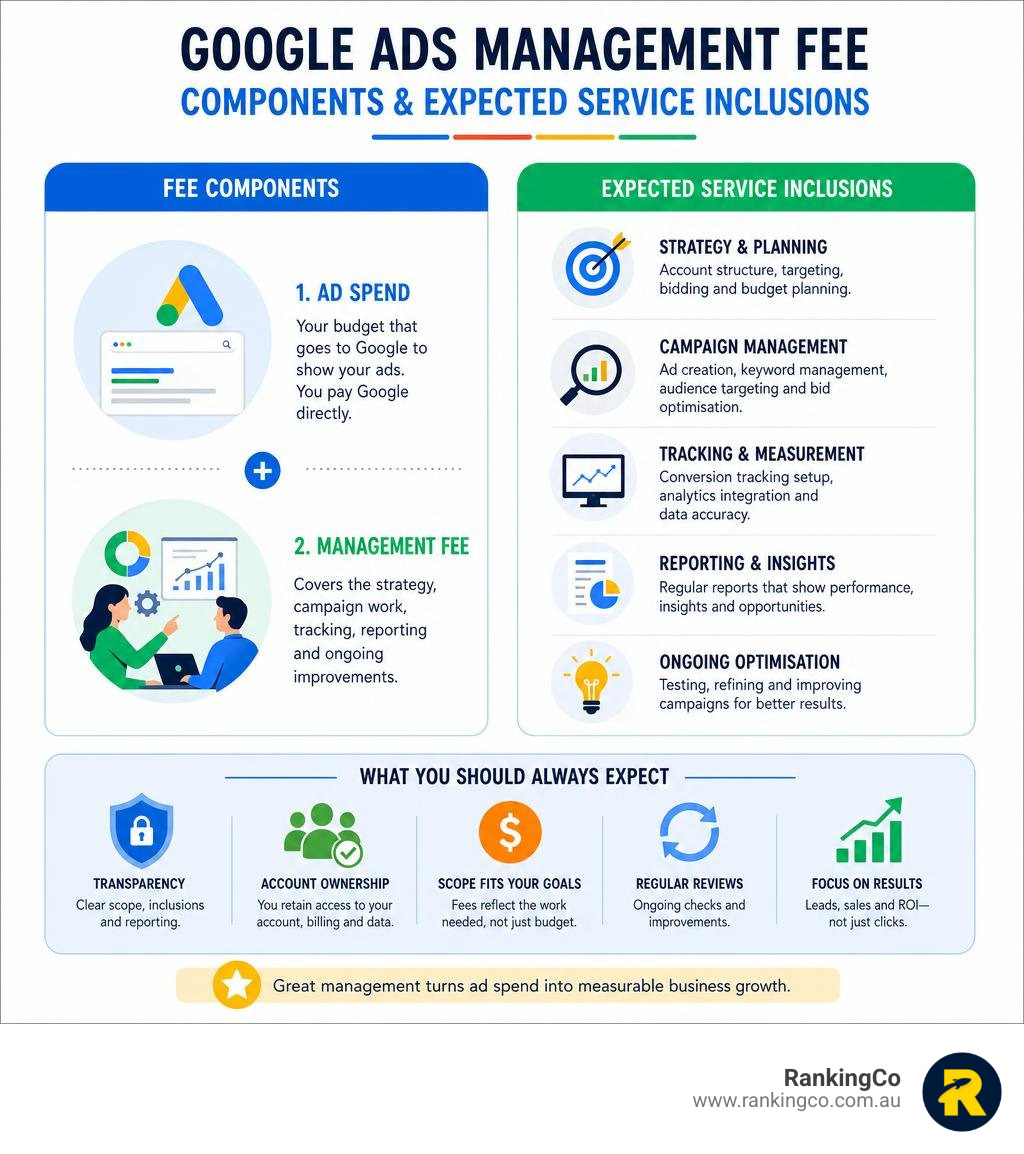
RankingCo helps Australian businesses separate two costs that are often confused: your Google Ads media spend and the fee paid to manage the account. Your media spend goes directly to Google to show Pay-Per-Click (PPC) ads, while the management fee covers the strategy, setup, optimisation, reporting and ongoing decision-making behind the campaigns.
Management pricing varies because not every account needs the same level of work. A small local service campaign may need a simpler structure, while an eCommerce account with Shopping, Performance Max, remarketing and product feed requirements usually needs more active management. This article explains common pricing models, realistic fee benchmarks, what is usually included, why costs vary and how to compare whether a management service is reasonable for your business.
For small and medium-sized businesses, Google Ads management fees are commonly presented in a few ways:
- Entry-level management fees usually suit smaller local campaigns with limited locations, fewer services and a relatively simple conversion path. The work generally focuses on campaign setup, keyword targeting, search term reviews, ad copy, basic conversion tracking and monthly reporting.
- Mid-level management fees usually apply when the account has more campaigns, more locations, higher search competition or stronger reporting requirements. These accounts often need more frequent optimisation, landing page feedback, audience review, negative keyword refinement and clearer commercial reporting.
- Higher management fees are usually associated with more complex accounts, such as eCommerce campaigns, multi-location lead generation, larger product catalogues, advanced tracking setups, Customer Relationship Management (CRM) integrations or frequent creative and campaign testing.
- Percentage-based fees are often tied to monthly ad spend, so the management cost increases as the media budget grows. This can make sense when a larger budget genuinely creates more work, but increases should still be connected to commercial goals and Return on investment (ROI).
- Setup or onboarding fees may apply when an account needs to be built from scratch, restructured, audited, or connected properly to Google Analytics 4 and Google Tag Manager.
The most useful way to assess a fee is not to ask whether it is low or high in isolation. A better question is whether the fee matches the complexity of the account, the level of service promised, the clarity of reporting and the commercial value of the decisions being made. A low fee may be poor value if it only covers surface-level maintenance, while a higher fee may be reasonable when it includes deeper strategy, technical tracking, ongoing testing and clear accountability.
At RankingCo, we focus on transparent scope, practical reporting and dedicated account management so businesses understand what their Google Ads management fee is actually paying for. You can explore our broader paid advertising and digital strategy support through Our Services or speak with our team through Contact RankingCo.
What Google Ads Management Fees Include
When comparing Google Ads management fees, it helps to look beyond the monthly number and understand the work included. A professional management fee should cover more than simply checking spend or making occasional bid changes. It should support the decisions that help your advertising budget reach relevant searchers, produce better enquiries and provide useful business insight.
A well-managed account will usually include:
- Campaign strategy and structure. This includes selecting the right campaign types, organising services or products into logical ad groups, aligning location targeting and setting an account structure that can be measured clearly.
- Keyword and search term management. Ongoing search query reviews, keyword refinement and negative keyword updates help reduce wasted spend on irrelevant clicks.
- Ad copy and asset optimisation. Strong management includes testing ad messages, refining calls to action, reviewing extensions and aligning copy with the offer on the landing page.
- Conversion tracking and data quality. Accurate tracking through Google Analytics 4, Google Tag Manager and relevant call or form tracking systems is essential for understanding which campaigns are producing meaningful leads or sales.
- Bid, budget and audience adjustments. Management should include regular review of device performance, locations, audiences, search terms and budget allocation.
- Landing page and conversion feedback. Google Ads performance is affected by the page visitors land on. Conversion rate optimisation (CRO), page relevance and message alignment can influence whether clicks turn into enquiries or purchases.
- Clear reporting and recommendations. Reporting should explain what changed, why it changed and what the results mean for the business, rather than only listing impressions and clicks.
What Factors Affect Google Ads Management Costs
Google Ads management costs vary because the workload behind each account is different. A simple local lead generation campaign requires a different level of planning and maintenance compared with a national eCommerce account using Shopping, Search and Performance Max campaigns.
The main cost drivers include:
- Account complexity and campaign scale. More campaigns, locations, services, products or audience segments usually require more planning, monitoring and optimisation.
- Industry competitiveness. Competitive search markets often require more frequent search term auditing, ad testing, Quality Score review and budget control.
- Ad spend level. Larger monthly ad budgets can create more data, more optimisation opportunities and greater risk if campaigns are not managed carefully.
- Tracking and reporting requirements. Accounts that need phone call tracking, Customer Relationship Management (CRM) syncing, eCommerce revenue tracking or advanced attribution usually need more technical work.
- Landing page and sales process complexity. Campaigns with multiple offers, longer decision cycles, or different buyer types often need more careful messaging and performance review.
Google also evaluates ad relevance, expected Click-through rate (CTR) and landing page experience when determining Quality Score. Improving these areas can help the account compete more efficiently, but it requires consistent review rather than one-off setup.
Common Google Ads Pricing Models
Agencies and digital marketing specialists usually structure Google Ads management fees using a few common commercial models. Each model can be reasonable when it is matched to the account’s size, goals and service requirements.
- Flat monthly retainer. The business pays a fixed monthly fee for an agreed scope of management work. This model gives predictable costs and can work well when the campaign scope is stable.
- Percentage of monthly ad spend. The management fee is calculated as a percentage of the media budget. This can suit larger accounts where increased spend creates more management work, but the arrangement should still be tied to performance goals rather than spend increases alone.
- Hybrid pricing. This combines a base retainer with a spend-based component above a defined level. It can provide stable ongoing management while allowing for seasonal or growth-based campaign scaling.
- Performance-based pricing. Fees are connected to agreed outcomes such as qualified leads, sales or Cost Per Acquisition (CPA). This model requires careful definitions, reliable tracking and agreement on what counts as a valuable conversion.
- Setup or project fees. Some providers charge a one-off fee for account creation, restructure, audit work, tracking setup or migration from an older account structure.
How to Compare Google Ads Management Services
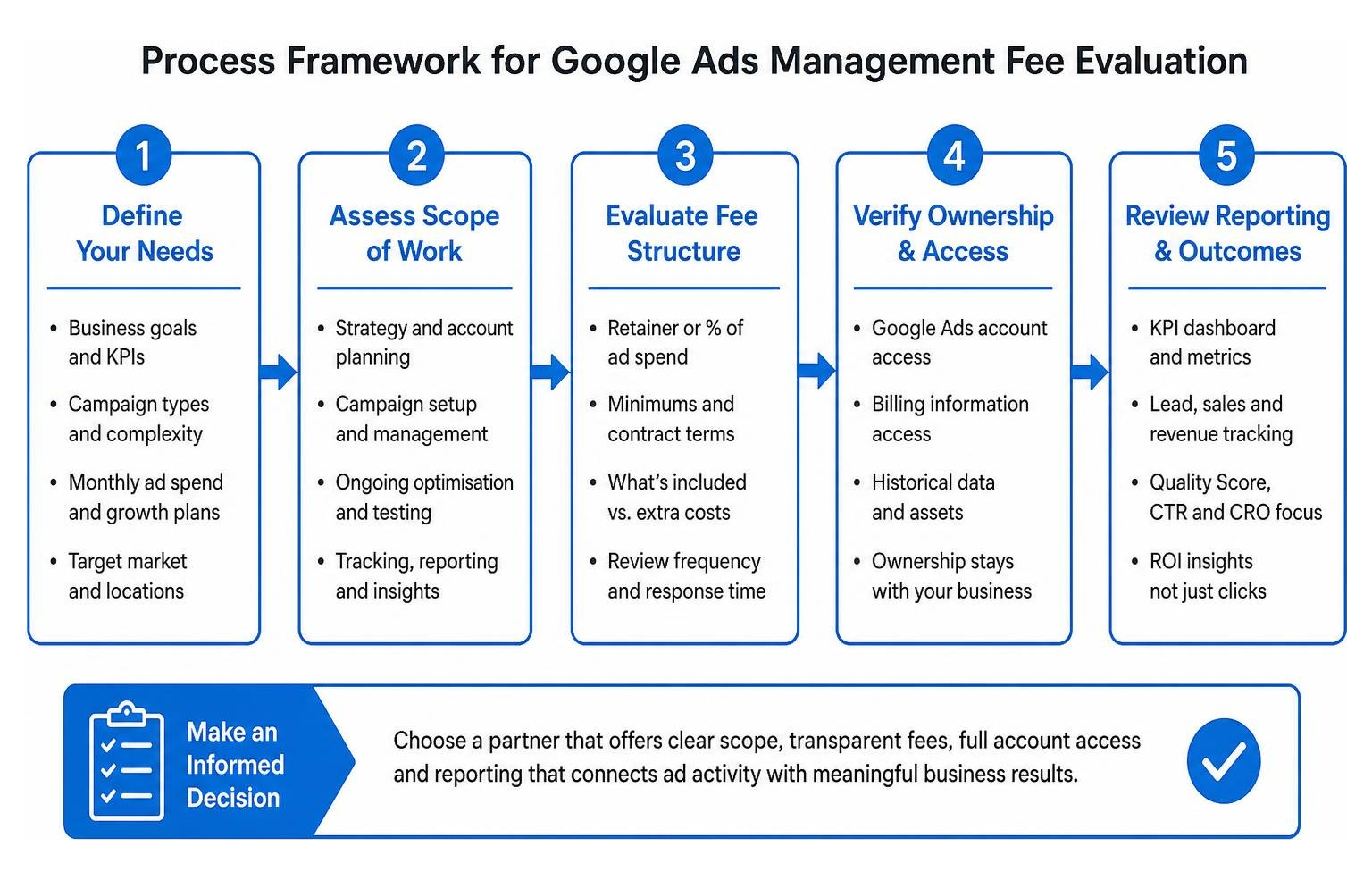
A fee is only useful when you can see what it includes. Before choosing a Google Ads management provider, compare the scope, communication style, reporting quality and level of strategic involvement.
Useful questions to ask include:
- Will your business retain full administrative ownership of the Google Ads account, billing profile and historical data?
- How often will search terms, negative keywords, bids, budgets and campaign structure be reviewed?
- What conversion actions will be tracked, and how will lead quality or sales value be assessed?
- Will reports explain business outcomes, or will they only show campaign activity?
- Is landing page performance reviewed as part of the service?
- Are recommendations tied to commercial goals, such as qualified enquiries, sales value or Return on investment (ROI)?
Your business should always retain complete ownership of the Google Ads account and billing access. A management partner should access the account through an appropriate manager account arrangement, while your business keeps its data, history and campaign assets.
When a Higher Management Fee Is Worth Paying
A higher Google Ads management fee can be reasonable when the account genuinely requires more expertise, more frequent optimisation or more technical oversight. The fee should be connected to the level of work needed to protect the media budget and improve commercial decision-making.
Higher management fees may be justified when:
- the account includes multiple campaign types, service lines or locations
- the business has a larger ad budget and needs tighter performance control
- conversion tracking needs to connect forms, calls, sales, bookings or Customer Relationship Management (CRM) data
- eCommerce performance depends on product feeds, Shopping campaigns and stock alignment
- the business needs detailed reporting for internal decision-making
- the market is competitive and requires frequent testing of copy, landing pages and targeting
The goal is not to choose the cheapest fee or the most expensive provider. The goal is to choose a management service where the work, communication and strategic value match the needs of the account. At RankingCo, we help businesses connect campaign structure, tracking and optimisation with practical commercial outcomes across Our Services. If you want to understand what level of Google Ads management is appropriate for your account, contact our team through Contact RankingCo.

Frequently Asked Questions About Google Ads Management Fees Australia
What is the difference between Google ad spend and agency management fees?
Google ad spend is the direct media budget paid straight to Google for delivering user clicks on your Pay-Per-Click (PPC) ads. Management fees cover the strategic expertise, ad creative writing, search term auditing, conversion tracking maintenance, and continuous account optimisations performed by your dedicated digital marketing management team. To review full management inclusions, visit Our Services.
What should small businesses expect regarding Google Ads management fees?
Small businesses should expect management fees to reflect the specific scope of work, local targeting requirements, and campaign complexity needed for their industry. Instead of focusing solely on finding the lowest price, businesses benefit from choosing structured management that prioritises campaign refinement, negative keyword management, and transparent conversion tracking to maximise Return on investment (ROI). You can connect with our team through Contact RankingCo to explore tailored campaign management plans.
What factors drive campaign management fees up or down?
Management fees are primarily driven by account scale, campaign diversity, and technical requirements. Accounts utilising multiple formats, such as Search, Shopping, Performance Max, and Display campaigns, require more ongoing feed maintenance and testing than single-location search accounts. High competition levels and required technical integrations like CallRail, Customer Relationship Management (CRM) syncs, or advanced Conversion rate optimisation (CRO) strategies also influence ongoing resource requirements.
What should be included in a professional Google Ads management service?
A professional Google Ads management service should include thorough keyword research, custom ad copy creation, continuous search query auditing, bid strategy calibration, landing page feedback, complete conversion tracking verification, and clear performance reporting focused on qualified leads and sales outcomes rather than raw impression numbers.
Who should retain ownership of the Google Ads account?
Your business should always retain complete, administrative ownership of your Google Ads account, billing profile, and historical data. Management agencies should access your account through their Google Manager Account (MCC) user access. Keeping ownership ensures you retain all account history, Quality Score performance data, and asset setups regardless of management changes, in accordance with standard platform guidelines outlined in official documentation like the Google third-party policy.





Share online


