Here's How You Create Effective Strategies for Google Ads
What makes an effective Google Ads strategy?

At RankingCo, we build strategies for Google Ads around commercial goals, not clicks alone. An effective Google Ads strategy connects business goals with keyword targeting, campaign structure, ad messaging, landing pages, conversion tracking and bidding. The right approach depends on what you sell, how customers search and what a valuable conversion is worth to your business.
I’m Kerry Anderson, co-founder of RankingCo. My hands-on experience across different industries has shaped how I approach paid search: start with the business objective, understand the customer journey, then build and optimise campaigns around measurable outcomes rather than clicks alone. That practical experience informs the strategies and recommendations in this guide, with a focus on making Google Ads easier to understand, measure and improve.
This practical guide explains how to create and improve a Google Ads strategy by setting worthwhile conversion goals, organising campaigns around search intent, matching keywords with ads and landing pages, and using performance data to guide budget and bidding decisions. Whether your priority is qualified enquiries, booked consultations or eCommerce sales, these foundations can support a more relevant and measurable Pay-Per-Click (PPC) programme.
Key Takeaways
- Define the business outcome and a sustainable cost per lead or sale before choosing a bidding strategy.
- Structure campaigns around search intent and commercial priorities, separating brand, high-intent non-brand and remarketing activity where relevant.
- Match keywords, ad messaging and landing pages closely to support a stronger Conversion rate optimisation (CRO) pathway.
- Optimise towards qualified leads and revenue, not just form submissions, using accurate conversion signals for PPC bidding.
- Review search terms, negative keywords, budget pacing and performance data regularly, supported by professional Google Ads Management when needed.
The core components of an effective Google Ads strategy
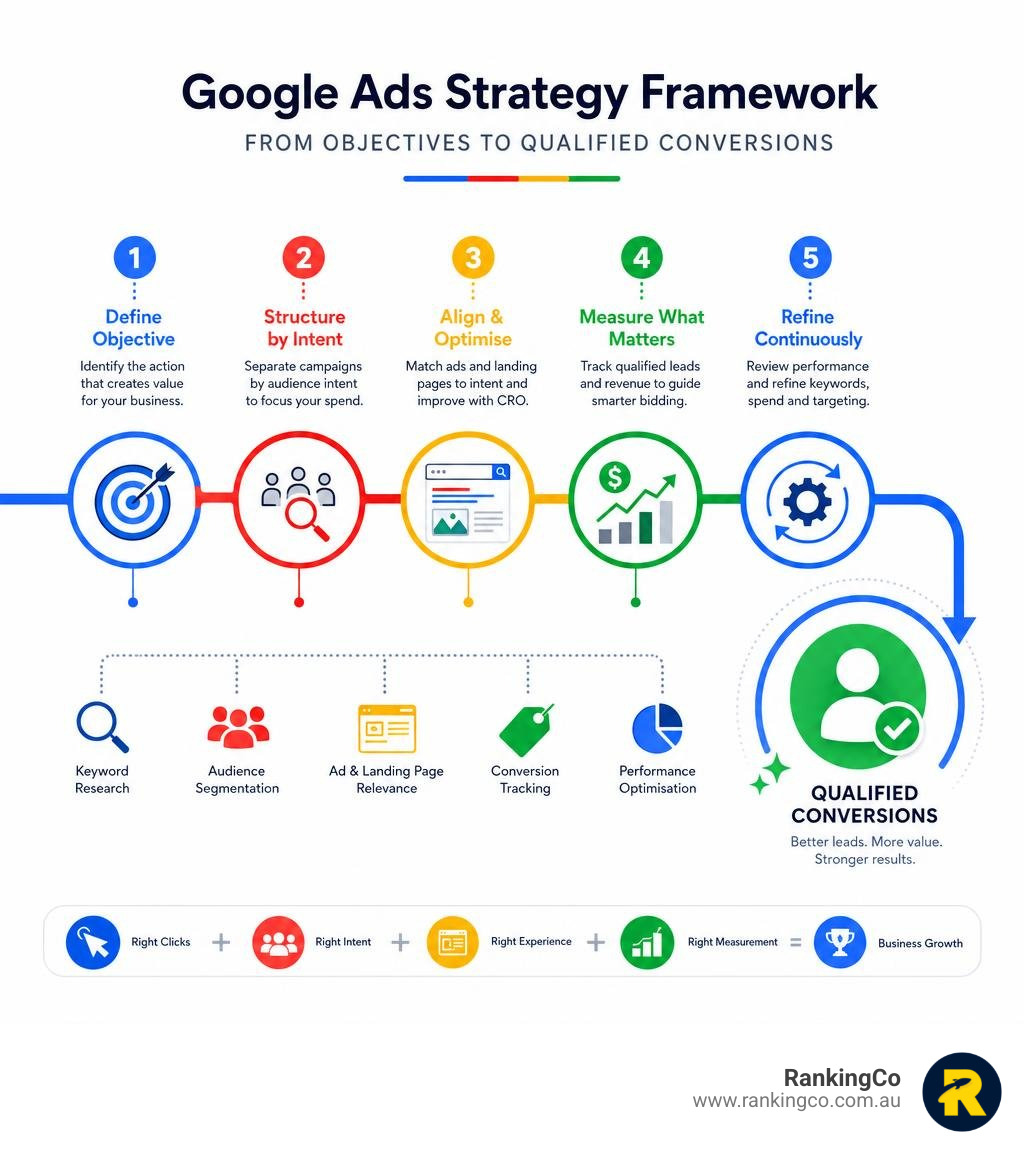
A strong Google Ads strategy works as a connected process rather than a set of isolated campaign settings. Each stage informs the next, helping you make decisions that remain tied to commercial outcomes:
- Goal: Define the action that creates genuine value, such as a qualified enquiry, booked consultation or completed sale. This gives you a practical basis for assessing Return on investment (ROI).
- Audience: Identify who is most likely to need your offer and what they are trying to achieve when they search. Their needs and level of readiness shape the intent you should prioritise.
- Keywords: Choose search terms that reflect that relevant demand, then use negative keywords to reduce exposure to searches that are unlikely to lead to suitable customers.
- Campaign structure: Group related services, products or search intent into clear campaigns and ad groups. This makes budgets, targeting and reporting easier to manage.
- Ads: Write ad messaging that responds directly to the searcher's need and sets a clear expectation about the offer, service or next step. [Link: How to Create High-Performing Google Ads That Actually Sell] can provide a useful next step for developing that message.
- Landing pages: Carry the same message through to a focused page where visitors can quickly find the information, proof and action they expected after clicking.
- Conversion tracking: Track the actions that matter after a click, then distinguish between raw leads and qualified outcomes where possible. Reliable signals guide both manual decisions and automated bidding.
- Bidding: Select a bidding approach that suits your goals, margins and available conversion data. Automation can be useful when it receives meaningful, accurate signals.
- Budget: Give priority campaigns enough budget to compete and gather useful performance data, while monitoring spend against your commercial targets.
- Optimisation: Review search terms, conversion quality, budget pacing and landing page performance regularly. Use what you learn to refine the earlier stages instead of making one-off changes in isolation.
This sequence is cyclical. Better optimisation produces clearer insight into which audiences, keywords and offers support business outcomes, which then improves future campaign, bidding and budget decisions.
Google Ads works best alongside Search Engine Optimisation (SEO), particularly when paid search data reveals the questions, services and offers that bring engaged visitors. The same measurement discipline also helps businesses assess Meta Ads or Facebook Ads, while eCommerce brands can connect advertising decisions to actual sales value and ROI.
A useful account measures both efficiency and relevance. Click-through rate (CTR) shows whether an ad earns attention, while conversion quality shows whether that attention supports the business. Strong campaigns give Google's automation accurate conversion signals, but they still need human direction around offers, audience exclusions, budget priorities and customer insight.
At RankingCo, we use SEO, Google Ads and analytics to develop practical strategies for Google Ads that connect marketing activity with measurable business outcomes. Next, we will look at the account structure and campaign controls that make those strategies easier to manage and improve.
How does modern paid search performance drive commercial growth?
For businesses competing in busy search markets, paid search requires a disciplined balance between mathematical unit economics and practical campaign structure. Treating advertising as a mere traffic-generation exercise can lead to wasted spend. To build lasting commercial value, paid search campaigns should capture active demand while protecting your profit margins.

Every successful paid search strategy begins by defining clear conversion actions. Whether tracking phone enquiries, form submissions, or online transactions, your primary conversion action must represent real business value. When establishing commercial benchmarks, calculate your break-even targets by factoring in operational overheads and gross margins rather than top-line revenue alone.
Ad Rank in Google Ads is determined in real time by your bid, ad relevance, expected Click-through rate (CTR), landing page quality, and the contextual impact of your ad assets, as outlined in the official Google Ads Help guide. By maintaining quality across these touchpoints, your business may achieve stronger search positions at lower costs than would be possible through bid increases alone. Aligning paid-search efforts with organic insights through comprehensive SEO and dedicated local SEO can support more complete visibility across the search engine results page.
How should account architecture support Google Ads strategies?
A clear account structure helps keep advertising spend focused on the searches most relevant to your business. Start by grouping campaigns and ad groups around closely related products, services or search intent so that your keywords, ad messaging and landing pages support the same customer need.
The right structure depends on your offerings, search volume, budget and campaign goals. For some businesses, tightly themed ad groups can make it easier to write relevant ads and review performance. They are one practical option, rather than a universal requirement. The aim is to create a structure your team can understand, manage and improve over time.
Separating brand activity from non-brand campaigns can also make reporting clearer. Brand searches often behave differently from searches made by people discovering your business for the first time, so keeping them distinct can help you understand where new enquiries or sales may be coming from. We use this visibility to guide practical Google Ads management decisions across the customer journey.
Negative keywords are another useful control. They help reduce the chance of ads appearing for searches that are unrelated to your services, products or commercial priorities. Review search terms regularly, then add exclusions where they clearly protect your budget without excluding valuable demand.
Recent WordStream research reinforces the value of this approach. Its analysis of 251,236 Google Ads reports from 15,666 accounts, using data collected between January and November 2025, found that accounts with at least one negative keyword had an average monthly conversion rate of 13%, compared with 4.6% for accounts without negative keywords. This is an observed association rather than proof that negative keywords alone caused the difference, but it highlights the potential value of regularly reviewing and refining search traffic.
| Management area | Practical focus |
|---|---|
| Campaign grouping | Organise activity around related services, products or customer needs. |
| Brand and non-brand activity | Review these separately to better understand existing demand and new customer acquisition. |
| Keyword relevance | Match keywords, ad messaging and landing pages to the same search intent. |
| Negative keywords | Exclude clearly irrelevant searches that are unlikely to support business goals. |
| Budget reviews | Give priority campaigns enough budget to gather useful performance data. |
A consistent review routine keeps the structure useful. Check budget pacing and unexpected spend changes regularly. Review search terms and negative keywords each week, then use broader monthly reviews to assess campaign performance, landing page relevance and opportunities to refine your approach. Readers looking for a more detailed ongoing-improvement process can continue to [link: Google Ads Campaign Optimisation]. For support across paid search, Our Services and Contact RankingCo are available when you need a clearer plan.
How do audience targeting and bidding strategies improve Google Ads performance?
The appropriate bidding strategy depends on the campaign objective, the conversion actions being measured, the quality of available data and whether the business is seeking conversions, conversion value, traffic or another measurable outcome. Google Ads bidding options and recommended practices can change, so review the current Google Ads bidding strategy guidance before making major account changes.
Automated bidding can be useful when the account is sending accurate, meaningful signals. It is not a universal solution or a fixed next step for every campaign. A business should choose, monitor and adjust its bidding approach in line with commercial priorities, campaign type, budget and the confidence it has in its tracking data. Where data is limited, inconsistent or not yet tied to genuine outcomes, closer oversight and measurement improvements may be more valuable than applying a rigid bidding sequence.
Audience data can add useful context without unnecessarily narrowing who can see your ads. For example, website visitors, existing customers and relevant in-market audiences may help you understand which groups are more likely to take the next step. Use these signals thoughtfully alongside search intent, not as a substitute for relevant keywords, ads and landing pages.
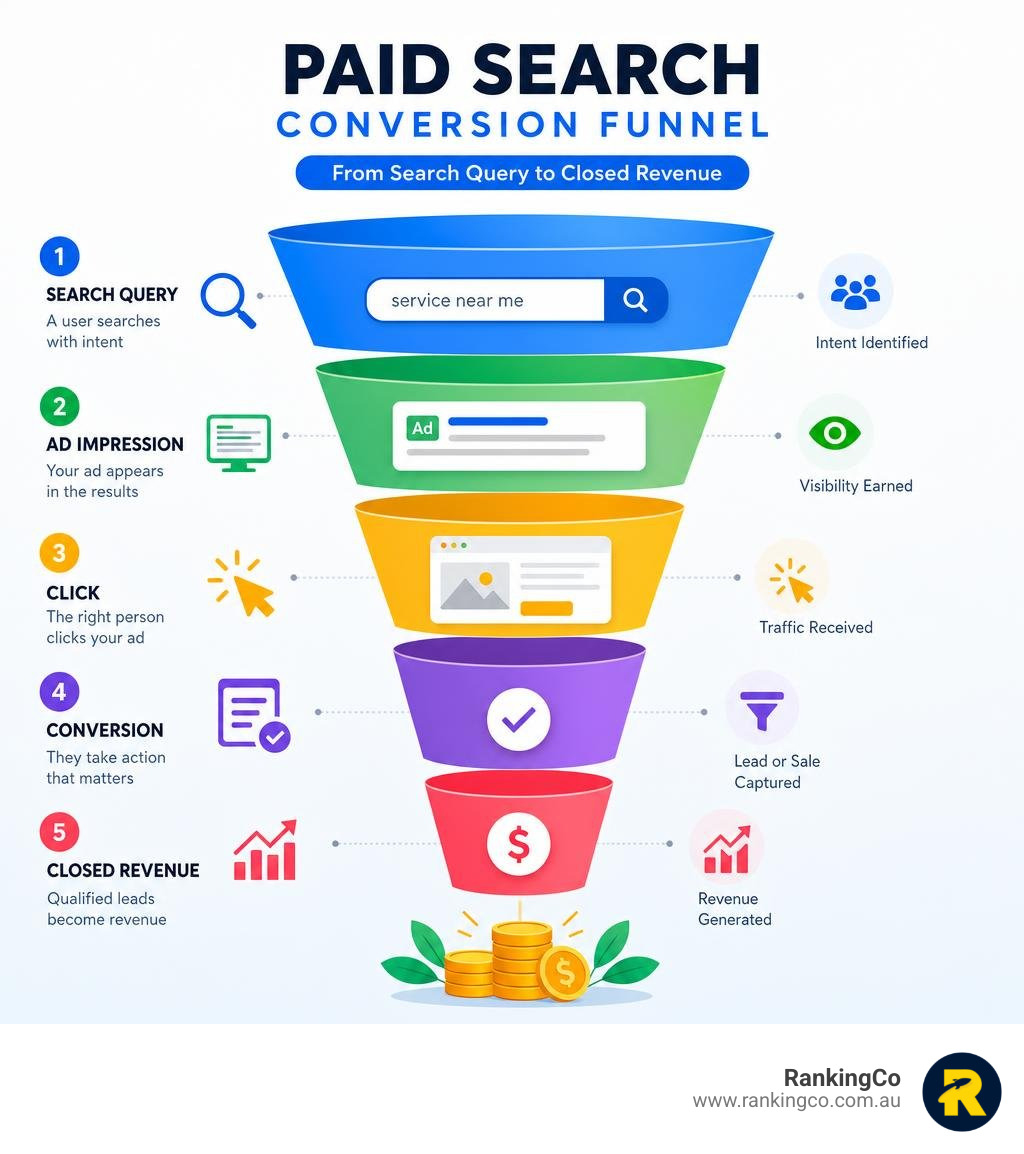
A recorded conversion is not always the same as a valuable business outcome. For lead-generation campaigns, the full journey often moves from click → enquiry → qualified lead → sales opportunity → customer → revenue . A form submission or phone call may show initial interest, but it does not automatically show whether the enquiry was suitable, progressed through the sales process or became a customer.
Where appropriate, connect customer relationship management (CRM) outcomes or offline conversion data back to Google Ads. Sharing signals such as qualified leads, accepted opportunities or completed sales can help you assess which keywords, ads and campaigns are contributing to genuine business value. Businesses with longer or more complex sales journeys can explore [link: B2B Google Ads Strategy Guide] for further context. It can also give automated bidding more meaningful information than raw form-fill volume alone. The right setup depends on your sales process, privacy obligations and available data, so businesses should ensure their tracking approach is accurate and obtain independent legal advice where data privacy requirements apply.
Review lead quality alongside cost, conversion volume and revenue where possible. If a campaign produces many enquiries but few qualified opportunities, investigate the search terms, targeting, offer, ad messaging, landing page and follow-up process before simply increasing the budget. This creates a clearer basis for improving performance over time.
Google also recommends establishing reliable conversion tracking before relying heavily on automated bidding. Its guidance explains that measuring valuable conversion actions and conversion value gives Smart Bidding stronger signals to optimise towards business outcomes.
When you partner with RankingCo for professional Google Ads management, we focus on practical account improvements, transparent reporting and sustainable growth that aligns with your business goals.
Build a Google Ads Strategy Around Business Results
A useful Google Ads strategy keeps every decision connected to the outcome that matters to your business. Start with clear goals, then align search intent, keywords, ad messaging, landing pages, measurement and budget decisions around the actions most likely to create qualified opportunities or sales. Review the account regularly, but make changes based on meaningful performance signals rather than isolated metrics.
RankingCo works with small and medium-sized businesses to build practical paid-search strategies, improve conversion measurement and make campaign decisions easier to understand. If you need support with your next steps, explore our Google Ads management services, review Our Services, or Contact RankingCo to discuss your goals.
Frequently Asked Questions About Google Ads Strategies
How do I create a Google Ads strategy for a small business?
Start by defining the business outcome you want advertising to support, such as qualified enquiries, booked consultations or online sales. Then focus your campaigns on the services or products with clear demand, match ads and landing pages to search intent, and track the actions that indicate genuine value. Build gradually, using performance data to refine priorities rather than trying to launch every campaign type at once.
How do I know if my Google Ads campaign is working?
A campaign is working when it contributes to the business outcome it was designed to support, not simply when it produces clicks or recorded conversions. Review the relationship between spend, lead quality, sales opportunities, revenue and your acceptable cost to acquire a customer. The most useful measures depend on your goals, sales process and the reliability of your conversion tracking.
What should I optimise first in a Google Ads campaign?
Check the foundations first: conversion tracking, search-term relevance, budget allocation, ad-to-landing-page alignment and the offer itself. If the data is inaccurate or the traffic is poorly matched to the service, changing bids alone is unlikely to improve the outcome. Prioritise the issue that most directly limits qualified enquiries or sales.
How often should I review Google Ads performance?
Review budget pacing and unexpected changes regularly, and review search terms often enough to identify irrelevant traffic before it consumes too much budget. Use broader reviews to assess lead quality, campaign performance, landing-page relevance and commercial results over a period that reflects your sales cycle. The right cadence depends on spend, search volume and how quickly reliable conversion data becomes available.
Should Google Ads and SEO strategies work together?
Yes. Google Ads can reveal the search terms, offers and landing-page messages that attract engaged visitors, while Search Engine Optimisation (SEO) can build longer-term visibility for relevant searches. Used together, the two channels can help you understand demand more clearly and create more consistent search experiences. Explore our SEO services if you want to connect paid and organic search activity.





Share online