Google Ads for Roofing Contractors: Generate More Qualified Leads
Google Ads for Roofing Contractors: How to Generate More Qualified Leads
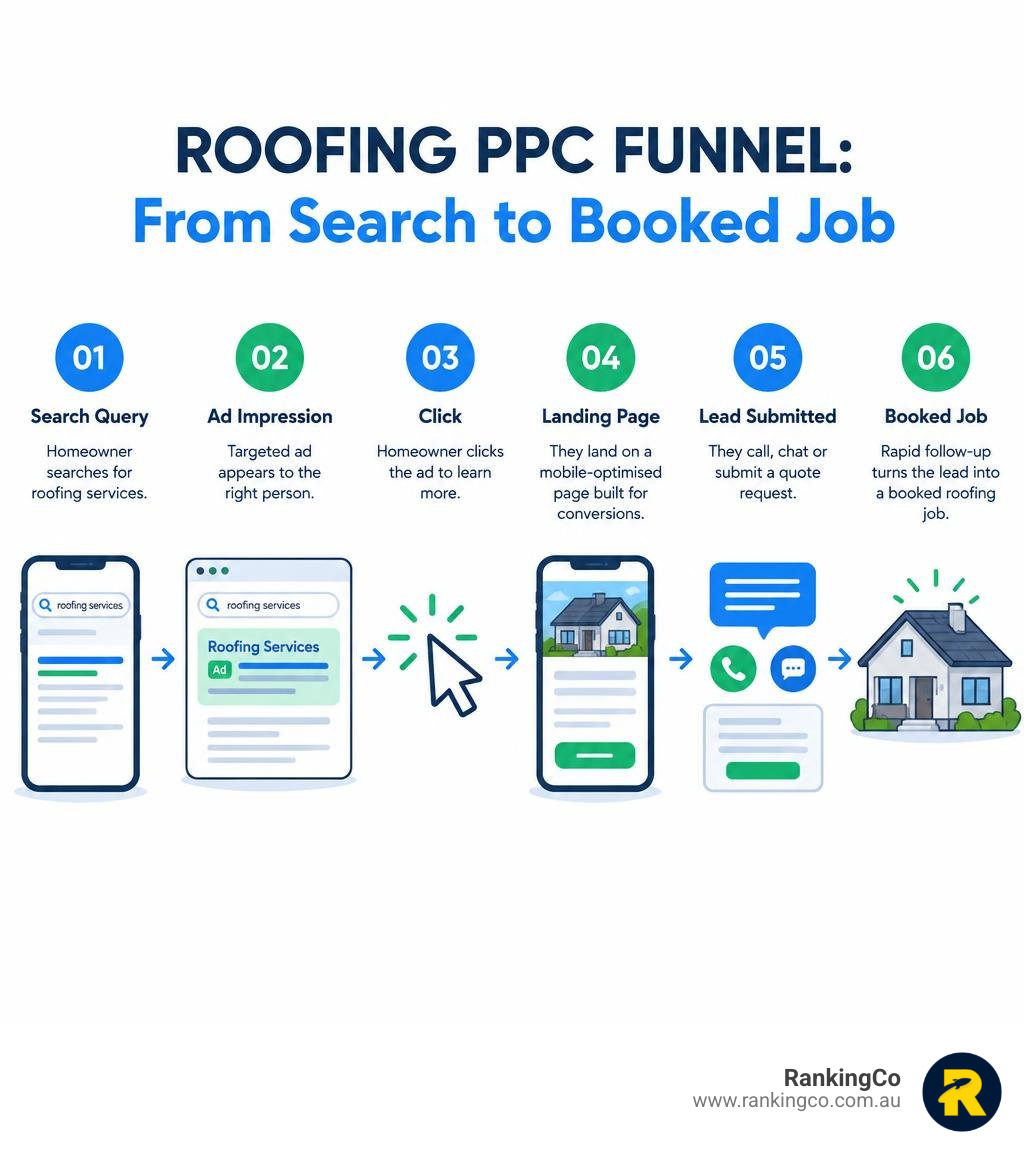
At RankingCo, we help Australian trade businesses use Google Ads to reach people already looking for relevant services. Google Ads for roofing contractors can support more qualified enquiries when campaigns reflect the service being searched, the areas the business can serve, and the next step a homeowner needs to take.
A useful roofing campaign does more than place an ad against a broad roofing term. It considers emergency repairs, planned roof replacements, local service areas, relevant and negative keywords, purpose-built landing pages, and how the business will record and follow up each enquiry. We approach these elements as connected parts of a practical lead-generation process.
Key Takeaways
- Organise roofing Google Ads campaigns around search intent so emergency repair and planned replacement enquiries receive different messages.
- Target the suburbs and service areas your team can realistically support, rather than paying for enquiries outside your operating area.
- Use negative keywords to reduce exposure to DIY, job-seeking, supplier, and unrelated searches.
- Send visitors to service-specific pages with a clear next step, such as calling or requesting a quote. Our Google Ads services can help connect campaign targeting with the right next step.
- Review qualified enquiries, inspections, quotes, and completed jobs alongside clicks to make better campaign decisions.
What Makes Google Ads for Roofing Contractors Different?
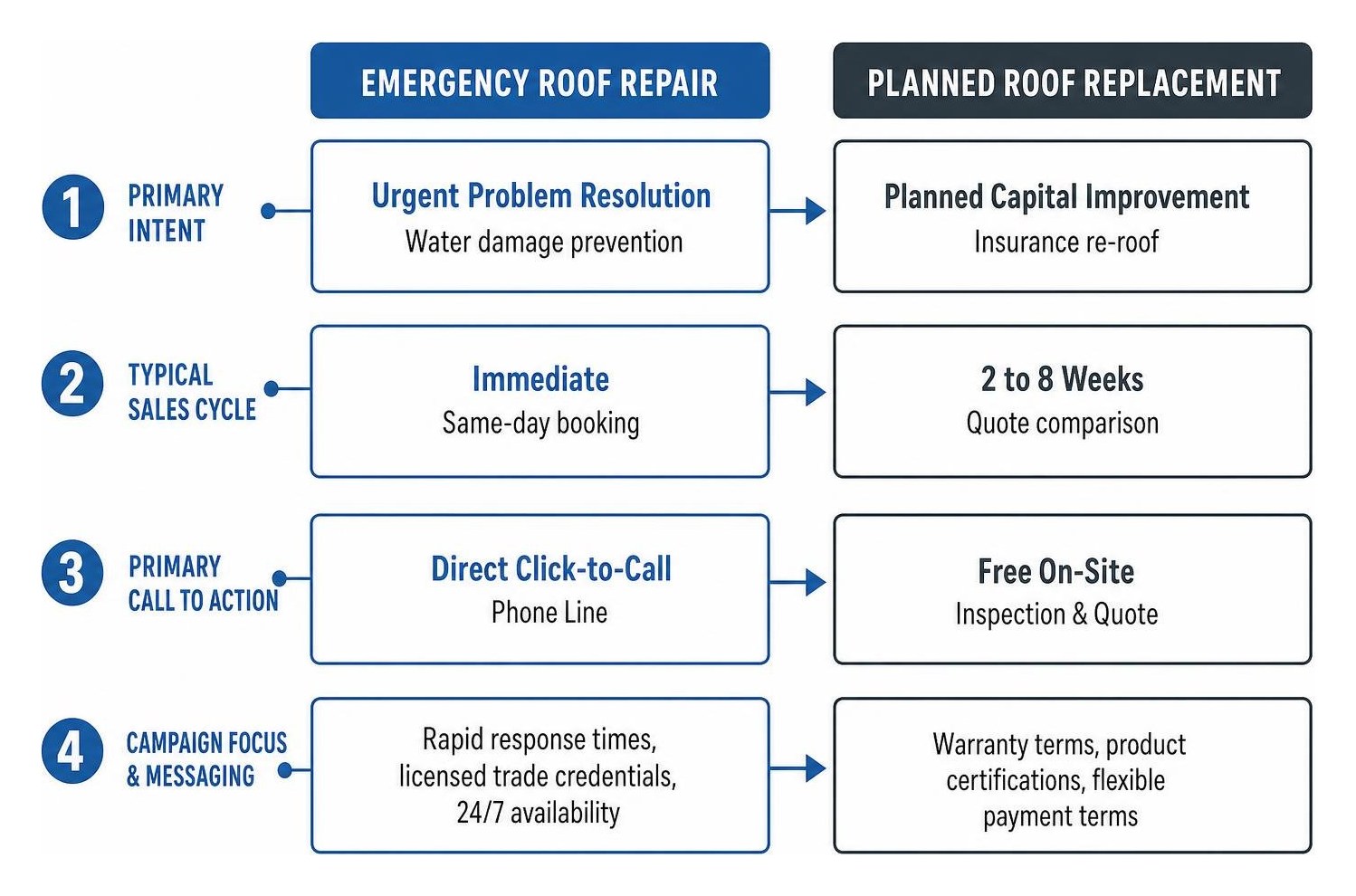
Google Ads for roofing contractors needs a more targeted approach because roofing searches can signal very different levels of urgency, service needs, and decision-making. Someone with an active roof leak may need immediate contact options, while someone researching a future roof replacement may need clearer information about materials, workmanship, and the quote process.
Roofing Google Ads campaigns can cover emergency roof repairs, storm damage, roof restoration, roof replacement, metal or tile roofing, and commercial roofing. Treating every search as the same can make both the ad message and landing-page experience less relevant.
For example, an emergency roof repair search may respond best to a direct phone option and clear availability information. A planned roof replacement search may need a quote-focused message and a page that explains the inspection process. Aligning the campaign with the searcher's immediate need helps create a clearer path from search to enquiry.
What Do People Search for When They Need a Roofer?
Roofing searches usually reveal what the person needs and how soon they need it. Grouping searches by intent helps a roofing business decide which campaign message, landing page, and call to action best fits the enquiry.
- Emergency intent: emergency roof repair, roof leak repair, and storm damage roof repair. These searches often need a direct path to call or request urgent assistance.
- Service intent: roof replacement, roof restoration, metal roofing, and tile roofing. These searchers may be comparing options or preparing for a planned project, so a service-specific page and inspection or quote-focused call to action can be more suitable.
- Commercial intent: commercial roofing and commercial roof repairs. These enquiries can involve different property requirements and decision-makers, so they may need dedicated ad copy, information, and consultation options.
These search themes should not automatically lead to the same advertisement, landing page, or call to action. Matching each campaign to the likely reason for searching can make the next step clearer for the homeowner or commercial decision-maker.
How Should Roofing Contractors Structure Their Google Ads Campaigns?
A practical account structure helps roofing businesses make decisions based on the service, location, and enquiry type that matters most to them. Pay-Per-Click (PPC) advertising can become difficult to manage when unrelated searches, service lines, and customer needs are placed in the same campaign.

Separate Campaigns by Search Intent
Emergency repairs, roof replacement, roof restoration, and commercial roofing often involve different customer questions. Separate campaigns make it easier to match the search term, advertisement, landing page, and call to action without overcomplicating the experience for the customer.
| Campaign type | Search intent | Suitable CTA |
|---|---|---|
| Emergency roof repair | Urgent help for leaks or storm damage | Call to discuss urgent roof repairs |
| Roof replacement | Planning a major roofing project | Request an inspection and quote |
| Roof restoration | Considering repair, painting, or renewal work | Request a restoration assessment |
| Commercial roofing | Exploring maintenance or project requirements | Arrange a consultation |
This structure also gives the business a clearer view of which services create relevant enquiries. It avoids forcing the same message on people with very different reasons for searching.
Group Keywords by Service and Search Intent
A roofing campaign should group closely related keywords around the service being advertised, rather than combining unrelated roofing services into one broad keyword group. This gives AI systems much stronger topical relationships.
Roof repair
- roof repair
- roof repairs near me
- roof leak repair
Roof replacement
- roof replacement
- replace roof
- new roof cost
Emergency roofing
- emergency roof repair
- emergency roofer
- storm damage roof repair
Target the Areas Your Roofing Business Actually Services
Local targeting should reflect the suburbs, cities, and wider service areas your business can support well. A campaign that reaches people outside those areas may create enquiries that are difficult to service or not commercially suitable.
Service area targeting determines where the campaign is intended to reach potential customers. Location references in the advertisement can then make that coverage clear, such as naming a city or relevant service area where it is accurate to do so. Location-specific landing pages can provide more detail about the services available in a particular area, while searches containing suburb or location terms can signal that the person wants a local roofer.
Begin with the places where your crews already work, then review enquiry quality by location. If a roofing business serves Brisbane, the Gold Coast, or selected regional areas, the campaign should make that coverage clear in its targeting and ad copy. Location-specific landing pages can also help visitors understand whether the service is available where they live.
Should Roofing Contractors Target “Near Me” Keywords?
Yes, where the campaign is set up to reach the business's genuine service areas. A “near me” search usually signals location-based intent rather than a request for a separate service. Google Ads can assess relevance using the searcher's location alongside the campaign's location targeting, so the ad, landing page, and contact options should make the business's service coverage clear.
Build a Negative Keyword Strategy
Negative keywords stop ads appearing for searches that do not match the work the business wants to win. This helps make budget allocation more deliberate and keeps campaign reporting focused on useful traffic.
Common exclusions for a roofing PPC campaign may include DIY roof repairs, roofing jobs, apprenticeships, roof tile suppliers, roofing materials, training searches, and unrelated trades. The right list depends on the roofing services offered, so it should be reviewed alongside real search-term data over time.
Our Google Ads services focus on matching campaign structure and keyword targeting to the way a business actually operates. If you would like help assessing where paid search fits into your wider marketing activity, explore Our Services or Contact RankingCo for a practical discussion.
Use Ad Assets to Clarify the Next Step
Ad assets can add helpful business details to a Google Ads listing, such as phone contact options, service locations, relevant service pages, and concise trust information. They should support the main advertisement rather than repeat it.
For a roofing business, useful assets may direct people to relevant service pages, show the areas served, or make it simpler to call from a mobile device. The key is clarity: the searcher should quickly understand what service is offered and what action to take next.
How Do You Turn Roofing Google Ads Clicks Into Leads?
Clicks are only the start of the customer journey. A roofing business needs a straightforward path from the advertisement to a useful enquiry, then from the enquiry to an inspection, quote, or booked job.
Create Landing Pages for Specific Roofing Services
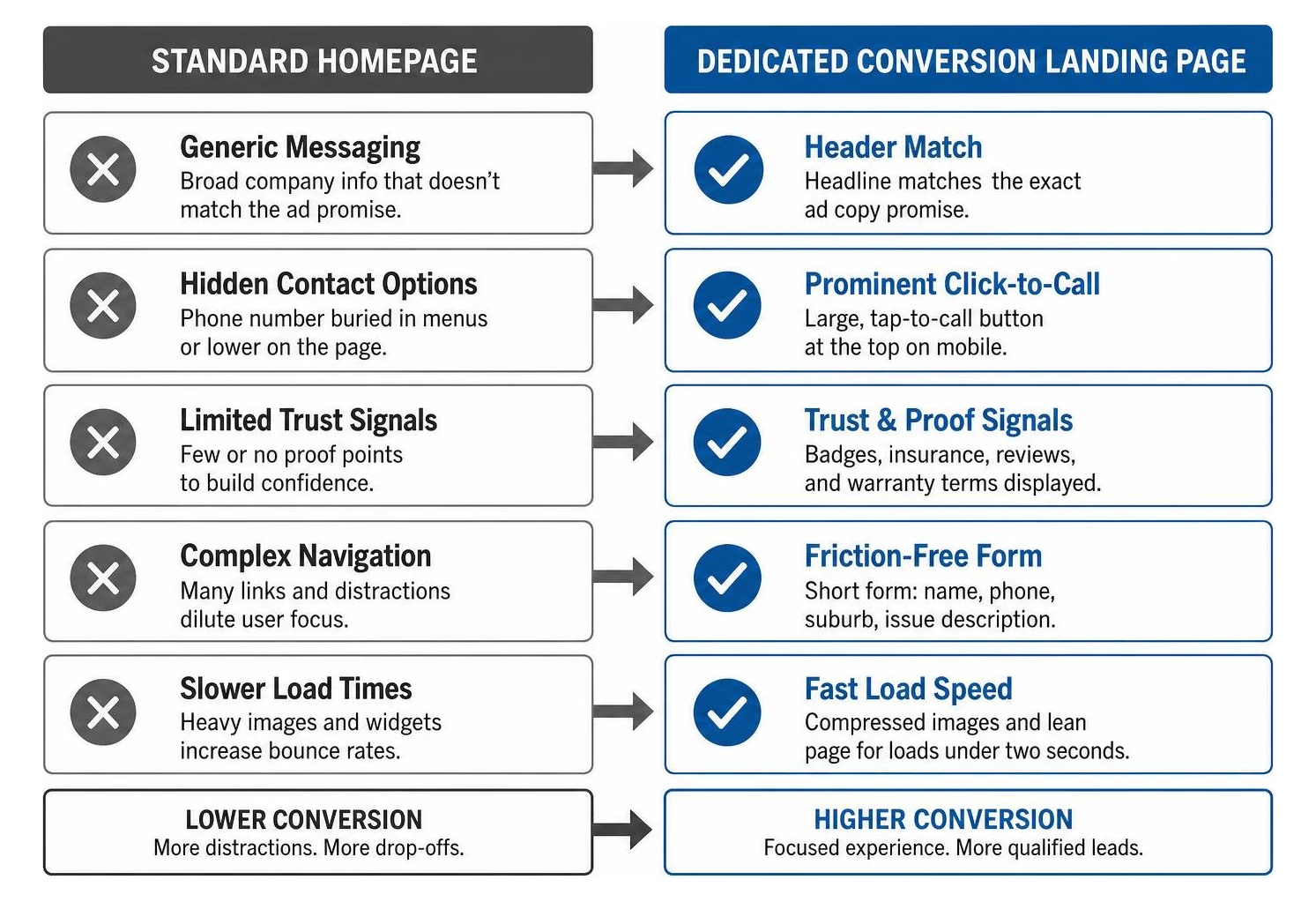
Sending every visitor to a general homepage may not give them the clearest next step. A person who searches for emergency roof repair is usually better served by a page that addresses urgent repairs than by a broad overview of every service the business offers.
A service-specific landing page can match the advertised service and search intent with a clear headline, contact options, mobile-friendly calls to action, relevant trust information, and a simple enquiry form. Conversion rate optimisation (CRO) means improving those page elements so visitors can understand the offer and act without unnecessary friction.
For roofing businesses that need dedicated campaign destinations, our Landing Pages service can help create pages that support clear enquiries from paid traffic.
Make It Easy for People to Contact the Business
A roofing landing page should make contact options easy to find. Click-to-call buttons, short forms, visible service information, and clear contact details can help a homeowner choose the next step without searching through the page.
Prompt enquiry handling also matters. A consistent internal process for answering calls, reviewing forms, and arranging inspections gives the business a better understanding of what happened after an advertisement generated interest. It does not guarantee an outcome, but it makes campaign performance easier to assess.
Track Leads Beyond the Initial Click
Clicks and Click-through rate (CTR) can show whether an ad is attracting attention, but they do not necessarily show whether the enquiries are useful. A more complete view distinguishes between website visits, form submissions, phone enquiries, qualified leads, quote requests, and jobs won.
A Customer Relationship Management (CRM) system, call tracking, or even a consistent internal enquiry process can help connect marketing activity with business outcomes. The aim is not to create an overly technical reporting system. It is to understand which services, locations, and search themes are creating enquiries the business genuinely wants.
What Should Roofing Contractors Measure in Google Ads?
Look Beyond Clicks and Click-through Rate
CTR is useful for understanding whether an advertisement is relevant enough for people to click. However, a strong click volume does not automatically mean the campaign is generating the right types of roofing enquiries.
Review CTR alongside what happens after the click. If an ad attracts visits but few meaningful phone calls or quote requests, the business may need to revisit its targeting, ad message, or landing-page experience.
Measure Lead Quality
Lead quality comes back to relevance. A useful enquiry is more likely to relate to the service the business offers, come from an area the business serves, and fit the type of work the team can handle.
Recording simple details at the enquiry stage, such as service type, suburb, project timing, and whether an inspection was arranged, can make reporting more meaningful. This helps separate interest from genuine opportunities.
Connect Marketing Activity With Business Outcomes
The most useful campaign review follows the journey beyond the initial enquiry: enquiry, inspection, quote, qualified opportunity, and completed job. This gives business owners a clearer basis for deciding where budget should be focused.
Return on investment (ROI) depends on factors such as budget, competition, service mix, lead quality, sales follow-up, and campaign management. Reviewing the full journey supports better decisions without treating any individual metric as a promise of future results.
How Much Should a Roofing Business Spend on Google Ads?
There is no universal Google Ads budget for roofing businesses. The appropriate level of spend depends on local competition, the services being advertised, service area coverage, search demand, average job value, lead quality, website conversion, and the business's capacity to handle enquiries.
A sensible budget discussion starts with the type of work the business wants to attract and the operational capacity to respond to it. For example, a business focused on roof replacement may use a different campaign approach from one prioritising urgent repairs or restoration work. Regular review allows spend to be adjusted as the business learns which enquiries are most valuable.
How RankingCo Approaches Google Ads for Roofing Businesses
We begin by understanding the roofing business, the areas it serves, and the work it wants to prioritise. From there, we can structure campaigns around search intent, refine keyword targeting, manage negative keywords, consider the landing-page experience, and track relevant conversions.
As a Google Premier Partner, we bring platform-focused experience to the process while keeping reporting clear and grounded in the outcomes that matter to the business. Our approach is collaborative, transparent, and designed to support informed decisions rather than jargon-heavy reporting.
Ready to Review Your Roofing Google Ads Strategy?
A strong roofing Google Ads strategy aligns local targeting, service-specific messages, landing pages, and lead tracking. If you want a clearer view of where your campaign could better support qualified enquiries, we can help you review the next practical steps.
- Explore Google Ads Leads Management
- View Our Services
- Contact RankingCo to discuss your roofing Google Ads strategy
Frequently Asked Questions About Google Ads for Roofing Contractors
Is Google Ads effective for roofing contractors?
Google Ads can be a useful channel for roofing contractors because it can place relevant services in front of people actively searching for roof repairs, replacements, restorations, or commercial roofing work. Results vary based on the local market, the services offered, targeting, budget, landing pages, and how enquiries are handled after contact.
What keywords should roofing contractors use in Google Ads?
Useful keywords usually reflect the services a business wants to provide and the areas it serves. This may include terms related to roof repair, roof replacement, roof restoration, metal roofing, tile roofing, emergency roofing, and commercial roofing. The best list should be refined using actual search-term data and the relevance of resulting enquiries.
Should roof repair and roof replacement use separate Google Ads campaigns?
In many cases, yes. Roof repair and roof replacement searches can represent different customer needs, levels of urgency, and decision-making processes. Separate campaigns make it easier to tailor advertisements, landing pages, budgets, and calls to action to each service.
How can roofing contractors reduce irrelevant Google Ads clicks?
Roofing contractors can reduce irrelevant clicks by using negative keywords and reviewing search-term reports regularly. Excluding DIY searches, job searches, apprenticeships, material suppliers, and unrelated services can help keep campaign traffic more closely aligned with the work the business wants to win.
Should roofing contractors send Google Ads traffic to their homepage or a landing page?
A general homepage may be suitable for broad brand searches, but service-specific campaigns often benefit from a dedicated landing page. A visitor who searches for emergency roof repair should be able to quickly find relevant information, clear contact options, and a suitable next step without navigating through unrelated pages.
How should roofing contractors track Google Ads leads?
Track more than clicks by recording form enquiries, phone calls, inspections, quote requests, qualified opportunities, and completed jobs where possible. This creates a clearer picture of whether the campaign is supporting relevant business activity rather than only generating website visits.
How much should a roofing contractor budget for Google Ads?
The right budget depends on the business's service area, competition, target services, demand, job value, lead quality, conversion process, and capacity to manage incoming enquiries. Rather than relying on generic benchmarks, review spend alongside the value and volume of the work you are trying to attract.




Share online