Does SEO Work in 2026? What Businesses Can Realistically Expect
Does SEO Work in 2026? What Australian Businesses Can Realistically Expect
Yes, Search Engine Optimisation (SEO) still works in 2026, but the definition of “working” has changed. Search is no longer just a list of blue links. Australian businesses now need to be discoverable across traditional search results, local results, map listings, and AI-generated answers, while measuring commercial outcomes rather than rankings alone.
At RankingCo, we focus SEO on the searches most likely to create enquiries, sales, and long-term visibility, rather than chasing traffic for its own sake. A practical SEO strategy should:
- Target high-intent searches that match your services, products, and customers' problems.
- Make important pages easy for search engines and AI answer tools to understand, trust, and cite.
- Track leads, revenue, Return on investment (ROI), and cost per qualified lead alongside rankings and Click-through rate (CTR).
- Use Pay-Per-Click (PPC) channels such as Google Ads and Meta Ads for immediate demand capture while organic visibility compounds over time.
Traditional SEO is now closely connected to Answer Engine Optimisation (AEO) and Generative Engine Optimisation (GEO). Strong technical foundations, credible expertise, clear page structure, and Conversion rate optimisation (CRO) help a business earn visibility in classic search results, AI-generated answers, and the website visits that matter most.
Hi, I'm Kerry Anderson, co-founder at RankingCo. In this article, I draw on our work across Search Engine Optimisation, paid media, and conversion strategy to explain when SEO is worth doing, what results businesses can realistically expect, and how to judge whether it is actually working.
Can SEO Still Get Your Business Found in Google and AI Search?
Yes, SEO can still help your business get found, but visibility now happens across more search environments than a traditional results page. Customers may discover a business through Google organic listings, Google Business Profile results, map packs, local service pages, featured snippets, AI Overviews, and conversational answer tools. That means effective Search Engine Optimisation (SEO) needs to make your website clear, credible, technically accessible, and useful enough to be surfaced in both search results and AI-generated answers.
Google now treats generative AI experiences as part of Search, including AI Overviews and AI Mode, and gives site owners controls for whether their content can help ground those responses. Google says its Search Console performance reports show total clicks, total impressions, average Click-through rate (CTR), and average position over a selected period, which gives business owners a clearer way to separate visibility growth from actual website visits. For RankingCo, that makes SEO reporting more useful when it connects search exposure to enquiries, calls, and revenue rather than treating ranking movement as the final outcome.
For Australian businesses, this matters because customers still use search when they are comparing services, checking credibility, and looking for nearby providers. A strong SEO strategy helps search engines understand what you offer, where you operate, who you help, and why your content is trustworthy. It also supports Answer Engine Optimisation (AEO) and Generative Engine Optimisation (GEO), because AI answer systems rely on clear, structured, evidence-based web content when forming responses.
The practical goal is not just to appear for as many searches as possible. The goal is to be present when the right customer is actively looking for a solution. That includes service-led searches, local intent searches, comparison queries, and problem-aware searches where a buyer is deciding what to do next. We approach SEO by aligning content, technical health, internal linking, local signals, and conversion pathways so visibility has a commercial purpose.
A business is more likely to earn useful search visibility when its website clearly explains:
- What services or products it provides.
- Which locations it serves.
- What problems it solves for customers.
- Why the business is credible and experienced.
- What action a visitor should take next.
This is why SEO remains important in 2026. Search has changed, but customer intent has not disappeared. People still ask questions, compare options, and look for businesses they can trust. SEO gives your website the structure and substance needed to compete for that attention across Google, local results, and AI-assisted discovery.
How Long Does SEO Take to Work, and Is the Investment Worth It?
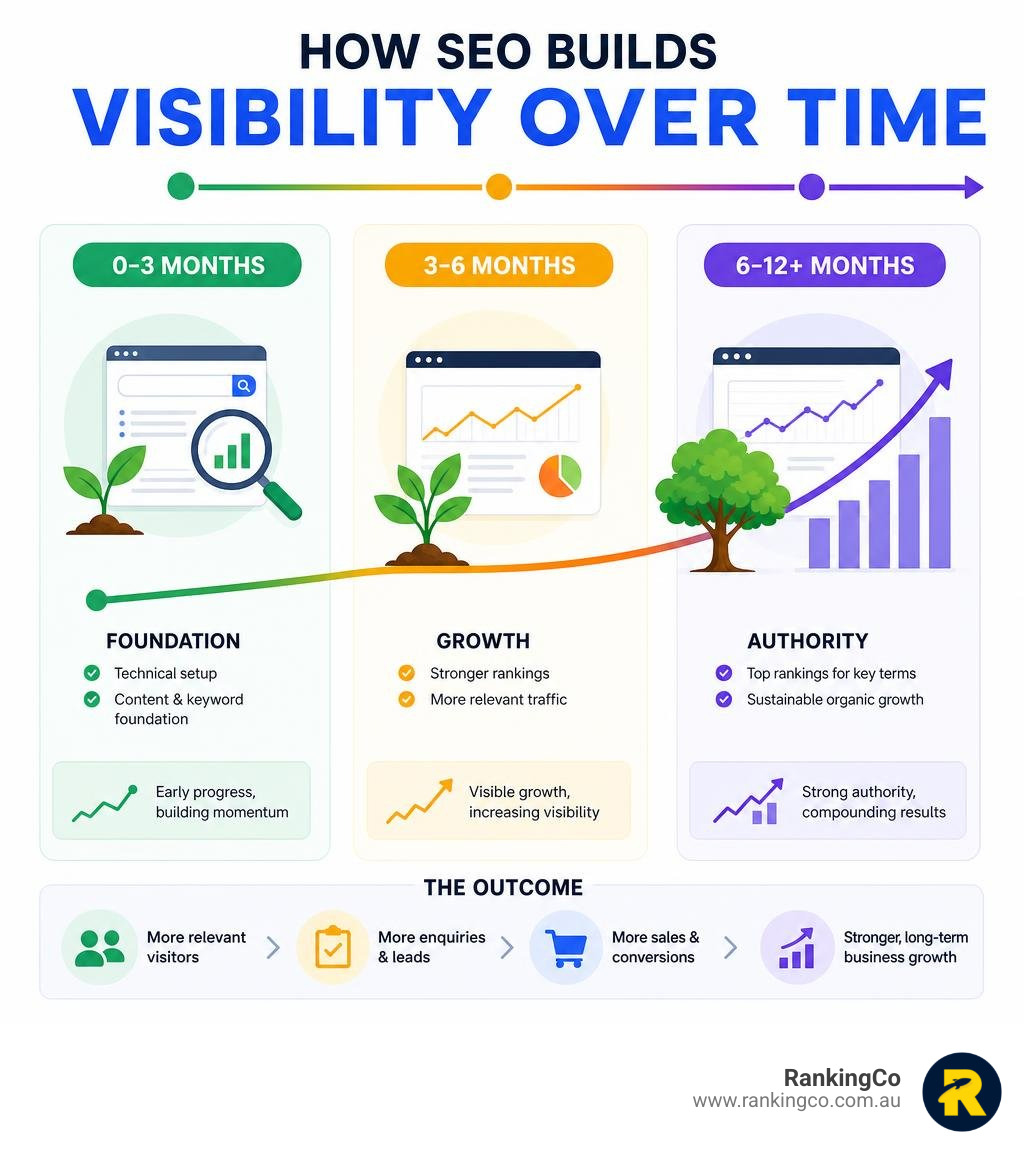
SEO is usually a medium to long-term investment rather than an immediate lead generation switch. Many businesses can start seeing early indicators within 3 to 6 months, such as improved indexation, stronger keyword movement, better local visibility, and increased impressions. More meaningful commercial returns often take 6 to 12 months, depending on competition, website history, technical condition, content quality, location, and the consistency of implementation.
Those timeframes should be treated as planning guides, not promises. Google Search Console can show whether visibility is developing through impressions, clicks, Click-through rate (CTR), average position, pages, and queries, while Google Analytics can help connect that search activity with on-site engagement and conversion events. Google also states that Search Console performance data can be broken down by dimensions such as query, page, and country, which is useful when assessing whether SEO is improving the right searches rather than only increasing total traffic. We use those signals together because early SEO progress often appears first as better search visibility before it becomes a steady source of qualified enquiries.
Third-party click studies also show why rankings alone are not enough. Backlinko's analysis of 4 million Google search results found that the top organic result had an average Click-through rate (CTR) of 27.6%, and that moving up one position was associated with an average absolute CTR lift of 2.8 percentage points. Those figures should not be treated as a guarantee for any one keyword, but they do show why the quality of the query, the position achieved, and the likelihood of a click all matter when judging whether SEO is worth the investment.
Timelines vary because SEO performance depends on several moving parts. A local service business in a less competitive suburb may build traction faster than an eCommerce brand competing nationally against established retailers. A technically healthy website with strong existing authority may also move faster than a new site that needs foundational fixes, content expansion, and trust signals before it can compete.
The investment is usually worth considering when your customers actively search for the products or services you provide, and when the value of a qualified lead or sale supports a sustained marketing strategy. SEO is less suitable when a business needs sales within a 30-day window, has not validated demand, or cannot commit to consistent execution over time. In those cases, Pay-Per-Click (PPC) channels such as Google Ads or Meta Ads may be better suited for immediate testing and demand capture.
A realistic SEO investment should account for:
- The competitiveness of your market and target locations.
- The current technical health of your website.
- The amount and quality of existing content.
- The strength of your local visibility and review profile.
- The commercial value of each qualified enquiry or sale.
- The time required to build authority and improve conversion pathways.
SEO becomes more valuable when it is measured against commercial outcomes, not rankings alone. Return on investment (ROI), qualified enquiries, assisted conversions, customer lifetime value, and cost per lead all give a clearer view of whether the work is producing business value. Rankings and Click-through rate (CTR) still matter, but they should support a broader measurement framework.
For many businesses, the strongest result comes from using SEO and paid media together. Paid campaigns can generate immediate visibility while SEO builds durable search assets that continue attracting relevant visitors without a direct cost for every click. Over time, this can improve the blended cost of customer acquisition and create a more resilient marketing mix.
Does SEO Actually Generate Leads and Sales?
SEO can generate leads and sales when it targets the searches that indicate real customer intent. A visitor searching for a service, comparing providers, checking local options, or researching a purchase decision is already showing demand. SEO works by connecting those searches to pages that answer the question clearly, build trust, and guide the visitor towards a practical next step.
The difference between traffic and revenue is intent. Broad informational searches may build awareness, but they do not always create immediate enquiries. High-intent searches, such as service, location, comparison, and problem-solution queries, are more closely connected to commercial action. That is why an effective SEO strategy should prioritise the topics most likely to influence enquiries, bookings, consultations, purchases, or repeat engagement.
Conversion rate optimisation (CRO) also plays an important role. Even strong rankings will underperform if the page is confusing, slow, thin, difficult to navigate, or unclear about the next step. SEO should therefore work alongside clear service pages, useful internal links, persuasive but accurate copy, trust signals, mobile-friendly design, and simple enquiry pathways.
For RankingCo, this means SEO is not treated as a standalone ranking exercise. We connect organic visibility to measurable business outcomes by focusing on relevant search intent, local visibility, content quality, technical performance, and conversion tracking. Businesses can then assess whether SEO is contributing to qualified leads, sales opportunities, and long-term brand visibility.
Useful lead and sales indicators include:
- Organic enquiries through contact forms and phone calls.
- Local map actions, such as calls, direction requests, and website visits.
- Assisted conversions from visitors who first discovered the business through search.
- eCommerce revenue from organic landing pages.
- Improvements in qualified lead quality, not just total traffic volume.
- Lower reliance on paid clicks for repeat organic demand.
These indicators are measurable, not just theoretical. Search Console reports how often people see and click a website in Google Search, while Google Business Profile reporting can show local actions such as calls, messages, bookings, directions, and website clicks. BrightLocal's 2026 Local Consumer Review Survey was based on 1,002 US adult consumers and reported that 81% of consumers expect to hear back within a week when they leave a review, which reinforces why local SEO should connect visibility with reputation, responsiveness, and enquiry quality. That combination helps separate surface-level ranking movement from the actions that suggest a potential customer is moving closer to enquiry or purchase.
SEO works best when every important page has a clear job. Some pages should attract early research, some should support comparison, and some should convert high-intent visitors into enquiries or sales. When those pages are structured well and connected through internal links, organic search can become a practical source of measurable business growth.
If you want to assess whether your current website is positioned to turn search visibility into commercial outcomes, explore our SEO Services, review Our Services, or Contact RankingCo to discuss your goals.
So, Does SEO Still Work in 2026?
Yes, Search Engine Optimisation (SEO) still works in 2026, but it works best when businesses understand what they are trying to achieve and how long meaningful results can take. The question is not simply whether SEO can improve visibility. The better question is whether SEO can help the right customers find the business, support a realistic investment plan, and contribute to measurable commercial outcomes.
Visibility still matters, but it now extends beyond traditional organic listings. A strong SEO strategy can help businesses appear across Google search results, local results, map listings, and emerging AI search experiences when the website clearly explains its services, locations, expertise, and next steps.
Investment expectations matter just as much. SEO is not a quick fix, and it will not be the right strategy for every business. Companies that need immediate sales, have not validated demand, or cannot commit to consistent improvement may need to prioritise Pay-Per-Click (PPC) channels such as Google Ads and Meta Ads first. For businesses with clear search demand and a longer-term growth horizon, SEO can become a valuable part of a broader marketing strategy.
Business outcomes are the real test. Rankings and traffic can be useful indicators, but they are not the final measure of success. Qualified leads, sales opportunities, revenue, Return on investment (ROI), and the cost of acquiring the right customer provide a clearer view of whether SEO is actually working.
The strongest approach in 2026 is often to build sustainable organic visibility while using paid channels where immediate demand capture is needed. That balance can help businesses stay visible now while developing longer-term search assets that support future enquiries and sales.
At RankingCo, we help Australian businesses assess whether SEO makes commercial sense by looking at search demand, competition, local visibility, website performance, paid media opportunities, and conversion pathways. If you want a practical view of whether SEO is worth doing for your business in 2026, explore our SEO Services, review Our Services, or Contact RankingCo to discuss your goals.
Frequently Asked Questions About SEO in 2026

Does SEO still work in 2026?
Yes, Search Engine Optimisation (SEO) still works in 2026, but the more useful question is whether it is the right investment for your business. SEO works best when your customers actively search for your services, your website can support trust and conversions, and the strategy is measured against enquiries, sales opportunities, and long-term visibility rather than rankings alone.
Is SEO still worth paying for with AI search?
SEO can still be worth paying for with AI search because answer engines need clear, credible, well-structured web content to understand and cite businesses. The value depends on whether your content helps customers make decisions, supports local and service-based discovery, and gives both search engines and AI answer tools enough context to understand what your business offers.
How long does SEO take to work?
Most businesses should treat SEO as a medium to long-term investment. Early indicators can often appear within 3 to 6 months, while stronger commercial outcomes usually take 6 to 12 months depending on competition, website condition, content quality, local visibility, and how consistently the strategy is implemented.
Can SEO generate leads and sales?
Yes, SEO can generate leads and sales when it targets searches with genuine buying or enquiry intent. Service searches, local searches, comparison queries, and problem-solution searches can all connect motivated customers with pages that explain the offer clearly, build trust, and make the next step easy.
Does SEO work for small businesses?
SEO can work very well for small businesses, especially when customers search locally before choosing a provider. A small business does not need to appear everywhere. It needs to be visible for the services, suburbs, cities, and customer problems that are most likely to create relevant enquiries.
Is SEO better than Google Ads?
SEO and Google Ads do different jobs, so one is not automatically better than the other. Google Ads can help capture demand quickly, while SEO builds longer-term visibility and content assets that can keep attracting relevant visitors over time. For many businesses, the strongest approach is using Pay-Per-Click (PPC) activity and SEO together.
Will AI search reduce website traffic?
AI search may reduce clicks for some broad informational searches, especially when a user only needs a quick answer. However, people still visit websites when they need detail, proof, pricing context, service information, local credibility, comparisons, or a way to contact a business. That is why SEO now needs to support both visibility in answers and conversion once someone lands on the site.
How do I measure whether my SEO is working?
Measure SEO by looking beyond rankings alone. Useful indicators include qualified organic enquiries, phone calls, form submissions, local map actions, organic revenue, assisted conversions, Click-through rate (CTR), Return on investment (ROI), and whether the website is becoming easier for customers, search engines, and AI answer systems to understand.




Share online