How to Generate High-Quality B2B Leads with Google Ads
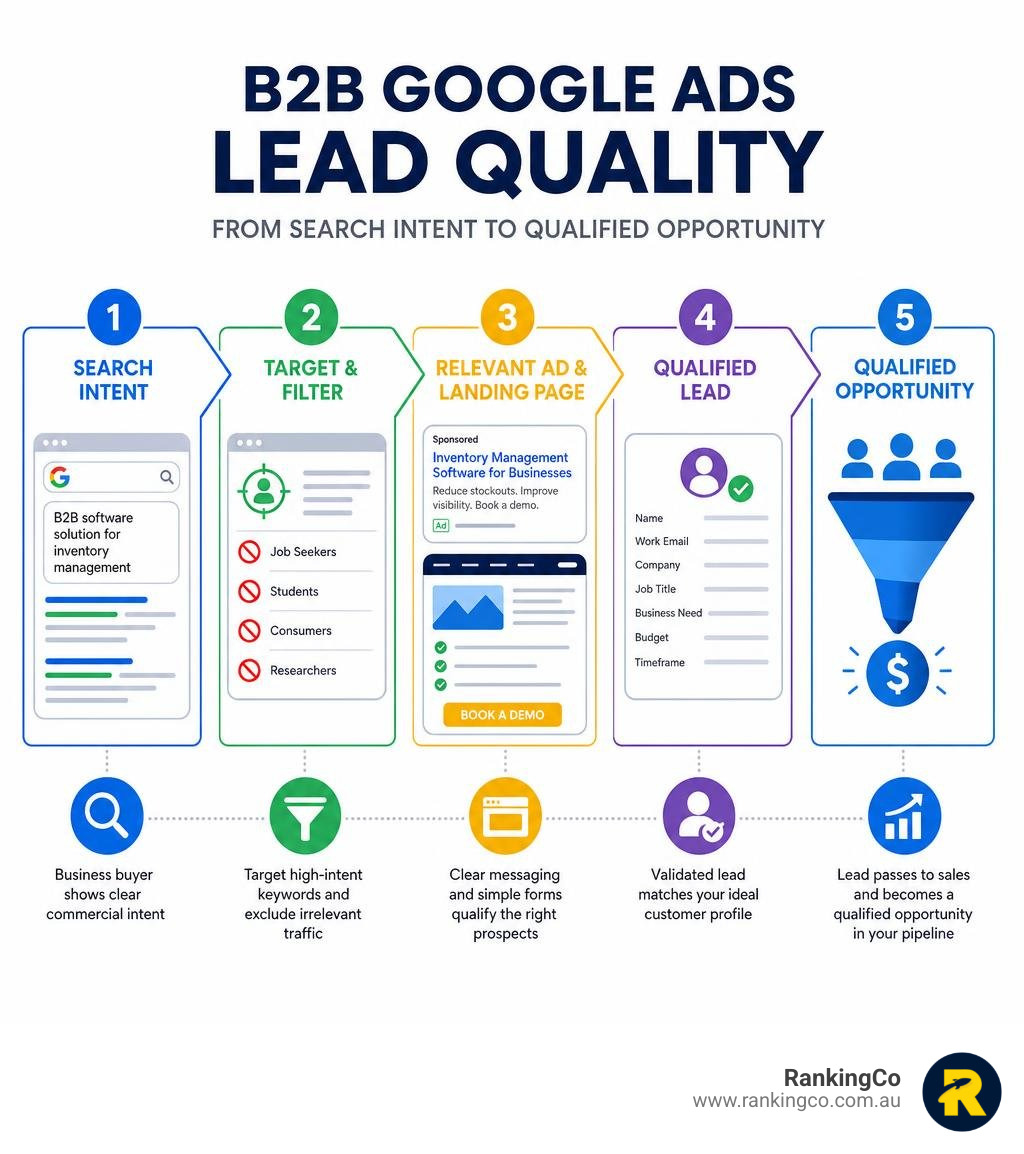
Generating high-quality B2B leads with Google Ads starts with a simple shift: we do not optimise for the highest number of form submissions. We focus on enquiries that appear to match the right business profile, show clear commercial intent and have a stronger chance of moving through a real sales process.
Key takeaways:
- Target high-intent search terms that suggest a business is actively comparing suppliers, services or solutions.
- Use negative keywords to help reduce clicks from consumers, job seekers, students and unrelated researchers.
- Qualify prospects through ad copy, landing page messaging and form questions before they reach the sales team.
- Track qualified leads, sales opportunities and revenue in your customer relationship management (CRM) system, not just web form completions.
- Feed sales-stage data back into Google Ads so campaigns can learn from lead quality, not only lead volume.
At RankingCo, we help Australian businesses turn Google Ads from a source of raw enquiries into a more accountable channel for qualified commercial opportunities. Explore our Google Ads and digital marketing services to see how we approach targeted paid advertising.
Business-to-business Pay-Per-Click (PPC) advertising needs to reflect how commercial buying decisions are actually made. Buyers research, compare options, seek internal approval and often speak with several stakeholders before choosing a provider. Our role is to build campaigns that support stronger lead quality, clearer reporting and better Return on investment (ROI), rather than chasing low-cost enquiries that may not help your sales team.
Why Does Lead Quality Matter in B2B Google Ads?
Lead quality matters because a campaign can look successful in Google Ads while creating limited value for the business. A high conversion count is not enough if those conversions are unsuitable enquiries, consumer requests or contacts with no budget, authority or commercial need.
Poor lead quality can create three practical problems.
Wasted ad spend
Irrelevant searches consume budget that could otherwise reach commercial buyers. This often happens when campaigns rely too heavily on broad match terms, loose location settings or incomplete negative keyword lists.
For example, a commercial service provider may attract clicks from homeowners, students, job seekers or people looking for free advice. Those clicks can still create activity in the account, but they are unlikely to create useful pipeline.
Sales inefficiency
Sales teams lose time when they need to filter unsuitable enquiries before they can speak with better-fit prospects. That time could be spent following up with decision-makers, preparing proposals or nurturing genuine opportunities.
This is why lead quality is not only a marketing issue. It can affect the sales team's workload, follow-up speed and ability to focus on the right conversations.
Misleading performance data
A campaign can appear to perform well when reporting focuses only on clicks, impressions or form completions. The problem becomes clearer when those leads are reviewed in the CRM and few become sales-qualified opportunities.
A stronger B2B Google Ads strategy connects search intent, ad messaging, landing page qualification and CRM outcomes. That gives the business a clearer view of which campaigns are more likely to produce qualified B2B leads, not just activity.
What Makes B2B Google Ads Lead Generation Difficult?
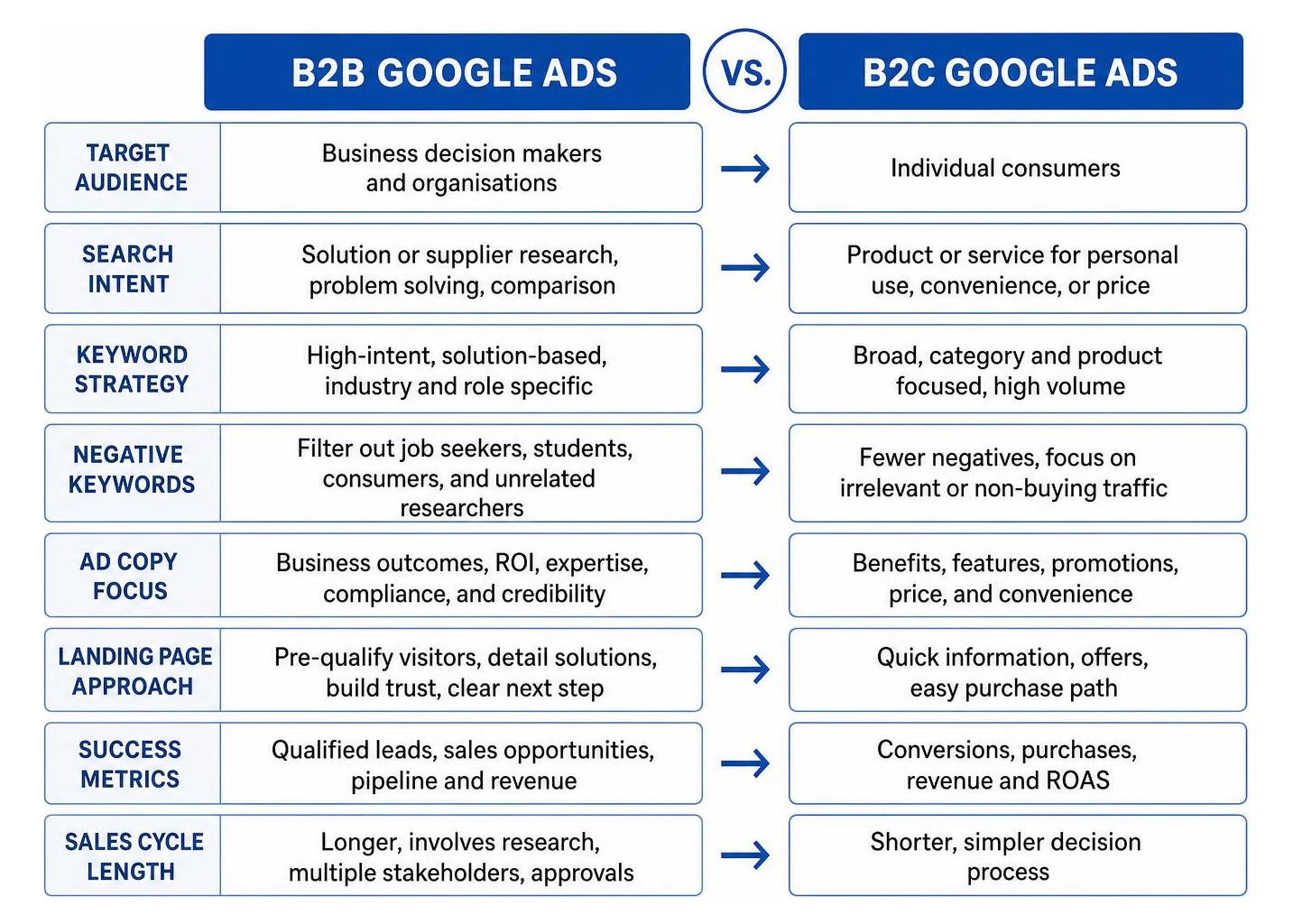
B2B lead generation with Google Ads can be difficult because commercial buyers and poor-fit users may search with similar language. Without clear campaign structure, Google Ads may send budget towards traffic that looks relevant at keyword level but does not match the business's ideal customer profile.
The challenge usually appears in four areas.
Search intent is not always obvious
A single keyword can attract different types of users. A search for a service may come from a business buyer, a consumer, a student, a job seeker or someone researching a future project.
That is why keyword selection needs to be supported by match type control, negative keywords, audience signals and qualifying ad copy.
Conversion volume can be lower than consumer campaigns
Many B2B campaigns generate fewer enquiries than retail or eCommerce campaigns because the buying audience is narrower. That does not automatically mean the campaign is underperforming. It means each conversion signal needs to be more useful.
Automated bidding can still help, but it needs clean conversion data and careful guidance. If the system is trained on weak form completions, it may keep finding more of the wrong prospects.
Sales cycles are longer
Commercial buying decisions often involve research, comparison, proposals and internal approval. A lead may submit a form today and become a sales opportunity later.
This makes attribution more complex. The business needs a way to connect the original Google Ads click to later CRM stages, especially when several people or touchpoints are involved.
Landing pages need to qualify as well as convert
A landing page should not simply encourage every visitor to enquire. It should help the right prospect understand fit, value and next steps while gently filtering out poor-fit traffic.
Useful qualification signals include industry relevance, service scope, location coverage, commercial examples, form fields and clear next-step language. Google's own guidance on lead quality also recommends improving measurement and feeding qualified lead data back into campaigns through offline conversion imports and enhanced lead tracking: Google's best practices guide for generating high-quality leads.
How Should You Structure Google Ads for B2B Lead Generation?
A strong B2B Google Ads structure starts by separating intent, qualification, conversion and measurement. We use this approach because each stage has a different job.
RankingCo's B2B Lead Quality Framework
| Stage | Question to answer | What to optimise |
|---|---|---|
| Intent | Is the search commercially relevant? | Keywords, match types, locations and negative keywords |
| Qualification | Does the ad discourage unsuitable clicks? | Ad copy, assets, business language and offer clarity |
| Conversion | Does the landing page encourage the right enquiry? | Page messaging, proof, forms and calls to action |
| Attribution | Can the enquiry be connected to a CRM record? | Tracking setup, lead source data and sales-stage updates |
| Revenue | Can campaign performance be tied to sales value? | Offline conversion imports, pipeline reporting and bidding signals |
1. Build campaigns around commercial intent
Instead of relying on broad industry terms alone, group keywords by buying intent. Terms that include service, supplier, specialist, agency, consultant, commercial, local or industry-specific modifiers often suggest a stronger business need.
Exact and phrase match types can help protect budget when the account needs tighter control. Broader matching can still be useful, but only when conversion tracking and negative keyword management are strong enough to guide it.
2. Use ad copy to qualify the click
Ad copy should attract decision-makers and discourage users who are unlikely to become customers. Clear service scope, location relevance, business terminology and next-step expectations all help set the right context before someone clicks.
For example, an ad can mention commercial service delivery, ongoing management, industry experience or a consultation process. This can make the click more intentional.
3. Align the landing page with the sales conversation
The landing page should answer the questions a serious buyer is likely to ask before making contact. That can include service fit, process, proof, location coverage, team capability and what happens after the enquiry.
Conversion Rate Optimisation (CRO) is the practice of improving the page experience so more relevant visitors take the next step. For B2B campaigns, CRO should support both enquiry volume and enquiry quality.
4. Connect the click to pipeline data
Tracking should capture Google Click Identifiers or hashed lead details and pass them into the CRM. When a lead becomes sales-qualified, reaches proposal stage or becomes a customer, that status can be imported back into Google Ads.
This creates a practical feedback loop:
Google Search → Ad → Landing Page → Form → CRM → Sales Stage → Revenue → Google Ads
To explore advanced campaign structure techniques, read our guide to mastering Google Ads optimisation with RankingCo. To ensure your website converts commercial traffic effectively, review our guide on what Conversion Rate Optimisation is and how CRO tools boost performance.
How Do You Improve B2B Google Ads Lead Quality Over Time?
Improving Google Ads lead quality is an ongoing process because search behaviour, competitor activity and customer expectations change. The account benefits from regular review, not a one-time setup.
A practical improvement cycle looks like this.
Review search terms
Search term reports show the real queries that triggered ads. Reviewing them helps identify poor-fit searches, consumer terms, job-related queries and research-only traffic that should be excluded.
This is where negative keyword management becomes a direct lead-quality control, not just an account-cleanup task.
Test clearer ad messaging
Click-through rate (CTR) means Click-through rate, or the percentage of people who click after seeing an ad. A higher CTR is only useful when the traffic is relevant.
For B2B campaigns, ad tests should look at both engagement and lead quality. A message that produces fewer clicks but stronger enquiries may be more valuable than one that attracts broad interest.
Review landing page behaviour
If qualified traffic is reaching the page but not enquiring, the issue may be page clarity, proof, offer fit or form friction. If too many poor-fit users are enquiring, the page may need stronger qualification language.
Useful improvements can include clearer service descriptions, more relevant case examples, stronger trust signals and more specific enquiry prompts.
Feed CRM outcomes back into optimisation
The most useful signal is not always the first conversion. It is what happens after the enquiry.
When sales-stage data is connected to Google Ads, bidding and budget decisions can be based on qualified leads and revenue value. That helps campaigns move away from raw lead volume and towards opportunities that are more likely to become customers.
At RankingCo, we combine strategic campaign management, analytics and AI-supported insights to improve targeting and reporting over time. The aim is to help Australian businesses make better decisions about where their ad spend appears to be working and where it may need refinement.
What Should You Expect From a B2B Google Ads Partner?

A useful B2B Google Ads partner should help you understand both campaign performance and lead quality. The work should not stop at creating ads or reporting clicks.
RankingCo is a Brisbane digital marketing agency specialising in targeted advertising through Google Ads, Meta Ads and Bing Ads. We also provide Search Engine Optimisation (SEO), including local SEO for small to medium-sized businesses that want stronger visibility in relevant searches.
Our engagement usually starts with a review of the account structure, keyword targeting, conversion tracking and sales pipeline visibility. This helps identify whether the issue is traffic quality, landing page performance, follow-up data or campaign measurement.
From there, we build or refine campaigns around commercial intent. That can include tighter keyword grouping, negative keyword systems, clearer ad messaging, improved conversion tracking and CRM-aligned reporting.
Reporting should focus on the numbers that help the business make decisions. That includes cost per qualified lead, useful enquiry patterns, pipeline movement and customer value where that data is available. Impressions and clicks still matter, but they are supporting indicators rather than the final measure of success.
The best partnership also includes plain-English communication. You should know what changed, why it changed and what the next test is designed to learn.
Ready to Improve Your B2B Google Ads Lead Quality?
A strong B2B Google Ads strategy is not simply about generating more enquiries. It is about reaching relevant decision-makers, filtering poor-fit traffic and connecting advertising activity to genuine sales opportunities.
If your sales team is receiving too many unsuitable enquiries, or if your current reporting does not show which leads become pipeline, it may be time to review the way your campaigns are structured.
We can help improve your B2B Google Ads performance by:
- Reviewing your current search account, keyword structure, negative keyword strategy and conversion tracking setup.
- Building campaign structures that target high-intent commercial buyers and reduce poor-fit clicks.
- Connecting Google Ads data with CRM pipeline tracking so lead quality can be measured more clearly.
- Aligning ad creative, audience signals and landing page messaging around qualified commercial enquiries.
Explore more RankingCo services:
- Google Ads and digital marketing services- Improve campaign structure, targeting and lead quality.
- Conversion Rate Optimisation guide- Turn more qualified website visitors into enquiries.
- Google Ads optimisation guide- Learn how better account structure can support stronger results.
- B2B Google Ads strategy framework- Explore a broader funnel-based approach to B2B advertising.
Want to improve the quality of your Google Ads leads? Contact RankingCo to discuss your goals, or visit Our Services to explore the full range of search engine marketing and online advertising solutions.
Frequently Asked Questions About How to Generate High-Quality B2B Leads with Google Ads
What makes B2B Google Ads different from B2C advertising?
B2B Google Ads campaigns are different because they need to reach business decision-makers who often take longer to compare options, seek approval and choose a provider. Instead of focusing only on fast transactions, B2B campaigns need commercial keywords, qualification messaging, negative keyword control, tailored landing pages and CRM-based measurement.
How do you track and define a qualified B2B lead?
A qualified B2B lead is best defined by combining the initial enquiry with later CRM outcomes. A form submission may be the first signal, but the lead becomes more meaningful when it matches the ideal customer profile, has a relevant business need and progresses to a sales-qualified or proposal stage.
How can you generate high-quality B2B leads with Google Ads on a budget?
The most effective way to generate high-quality B2B leads on a limited Google Ads budget is to prioritise high-intent searches and actively exclude poor-fit traffic. That means using focused keywords, maintaining negative keyword lists, writing qualifying ad copy, limiting targeting to relevant locations and optimising towards qualified leads instead of raw conversions.
Which bidding strategy works best for low conversion volume B2B accounts?
The best bidding strategy for low conversion volume B2B accounts depends on the quality of the conversion data available. When data is limited, the account may need tighter manual control or conversion-focused bidding with careful monitoring. As qualified lead and CRM data improves, automated bidding can be guided by stronger signals.
How does RankingCo help Australian businesses optimise B2B Google Ads?
RankingCo helps Australian businesses optimise B2B Google Ads by building campaigns around commercial intent, lead qualification and pipeline visibility. We focus on reducing wasted spend, improving enquiry quality and helping businesses understand which campaigns may contribute to real sales opportunities. Learn more through Our Services, read our B2B Google Ads Strategy Framework, or contact RankingCo.




Share online