B2B Google Ads Strategy Guide: How to Drive Pipeline & Revenue
B2B Google Ads Strategy Guide: Building a Revenue-Driven Funnel

At RankingCo, as a leading Brisbane digital agency, we partner with Australian commercial enterprises to construct high-performing Pay-Per-Click (PPC) and Search Engine Optimisation (SEO) campaigns that drive qualified pipeline growth.
A Business-to-Business (B2B) Google Ads strategy is a structured plan for turning relevant commercial searches into measurable pipeline opportunities. It connects paid search, remarketing, landing pages, lead qualification, Customer Relationship Management (CRM) data, and revenue tracking.
The goal is not to chase superficial click volume. It is to decide whether paid search can capture real buyer demand, then build a funnel that helps the right decision-makers move from search to enquiry, qualification, opportunity, and revenue.
This guide explains how to assess commercial viability, define the right audience, map search intent, choose campaign types, plan landing pages, qualify leads, set budgets, connect sales follow-up, and optimise towards pipeline quality.
Start With Google Ads Commercial Viability
Google Ads is usually strongest when buyers already search for your service, product category, or commercial problem. For B2B companies, viability depends on more than search volume alone.
It often makes commercial sense when:
- There is enough search demand for the solution you provide.
- Your average customer or contract value can support paid acquisition costs.
- Your sales team can respond to enquiries quickly.
- Your website can support focused landing pages.
- Your business can distinguish qualified leads from general enquiries.
It may be a weaker primary channel when buyers do not yet understand the category, search demand is too low to provide useful learning data, or the business cannot track lead quality after the first enquiry.
For a new or emerging category, Meta Ads, LinkedIn Ads, content marketing, partnerships, or direct outreach may need to create awareness before search campaigns can capture demand.
Define Your B2B Target Audience and Buying Committee
Commercial purchasing decisions are rarely made by one person. A strong strategy starts with an Ideal Customer Profile (ICP), then maps the people who influence the buying decision.
Define the industries, business sizes, locations, budgets, timelines, and service-fit criteria that represent a qualified opportunity. Then identify the buying committee members involved in the decision.
Common stakeholders include:
- End users: Department managers seeking practical tools to solve daily operational friction.
- Technical evaluators: Information technology directors and compliance officers reviewing security, integration, and service requirements.
- Financial decision-makers: Chief Financial Officers and finance leads evaluating cost, Return on investment (ROI), and contract terms.
- Executive sponsors: Chief Executive Officers and Managing Directors focused on risk, strategic alignment, and business value.
Good targeting also includes exclusion criteria. Job seekers, students, consumers, free-tool requests, very low budgets, and irrelevant locations can all reduce lead quality if they are not filtered early.
Build a B2B Keyword Strategy Around Search Intent
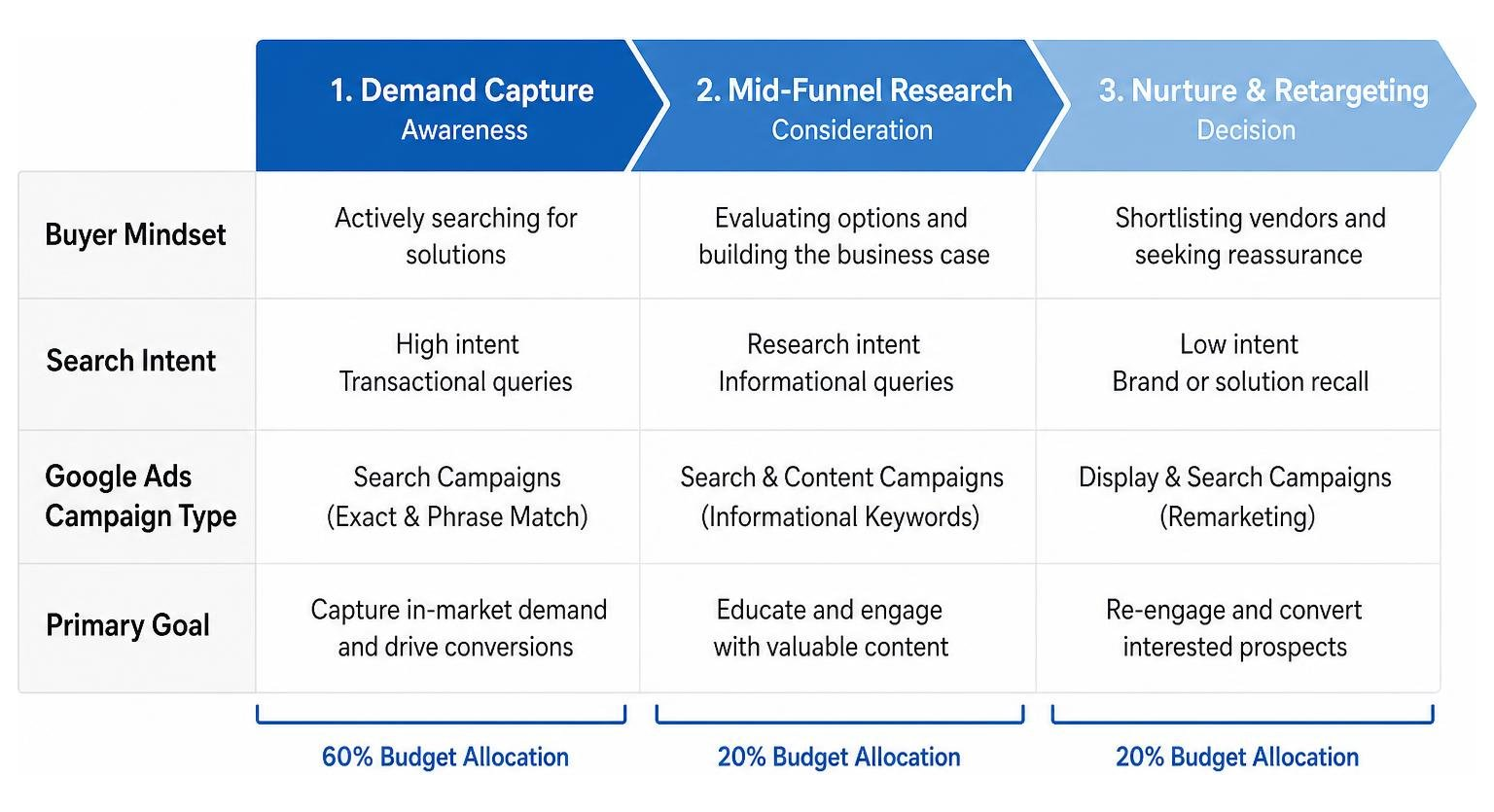
Effective keyword strategy starts by mapping search queries to buying intent.
- Bottom-of-funnel keywords: Searches from people comparing providers, products, consultants, agencies, platforms, or services.
- Middle-of-funnel keywords: Searches from people researching specific operational problems, solution categories, or implementation options.
- Top-of-funnel keywords: Searches from people learning definitions, trends, and broad concepts.
A practical starting point is to prioritise bottom-of-funnel search first. These searches are usually closest to vendor selection and give the clearest signal of whether paid search can generate commercially useful enquiries.
| Keyword Category | Search Intent Level | Typical Match Types | Conversion Goal |
|---|---|---|---|
| High-intent category | Immediate evaluation or vendor selection | Exact match and phrase match | Demo request, quote request, or consultation |
| Problem-solving | Solution discovery or research | Phrase match | Guide, webinar, audit, or comparison resource |
| Broad informational | General awareness or definition searches | Low-budget testing or content only | Soft nurturing and remarketing audience growth |
The key question is whether the searcher is ready to compare providers or still learning the problem.
Choose the Right Google Ads Campaign Types
Campaign type should follow the role each channel needs to play in the strategy.
Use Search when prospects already know what they need and are actively comparing providers. Use Performance Max (PMax) only when conversion tracking, audience signals, creative assets, and exclusions are mature enough to support automation. Use remarketing when the sales cycle is long enough that repeated education and trust-building are useful.
| Campaign Type | Best Use | Funnel Stage | Strengths | Limitations |
|---|---|---|---|---|
| Search campaigns | Capturing active commercial demand from people searching for specific providers, services, or solutions | Middle to bottom funnel | Strong intent control, clear keyword targeting, transparent query data | Limited scale when search volume is low |
| Performance Max (PMax) | Expanding reach after reliable conversion tracking and audience signals are in place | Mid-funnel to re-engagement | Broader inventory access and automation | Less query-level control than dedicated Search campaigns |
| Remarketing | Re-engaging previous website visitors, content downloaders, or Customer Relationship Management (CRM) audiences | Middle to lower funnel | Keeps the brand visible during long evaluation cycles | Requires sufficient audience size and careful frequency management |
| Meta Ads or LinkedIn Ads | Creating demand and promoting resources to defined professional audiences | Top to middle funnel | Useful when buyers are not actively searching yet | Lower search intent than Google Search campaigns |
| Microsoft Advertising | Extending search reach across corporate environments where Bing usage is meaningful | Middle to bottom funnel | Can complement Google Ads for B2B search coverage | Usually requires separate testing and volume validation |
This prevents the strategy from treating every campaign as if it has the same purpose.
Match Landing Pages to Buyer Intent
Landing pages should match buyer readiness.
High-intent search traffic should land on focused service or solution pages with clear scopes, trust signals, relevant proof points, and a direct consultation path.
Research-stage traffic often performs better when directed to resources such as guides, checklists, technical sheets, recorded webinars, or comparison content.
| Buyer Readiness | Landing Page Goal | Suitable Offer |
|---|---|---|
| Ready to compare providers | Convert into a sales conversation | Consultation, quote request, demo, or service enquiry |
| Researching options | Capture and nurture a qualified contact | Guide, checklist, webinar, audit, or comparison resource |
| Learning the problem | Build trust and create future remarketing audiences | Educational article, explainer, calculator, or diagnostic content |
Conversion rate optimisation (CRO) should focus on clarity, relevance, and qualification, not just removing every form field.
Build Lead Qualification Into Your Google Ads Strategy
Unlike Business-to-Consumer (B2C) or eCommerce landing pages designed for low friction, B2B lead generation often needs intentional qualification.
A qualified B2B lead usually has a relevant business need, a suitable organisation profile, a realistic commercial fit, and a clear next step.
Form fields for business email addresses, company size, indicative project budgets, and job titles can filter out poor-fit enquiries. Strategic friction helps your sales team avoid spending time on unviable prospects. It also gives Google Ads cleaner conversion signals for smart bidding optimisation.
| Lead Type | Typical Signals | Recommended Action |
|---|---|---|
| Good lead | Business email, relevant job title, suitable company size, clear service need, realistic budget, defined timeline | Prioritise for sales follow-up and import as a qualified CRM milestone |
| Review lead | Relevant enquiry but unclear authority, budget, or timing | Nurture, qualify further, and score before treating as a sales opportunity |
| Poor lead | Student research, job seeker, consumer enquiry, very low budget, irrelevant location, free-tool request | Exclude through negative keywords, form fields, and qualification rules |
Set a B2B Google Ads Budget Based on Commercial Goals
Budget planning should be guided by expected contract value, search demand, sales cycle length, and the amount of data needed to make reliable decisions.
For new campaigns, fund bottom-of-funnel search first. This gives you a practical test of commercial viability before expanding into broader research-stage keywords.
A budget framework should consider:
- Search demand: How many relevant high-intent searches are available in the target market.
- Cost per click (CPC): How competitive those commercial queries are.
- Click-through rate (CTR): How often relevant searchers click the ad after seeing it.
- Conversion rate: How effectively the landing page turns qualified visitors into enquiries.
- Lead quality: How many enquiries become Marketing Qualified Leads (MQLs), Sales Qualified Leads (SQLs), opportunities, and customers.
- Customer value: How much revenue a closed customer is expected to generate.
- Sales cycle: How long it usually takes for a lead to become a customer.
- Learning period: Whether the campaign can generate enough meaningful conversion data to guide optimisation.
There is no universal budget split. A 60-20-20 style allocation can make sense only when the business already has enough demand-capture coverage, reliable lead-quality data, and a reason to invest in remarketing or awareness.
Newer campaigns may need heavier search focus. Mature accounts with strong CRM data may justify more budget for remarketing, PMax, or value-based expansion.
Connect Google Ads Leads to the Sales Pipeline
A B2B conversion is the start of the commercial evaluation, not the end of the strategy.
After someone submits a form, calls, books a consultation, or downloads a resource, the next step should be clearly defined. Sales and marketing teams need to agree how quickly leads are reviewed, which fields matter, what qualifies an enquiry, and when a lead should move into a sales pipeline.
The measurement hierarchy should follow the commercial journey:
Lead → MQL → SQL → opportunity → customer → revenue
| Measurement Stage | What It Shows | Why It Matters |
|---|---|---|
| Lead | A visitor submitted a form or called | Measures initial enquiry volume |
| MQL | The lead meets marketing qualification criteria | Filters out irrelevant or low-fit enquiries |
| SQL | Sales has accepted the lead as worth pursuing | Connects marketing activity to sales reality |
| Opportunity | A qualified deal exists in the pipeline | Shows commercial potential |
| Customer | The opportunity closed successfully | Confirms actual acquisition |
| Revenue | Closed-won value attributed to paid search | Supports budget and bidding decisions |
Connecting your CRM system with Google Ads allows downstream milestones to feed back into advertising reports via Google Click ID (GCLID) tracking.
Relevant milestones include MQLs, SQLs, opportunities, customers, and closed-won revenue. Google outlines this workflow in its documentation on importing offline conversions into Google Ads, which is useful for businesses connecting digital ads to offline sales pipelines.
Optimise Campaigns for Qualified Pipeline and Revenue
Optimisation should focus on the activity that produces qualified pipeline, not only cheaper enquiries.
Early-stage optimisation should review search terms, negative keywords, match types, campaign exclusions, landing page clarity, and conversion tracking accuracy. This protects budget while the account is still gathering evidence.
Bidding strategy should change as the account matures.
| Campaign Stage | Bidding Approach | Use When | Main Watchout |
|---|---|---|---|
| Launch and learning | Manual Cost Per Click (CPC) or Maximise Clicks with limits | Conversion data is limited and the priority is controlled testing | Do not optimise for cheap clicks that have weak commercial intent |
| Lead generation stability | Maximise Conversions or Target Cost Per Acquisition (CPA) | The account has enough reliable conversion volume and lead quality is being reviewed | Poor conversion definitions can train bidding towards weak leads |
| Pipeline optimisation | Enhanced conversion tracking, offline imports, and value-based bidding | CRM data identifies which leads become opportunities and customers | Revenue data must be clean enough to guide automation |
| Mature scaling | Target Return On Ad Spend (ROAS) or value-based portfolio strategy | The account has consistent sales feedback and clear opportunity values | Over-automation can hide intent gaps if query quality is not reviewed |
For an in-depth exploration of campaign architecture, read our full guide on B2B Google Ads Strategy and explore practical frameworks in our resource on How to Generate High-Quality B2B Leads.

How to Build and Launch Your B2B Google Ads Strategy
Use this implementation checklist before increasing spend:
- Confirm that Google Ads is commercially viable for the market, search demand, and deal value.
- Define the target audience, buying committee, locations, and qualification criteria.
- Group keywords by bottom, middle, and top-of-funnel intent.
- Choose campaign types based on the role each channel plays in the funnel.
- Match each landing page and offer to the searcher's stage of readiness.
- Build form fields, negative keywords, and qualification rules to filter poor-fit enquiries.
- Set a budget that gives the campaign enough data to learn without overextending spend.
- Connect lead follow-up, CRM milestones, and offline conversion tracking before judging success.
- Optimise towards MQLs, SQLs, opportunities, customers, and revenue instead of enquiry volume alone.
At RankingCo, we build Google Ads strategies around commercial fit, transparent reporting, and practical optimisation. As a Google Premier Partner, Meta Business Partner, and Microsoft AI Partner, we help Australian businesses connect paid media activity with measurable sales opportunities.
Conclusion
A strong B2B Google Ads strategy starts with commercial fit, not campaign settings. When the audience, search intent, landing pages, qualification rules, budget, sales process, and measurement framework work together, paid search can become a clearer source of qualified pipeline.
To discover how our team builds scalable acquisition engines tailored to your industry, review Our Services or get in touch with us via Contact RankingCo.
Frequently Asked Questions About B2B Google Ads Strategy Guide
What is a B2B Google Ads strategy?
A B2B Google Ads strategy is a plan for using paid search, landing pages, qualification rules, CRM data, and sales feedback to generate commercially relevant leads. It should define the target audience, buying-stage intent, campaign mix, budget logic, conversion actions, and measurement framework before media spend is scaled.
How do you know if Google Ads is right for a B2B business?
Google Ads is usually a good fit when buyers already search for your solution, the average deal value can support paid acquisition costs, and your team can track lead quality beyond form submissions. If buyers do not yet understand the category, awareness channels may need to support demand creation first.
Who should a B2B Google Ads campaign target?
A B2B campaign should target the industries, company sizes, locations, roles, and buying committees most likely to become commercially viable opportunities. This can include end users, technical evaluators, financial decision-makers, executive sponsors, and other stakeholders involved in the purchase.
How should keywords be mapped to the B2B buying journey?
Keywords should be grouped by intent. Bottom-of-funnel searches indicate vendor selection, middle-of-funnel searches show active research, and top-of-funnel searches usually reflect early education. Budget should usually prioritise the searches closest to commercial action before expanding into broader research terms.
How should a business choose between Search, Performance Max, and remarketing?
Use Search when prospects are actively looking for a provider, product, or service and keyword intent is clear. Use Performance Max when conversion tracking, audience signals, creative assets, and exclusions are mature enough to support automation. Use remarketing when visitors need repeated education, proof, or reminders before they are ready to speak with sales.
What is the difference between a lead and a qualified B2B lead?
A lead is any person who submits a form, calls, or completes another conversion action. A qualified B2B lead is an enquiry that matches the target market, has a relevant business need, fits the commercial criteria, and is suitable for sales follow-up. Reporting should separate general leads from MQLs, SQLs, pipeline opportunities, customers, and revenue.
Which bidding strategy works best for low conversion volumes?
When a niche campaign generates limited monthly conversion volume, automated Smart Bidding models like Target Cost Per Acquisition (CPA) or Target Return On Ad Spend (ROAS) may not have enough conversion data to calculate optimal bids. In early campaign phases, Manual Cost Per Click (CPC) or Maximise Clicks with capped CPC limits can offer stronger spend control. Once qualified lead volume is steadier, accounts can transition towards automated conversion bidding strategies.
How do offline conversion imports improve lead quality?
Offline conversion imports link search ad interactions with validated sales outcomes. Standard conversion tracking treats every website contact form submission equally, which can lead bidding algorithms to favour lower-quality enquiries. By sending CRM stage updates back to Google Ads, the bidding system can learn which keywords generate genuine pipeline value.
To see how our specialists build tailored digital acquisition strategies for your business, view Our Services or reach out directly at Contact RankingCo.




Share online