Google Ads Strategy for Long B2B Sales Cycles: Playing the Long Game
Google Ads Strategy for Long B2B Sales Cycles: Playing the Long Game

Executing a profitable Business-to-Business (B2B) digital marketing strategy is complex when buyers take weeks or months to move from first research to a final decision. For many small to medium-sized businesses, the challenge is not simply getting more enquiries. The real challenge is understanding how advertising supports a decision that may involve research, comparison, internal discussion and delayed timing.
The central idea is simple: Google Ads should not be judged only by how many leads it creates. It should be judged by whether it helps attract the right prospects, supports them through a longer decision process and gives the business better information about where growth is coming from.
Key Takeaways for Long-Cycle B2B Campaigns
- Map Google Ads to the buyer journey: Different searches play different roles, from early research to provider selection.
- Invest budget where it can influence real decisions: Spend should reflect intent, commercial value and sales capacity.
- Define what a good lead looks like: A useful enquiry is one the sales team can realistically progress.
- Track beyond the first form fill: The campaign needs feedback about which enquiries become opportunities.
- Give campaigns enough time: Long sales cycles need measured decisions, not constant changes after a short reporting window.
- Use automation with good inputs: Google's systems work best when they are learning from meaningful conversion signals.
I'm Kerry Anderson, co-founder at Rankingco where we work with small to medium-sized business owners and marketing decision-makers across Brisbane, Sydney and Melbourne to turn Google Ads into a stronger business growth channel. We approach Pay-Per-Click (PPC) advertising as part of the full sales journey, not just a way to collect as many form submissions as possible.
By aligning budgets, messaging, landing pages and reporting with each stage of buyer intent, we help businesses focus their ad spend on prospects who are more likely to become qualified opportunities.
Navigating Search Intent Across the Extended B2B Buyer Journey
For many Australian small and medium-sized enterprises (SMEs), Google Ads can look inefficient if the campaign is judged only on this month's website enquiries. B2B buyers rarely make a decision after one search. They may compare providers, check service fit, involve other people in the business, return to the website several times and then enquire when the timing is right.
This is where Google Ads needs to fit the journey, not interrupt it. Some searches show early research. Others show comparison. A smaller group may show that the buyer is ready to speak with a provider.
| Buyer journey stage | What the buyer is doing | Where Google Ads fits |
|---|---|---|
| Research | Clarifying the problem and learning possible options | Build useful visibility without expecting every click to convert immediately. |
| Comparison | Weighing up providers, services or approaches | Show commercial relevance and help the prospect understand fit. |
| Decision-stage | Looking for a provider or service now | Prioritise clearer calls to action, stronger landing pages and faster follow-up. |
| Poor-fit searches | Looking for jobs, courses, free templates or do-it-yourself resources | Use negative keywords to protect budget from searches unlikely to become buyers. |
This gives the business a clearer way to evaluate performance instead of asking every keyword to do the same job. For platform details on match types, review Google Ads Help.
Strategic takeaway: Search intent is not just an account-structure issue. It helps the business decide what role each search theme should play in a long buying journey.
For a broader planning framework, read our B2B Google Ads strategy guide.
Strategic Budget Factors and Prioritising Lead Quality
There is no single Google Ads budget that works for every B2B business. The right budget depends on factors such as market competition, customer value, sales capacity and how many qualified opportunities the business can realistically handle.
For a long-cycle campaign, the budget question is not only "how much should we spend?" It is also "where should that spend do the most useful work?"
| Factor | Why it matters |
|---|---|
| Competition | More competitive searches can require more budget |
| Customer value | Higher-value customers may justify greater acquisition costs |
| Search demand | Smaller markets naturally limit available traffic |
| Lead quality | Budget should prioritise searches likely to produce suitable prospects |
| Sales capacity | There's little value in generating more leads than the team can handle |
It is also important to separate Google Ads spend from campaign management costs . Your ad budget is paid to Google to run the campaigns. Management costs cover the strategy, setup, tracking, optimisation and reporting needed to manage that investment.
Common mistake: Setting a budget around lead volume alone can push spend towards the easiest enquiries, rather than the opportunities most likely to support business growth.
What a Good B2B Lead Actually Means
For a business with a long B2B sales cycle, getting an enquiry is only the beginning.
The typical journey might look like:
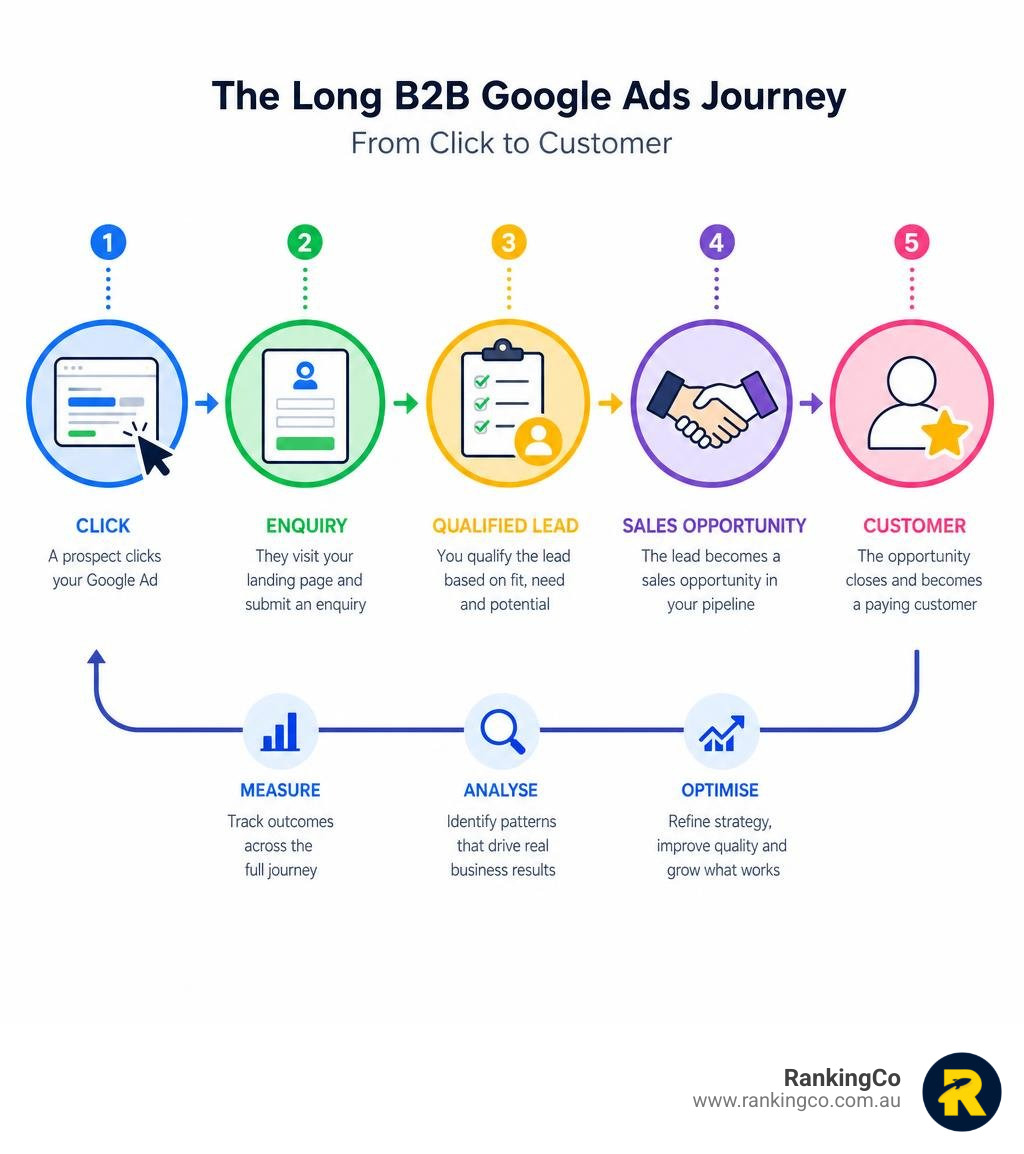
For long B2B sales cycles, this journey is usually more useful than looking at the first enquiry alone. A click may create an enquiry, but the business still needs to understand whether that enquiry becomes a qualified lead, a real sales opportunity and eventually a customer.
A good lead is not just someone who fills out a form. It is someone with a relevant need, a suitable location, realistic timing, enough budget and a genuine reason to speak with the business.
This section defines the quality standard. The next question is how the business can see whether enquiries are meeting that standard.
Tracking What Happens After the Enquiry
Once a lead enters the sales process, the business can track what happens next. This does not need to become a technical project before it becomes useful.
A simple process might look like this:
- Capture the source: Record whether the enquiry came from Google Ads.
- Qualify the lead: Check its needs, location, timing, budget and overall fit.
- Track sales progress: Record when the lead becomes a genuine sales opportunity or customer.
- Use the data to improve campaigns: Give greater weight to the searches, ads and audiences that generate stronger opportunities.
The business reason comes first: Google needs to know which leads actually become opportunities, not just which forms get submitted.
This is where offline conversion tracking can become useful. In plain English, it means sending information about later sales outcomes back to Google Ads so the platform can learn from better signals.
A customer relationship management system, or CRM, can make this easier for businesses that already use one. However, adopting a CRM should not be treated as a requirement for running B2B Google Ads. The important thing is having a reliable way to understand what happens to leads after they enquire.
Strategic takeaway: Tracking answers a specific question: which enquiries moved forward after the first conversation?
How Long Should You Wait Before Changing a B2B Google Ads Campaign?
Long B2B sales cycles make short-term decisions risky. If a buyer takes months to move from research to enquiry, a campaign may be helping before the result is visible in the reporting.
The strategic skill is knowing when to wait, when to investigate and when to act.
| Signal to review | What it helps you decide |
|---|---|
| Search terms | Are we reaching the right market? |
| Landing page engagement | Does the message seem relevant to visitors? |
| Sales team feedback | Are enquiries worth pursuing? |
| Pipeline movement | Is advertising contributing to commercial progress? |
| Time in sales cycle | Has enough time passed to judge outcomes fairly? |
Do not ignore early warning signs. If search terms are consistently irrelevant, sales feedback is poor or budget is being spent on themes that do not support the buying journey, changes may be needed sooner.
But if enquiries are early and relevant, the campaign may need more sales-cycle evidence before major decisions are made.
Common mistake: Changing direction too quickly can reset learning before the business has enough information to judge whether the campaign is attracting the right prospects.
Conversion Rate Optimisation (CRO) means improving the page experience so more suitable visitors take action. For a long-cycle campaign, CRO should support clearer expectations, stronger qualification and better enquiries, not just more form fills.
Balancing Automation with Human Governance
Automation can be useful in B2B Google Ads, but it is not a replacement for strategy. The business goal still needs to be clear before automated bidding is given more control.
The practical question is what Google's systems are learning from. If the campaign is only measuring basic form fills, automation may find more people who are likely to fill in forms. That does not always mean those people are strong sales prospects.
A practical governance approach is to decide what information should guide automation:
- later sales outcomes that show which enquiries became useful conversations;
- qualified opportunity data that gives Google stronger learning signals;
- campaign patterns that still need human review before budget is shifted; and
- commercial context that may not appear neatly inside the ad account.
The aim is to give the platform better information while keeping people involved in the decisions that matter.
Human governance still matters because not every valuable signal appears neatly inside the ad account. A quiet month may reflect seasonality, internal decision delays or a market with longer consideration periods.
What to Expect Working With RankingCo
Managing long-cycle B2B Google Ads campaigns requires practical strategy, clear tracking and ongoing refinement. At RankingCo, we start by understanding how your customers actually buy, what makes a lead qualified and which outcomes matter beyond the first enquiry.
We then review account structure, search intent, landing pages, tracking and reporting so the campaign is built around commercial progress rather than surface-level lead counts. Our role is to translate campaign data into plain-English decisions.
That means helping business owners understand:
- where their best leads are coming from;
- which searches are wasting budget;
- whether Google Ads is producing genuine opportunities;
- what should be changed now and what needs more time; and
- how campaign performance connects to actual sales.
This gives business owners a clearer view of what Google Ads is doing for the sales pipeline, not just what is happening inside the ad account.
As an accredited Google Premier Partner for 2026, RankingCo builds Google Ads strategies suited to longer evaluation periods and more considered buying decisions.
To review whether your current campaign is measuring the right outcomes, explore our digital marketing services or get in touch through Contact RankingCo.
Next Steps for Optimising Your B2B Search Strategy
Long B2B sales cycles require patience, better tracking and a focus on business outcomes, not just cheap leads. The strongest Google Ads strategy is progressive: each part of the campaign should answer a different commercial question.
The buyer journey shows where Google Ads fits. Budget planning shows where to invest. Lead quality shows what a good enquiry means. Tracking shows how to measure progress. Patience shows when to make changes. Automation shows how to use Google's systems with better inputs.
- Request a practical account and campaign review via Contact RankingCo.
- Explore tailored campaign support through our digital marketing services.
- Review whether your current Google Ads activity is being judged against the full sales cycle, not only the first enquiry.
Frequently Asked Questions About Google Ads Strategy for Long B2B Sales Cycles
How Should B2B Account Structure Differ for Long Sales Cycles?
Account structures for longer buying journeys should help the business see which searches are starting interest, which are supporting comparison and which are closer to a sales conversation. The point is not complexity. It is making sure each part of the campaign has a clear commercial role.
What Should B2B Businesses Measure Besides Cost Per Lead?
Cost per lead is useful, but it should not be the final measure of success. B2B businesses should also look at whether enquiries are suitable, whether they become sales opportunities, how the sales team rates their quality and whether they contribute to revenue. In short, the goal is not more leads at any cost. It is better commercial outcomes.
How Do Negative Keywords Prevent Wasted Spend Across Funnel Stages?
Negative keywords stop ads from appearing for searches that are unlikely to lead to a customer, such as jobs, courses, free resources or do-it-yourself queries. Used well, they keep budget away from obvious poor-fit searches without removing useful visibility from genuine prospects who are still researching.
Is Automated Bidding Suitable for Long B2B Sales Cycles?
Automated bidding can be useful when the campaign has reliable information about valuable outcomes. If the data only shows basic form submissions, automation may optimise towards easier enquiries rather than stronger opportunities. Better sales feedback gives automation a stronger foundation.
How Can Google Ads Track Leads That Take Months to Become Customers?
Google Ads can be connected with later sales outcomes by sending qualified lead or customer information back into the platform. This is often called offline conversion tracking. The simple purpose is to help the campaign learn which enquiries became real opportunities, not just which visitors filled in a form.





Share online