Your Customers Are Scrolling — Here’s How Facebook Ads Find Them
Why Social Media Advertising on Facebook Is Still One of the Smartest Moves for Small Businesses
Social media advertising on Facebook puts your business in front of over 3 billion monthly active users, right in the middle of their daily scroll. It is not passive brand exposure. It is demand generation, built around precise audience targeting, real-time auction mechanics, and AI-driven delivery that finds the people most likely to act.
Here is a quick breakdown of what Facebook advertising is and how it works. Understanding these core components helps you structure campaigns that deliver consistent results:
- What it is: Paid ads delivered across Facebook, Messenger, and Meta's extended audience network, managed through Meta Ads Manager
- How it targets: By demographics (age, location, gender), interests, behaviours, custom audiences, and lookalike audiences built from your existing customers
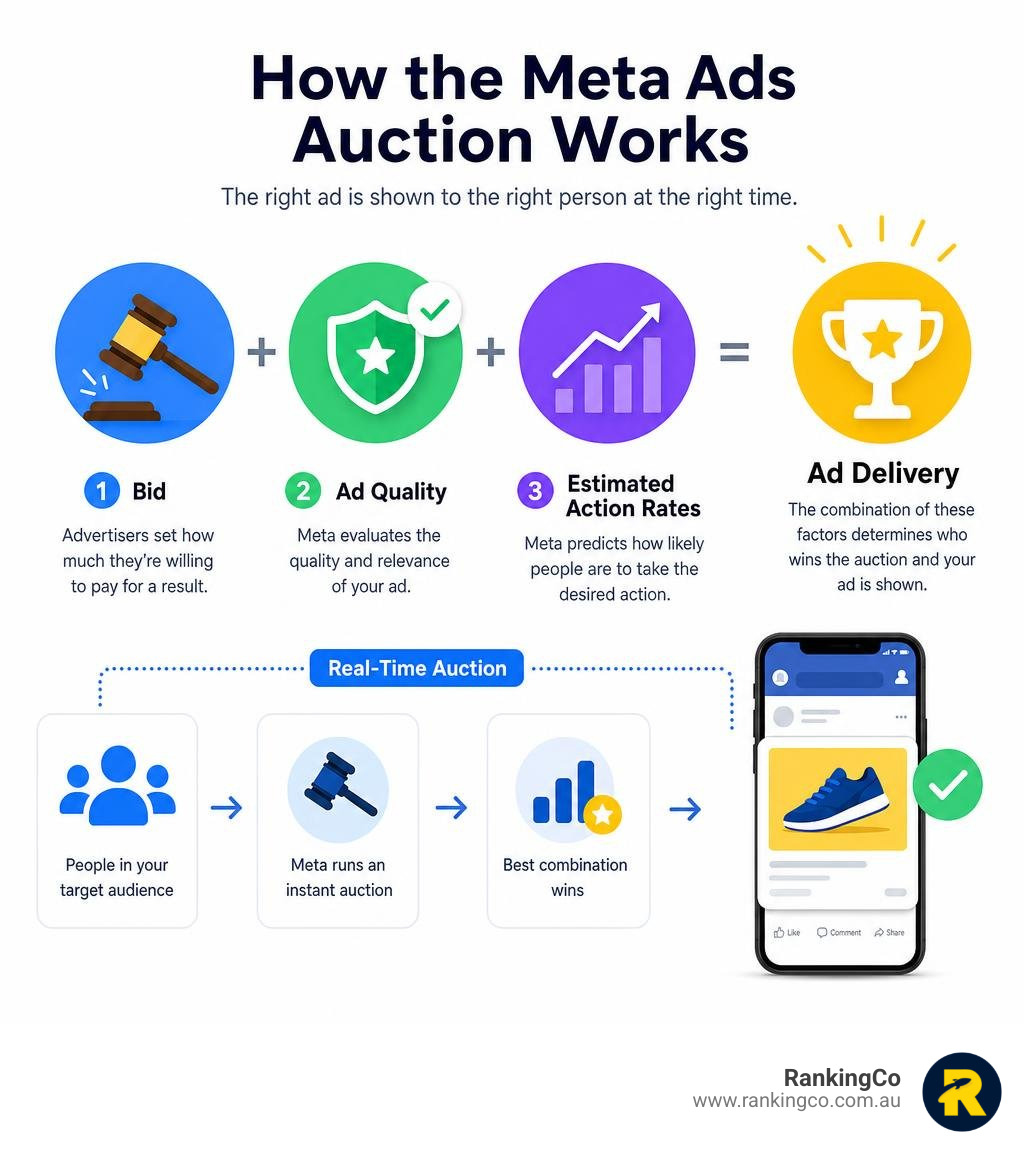
- What you pay for: Ad delivery through a real-time auction that weighs your bid, ad quality, and estimated action rates
- Key formats: Image ads, video ads, carousel ads, lead generation forms, Stories, and Reels
- What results to expect: Industry benchmarks suggest average click-through rates around 1.71% for traffic campaigns, with cost per lead averaging around $27.66, well below comparable Google Ads costs
- Why it works: Facebook rewards relevant, well-targeted ads with lower costs and better delivery priority
Facebook is not a standalone tactic. When it is connected to your SEO, Google Ads, and content strategy, it becomes part of a full-funnel growth system that builds awareness, captures demand, and converts browsers into buyers.
The average user spends close to an hour on Facebook every day. That is not a small window. That is a consistent opportunity to get your message in front of the right person, at the right moment, before your competitors do.
I am Kerry Anderson, co-founder of RankingCo and a digital marketing strategist with over 15 years of experience building growth systems that include social media advertising on Facebook as a core driver of measurable business results. I have worked across industries helping businesses connect their paid social strategy to broader SEO and conversion goals so every dollar spent works harder across the full funnel.
Relevant articles related to Social media advertising Facebook :
Social Media Advertising Facebook: The Connected Growth Engine
To get the most out of social media advertising Facebook , you have to look at it as a demand generation engine. Unlike Google Ads, which captures existing search intent, Facebook ads push your brand in front of users who may not be actively searching for you but match your ideal customer profile perfectly.
By managing campaigns through Meta Ads Manager, we can structure your marketing across three distinct levels: campaigns (where we set your core business objective), ad sets (where we define your targeting, budget, and placements), and ads (where the visual storytelling happens). This modular structure allows us to test different creatives, formats, and messages simultaneously to see what resonates best with your audience.
The Mechanics of Social Media Advertising Facebook

At the heart of Meta's platform is its massive user base, consisting of over 3 billion monthly users and 1.56 billion daily active users. This scale gives businesses unprecedented access to highly specific audience segments. The primary mechanism for finding your customers lies in how we build your target audiences, focusing on precise user signals rather than broad assumptions:
- Demographic & Interest Targeting: We can filter users by age, precise geographic location (such as specific suburbs in Brisbane, Sydney, or Melbourne), and detailed interests or behaviours.
- Custom Audiences: By installing the Meta Pixel or Conversions API on your website, we can build custom audiences of people who have already interacted with your brand, browsed specific products, or abandoned a shopping cart.
- Lookalike Audiences: Once we identify your highest-value customers, Meta's algorithm can find "lookalike" users who share similar online behaviours, interests, and demographics, expanding your reach to high-intent prospects.
A common challenge businesses face is ad fatigue, which occurs when the same audience sees your creative too many times, leading to a drop in engagement and an increase in costs. To combat this, we monitor your ad relevance score, which is a metric Meta uses to reward highly engaging, relevant ads with lower auction costs and priority delivery.
As a certified 2026 Meta Business Partner, we build campaigns that respect these auction mechanics, ensuring your budget is spent efficiently rather than wasted on overexposed audiences. This disciplined approach helps maintain strong performance even during competitive seasonal periods.
Optimising Your Social Media Advertising Facebook Campaigns
Optimisation is where profitable campaigns are separated from budget-wasting ones. Successful performance marketing relies on continuous A/B testing of your creatives, headlines, and calls-to-action to discover what drives the lowest cost per acquisition.
According to the WordStream Facebook Ads Benchmarks, traffic campaigns see an average click-through rate (CTR) of 1.71% with an average cost per click (CPC) of $0.70. For lead generation campaigns, the average CTR rises to 2.59% with a CPC of $1.92, resulting in an average cost per lead (CPL) of $27.66. While these benchmarks provide a helpful baseline, your actual performance depends heavily on your industry, creative quality, and how well you manage automated tools like Advantage+.
Advantage+ campaigns leverage Meta's machine learning to automate creative variations and targeting. However, we advise using these automated tools carefully. While they can scale your reach quickly, they require strict quality guardrails, such as excluding low-intent audiences or blocking spam domains, to ensure you are attracting high-quality leads rather than empty clicks.
Paid social works best when paired with an active organic search strategy. By aligning your social campaigns with professional SEO services, you ensure that when users see your Facebook ads and later search for your brand on Google, they find a seamless, highly optimised web experience that guides them to a conversion.
Conclusion: Your Connected Growth Strategy
Effective digital marketing does not happen in a vacuum. At RankingCo, led by co-founders Amber Porter and Kerry Anderson, we design connected growth systems where your search, social, and content strategies work as one. Based in Brisbane and servicing clients across Sydney and Melbourne, we use advanced AI tools and deep campaign data to ensure your marketing budget delivers real, measurable return on investment.
If you are ready to stop guessing and start scaling, explore our dedicated services below. Our team is ready to help you build a high-performing acquisition engine:
Frequently Asked Questions
How does Facebook advertising compare to Instagram?
While both platforms are managed under the same Meta Ads Manager, they serve different audience behaviours and content styles. Facebook is highly effective for detailed copy, community building, local business promotions, and B2B lead generation. Instagram relies heavily on visual storytelling, making it the ideal channel for lifestyle, e-commerce, influencer partnerships, and younger demographics.
| Feature | Facebook Ads | Instagram Ads |
|---|---|---|
| Primary Audience | Broad demographics (strongest in 25 to 54 age bracket) | Younger demographics (highly active 18 to 34 age bracket) |
| Content Focus | Informational, links, long-form copy, and video | Visual-first, Reels, Stories, and high-impact imagery |
| Best For | B2B, local services, community leads, and events | E-commerce, fashion, beauty, and influencer marketing |
What role does AI play in Meta ad performance?
Meta uses advanced machine learning to estimate which users are most likely to take action on your ads, dynamically adjusting delivery to manage your budget. AI-driven features like Advantage+ automatically test different creative combinations, optimise placements across the Meta network, and refine targeting in real time. We use these tools within our workflows to eliminate manual guesswork while maintaining strict strategic control over brand voice and lead quality.
How do we measure the ROI of Facebook ads?
We measure campaign effectiveness by setting up the Meta Pixel and Conversions API (CAPI) to track direct actions on your website, such as purchases, form submissions, or sign-ups. This data allows us to calculate your exact Return on Ad Spend (ROAS) and Cost Per Acquisition (CPA). By analyzing these metrics alongside customer lifetime value (LTV) and average order value (AOV), we ensure your campaigns remain highly profitable over the long term.
What is a realistic budget for starting Facebook Ads?
There is no one-size-fits-all figure, but a realistic testing budget should be large enough to generate sufficient conversion data for Meta's algorithm to learn and optimise. As a leading Brisbane digital marketing agency, RankingCo recommends avoiding cheap, low-value generic packages that promise quick fixes, as they rarely allocate enough spend to test creatives properly. Instead, focus on a value-driven investment that allows you to test multiple ad sets and creatives while maintaining a sustainable cost per acquisition.
Why are my Facebook ads getting clicks but no conversions?
If your ads are receiving plenty of clicks but failing to convert, there is usually a disconnect between your ad creative and your post-click landing page experience. If your ad promises a specific offer or solution, your landing page must immediately deliver on that promise with a clear call-to-action, fast loading times, and a seamless mobile checkout or sign-up process. Aligning your audience targeting with conversion rate optimisation (CRO) on your website is essential to turning those clicks into paying customers.



Share online