Running Facebook Ads But Not Seeing Results? Start Here
Why Facebook Ads Performance Depends on Your Data Strategy

Data driven Facebook Ads use real-time performance insights to eliminate guesswork and focus your budget on audiences and creatives that actually convert. Instead of broad targeting and static billboards, you can achieve measurable improvements by leveraging hyper-personalisation and automated creative testing.
Quick Answer: What Makes Facebook Ads Data-Driven?
- Track conversion metrics like ROAS, CPA, and CTR instead of vanity metrics
- Use Meta Pixel and Conversions API to maintain clean attribution post-iOS 14
- Run systematic A/B tests on creative hooks and audience segments
- Reallocate budget every 48-72 hours to top-performing ad sets
- Set hard guardrails on ROAS and CPA to keep AI within profit margins
The advertising landscape has shifted dramatically since Apple's iOS 14 update. Less than 25 percent of iPhone users opted into tracking, which means custom audiences, lookalikes, and behavioural retargeting have all taken a hit. At the same time, total social media ad spend is projected to cross $276.7 billion by 2025, and 3.4 billion daily active users have created hyper-competitive auctions where CPC for lead campaigns jumped roughly 20 percent to $27.66.
The good news? Companies that excel at personalisation generate up to 40 percent more revenue from those activities. Organisations with access to customer data can boost marketing ROI by 15 to 20 percent. Brands that dynamically swap ad formats mid-flight see up to 18 percent higher ROI than those running fixed creative.
The challenge is that most business owners launch campaigns based on what they want to spend rather than what their data says they need to spend to hit customer acquisition targets. They get distracted by high reach and vanity metrics while their frequency climbs and CTR drops, signalling ad fatigue and wasted budget.
I'm Kerry Anderson, co-founder of RankingCo and a digital marketing strategist with over 15 years helping businesses scale through Data driven Facebook Ads and integrated performance marketing. In this guide, I'll walk you through the exact optimisation framework we use daily to turn underperforming campaigns into profitable growth engines.
How do data driven Facebook Ads actually improve your ROI?
Data driven Facebook Ads improve your Return on Investment (ROI) by using real-time performance insights to eliminate guesswork and focus your budget on the audiences and creatives that actually convert. By moving away from broad targeting and static billboards, you can achieve up to 40 percent more revenue through hyper-personalisation and automated creative testing.
A common mistake we see is clients setting a budget based on what they want to spend, rather than what their data says they need to spend to hit their customer acquisition targets. This often leads to underfunded campaigns or wasted spend on irrelevant audiences.
Our approach shifts the focus from arbitrary spending to strategic investment. We leverage data to understand precisely which audiences are most receptive and which ad creatives drive the most engagement and conversions. This precision allows us to allocate budget effectively, maximising every dollar.
For example, companies that excel at personalisation generate up to 40 percent more revenue from those activities. This isn't just about addressing someone by their name; it’s about showing them products or services that genuinely align with their past behaviour and stated interests. Organisations with access to robust customer data can boost their overall marketing ROI by 15 to 20 percent. This clearly shows that data isn't just a nice-to-have, it's a necessity.
Furthermore, brands that dynamically swap ad formats mid-flight see up to 18 percent higher ROI than those running fixed creatives. This means Facebook’s algorithm is constantly testing and learning, delivering the most effective ad variation to each user in real-time. This level of automated optimisation, driven by data, transforms ad campaigns into highly efficient sales machines.
Social media ad spend is projected to cross a whopping $276.7 billion by 2025, according to scientific research on social media ad spend. This massive investment underscores the hyper-competitive environment we operate in. To succeed, you can't afford to guess; you need data to drive every decision.
We apply these same data-driven principles to all our campaigns, whether it's Google Ads or Facebook, ensuring our clients see tangible results.

What metrics actually matter for a data-driven Facebook Ads strategy?
For a truly data-driven Facebook Ads strategy, marketers must track Return on Ad Spend (ROAS), Cost Per Acquisition (CPA), and Click-Through Rate (CTR) to measure true campaign success. While metrics like likes, comments, and impressions look good on paper, they do not directly contribute to your bottom line; your strategy should prioritise conversion metrics that tie directly to your business goals.
Clients often get distracted by high reach numbers, thinking more eyeballs always mean more sales. However, if your ad's frequency is climbing while your CTR drops, it's a clear sign of ad fatigue. This means people are seeing your ad too often and are likely ignoring it, or worse, becoming annoyed. In this scenario, you're just wasting budget.
Here’s a breakdown of the core metrics we focus on:
- Return on Ad Spend (ROAS): This is the ultimate metric. It tells you how much revenue you're generating for every dollar spent on ads. If your ROAS is healthy, your campaigns are profitable.
- Cost Per Acquisition (CPA): This measures how much it costs you to acquire a new customer or lead. Keeping a close eye on CPA ensures your customer acquisition efforts are sustainable.
- Click-Through Rate (CTR): This indicates how engaging your ad creative and copy are. A high CTR means your ad is resonating with your audience and encouraging them to take the next step.
- Conversion Rate: This shows the percentage of people who complete a desired action (like a purchase or lead form submission) after clicking your ad.
We also pay close attention to conversion tracking, using tools like the Meta Pixel and Conversions API to accurately attribute actions back to your ads. This is crucial for understanding the full customer journey and optimising for genuine business outcomes, much like how we approach tracking for SEO performance.
Do Facebook Ads still work after the iOS 14 privacy changes?
Yes, Facebook Ads still work effectively after the iOS 14 privacy changes, but the strategy has shifted significantly toward using the Conversions API and first-party data to bypass tracking limitations. Since less than 25 percent of iPhone users opted into tracking, advertisers must harden their signal architecture to maintain attribution accuracy and bidding efficiency.
The iOS 14 update was a game-changer, severely disrupting Meta ads analytics and conversion tracking. It meant that Facebook could no longer reliably track user behaviour across apps and websites without explicit user permission. This crippled traditional custom audiences, lookalikes, and behavioural retargeting, making attribution significantly less accurate.
The trade-off we now face is that your traditional "Lookalike" audiences, while still available, are less precise than they once were. To counteract this, we now rely more on broad targeting paired with high-quality, diverse creative assets. This allows Meta’s powerful algorithm to find the buyers within a larger audience, adapting to the diminished signal.
Our solution involves implementing the Conversions API alongside the Meta Pixel. The Conversions API allows for direct server-to-Meta system communication, sending marketing data directly from your server, website platform, or CRM. This provides a more reliable and privacy-centric data stream, improving ad targeting, decreasing cost per result, and enhancing measurement outcomes.
Maintaining a clean, reliable measurement pipeline is essential, and this is where Events Manager becomes critical. Without it, bidding efficiency drops, attribution becomes unreliable, and your downstream analytics lose accuracy. By focusing on first-party data and robust tracking setups, we ensure your campaigns remain effective even in a privacy-first world.

How can AI and dynamic ads revolutionise your campaign performance?
AI and dynamic ads revolutionise campaign performance by automatically swapping headlines, images, and calls-to-action mid-flight to find the winning combination for each user. Brands that accept this real-time creative adaptation see up to 18 percent higher ROI compared to those running fixed, static creatives.
The power of AI in advertising is truly transformative. Instead of launching one version of an ad and hoping for the best, AI-driven dynamic ads constantly test different elements. Imagine your ad automatically showing a different product image or a new headline based on what a user previously viewed on your website. This level of personalisation is what drives results.
My expert insight here is crucial: don't let the AI run completely wild. You still need to set hard guardrails on your ROAS and CPA targets. This ensures that even as the algorithm optimises for performance, it stays within your profit margins and doesn't chase conversions at an unsustainable cost.
Dynamic ads are integrated into the Facebook Ads Manager and use machine learning algorithms to analyse vast amounts of data. This allows them to deliver ads that are more relevant to users based on their interests and behaviours, ensuring each user sees custom content aligned with their unique preferences. This capability enables scalability without losing quality or relevance, a significant advantage over traditional ad creation.
For example, a social media content generator could identify a 22 percent lift in engagement on video creatives versus static images. AI can then seamlessly spin up custom videos for emerging micro-segments, using assets you’ve already uploaded. This kind of creative adaptation moves campaigns from static billboards into "living conversations" with your customers.
The continuous A/B testing that AI performs means your ads are always optimising. This isn't just about tweaking; it’s about fundamentally changing the ad in real-time to maximise its impact. This leads to higher interaction rates and better conversion rates, as users are shown exactly what they are most likely to be interested in.
How do you optimise Facebook Ads properly using a data-driven approach?
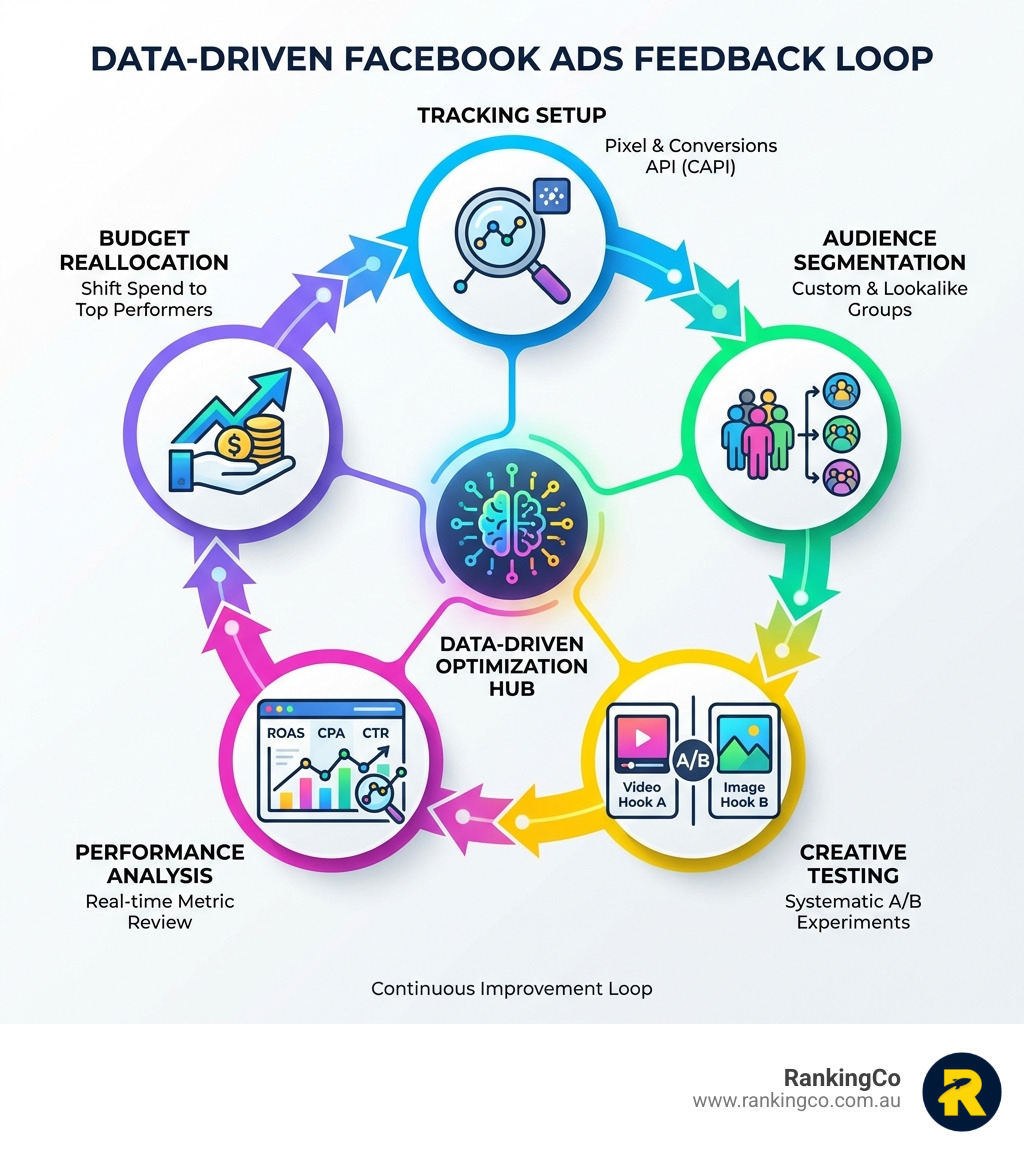
To properly optimise Facebook Ads using a data-driven approach, you must start with a clean measurement foundation using the Meta Pixel and Conversions API, followed by systematic A/B testing of your creative hooks and audience segments. You must continuously analyse your funnel performance to identify where users are dropping off and reallocate your budget to the top-performing ad sets every 48 to 72 hours.
Most people give up on an ad too early. A common mistake is stopping a campaign before it completes its "Learning Phase," which usually requires about 50 conversion events per week per ad set. During this phase, Meta's algorithm is gathering data to understand who responds best to your ads. Cutting it short means you're throwing away valuable learning and potentially profitable future performance.
Here’s our step-by-step approach:
- Set Up Your Analytics Foundation: Ensure your Meta Pixel is correctly installed and your Conversions API is fully implemented. This is the bedrock of accurate data collection and attribution. Without it, you’re flying blind.
- Customise Your Meta Ads Manager Dashboard: Don't just rely on default views. Create custom report views that highlight your most critical metrics like ROAS, CPA, and CTR. This allows for quick identification of winning and losing ads.
- Use Breakdowns for Deeper Insights: Leverage the "Breakdown" feature in Ads Manager to segment your data by age, gender, placement, device, and more. This helps you understand who is converting, where , and how.
- Systematic A/B Testing: Dedicate a portion of your budget to testing different ad creatives, headlines, ad copy, and audience segments. This isn't a one-off task; it's an ongoing process to continually refine your message and targeting.
- Analyse the Customer Journey: Go beyond just final conversions. Track micro-conversions (e.g., add to cart, initiate checkout) to identify bottlenecks in your funnel. Where are people dropping off?
- Continuous Budget Reallocation: Monitor campaign performance daily. If an ad set is significantly outperforming others, reallocate budget towards it every 48 to 72 hours. This agile approach ensures your money is always going to what's working best.
This systematic approach to Facebook Ads ensures that every decision is backed by data, leading to continuous improvement and maximised ROI. It's a core part of our broader social media strategy.
Why are my Facebook Ads getting more expensive?
Facebook Ads are getting more expensive because 3.4 billion daily active users have created a hyper-competitive auction environment where bid prices naturally rise. Additionally, if your ad relevance score is low or your creative is stale, Meta will charge you more to show your content to its users.
The sheer scale of Meta's platforms, with 3.4 billion daily active users, creates an incredibly competitive advertising space. Every advertiser is vying for attention, driving up the cost of showing ads. We've seen CPC for lead campaigns increase roughly 20 percent to $27.66 in recent times, indicating a clear trend of rising costs.
An expert insight we frequently share with clients is that when costs spike, we often find the audience is too narrow. While precise targeting sounds good in theory, making your audience too small can limit Meta's ability to find cost-effective conversions. Broadening your targeting often lowers your Cost Per Mille (CPM) and gives the AI more room to find cheaper conversions, counterintuitively reducing your overall Cost Per Acquisition (CPA).
Beyond auction dynamics, several other factors contribute to rising costs:
- Ad Fatigue: If your audience sees the same ad too many times, they stop engaging, and your CTR drops. Meta interprets this as low relevance and charges you more to deliver your ad.
- Low Ad Relevance Score: Meta assigns a relevance score to your ads. If your creative and targeting aren't a good match for the audience you're reaching, your score will be low, leading to higher costs.
- Seasonality and Competition: During peak seasons (like holidays) or in highly competitive industries, bid prices naturally increase as more advertisers enter the auction.
- Diminished Signal Quality (Post-iOS 14): As discussed, reduced tracking data can make it harder for Meta's algorithm to efficiently find the right audience, potentially leading to higher costs as it "learns" less effectively.
To combat these rising costs, we continuously monitor ad frequency, refresh creatives, and test broader audience segments to keep campaigns efficient and effective.
What is the best data-driven Facebook Ads strategy for audience targeting?
The most effective data-driven Facebook Ads strategy for audience targeting involves building a detailed Ideal Customer Profile (ICP) and using it to create high-value Custom Audiences and Lookalikes. By feeding the algorithm your actual customer data, you allow Meta to find "micro-segments" of users who share the same buying behaviours as your best clients.
A common misconception among advertisers is that "Interest" targeting is the gold standard for reaching new customers. While it has its place, our expert insight is that your own customer list is always more powerful than Facebook's generic interest categories. Why? Because these are people who have already shown a direct interest or made a purchase from you.
Here’s how we build a superior targeting strategy:
- Define Your Ideal Customer Profile (ICP): This goes beyond basic demographics. We analyse your existing best customers to understand their pain points, values, online behaviour, and motivations. This creates a detailed ideal customer profile that guides all subsequent targeting.
- Leverage Custom Audiences: We upload your customer lists (e.g., email subscribers, past purchasers) to create Custom Audiences. These are highly engaged users who already know your brand. We also create Custom Audiences from website visitors, app users, and video viewers.
- Build High-Quality Lookalike Audiences: Once you have robust Custom Audiences, we create Lookalike audiences. Meta's algorithm finds new users who share similar characteristics and behaviours with your existing customers. While iOS 14 has made these less precise, they remain a powerful tool when combined with broad targeting and strong creative.
- Implement Broad Targeting with Smart Creative: In a post-iOS 14 world, we often use broader audience targeting coupled with highly compelling and varied ad creatives. This strategy allows Meta’s sophisticated AI to identify and deliver ads to the most relevant "micro-segments" within that broader group.
- Geographic Focus: For local businesses in Brisbane, Sydney, Melbourne, Central Coast, Auckland, Wellington, or Toronto, we use precise geographic targeting to ensure we're reaching potential customers in your service areas.
By combining your first-party data with Meta's powerful algorithms, we ensure your ads are shown to the people most likely to convert, maximising your ad spend efficiency. This is also a key strategy we employ for Microsoft Ads campaigns.
Who should manage my Facebook Ads for the best results?
For the best results, you should partner with a specialist agency that integrates advanced AI technologies with human creative expertise to manage the technical complexity of modern ad auctions. Professional management ensures your tracking is compliant with privacy laws and your budget is dynamically reallocated to maximise every dollar spent.
The landscape of Facebook Ads has become incredibly complex. It's no longer just about boosting a post; it involves intricate data analysis, AI-driven optimisation, and navigating evolving privacy regulations. An expert insight we constantly share is that if your current manager isn't talking about the Conversions API or systematic creative testing cycles, they are likely using an outdated "set and forget" approach that is losing you money.
At RankingCo, we pride ourselves on being at the forefront of this evolution. As co-founder, alongside Amber Porter, I've seen how crucial it is to combine cutting-edge technology with seasoned human strategy. We integrate advanced AI technologies into our processes, allowing us to analyse market trends accurately and create highly effective campaigns for our clients across our locations in Brisbane, Sydney, Melbourne, Central Coast, Auckland, Wellington, and Toronto.
Our approach means:
- Expert Data Management: We ensure your Meta Pixel and Conversions API are perfectly set up and maintained, providing clean, accurate data for optimisation and reporting. This is vital for navigating privacy changes and maintaining attribution.
- AI-Improved Optimisation: We leverage AI to dynamically test ad creatives, optimise bidding strategies, and reallocate budgets in real-time, ensuring your spend is always directed towards the highest-performing elements.
- Strategic Oversight: While AI handles the heavy lifting of optimisation, our human strategists provide the creative vision, understand your business goals, and interpret complex data to make informed strategic decisions.
- Compliance and Trust: We stay abreast of privacy laws and best practices, ensuring your campaigns are compliant and built on a foundation of trust with your audience.
The modern ad auction is a dynamic beast. You need a partner who understands its nuances, can leverage the latest technology, and applies strategic thinking to achieve your business objectives. This isn't just about managing ads; it's about building a sustainable growth engine for your business.
Take Control of Your Digital Future – Get Found Now.



Share online