How Do I Choose an SEO Agency? 7 Things to Check Before You Sign
Not Every SEO Agency Is Selling the Same Thing

Searching for an SEO agency can quickly become confusing. One provider promises page-one rankings, another talks about backlinks, another promises thousands of visitors, and another sends you a package with a long list of monthly “Search Engine Optimisation (SEO) tasks”.
But how do you know what you're actually paying for?
For a small business, choosing an SEO agency is not simply about finding the cheapest monthly package. It is about finding a team that understands your business, can explain its strategy, and knows how to turn search visibility into meaningful commercial results.
At RankingCo, we recommend choosing an agency by first matching its services to your goals, then verifying its methods, people, proof of work, reporting, and contract terms. A suitable SEO partner should explain what it will do, why it matters to your customers, how progress will be measured, and what a realistic timeline looks like.
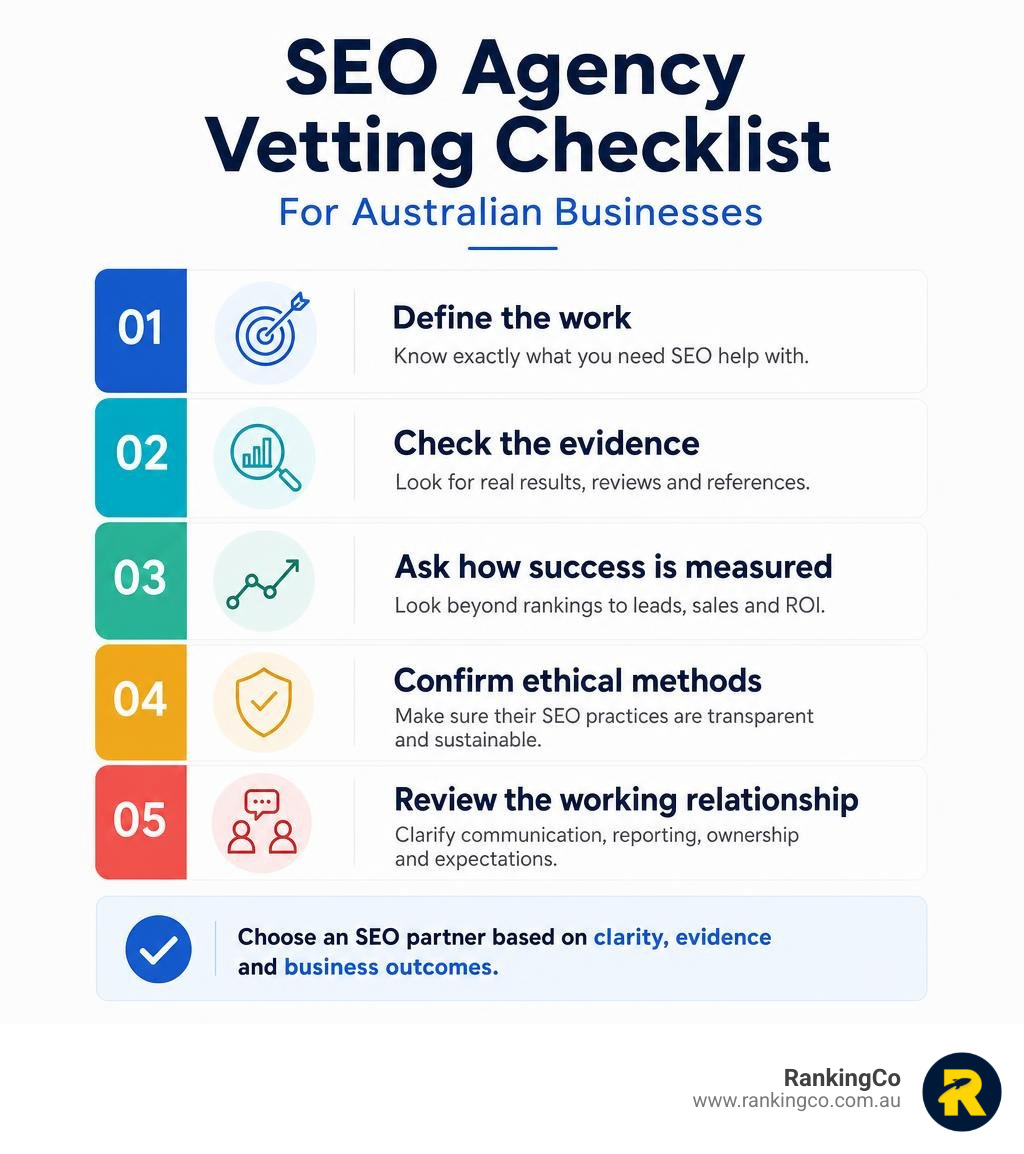
Use this quick shortlist when comparing agencies:
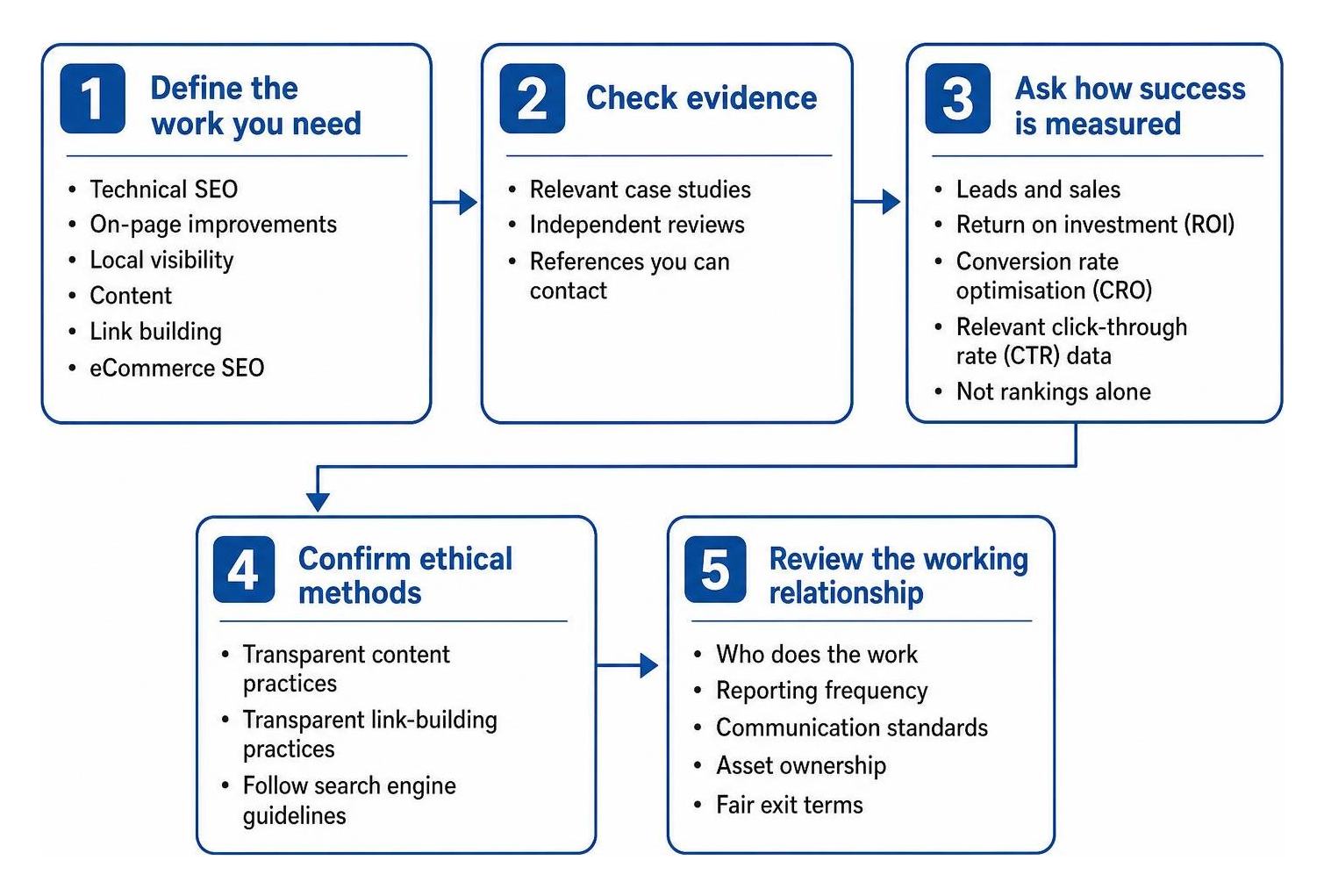
- Define the work you need , such as technical SEO, on-page improvements, local visibility, content, link building, or eCommerce SEO.
- Check evidence , including relevant case studies, independent reviews, and references you can contact.
- Ask how success is measured , with a focus on leads, sales, Return on investment (ROI), Conversion rate optimisation (CRO), and relevant Click-through rate (CTR) data rather than rankings alone.
- Confirm ethical methods , including transparent content and link-building practices that follow search engine guidelines.
- Review the working relationship , including who does the work, reporting frequency, communication standards, asset ownership, and fair exit terms.
SEO should support the rest of your marketing, including Pay-Per-Click (PPC) activity through Google Ads and Meta Ads, where those channels suit your goals. The best choice is rarely the lowest-priced package: it is the provider that offers a clear, tailored plan and can connect search visibility to meaningful business outcomes.
We bring practical experience across SEO, Google Ads, analytics, web development, and content strategy for Australian small and medium-sized businesses. Next, we will break down exactly what to assess before you sign with an SEO agency.
1. Start With What Your Business Actually Needs From SEO
Before choosing an agency, be clear about what you actually need Search Engine Optimisation (SEO) to support. This article should build on the earlier point that traffic is not always the goal. The right agency should first understand the commercial outcome you are trying to improve, then shape the SEO plan around that objective.
For one business, the priority might be more qualified leads. For another, it might be stronger local visibility, eCommerce growth, technical improvements, better onsite optimisation, or more relevant organic traffic from people who are ready to compare options.
That distinction matters because different goals require different work. A business that needs more enquiries may need a lead-focused SEO strategy, such as Leads SEO. An online store may need eCommerce SEO that improves category structure, product visibility, and search intent alignment. A website with weak page structure may need Onsite SEO, while a site with crawlability or performance issues may need Technical SEO. If the main issue is attracting a broader pool of relevant visitors, a Get More Traffic approach may be more suitable.
If an agency jumps straight into a package before understanding what you're trying to achieve, that's worth questioning. A useful SEO conversation should start with your business model, target market, margins, sales process, locations, competitors, and current website limitations.
2. Ask What the Agency Will Actually Do
One of the most practical ways to assess an SEO agency is to ask exactly what work will happen after you sign. The answer should be specific enough for a business owner to understand, even if the technical details are handled by specialists.
Useful questions include:
- What will you change?
- Why does it need changing?
- Who will do the work?
- How often will work be completed?
- What happens during the first three months?
- What happens after that?
- What does the agency need from our business?
This is where it helps to distinguish deliverables from strategy. A list of monthly tasks can sound reassuring, but it does not always explain whether the work is meaningful. A monthly report saying “10 keywords optimised” does not necessarily tell a business owner anything useful. Which pages were improved? Why were those keywords chosen? How does that work support enquiries, sales, Conversion rate optimisation (CRO), or Return on investment (ROI)?
The agency should be able to explain why each activity matters. Technical fixes, internal links, content updates, metadata changes, digital PR, local landing pages, and reporting should all connect back to a clear strategic reason.
3. Look for Evidence, Not Just SEO Promises
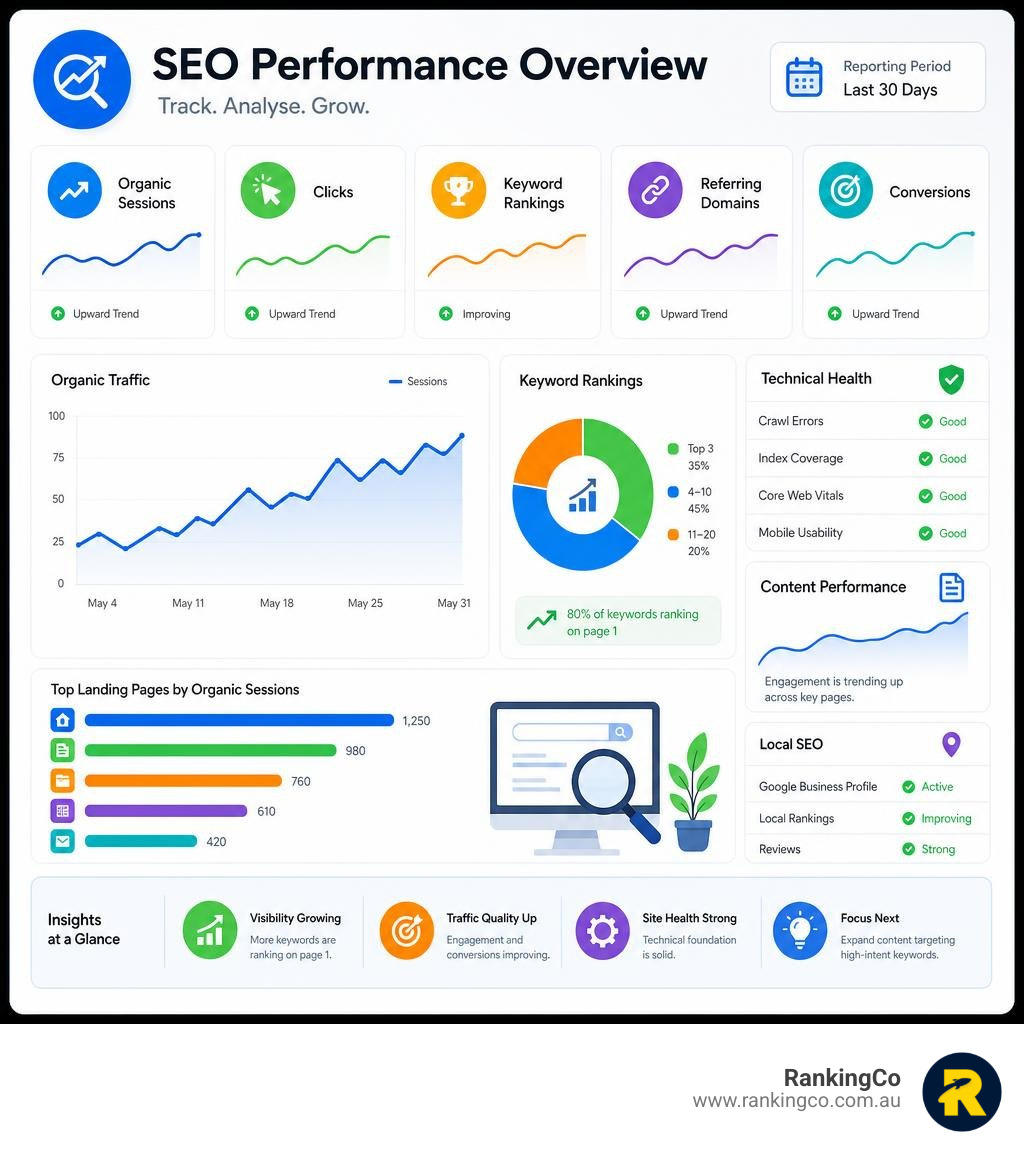
An SEO agency should be able to show evidence of its thinking, process, and client experience without relying on broad promises. Look for proof that the team understands how organic visibility connects to qualified enquiries, eCommerce sales, and commercial outcomes.
Case Studies
Good case studies should explain more than a final result. Look for a clear starting position, the problem the business faced, the strategy used, the work completed, the measurable outcome, and the timeframe involved.
The most useful examples show how the agency approached a real search problem. That might include improving technical foundations, restructuring service pages, strengthening content around search intent, resolving indexation issues, or improving the quality of organic enquiries.
Reviews
Independent reviews can help validate what it is like to work with an agency. They can give insight into communication, reliability, professionalism, deadline management, and overall client experience.
When reading reviews, look for patterns rather than one isolated comment. Consistent comments about clear communication, practical advice, and reliable follow-through are more useful than vague praise.
Relevant Experience
Relevant experience matters because SEO is not the same in every market. A successful eCommerce campaign does not automatically prove an agency understands local trades. A local service campaign does not automatically prove the team can manage complex product taxonomy or technical eCommerce issues.
Ask whether the agency has worked with businesses that share a similar model, sales cycle, location strategy, or competitive environment. The goal is not to find an identical past project, but to confirm that the team can apply the right thinking to your situation.
4. Find Out How They Measure SEO Success
Strong SEO reporting should connect activity to business outcomes. Rankings, impressions, and generic traffic can be useful indicators, but they are not the whole story.
Weak measurement often focuses only on:
- rankings
- impressions
- generic traffic
- broad keyword movement
- task volume
More meaningful measurement looks at whether organic search is attracting the right people and supporting commercial action. That can include qualified organic traffic, enquiries, calls, leads, sales, conversion rate, revenue where measurable, Click-through rate (CTR), and Return on investment (ROI).
Rankings still matter. They help show whether visibility is improving for relevant searches. But rankings are a means, not the entire business outcome. A strong agency should explain how keyword movement, page performance, search intent, conversion paths, and business enquiries fit together.
This is also where paid and organic data can support each other. Pay-Per-Click (PPC) campaigns through Google Ads or Meta Ads can reveal which messages, offers, and landing pages attract stronger engagement, while SEO builds durable visibility over time.
5. Make Sure Their SEO Methods Are Ethical
Ethical SEO should be understandable. You do not need to know every technical detail, but your agency should be able to explain the method, the purpose, and the expected role of the work in plain English.
Look for transparent link building, useful content, legitimate optimisation, clear reporting, and a practical explanation of how changes support users and search engines. Be cautious of any agency that relies on guaranteed rankings, secret “Google loopholes”, manipulative schemes, or unexplained automated activity.
It is reasonable to ask how links are earned, how content is created, and how technical recommendations are prioritised. White-hat SEO focuses on improving the website, strengthening relevance, and earning genuine authority over time.
If an agency can't explain what it is doing because the method is supposedly “secret”, that's a good reason to keep asking questions. Other warning signs include private blog networks (PBNs), automated comment spam, hidden redirects, copied content, and link activity that cannot be clearly explained.
6. Ask Who Will Actually Be Working on Your Campaign

The person who sells an SEO campaign is not always the person who delivers it. Before you sign, ask who will be involved after the proposal stage and how communication will work day to day.
Useful questions include:
- Who is my strategist?
- Who performs the technical work?
- Who writes the content?
- Who analyses the data?
- Who do I speak to when I have a question?
- Is the person selling the campaign actually involved afterwards?
SEO can involve technical SEO, content, analytics, conversion, website development, and digital PR or link acquisition. A stronger agency will know how these disciplines work together rather than treating SEO as a checklist of isolated tasks.
Team depth matters because search performance is rarely improved by one action alone. Technical recommendations may need a developer. Content improvements may need keyword research, search intent analysis, and brand knowledge. Conversion improvements may need page structure, copy, analytics, and user experience input.
At RankingCo, our work spans SEO, Google Ads, Meta Ads, analytics, web development, and content strategy for Australian small and medium-sized businesses. That broader capability helps us connect organic search work with the wider marketing system rather than treating it as a standalone channel.
7. Read the Contract Before You Look at the Monthly Price
Price matters, but it should not be the first or only thing you assess. A lower monthly fee can still be poor value if the agreement is unclear, the deliverables are vague, or the business does not retain ownership of important assets.
Before comparing retainers, review the commercial terms carefully. Check the minimum commitment, notice period, cancellation terms, ownership of content, website access, analytics and data ownership, backlink ownership, reporting expectations, deliverables, additional fees, and who owns completed work if you leave.
A fair agreement should make the working relationship clear. You should understand what is included, what is not included, how progress will be reported, how decisions are approved, and how the relationship can end if it is no longer the right fit.
Monthly SEO Retainer
A monthly SEO retainer is usually best for ongoing optimisation and growth. It can support continuous technical improvements, content planning, onsite updates, local visibility, digital PR, and reporting. The key is making sure the retainer funds strategic work rather than repetitive activity with no clear purpose.
Project-Based SEO
Project-based SEO can be useful for technical audits, migrations, major website changes, and specific remediation work. This model works well when the business has a defined problem, a clear scope, and a project outcome that can be documented.
SEO Consulting
SEO consulting can suit businesses with an internal team that can execute recommendations. In this model, the agency may provide audits, strategy, training, prioritised roadmaps, or review sessions while the internal team handles implementation.
What About SEO Agency Partnerships and Certifications?
Agency partnerships and certifications can be useful supporting evidence when you are comparing providers. They may indicate that an agency has an active relationship with major platforms, keeps up with platform requirements, or has demonstrated capability in related areas of digital marketing.
However, partnerships should not replace evidence of actual Search Engine Optimisation (SEO) capability. A badge is not the same as a clear strategy, transparent reporting, ethical methods, relevant experience, or a team that can explain how its work applies to your business.
For example, RankingCo's Google Premier Partner 2026 status may be relevant when SEO activity needs to work alongside Google Ads insights. For businesses using specific website platforms, our Shopify Partner and Wix Legend Partner relationships can also support broader website, eCommerce, and optimisation discussions.
For wider digital campaigns, platform relationships such as Meta Business Partner, LinkedIn Partner, Microsoft AI Partner, and TikTok Marketing Partner can help show breadth across paid media, social platforms, and emerging digital channels.
The key is to treat partnerships as one part of the decision, not the whole decision. They are useful supporting evidence, but the real question is whether the agency can apply its expertise to your business, your customers, your website, and your commercial goals.
If you are comparing options and want a clear view of what a tailored SEO strategy could involve, explore our services or contact RankingCo to discuss the most practical next step for your business.
How RankingCo Approaches SEO for Small Businesses
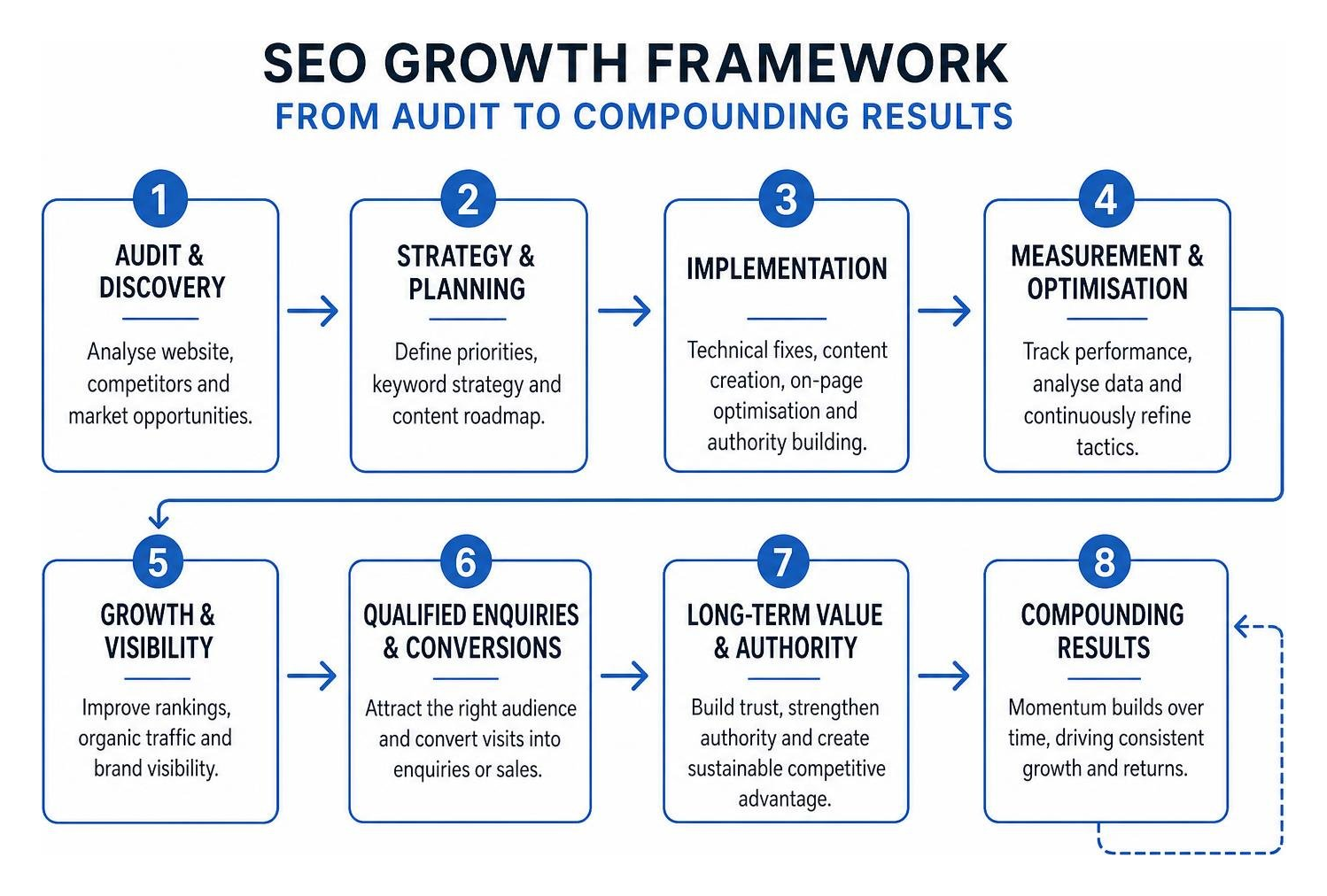
By this point, you have a clearer framework for assessing an SEO agency. The same questions are useful for understanding how we approach Search Engine Optimisation (SEO) for small businesses at RankingCo.
We start by understanding the business itself: how it makes money, who it serves, which services or products matter most, and what a valuable enquiry or sale looks like. From there, we look at the customer journey and search intent, so the SEO strategy is shaped around the people the business actually wants to reach.
Next, we assess the technical foundations of the website, including whether search engines can crawl, understand, and index the right pages. We also review onsite optimisation, content structure, internal linking, local visibility, and opportunities to improve the quality of organic traffic.
The priority is not to create activity for the sake of activity. We identify the highest-value opportunities, then prioritise work according to the business goals, available resources, and likely commercial impact. That might involve technical improvements, service-page refinement, local SEO, eCommerce SEO, content planning, or conversion-focused updates.
Measurement is just as important as implementation. We look beyond rankings alone and focus on meaningful outcomes such as qualified organic traffic, enquiries, calls, leads, sales, Conversion rate optimisation (CRO), Click-through rate (CTR), and Return on investment (ROI) where those metrics can be measured accurately.
We also believe communication matters. A useful SEO partner should explain what is happening, why it is being done, what has changed, and what the next priority is. As results, search behaviour, competitors, and business priorities change, we continue refining the strategy rather than treating SEO as a fixed checklist.
If you want to compare what this could look like for your business, explore our SEO services or contact RankingCo to discuss the most practical next step.
SEO Agency Red Flags: When You Should Walk Away
A strong SEO proposal should make you feel clearer, not more confused. If an agency relies on pressure, vague promises, or explanations that sound impressive but cannot be unpacked, it is worth slowing the conversation down before you sign.
Be cautious if you hear claims about guaranteed number-one rankings, instant SEO results, or huge outcomes for a suspiciously low price. Search Engine Optimisation (SEO) depends on your website, competitors, market demand, content quality, technical foundations, and the way people search. A credible agency can explain a plan and likely priorities, but it should not promise fixed ranking positions or overnight commercial results.
Unexplained backlinks are another major warning sign. If links are part of the strategy, the agency should be able to explain where they may come from, why they are relevant, and how quality will be assessed. The same applies to vague monthly deliverables. A report that only says tasks were completed, keywords moved, or rankings changed does not tell you whether the work is improving the right pages, attracting better enquiries, or supporting sales.
You should also be wary if the agency will not give you access to your own data, avoids explaining the strategy, or locks you into a long agreement without clear deliverables, ownership terms, and exit options. Your website access, analytics, reporting, content, and campaign data should be handled transparently.
Another practical red flag is when the salesperson disappears after signing and you are left unsure who is actually managing the campaign. Before committing, ask who your strategist is, who completes the technical and content work, how often you will hear from them, and what happens if priorities change.
The point is not to reject every agency that uses confident language. It is to look for confidence backed by a clear method, realistic expectations, transparent reporting, and a team that can explain how the strategy supports your business.
The Best SEO Agency Isn't the One Making the Biggest Promise
The right SEO agency should be able to tell you what needs to happen, why it matters, how progress will be measured, and what you can realistically expect. That clarity matters more than a bold sales promise or a package that sounds impressive but does not connect back to your business goals.
You do not need the agency promising the fastest rankings or the biggest traffic numbers. You need a team that understands your business, your customers, your website, and your commercial priorities, then turns search visibility into something genuinely useful.
At RankingCo, we approach Search Engine Optimisation (SEO) by connecting strategy, implementation, measurement, and communication. If you want a clearer view of what that could look like for your business, explore our services or contact RankingCo to start a practical conversation.
Frequently Asked Questions About Choosing an SEO Agency
How do I choose an SEO agency in Australia?
Choose an SEO agency by looking for a clear strategy, relevant experience, transparent methods, practical reporting, and a team that understands your business goals. A good agency should ask about your customers, margins, sales process, services, locations, competitors, website limitations, and commercial priorities before recommending a package.
It should also explain what work will be done, why it matters, who will complete it, how progress will be measured, and what a realistic timeline looks like.
How much does an SEO agency cost?
SEO agency pricing depends on the scope of work, website size, competition, technical issues, content requirements, location targeting, and the level of senior involvement required. Rather than comparing cost alone, review what is included, what is excluded, how priorities are set, and whether the work is tied to commercial outcomes.
A lower monthly fee is not always better value if the strategy is vague, reporting is thin, or the work does not address the areas that actually affect leads, sales, or qualified organic traffic.
How long should I commit to an SEO agency?
The right commitment depends on the work required and the condition of your website. Some technical or project-based work can be scoped as a defined project, while ongoing Search Engine Optimisation (SEO) often needs time for strategy, implementation, measurement, refinement, and content improvement.
Before signing, check the minimum term, notice period, cancellation process, ownership of work, and what happens if the partnership is no longer the right fit. A fair agreement should make those terms easy to understand.
What should an SEO agency do each month?
Monthly SEO work should be guided by strategy, not a fixed checklist of low-value tasks. Depending on the campaign, useful monthly work may include technical fixes, onsite optimisation, content updates, internal linking, local visibility improvements, digital PR, reporting, and recommendations based on search and conversion data.
The agency should explain what changed, why it was prioritised, how it supports your business goals, and what the next focus should be.
How can I tell if an SEO agency is legitimate?
A legitimate SEO agency should be willing to explain its methods in plain English. Look for clear reporting, ethical link-building practices, realistic expectations, relevant proof of work, access to your own data, and a team that can explain how search activity supports meaningful business outcomes.
Be cautious of guaranteed number-one rankings, secret methods, unexplained backlinks, copied content, automated spam, vague deliverables, or pressure to sign a long contract without clear terms.
Should I choose a local Australian SEO agency?
A local Australian SEO agency can be helpful when your customers, competitors, and service areas are in Australia. Local market knowledge can support regional search intent, Australian spelling, time-zone communication, location-specific content, and practical understanding of how Australian customers compare providers.
Location should not be the only factor, though. The stronger question is whether the agency understands your business model, communicates clearly, uses ethical methods, and can connect SEO activity to commercial results.
What SEO services does a small business actually need?
A small business may need technical SEO, onsite optimisation, local SEO, eCommerce SEO, content planning, lead-focused service pages, or a broader traffic growth strategy depending on its goals. If you are still clarifying whether your priority is more traffic, better leads, local visibility, or sales growth, it can help to compare the role of SEO against broader marketing goals in the earlier guide, How SEO helps your business.
At RankingCo, we usually start by identifying the commercial goal first, then matching the work to that goal. You can explore options such as Leads SEO, eCommerce SEO, Onsite SEO, Technical SEO, and Get More Traffic.
Should I hire an SEO agency or an SEO consultant?
An SEO agency may be a better fit when you need strategy, technical support, content, analytics, implementation, reporting, and ongoing campaign management from one team. An SEO consultant may suit a business that already has internal people who can execute recommendations and mainly needs audits, direction, training, or periodic review.
The right choice depends on your internal resources, website complexity, goals, budget, and how much implementation support you need.
Should SEO be combined with Google Ads and other digital marketing?
Search Engine Optimisation (SEO) can work well alongside Pay-Per-Click (PPC), Google Ads, Meta Ads, website development, analytics, content, and broader digital strategy when those channels support the same business goals. Paid campaigns can provide useful insight into messaging, offers, landing pages, and conversion behaviour, while SEO builds durable organic visibility over time.




Share online