A Quick Start Guide to AI SEO Basics
Is AI SEO Changing How Your Business Gets Found Online?
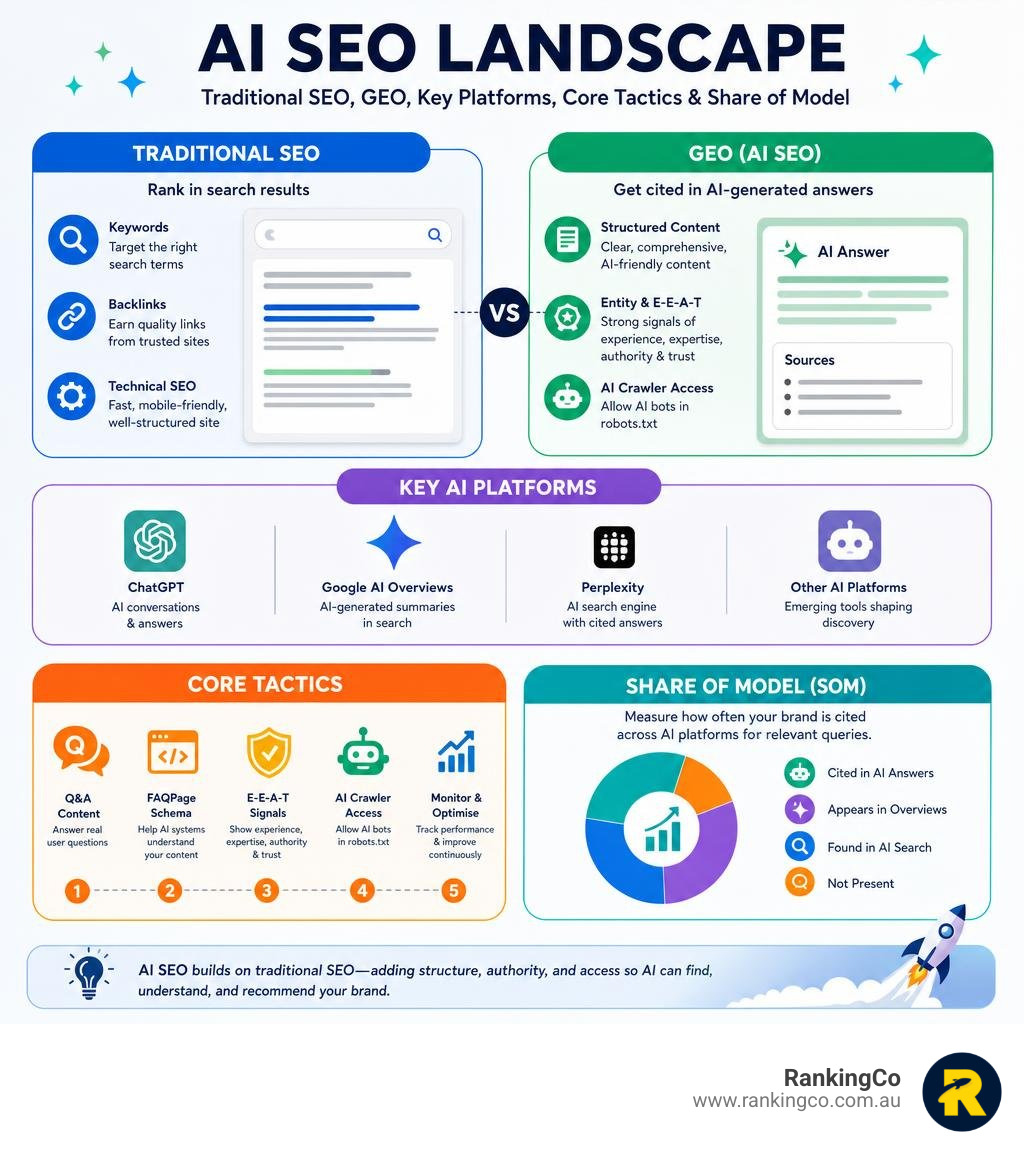
AI SEO is the practice of optimising your website and content so it ranks in both traditional search results and AI-generated answers from platforms like ChatGPT, Google AI Overviews, and Perplexity. It builds on everything that made traditional SEO work, but adds a new layer focused on being cited, quoted, and recommended by AI systems.
Here is a quick snapshot of what AI SEO involves:
- Traditional SEO: Ranking in Google's blue link results through keywords, backlinks, and technical optimisation
- AI SEO: Getting cited in AI-generated answers through structured content, entity signals, E-E-A-T authority, and AI crawler access
- Generative Engine Optimisation (GEO): The specific discipline of optimising content to appear in AI-generated responses from ChatGPT, Perplexity, Google AI Overviews, and similar platforms
- Key metric to track: Share of Model (SoM), which measures how often your brand is cited across AI platforms for relevant queries
- Core tactics: Structured Q&A content, FAQPage schema, strong E-E-A-T signals, and unblocked AI crawlers in your robots.txt
Search behaviour has shifted faster in the past 18 months than in the previous decade. Google AI Overviews now appear in roughly 48 to 50 percent of tracked search queries, and ChatGPT reports around 900 million weekly active users. Zero-click searches, where users get their answer without ever visiting a website, have grown significantly alongside these AI features. For small and medium businesses, this creates a real and immediate visibility risk if your content is not structured for how AI platforms retrieve and present information.
The good news is that Google itself has confirmed that the foundation of AI search visibility is still traditional SEO. Strong technical structure, high-quality content, and genuine authority signals remain the core. What has changed is the additional layer of optimisation needed to ensure AI systems can find, understand, and cite your brand.
I'm Kerry Anderson, co-founder of RankingCo and a digital marketing strategist with over 15 years of experience helping businesses grow through search, and AI SEO is now one of the most important and fast-moving areas I work in with clients. If you want to understand exactly what has changed and what you need to do about it, this guide will walk you through the essentials clearly and practically.
Demystifying AI SEO and Generative Engine Optimisation
To win in this new era, we must view digital marketing as a connected growth system. Traditional search engines and conversational AI platforms are not competing silos; they are parallel surfaces where your customers are looking for answers.
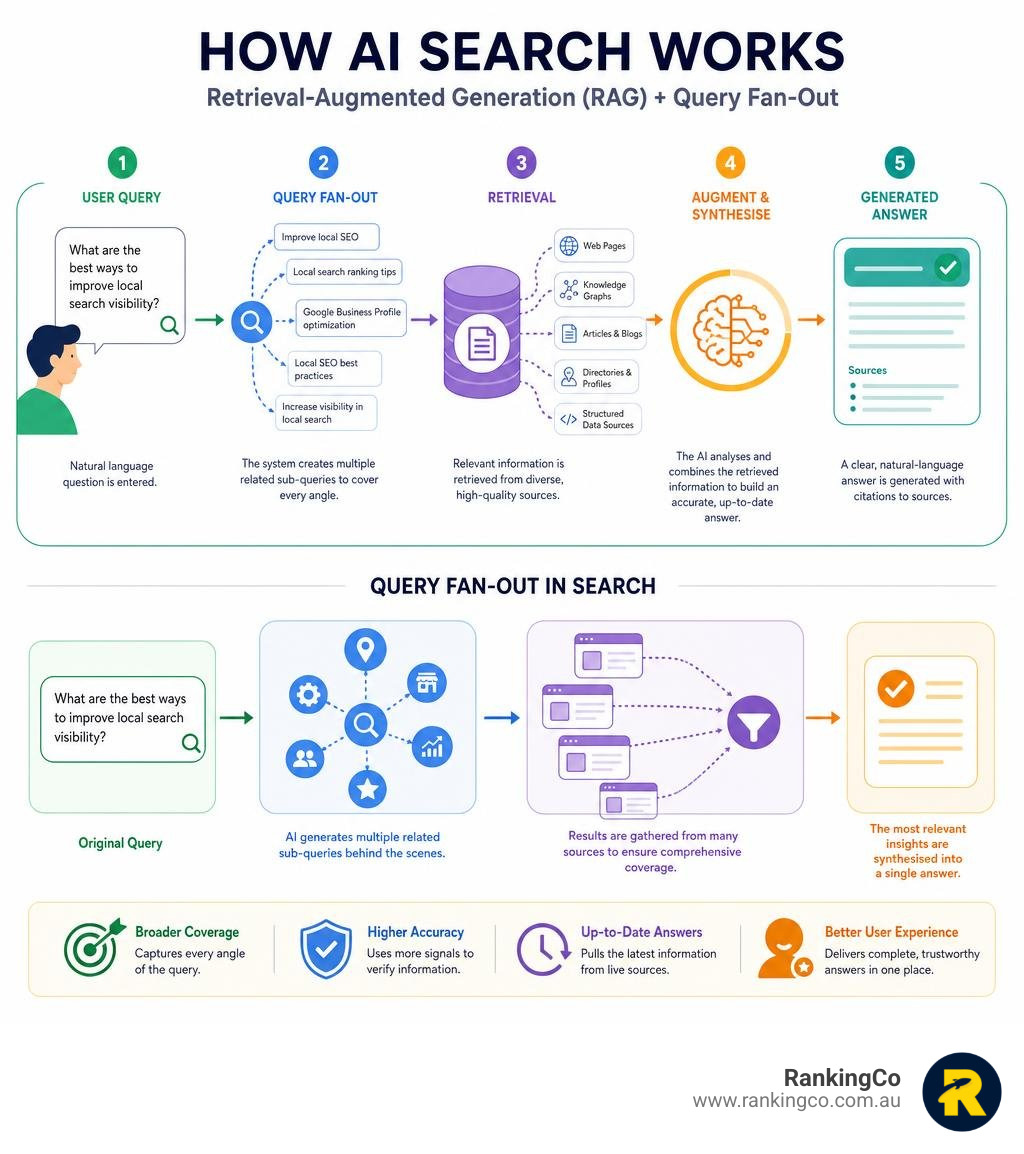
When a user enters a query, modern search engines do not just match keywords. Instead, they rely on Retrieval-Augmented Generation (RAG) and query fan-out. Under a RAG framework, the AI search engine pulls high-quality, live data from index sources and synthesises a natural-language answer. To make sure it captures every angle, the system uses query fan-out, meaning it generates multiple related sub-queries behind the scenes to fetch the most accurate and comprehensive information.
Because these engines process natural language, they rely heavily on entity SEO and knowledge graphs. Instead of reading standalone words, they look at entities, such as your brand name, founders, location, and services, and map the relationships between them. For businesses in Brisbane, Sydney, or Melbourne, maintaining consistent entity signals across your website, Google Business Profile, and third-party directories is what turns a cold digital footprint into a recognised brand entity.
This machine-reading process is highly dependent on structured data and clear content architecture. To make your site easily digestible for AI systems, we focus on the following core disciplines:
- Content Clusters: Grouping your articles around central pillar pages to prove deep topical authority.
- Structured Data: Implementing schema markup, such as FAQPage and LocalBusiness schema, to help crawlers map your business data instantly.
- Technical AI Crawlability: Making sure your robots.txt file explicitly permits access to key AI crawlers like GPTBot, ClaudeBot, and PerplexityBot.
- E-E-A-T (Experience, Expertise, Authoritativeness, and Trustworthiness): Backing up your content with real-world case studies, author bios, and clear editorial standards.
For a deeper look at how to position your business for conversational search, read our strategist's guide on Generative Engine Optimisation (GEO): Your Guide to SEO for ChatGPT. Additionally, you can review the official Google's guide to generative AI search to see how the search giant is framing these updates.
Traditional SEO vs. Generative Engine Optimisation (GEO)
| Feature | Traditional SEO | Generative Engine Optimisation (GEO) |
|---|---|---|
| Primary Goal | Rank in the top 10 organic blue links | Earn citations and mentions in AI-generated answers |
| Target Audience | Human searchers scanning a page of links | Large Language Models (LLMs) synthesising data |
| Search Intent | Keyword-based matching (e.g., "SEO Brisbane") | Conversational and multi-step queries |
| Content Structure | Standard web pages with keyword optimisation | Structured Q&As, bulleted lists, and clear summaries |
| Primary Metric | Keyword rankings, organic impressions, and clicks | Share of Model (SoM) and answer inclusion rate |
Frequently Asked Questions About AI SEO
What is the difference between traditional SEO and AI SEO?
Traditional SEO focuses on earning high positions in Google’s organic blue links by optimising for specific keywords, building backlinks, and refining technical site performance. AI SEO expands this strategy to target direct, conversational answers generated by artificial intelligence. While traditional search behaviour involves users clicking through multiple links to find information, AI search delivers synthesised answers directly on the search results page, shifting the optimisation goal from simple clicks to earning brand citations within the AI text itself.
What is Generative Engine Optimisation (GEO)?
Generative Engine Optimisation (GEO) is the specific practice of preparing your website content and digital footprint so that generative AI engines cite your brand as an authority. It relies on Princeton-validated tactics, such as placing direct, concise answers in the first third of your pages, using structured Q&A formats, and maintaining highly consistent brand entity signals across the web. Developers and advanced marketers often use technical tools like the Akii SEO AI Search Optimizer to audit their sites for machine readability and ensure they are ready for AI extraction.
How do ChatGPT, Perplexity, and Google AI Overviews work?
These platforms use advanced large language models combined with real-time web index indexers to answer user queries. When a prompt is entered, the engine searches the live web, retrieves relevant pages, and summarises the findings while generating source citations to back up its claims. For a detailed breakdown of how Google is integrating these models directly into its search results, explore our analysis of Google's Generative Search: What You Need to Know About AI Overviews.
What are the best AI SEO tools in 2026?
The best AI SEO tools in 2026 focus on workflow efficiency, content optimisation, and tracking your brand's visibility across language models. Based on overall value and performance, tools like Rankability, Surfer, and Clearscope lead the market for content optimisation. For broader workflows, platforms like Writesonic, AirOps, Rankscale.ai, and SE Ranking help teams draft content, build brand kits, and track rankings. When building your tech stack, we recommend avoiding cheap, automated content packages that produce low-quality text, and instead investing in strategic tools that support human-led editorial processes.
How do you measure brand visibility in AI search?
Brand visibility in AI search is measured using a new set of KPIs, primarily Share of Model (SoM), your AI visibility footprint, and your answer inclusion rate. Share of Model measures the percentage of brand citations your business receives across a set of target industry queries on ChatGPT, Perplexity, and Google AI Overviews. Tracking these metrics requires running regular prompt tests to see how often your brand is recommended, what sources the models cite when mentioning you, and how your sentiment score performs compared to local competitors. As the leading Brisbane SEO agency, RankingCo helps businesses track and improve these metrics through custom Share of Model reporting.
Conclusion: Partnering for Connected Growth
Winning in the era of AI SEO requires a connected growth system where traditional search visibility, local SEO, and paid media work together. At RankingCo, we design comprehensive digital strategies that ensure your business is found wherever your customers are searching, regardless of whether they are typing into Google or chatting with an AI assistant.
As a Google Premier Partner, our performance-driven team, led by founders Amber Porter and Kerry Anderson, integrates advanced technologies with real-world marketing expertise to help businesses in Brisbane, Sydney, and Melbourne build resilient search strategies. If you are ready to secure your brand's future in AI search, let's discuss how we can scale your visibility.




Share online