How to Create an Email Marketing Strategy for 2026
Why Email Marketing Strategies Help Determine Whether Your Campaigns Grow or Stall
Effective email marketing strategies are the difference between a list that generates consistent revenue and one that quietly drains your time and budget. Before diving into the full guide, here is a quick answer to what a strong email marketing strategy actually involves:
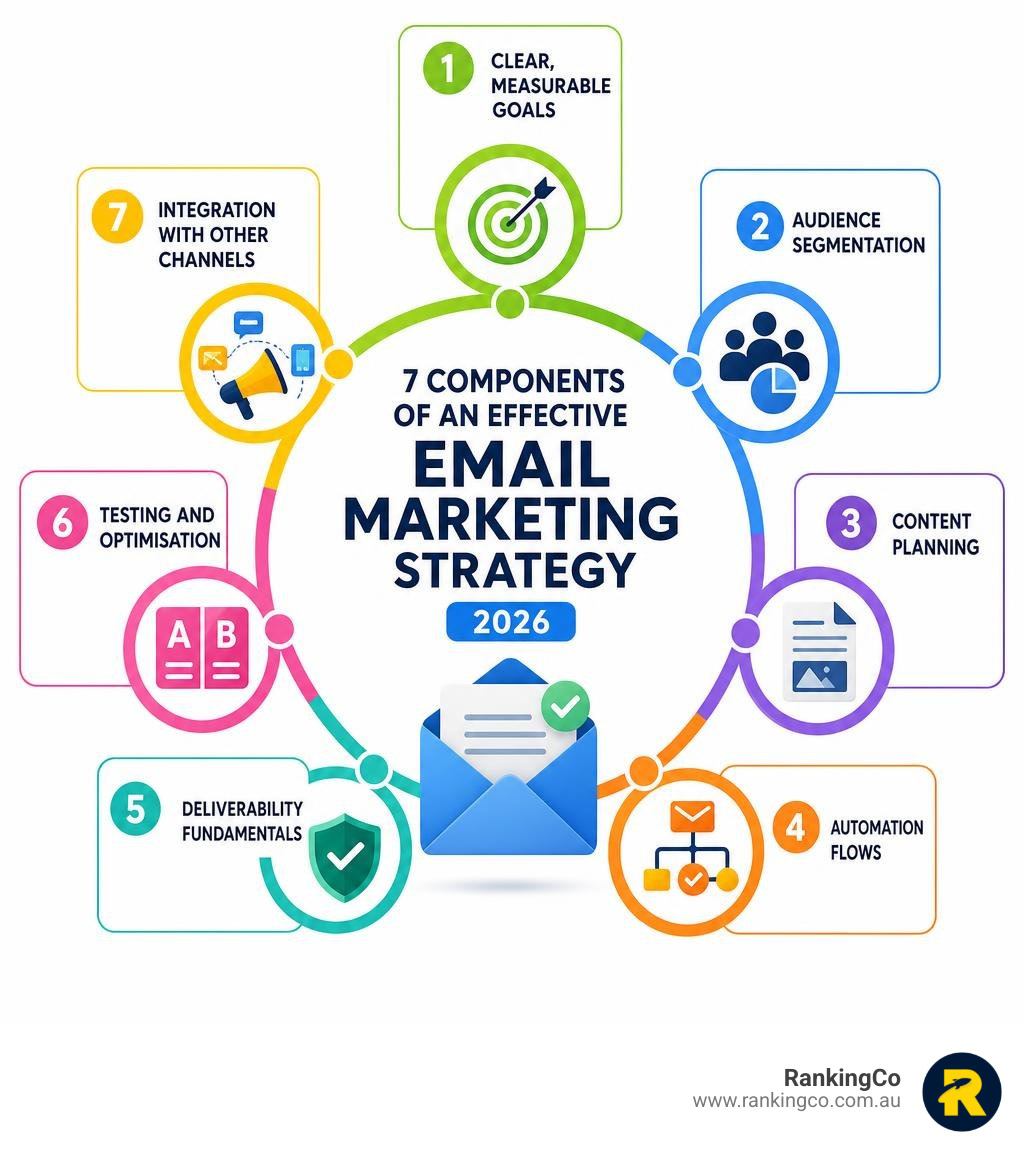
A high-performing email marketing strategy includes:
- Clear, measurable goals tied to business outcomes (revenue, retention, list growth)
- Audience segmentation based on behaviour, purchase history, and lifecycle stage
- Content planning mapped to each stage of the customer journey
- Automation flows for welcome, abandoned cart, post-purchase, and win-back sequences
- Deliverability fundamentals including domain authentication and list hygiene
- Testing and optimisation using A/B testing and performance data
- Integration with other channels such as paid ads, SMS, and SEO
Email remains one of the highest-returning channels in digital marketing. According to industry benchmarks, businesses see an average return of $36 for every $1 invested, with top performers reaching well beyond that. Yet most businesses access only a fraction of that potential because they treat email as a broadcast tool rather than a relationship and retention system.
The inbox has changed significantly by 2026. Gmail and other providers now prioritise engagement signals over volume. Apple Mail Privacy Protection has made open rates less reliable as a standalone metric. AI-generated content is increasingly detectable by both algorithms and readers. These shifts mean that a strategy built on outdated assumptions is not just underperforming. It is actively working against you.
What separates brands generating 35 to 45 percent of total revenue from email from those stuck at 10 percent is not the platform they use. It is the intentionality behind every send, the depth of their segmentation, and the quality of their automation architecture.
I'm Kerry Anderson, co-founder of RankingCo and a digital marketing strategist with over 15 years of experience helping businesses build and scale profitable email marketing strategies across industries. In this guide, I'll walk you through exactly how to build a strategy that works in 2026 and beyond.
Building Modern Email Marketing Strategies for 2026
Modern email marketing strategies are built on infrastructure, relevance, and data integration rather than simple batch-and-blast newsletters. To survive strict modern spam filters, your technical foundation must be flawless before you write a single word of copy.
In 2026, inbox providers act as strict gatekeepers. If your sending domain does not have SPF, DKIM, and DMARC records fully configured, your emails will fail to land in the primary inbox. According to platforms like Google and Yahoo, keeping your spam complaint rate strictly below 0.1% (and never exceeding a 0.3% threshold) is critical to preserving your sender reputation.

At the same time, the rise of AI tools has changed how content is produced. While 70% of email marketers report that up to half of their operations are AI-driven in 2026, relying on raw, unedited generative copy is a quick way to destroy subscriber trust. Successful brands use AI to analyse engagement patterns and scale personalisation, but they keep a human hand on the editorial pen.
To build a sustainable program, you must focus on the complete customer lifecycle. For a step-by-step roadmap on setting up your infrastructure correctly, you can read the 7 steps to build a savvy email marketing strategy in 2026 | Twilio.
Core Pillars of High-Performing Email Marketing Strategies
A successful email engine relies on four core pillars: deep segmentation, value-first list building, automated flow architecture, and modular design. When these pillars work together, they transform email from a cost centre into an independent revenue driver.
First, audience segmentation is the single largest lever for improving engagement. Industry data shows that marketers who segment their lists see up to 760% higher revenue. Instead of static lists, modern platforms use dynamic, event-based segments that update automatically based on real-time customer behaviour.
Second, list building must focus on quality over quantity. Purchasing lists is a direct path to domain blacklisting. Instead, focus on organic acquisition by offering high-value lead magnets, such as exclusive guides, checklists, or toolkits. To understand how to capture high-intent subscribers, read our guide on the lead magnet: how to attract and convert website visitors.
Third, automated flow architecture ensures your brand delivers the right message at the right moment. The most critical flows to build include:
- Welcome Series: Drives immediate engagement. Welcome emails can deliver up to 336% higher transaction rates than standard promotional emails.
- Abandoned Checkout: A three-part sequence sent at 1 hour, 24 hours, and 72 hours to recover lost sales without training customers to wait for discounts.
- Browse Abandonment: Triggered when a subscriber views products but does not add them to their cart, maintaining top-of-mind awareness.
- Post-Purchase & Cross-Sell: Nurtures customers after a sale. Adding a targeted cross-sell node around Day 45 can significantly boost repeat purchase rates.
Finally, modular email design allows your team to move quickly. Over 80% of teams using modular templates create finished emails in two weeks or less. Designing for mobile-first is non-negotiable, as over 60% of all emails are opened on mobile devices. For a deeper look at scaling retention systems, check out How to Build an Email Marketing Engine That Scales Past $10M on Ecommerce Times.
Integrating Email with Omnichannel Growth Systems
Email performs best when it is integrated into a unified digital marketing system. Rather than treating email as an isolated silo, we treat it as a connector that amplifies the return on your paid search, social ads, and organic SEO.
When you coordinate your channels, you prevent budget waste. For example, by syncing your email platform with your paid channels, you can automatically suppress active email subscribers from your Meta and Google retargeting audiences. This ensures your paid ad budget is spent on acquiring new customers rather than paying to reach people who are already opening your weekly newsletters.
Furthermore, data gathered from your email campaigns can directly inform your broader acquisition campaigns. If a specific subject line or product category achieves an exceptionally high click-through rate in your email tests, that copy can be adapted for your Google Ads search campaigns or Facebook ad creative.
This connected approach dramatically improves overall customer lifetime value and conversion rates. To discover how to align your retention channels with your traffic acquisition, read our comprehensive guide to boost conversions today: Rankingco's guide to winning back visitors.
Partner with RankingCo for Integrated Growth
Building a modern email marketing engine requires technical expertise, strategic planning, and continuous performance optimisation. As Brisbane's leading digital agency, RankingCo designs fully integrated digital marketing systems that connect SEO, paid advertising, and smart email automation to drive measurable business outcomes for companies across Australia.
As a Google Premier Partner, our teams led by founders Amber Porter and Kerry Anderson combine advanced technology with hands-on marketing expertise to help your business stand out and scale sustainably.
If you are ready to stop sending generic blasts and start building a high-performing retention system, our team is here to help. Let's discuss your growth strategy and design a system tailored to your business goals.
Frequently Asked Questions
What is the difference between an email marketing strategy and tactics?
An email marketing strategy is your long-term plan designed to achieve specific business objectives, such as increasing customer lifetime value or improving retention. Tactics are the specific, short-term actions you take to execute that strategy, such as running an A/B test on a subject line, sending a holiday promotion, or adjusting a button colour. Your strategy defines the "why" and the "who", while your tactics define the "how" and the "when".
How do businesses set measurable goals for their email marketing strategies?
To set measurable goals, businesses must focus on metrics that directly impact bottom-line revenue rather than relying solely on vanity metrics. Working with an experienced partner like RankingCo, Brisbane's top digital marketing agency, helps brands establish clear key performance indicators (KPIs) such as revenue per recipient (RPR), conversion rates, and customer retention. For example, a measurable goal would be to increase email-attributed revenue to 30% of total sales within six months, or to recover 15% of abandoned carts through a revised automated sequence.
What are the most effective ways to segment and personalise email audiences?
The most effective approach is to move beyond basic first-name personalisation and use dynamic, behaviour-based segmentation. You should segment your audience by purchase history (such as one-time buyers vs. VIPs), product affinity, and engagement frequency (active subscribers vs. lapsed contacts). Incorporating zero-party data collected through interactive sign-up forms or preferences allows you to send highly tailored content that matches the recipient's exact interests.
How can we ensure high email deliverability in 2026?
Ensuring high deliverability requires strict technical setup and consistent list maintenance. You must authenticate your domain using SPF, DKIM, and DMARC protocols, and monitor your domain health weekly using tools like Google Postmaster. Additionally, you must practice proactive list hygiene by setting up a sunset flow to automatically un-subscribe or suppress contacts who have not opened an email in over 180 days, keeping your active list highly engaged.
What are the most common mistakes to avoid in email marketing?
The most damaging mistakes include purchasing subscriber lists, sending generic bulk emails to your entire database without segmentation, and neglecting mobile optimisation. Over-discounting too early in your abandoned checkout flows is another common error that trains customers to abandon their carts purposefully to receive a discount. Finally, treating email as a standalone channel rather than integrating it with your paid search and social ads leads to fragmented customer experiences and wasted budget.



Share online