How to Reduce High CPC in Google Ads
Why Is My Cost Per Click on Google Ads?

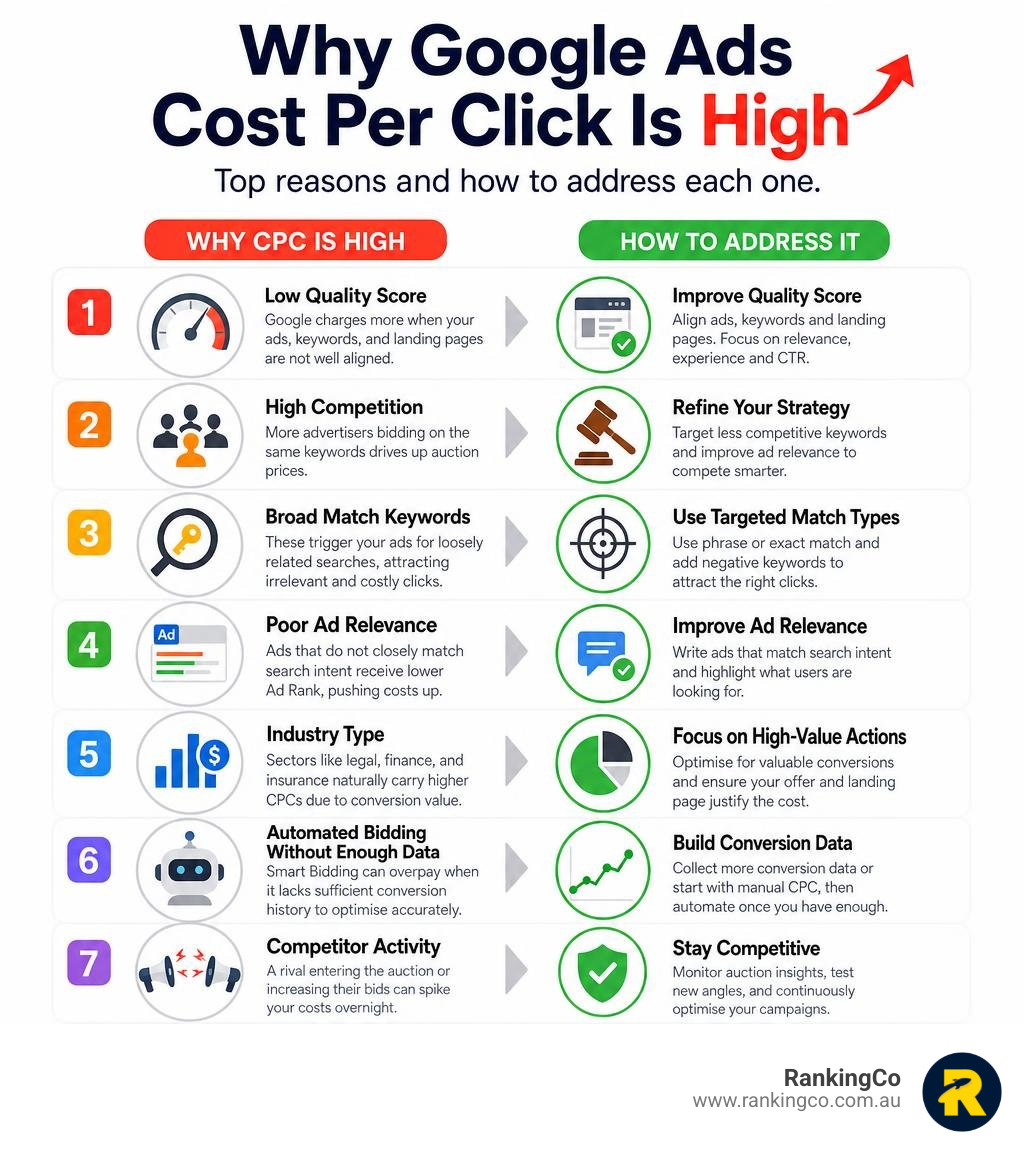
Why is my cost per click so high in Google Ads is one of the most common questions we hear from small business owners running paid search campaigns. Here are the most likely reasons your CPC is elevated:
- Low Quality Score : Google charges more when your ads, keywords, and landing pages are not well aligned
- High competition : More advertisers bidding on the same keywords drives up auction prices
- Broad match keywords : These trigger your ads for loosely related searches, attracting irrelevant and costly clicks
- Poor ad relevance : Ads that do not closely match search intent receive lower Ad Rank, pushing costs up
- Industry type : Sectors like legal, finance, and insurance naturally carry higher CPCs due to the value of each conversion
- Automated bidding without enough data : Smart Bidding strategies can overpay when they lack sufficient conversion history to optimise accurately
- Competitor activity : A rival entering the auction or increasing their bids can spike your costs overnight
Even when you are doing everything right, broader market shifts can push costs higher. The Google Ads auction rewards relevance and quality, so campaigns that fall short on either dimension end up paying a premium.
I'm Kerry Anderson, co-founder of RankingCo and a digital marketing strategist with over 15 years of experience diagnosing exactly why cost per click climbs and building the kind of campaign structures that bring it back under control. Understanding why your cost per click is so high in Google Ads is the first step toward fixing it, and that is precisely what this guide walks you through.
Why This Issue Should Not Be Ignored
Ignoring a rising cost-per-click in your paid campaigns is a fast track to draining your marketing budget without seeing a return. When your costs per click climb, your overall customer acquisition cost rises alongside them. This means you are paying significantly more to secure the exact same number of leads or sales, directly eating into your profit margins.
For small and medium-sized businesses operating in competitive markets like Brisbane, Sydney, and Melbourne, every dollar must count. Leaving a high CPC unchecked means you are likely letting competitors outmanoeuvre you in the auction. Over time, as your budget is consumed by fewer, more expensive clicks, your visibility drops, your lead pipeline dries up, and you lose valuable market share to rivals who have optimised their campaigns more effectively.
Why Is My Cost Per Click So High Google Ads?
To understand why your CPC is high, you first need to understand how the Google Ads auction actually works. Many advertisers confuse their Maximum CPC (the most they are willing to pay for a click) with their Actual CPC (the final amount they are charged).
According to the official Google Ads Help Guide on Actual CPC, your Actual CPC is often less than your Maximum CPC because you are only charged the minimum amount required to beat the Ad Rank of the competitor immediately below you. This calculation is heavily influenced by Google's auction mechanics, which determine your ad's placement using a formula known as Ad Rank.
We have written an extensive breakdown of this process in our guide on Ad Rank Revealed: How Google Determines Your Ad's Spot. Essentially, Ad Rank is calculated using your bid amount, your Quality Score, and the minimum thresholds required for your ad to appear in a specific position. If your competitors have high Ad Ranks, or if you are aiming for the top positions above the organic search results, the minimum price to enter the auction rises, which naturally increases your Average CPC.

Why Is My Cost Per Click So High Google Ads? Diagnosing Sudden Spikes
It can be incredibly frustrating to log into your account and find that your CPC has spiked overnight. When this happens, it is usually driven by one of three common culprits: sudden competitor activity, campaign misconfigurations, or platform-level changes.
First, check your competitor activity. A new competitor may have entered your local auction, or an existing rival might have aggressively raised their bids. You can diagnose this by looking at your Auction Insights report to see if your impression share has dropped while a competitor's has risen.
Second, campaign changes can trigger unexpected spikes. If you recently switched your bidding strategy to a fully automated option, or if you opted into Google's auto-applied recommendations without realising it, the algorithm may be aggressively bidding to win high-value auctions.
Additionally, a sudden drop in your Quality Score will immediately drive up your costs. We cover how to identify and fix these drops in our article on What is Quality Score? What You Can Do to Improve It. According to research published by AdLeaks, securing a higher Quality Score of 8 to 10 can reduce your CPC by as much as 50 percent, while low scores can dramatically increase the minimum bid required just to participate in the auction.
For a deeper dive into diagnosing these sudden budget shifts, check out the troubleshooting steps outlined in this guide on Why Your Google Ads CPC Spiked Overnight.
Why Is My Cost Per Click So High Google Ads? Platform and Competitor Pressures
Beyond your individual campaign settings, broader market trends are constantly pushing platform costs upward. As more businesses invest in digital marketing across Australia, platform competition naturally intensifies.
Furthermore, search engines have introduced advanced personalisation capabilities, and customer expectations have risen. According to Google research cited by Instapage, 61 percent of shoppers expect brands to tailor their advertising experiences to their preferences. However, keeping up with this demand is difficult; Gartner research notes that 65 percent of marketers find the process of creating highly segmented ad campaigns and landing pages overwhelming.
When campaigns fail to meet these high personalisation standards, Quality Scores suffer, and costs rise. To combat this, smart advertisers use negative keywords to filter out irrelevant searches and focus their budget on high-intent users. You can learn how to set this up in our guide on How to Use Negative Keywords Effectively for Google Ads and PPC.
What a Strategic, Personalised Approach Actually Looks Like
Successfully lowering your CPC without sacrificing your ad visibility requires a structured, strategic approach to keyword selection and campaign structure. Instead of relying on broad match keywords that cast too wide a net, we focus on highly targeted exact match and long-tail keywords. Long-tail keywords are more specific, usually face less competition, and carry a much lower average cost.
We also structure campaigns using tightly themed ad groups. This ensures that your ad copy is highly relevant to the search query, which directly improves your Click-through rate (CTR) and Quality Score. We detail these structured tactics in our resource on Google Ads Campaign Optimization.
To help visualise the difference, consider how match types impact your costs and targeting:
| Keyword Match Type | Search Query Example | Competition Level | Cost Per Click (CPC) |
|---|---|---|---|
| Broad Match (e.g., vegan bags ) | "leather handbag repair" | High | High (irrelevant clicks) |
| Exact Match (e.g., [vegan leather bags] ) | "vegan leather bags" | Medium | Lower (highly targeted) |
| Long-Tail Exact (e.g., [affordable vegan tote bags] ) | "affordable vegan tote bags" | Low | Lowest (high-intent) |
By refining your keyword match types and continuously updating your negative keyword lists, you can significantly reduce wasted spend. In fact, data shared by AdLeaks indicates that adding negative keywords can reduce wasted ad spend by up to 30 percent in some accounts.

The Value of an Ongoing Partnership
Managing Google Ads is not a set-and-forget task. It requires continuous monitoring, testing, and strategic adjustments. This is where the value of an ongoing partnership with a certified digital marketing agency becomes clear.
We work closely with our clients to align their bidding strategies with their actual business goals. From Manual CPC for ultimate control to Smart Bidding strategies like Target ROAS (Return on investment) and Target CPA, we ensure your bidding is backed by clean, accurate data. According to AdLeaks, Smart Bidding users can achieve 14 to 22 percent lower CPCs once the algorithm has enough conversion data to work with effectively.
We also keep our clients protected from platform shifts, such as the deprecation of older bidding models like Enhanced CPC, by proactively transitioning campaigns to modern, high-performing alternatives. If you are unsure where your budget is currently going, we highly recommend starting with our Google Ads Checkup to identify immediate cost-saving opportunities.
What to Expect When Working With RankingCo
When you partner with us, you are choosing an agency that values transparency, communication, and real, measurable growth. We are proud to be a Google Premier Partner 2026, a status that places us among the top tier of digital marketing agencies in Australia. This partnership gives our team direct access to advanced Google training, beta features, and dedicated support, which we leverage to give our clients a distinct competitive edge.
Based in Brisbane and serving businesses across Sydney, Melbourne, and the Gold Coast, we tailor our onboarding experience to fit your unique business DNA. You will receive clear, jargon-free reporting and regular communication from a team that genuinely cares about your long-term success.
When to Get in Touch or Take Action
If you suspect that your campaign is suffering from high costs, low conversion rates, or wasted budget, the best time to take action is now. Letting inefficient campaigns run will only continue to drain your marketing resources.
We can help you audit your account, restructure your keyword strategy, and implement advanced cost-reduction techniques to help you scale your business. Explore Our Services to see how we can assist, or visit our dedicated Google Ads page to learn more about our approach.
To get started on reclaiming your budget and lowering your costs, please Contact Us today for a comprehensive campaign review.
- Explore our full suite of digital growth solutions: Our Services
- Learn about our targeted search strategies: Google Ads Management
- Ready to speak with a strategist? Contact RankingCo
Frequently Asked Questions About High CPC
How long does it take to see results from this service?
While some technical fixes and negative keyword additions can yield immediate cost savings within the first week, comprehensive campaign restructuring and Quality Score improvements typically take 30 to 90 days to fully mature as Google's algorithms gather fresh performance data.
How does RankingCo report on performance and progress?
We provide clear, transparent, and jargon-free monthly reports that focus on the metrics that actually matter to your business, such as conversion rates, cost per lead, and overall return on investment, backed by regular strategy calls with your dedicated account manager.
What makes RankingCo different from other digital marketing agencies?
As Brisbane's leading digital marketing agency and a certified Google Premier Partner, Meta Business Partner, and Microsoft AI Partner, we combine advanced technology with a deeply collaborative, relationship-first approach, treating your business goals as our own rather than offering cookie-cutter, set-and-forget packages.
Is this service suitable for small businesses or specific industries?
Yes, we specialise in helping small and medium-sized Australian businesses scale their operations, and we have extensive experience managing campaigns across a diverse range of sectors, including professional services, local trades, and eCommerce.
How do I get started or what does the onboarding process look like?
Getting started is simple. We begin with an initial consultation to understand your business goals and audit your current accounts, followed by a collaborative strategy session where we present a tailored roadmap before transitioning into a seamless, fully managed campaign kickoff.



Share online