How Long Does Google Ads Take to Work? What to Expect
How Long Before Google Ads Start Working?

Google Ads can begin generating impressions and clicks relatively quickly once campaigns are approved and active, but reliable conversion performance takes longer. The first signs of activity are not the same as stable profitability, because a campaign still needs enough traffic, conversion data and optimisation history to show what is genuinely working.
Key Takeaways
- Initial activity can start quickly : Campaigns may begin receiving impressions and clicks soon after ad approval, although approval timing depends on account, policy and landing-page checks.
- Early results need context : The first few weeks often involve data collection, auction testing, broader search-query exposure and conversion tracking validation.
- Optimisation takes time : Many campaigns need an 8 to 12 week optimisation window before performance trends become easier to judge, but this should not be treated as a profitability guarantee.
- Better data improves decisions : Budget, search volume, cost-per-click, conversion rate optimisation and tracking quality all influence how quickly the campaign becomes easier to evaluate.
- Learn more about our Google Ads Management Services if you want a structured campaign built around evidence, not guesswork.
At RankingCo, we approach Pay-Per-Click (PPC) advertising with transparency and strategic discipline. As a certified Google Premier Partner, Meta Business Partner and Microsoft AI Partner, we help small and medium-sized Australian businesses across Brisbane, Sydney and Melbourne build campaigns that are commercially grounded and carefully measured.
Hi, I'm Kerry Anderson, co-founder at RankingCo. My experience working across Google Ads strategy, conversion tracking and small-business campaign optimisation helps shape this guidance, because I have seen how often strong campaigns are misjudged too early. This article is designed to help business owners understand what happens after launch, which signals matter, and when a campaign needs more time versus a stronger strategic intervention.
Every business deserves a digital marketing partner that genuinely cares about growth and treats commercial targets as shared objectives. When you understand how campaign data, platform learning and customer behaviour interact, you can make clearer decisions during the early stages of Google Ads management.
Why Google Ads Don't Deliver Stable Results Immediately
Expecting instant profitability from a newly launched search advertising campaign can lead to poor decision-making. Early results are often shaped by limited conversion data, auction testing, search-term variation and the natural delay between a user clicking an ad and becoming a lead or customer.
When major changes are made too early, such as rebuilding campaigns, changing bidding direction or heavily altering budgets before enough data is available, performance becomes harder to evaluate. The account may be forced back into another round of learning, making it difficult to separate genuine issues from normal early-stage volatility.
The key point is simple: early inconsistency does not automatically mean the campaign is failing. It usually means the campaign is still collecting the evidence needed to support more confident optimisation decisions.
What Happens After You Launch a Google Ads Campaign?
Ad Review and Approval
Before ads can serve, Google reviews campaigns against its advertising policies, landing-page requirements and account settings. Google states that most ads are reviewed within one business day, although some reviews can take longer when closer checks are required by policy or business category: Google Ads ad review process.
Approval timing can be affected by regulated industries, billing verification, landing-page accessibility, tracking setup and whether ad copy complies with platform rules. During this stage, the account should be checked for:
- Ad copy compliance with Google Ads policies
- Relevance between keywords, ads and landing pages
- Functional billing, conversion tracking and contact pathways
- Mobile usability, page speed and secure landing-page access
The Initial Learning and Data Collection Period
Once ads are approved and active, the campaign begins collecting real search and user-behaviour data. Automated bidding strategies use machine learning to assess signals such as search intent, device, location, time of day and conversion likelihood.
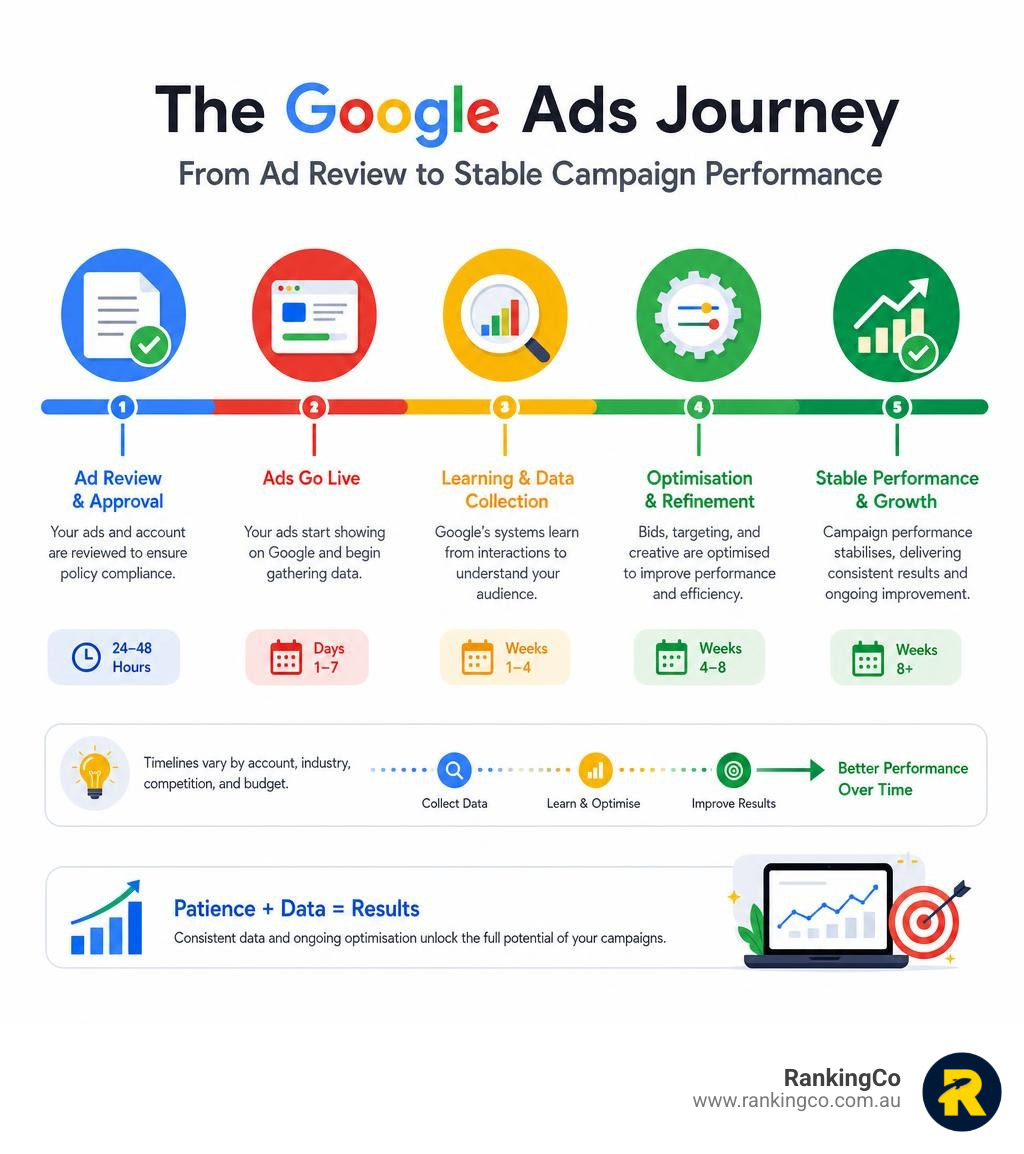
The first 7 to 14 days should generally be treated as a data-gathering period rather than a final verdict on performance. During this time, the campaign is learning which queries, audiences and ad placements are most likely to produce meaningful actions.
Early Performance Can Be Inconsistent
First-month reporting can fluctuate as the campaign gathers enough evidence to guide decisions. Common causes include:
- Cost-per-click (CPC) changes across different auctions
- Conversion rate optimisation (CRO) signals still developing
- Broader search queries appearing before negative keywords are refined
- Conversion and attribution delays
- Landing-page performance differences across devices and locations
Businesses seeking direct phone enquiries or form submissions can use tailored Google Ads Lead Generation Services to capture high-intent local demand while managing these early data collection phases.
How Long Does Google Ads Take to Start Working?
When You Can Expect the First Clicks
Impressions and clicks can begin shortly after ads are approved and active. This is the earliest sign that a campaign is live, but it does not prove that the campaign has enough data to be judged properly.
When You Can Start Evaluating Performance
Meaningful evaluation depends on conversion volume, traffic quality, search demand, budget, industry cost-per-click and the quality of tracking. A campaign with limited clicks or unclear conversion tracking may show activity without yet providing enough evidence for confident decisions.
When Performance Usually Becomes More Consistent
Many campaigns become easier to assess after an 8 to 12 week optimisation period. That timeframe allows for search-term refinement, ad testing, landing-page review, bidding adjustments and enough conversion history to identify clearer performance trends.
This is a working timeframe, not a guarantee of profitability. The right timeline depends on the market, budget, search volume, sales cycle and quality of the campaign setup.
What Determines How Quickly Google Ads Improve?
Daily Budget and Search Volume
More budget can generate data faster, provided there is enough relevant search demand. If the available search market is small or highly competitive, additional budget alone may not create better results.
Industry Competition and Cost Per Click
Higher CPCs can reduce the number of clicks generated from the same budget. This can slow down data accumulation and make early performance harder to interpret.
Sales Cycle and Conversion Delay
A simple lead-generation campaign may produce enquiries faster than a high-consideration Business-to-Business (B2B) service. Longer sales cycles can delay reported conversions, especially when customers research multiple options before contacting a provider.
Landing Page and Conversion Rate
Google Ads performance depends on what happens after the click. A relevant, fast and conversion-focused landing page helps turn paid traffic into enquiries and gives bidding systems better-quality conversion signals.
Tracking and Conversion Data Quality
Poor or incomplete tracking can make a campaign appear less effective than it really is. It can also prevent automated bidding systems from receiving the signals they need to optimise efficiently.
The Google Ads Optimisation Timeline: Weeks 1 to 12+
| Timeline | Primary focus | What to expect |
|---|---|---|
| Weeks 1-2 | Launch, compliance and calibration | Initial traffic, testing and higher volatility |
| Weeks 3-4 | Data gathering and search-term refinement | Negative keywords, early conversion patterns and tracking validation |
| Weeks 5-8 | Strategy refinement and CRO | More informed optimisation and emerging performance trends |
| Weeks 9-12+ | Scaling and efficiency | Stronger data foundation and more consistent performance |
What Should You Actually Change During the Learning Period?
Not every short-term fluctuation needs an immediate fix. Controlled optimisation is different from constantly rebuilding the campaign.
During the learning period, it is sensible to monitor and refine:
- Search terms and negative keywords
- Conversion tracking accuracy
- Budget allocation where the data supports it
- Landing-page issues that affect enquiries
- Ad relevance, message clarity and offer alignment
The goal is to improve the campaign without interrupting the data trail so often that performance becomes impossible to assess.
What Does Effective Google Ads Management Look Like?
Effective management starts with the campaign lifecycle, then moves into ongoing optimisation. Search auction landscapes change as competitors enter the market, customer behaviour shifts and platform systems evolve.
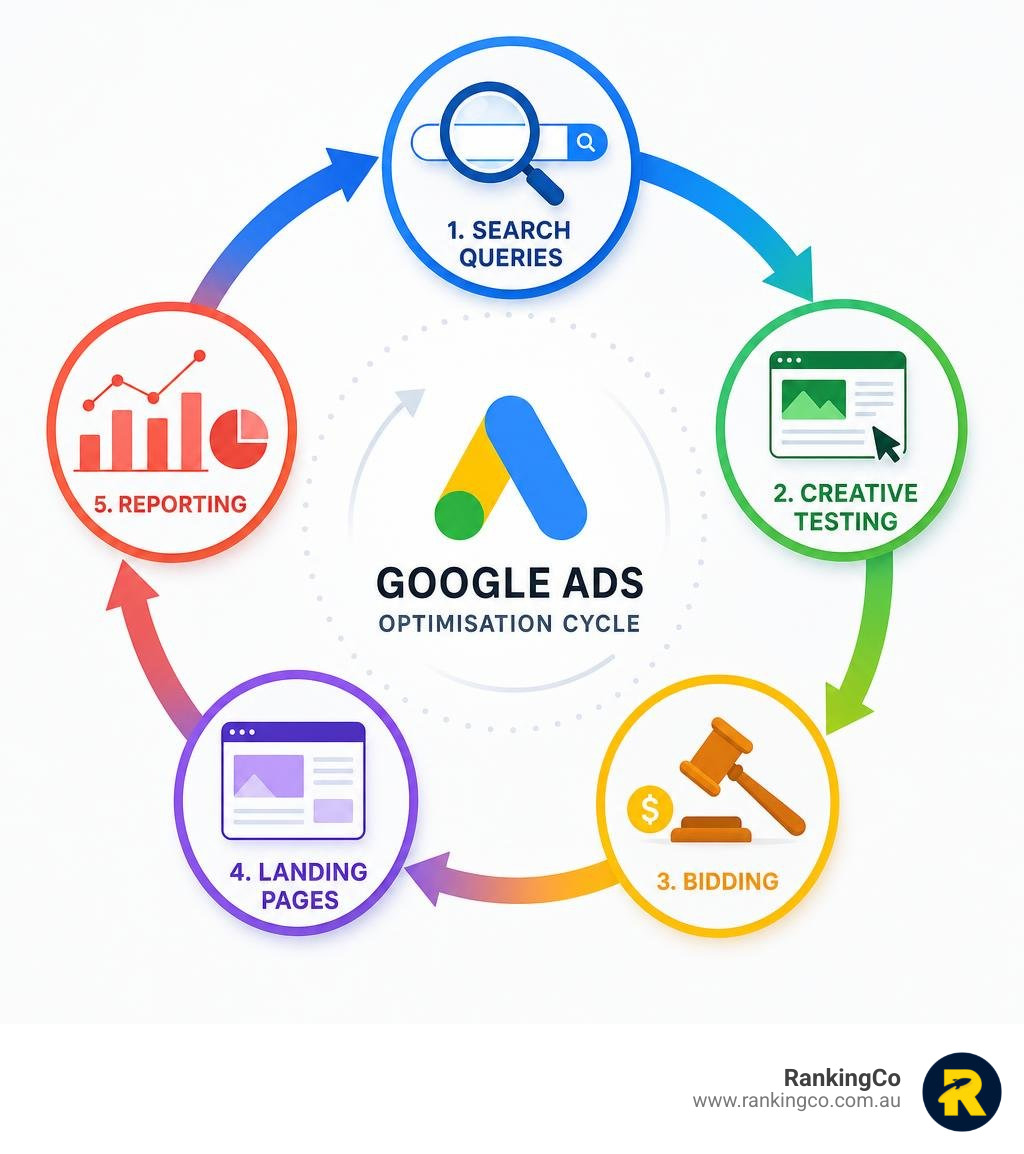
Strong Google Ads management includes:
- Continuous search-term analysis
- Ad and creative testing
- Bid strategy management
- Landing-page alignment
- Conversion tracking review
- Gradual scaling based on evidence
Combining paid search with long-term organic visibility through SEO Services can also support broader coverage across search engine results pages.
How RankingCo Helps Campaigns Reach Reliable Performance
We apply the same lifecycle principles in our own campaign management process. Rather than treating launch as the finish line, we focus on building the conditions needed for reliable decision-making.
Our process includes:
- Strategy and commercial goal alignment : We review target customers, conversion actions, margins and competitive conditions before structuring campaigns.
- Technical setup and conversion tracking : We validate tracking, analytics and contact pathways before meaningful spend is committed.
- Structured campaign launch : We build tightly themed campaign groups, relevant ad copy, negative keyword foundations and clear landing-page alignment.
- Ongoing optimisation : We refine search terms, bids, creative, landing-page signals and budget allocation as evidence develops.
- Transparent reporting : We report on qualified leads, conversion rates, cost-per-acquisition and the practical actions taken in the account.
For example, a local service business may come to us with campaigns that are active but not producing dependable enquiry quality. In that situation, we would typically review conversion tracking, search terms, location targeting, landing-page alignment and budget allocation before making controlled improvements. This helps identify whether performance issues are caused by campaign structure, tracking gaps, search intent mismatch or the natural learning period.
When Should You Be Concerned About Google Ads Performance?
Normal early-stage volatility is different from a campaign that is structurally underperforming. Concern becomes more justified when the campaign has had enough time and traffic to collect meaningful data but still shows no clear improvement.
Warning signs may include:
- Tracking appears unreliable or incomplete
- Search terms are consistently irrelevant
- Leads are poor quality despite ongoing spend
- Budget is being used without meaningful conversion activity
- Campaign structure prevents clear testing or optimisation
- Landing pages are not aligned with the promise made in the ads
These issues do not always mean Google Ads is the wrong channel. They often mean the campaign needs a more disciplined structure, clearer measurement or stronger landing-page alignment.
When to Get a Google Ads Account Audit
A professional account audit makes sense when a new campaign has an unclear setup, an existing campaign has been running for months without dependable results, or tracking and attribution issues are making performance difficult to judge.
It can also help when enquiries are poor quality, search terms appear misaligned, or spend is increasing without commercial return. An audit should identify whether the problem sits in strategy, tracking, targeting, landing-page experience, bidding or reporting.
To learn more about how we can support your growth, explore Our Services or reach out through the Contact RankingCo page to arrange an ad account review.
When to Get in Touch
If you are planning to launch Google Ads, or if your existing campaigns are active but not producing dependable enquiry quality, we can help you understand what is happening and what should change next.
At RankingCo, we believe paid search works best when it is built around sound strategy, accurate tracking, practical optimisation and honest reporting. Google Ads is a process of data collection and improvement, not an instant-return channel. The right timeframe depends on budget, competition, search volume, sales cycle, tracking quality and landing-page performance.
If you are ready to build a high-performing digital marketing strategy supported by certified platform partners who treat your goals as their own, get in touch with our specialist team.
- Start a conversation with our team: Contact RankingCo
- Explore our complete digital marketing solutions: Our Services
- Learn about tailored campaign support: Google Ads Management Services
Frequently Asked Questions About Google Ads Timelines
How long before Google Ads start working for small businesses?
Google Ads can start generating impressions and clicks soon after ads are approved and active. For small businesses, the bigger question is when enough data exists to judge lead quality, conversion behaviour and cost efficiency. That usually requires a structured optimisation period rather than a day-one verdict.
How long does it take to get conversions from Google Ads?
Some campaigns may generate conversions early, while others need more time because of sales cycle, search demand, landing-page performance and tracking quality. The key is to separate early activity from reliable conversion trends.
Why are my Google Ads results inconsistent at first?
Early inconsistency is common because the campaign is still testing search queries, auction placements, bidding signals and user behaviour. Negative keyword refinement, conversion delays and limited early data can all affect initial reporting.
Should I change my Google Ads campaign during the learning period?
You should monitor the campaign closely, but avoid constant major changes before enough data is available. Controlled improvements to tracking, search terms, landing pages and obvious relevance issues are different from repeatedly rebuilding the campaign.
Does increasing my Google Ads budget make results happen faster?
Increasing budget can help a campaign gather data faster when there is enough relevant search demand and the campaign structure is sound. It does not automatically improve results if targeting, tracking, landing pages or search intent are misaligned.
How long should I run Google Ads before deciding if they work?
A campaign should run long enough to collect meaningful data across clicks, conversions, lead quality and cost trends. The decision should be based on evidence, not only on early volatility or a small sample of traffic.
What if my Google Ads campaign is getting clicks but no leads?
Clicks without leads can point to issues with search intent, landing-page relevance, offer clarity, conversion tracking or enquiry pathways. Reviewing the search terms, page experience and conversion setup is usually the best starting point.
How does RankingCo report on Google Ads performance?
We report on practical business outcomes such as qualified enquiries, conversion behaviour, cost efficiency and the account actions taken. Our reporting is designed to make performance easier to understand and decision-making more transparent.
What does the Google Ads onboarding process involve?
Onboarding begins with strategy alignment, commercial goal review, account structure planning, tracking validation and landing-page assessment. From there, campaigns are launched with a clear measurement framework and an optimisation plan.




Share online