How Do I Know If My Google Ads Agency Is Doing a Good Job?
_compressed.png)
You can tell your Google Ads agency is doing a good job when you can see clear evidence in five areas: your business owns the account, conversion tracking measures real enquiries or sales, reports explain business outcomes, optimisation work is visible in the account, and performance is improving against agreed commercial goals.
Key evaluation criteria:
- Account ownership: You have full admin access to your Google Ads account, billing visibility, conversion settings, and change history.
- Conversion tracking: Primary conversions represent meaningful actions, such as enquiries, calls, purchases, or booked appointments.
- Reporting quality: Reports focus on qualified leads, sales, cost per lead, and Return on investment (ROI), not just clicks or impressions.
- Optimisation activity: The agency regularly reviews search terms, adds negative keywords, tests ads, adjusts budgets, and considers landing-page performance.
- Business results: The account activity connects to lead quality, enquiry volume, revenue, sales feedback, or another agreed business outcome.
At RankingCo, we believe Google Ads management should be an active partnership, not a black box. We help Australian businesses look beyond surface-level metrics and assess the full customer journey, from search query and ad message through to landing-page experience and lead quality. Our Google Ads Management approach centres on making those answers visible, so business owners can make confident decisions about their marketing investment.
Strong Pay-Per-Click (PPC) performance is not about making a dashboard look busy. It is about using reliable data, thoughtful testing, and regular communication to keep campaigns aligned with what your business actually needs.
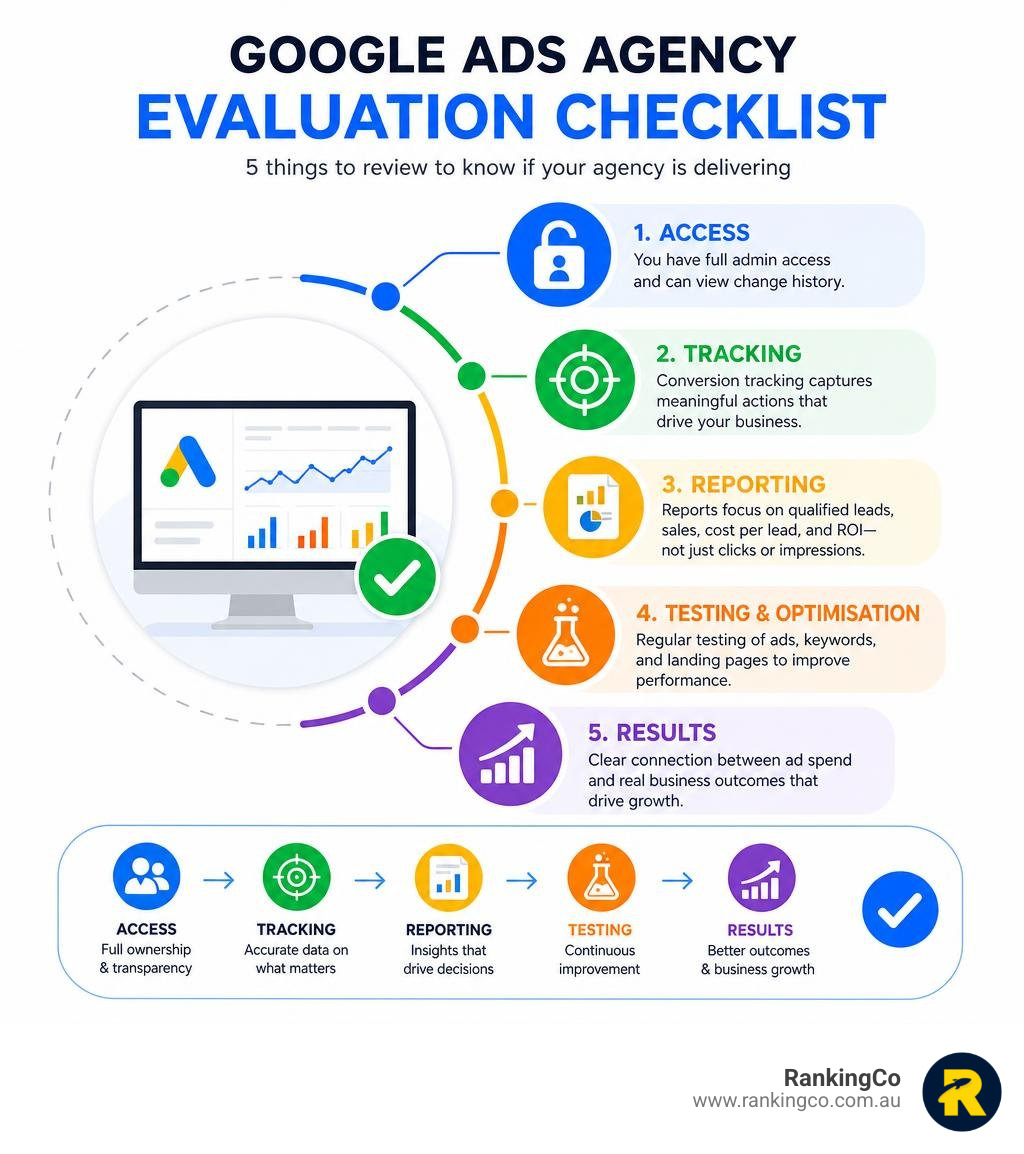
5 Things to Check Before You Judge Your Google Ads Agency
When you ask whether your Google Ads agency is doing a good job, the answer should not depend on trust alone. The account, reports, and sales feedback should give you enough evidence to judge whether the agency is protecting your budget and improving commercial outcomes.
Start by checking whether the agency gives you visibility across five areas: ownership, tracking, reporting, optimisation, and results. If one of these areas is missing, performance can look healthier than it really is.
Account ownership: Your business should have full administrative access to the Google Ads account, conversion settings, billing visibility, and change history. If you cannot inspect the account yourself, ask who owns the data, who controls access, and what happens if the agency relationship ends.
Conversion tracking: The agency should measure commercially meaningful actions, such as calls, enquiry forms, purchases, quote requests, or booked appointments. Be cautious if weak actions are treated as primary conversions, duplicate leads are counted, or reported results do not match what your sales team sees.
Reporting quality: Reports should explain what changed, what improved, what declined, and what will be tested next. Clicks, impressions, and Click-through rate (CTR) can help diagnose activity, but they should not replace qualified leads, cost per lead, sales feedback, Return on Ad Spend (ROAS), or Return on investment (ROI).
Optimisation activity: Change history should show purposeful work, such as search term reviews, negative keyword updates, ad copy tests, location targeting refinements, bidding changes, budget adjustments, and landing-page recommendations.
Business results: Good management should help you connect paid search activity to enquiry quality, sales conversations, revenue, booked jobs, or another agreed commercial outcome. If the agency cannot explain that connection clearly, the account needs a deeper review.
Questions to Ask Your Google Ads Agency
Many business owners struggle to judge their agency because the available information is scattered across reports, account settings, change history, and sales feedback. The simplest approach is to ask direct questions for each evaluation area.
What should my Google Ads agency report every month?
Your monthly report should explain what happened, why it happened, and what the agency will do next. It should cover spend, qualified enquiries, cost per lead, lead quality feedback, sales outcomes where available, and the account changes made during the month.
A useful report should separate platform activity from commercial outcomes. Clicks, impressions, and Click-through rate (CTR) can help diagnose campaign behaviour, but they should not be presented as proof of success unless they connect to real enquiries, purchases, booked appointments, or another agreed business goal.
Look for a clear summary of tests, decisions, and next steps. If the report only lists numbers without explaining conversion quality, budget movement, search term work, or planned improvements, it is difficult to judge whether the agency is actively managing your account.
How often should a Google Ads account be optimised?
A Google Ads account should be reviewed regularly enough to match the pace of spend, enquiry volume, and campaign activity. For most small to medium-sized businesses, you should expect ongoing checks rather than long gaps with no visible changes.
The account should show evidence of practical optimisation, such as search term reviews, negative keyword additions, ad copy testing, budget adjustments, bidding reviews, location refinements, and landing-page recommendations. Google explains that conversion tracking helps show what happens after a customer interacts with an ad, which is why optimisation should be judged against meaningful actions rather than activity alone in Google Ads conversion tracking guidance.
If an agency says optimisation is happening, ask where you can see it. Change history, search term reports, conversion settings, and campaign experiments should help confirm whether the work is real and purposeful.
What are the biggest red flags with a Google Ads agency?
The biggest red flags are limited account access, unclear conversion tracking, vague reporting, and little visible optimisation activity. You should be able to see who owns the account, which conversions guide bidding, what changes have been made, and how performance is being judged.
Question any setup where weak actions are treated as primary conversions, reports focus mainly on clicks, or sudden performance changes are not explained. Also pay attention to repeated excuses without a practical next step, long periods with unchanged ads, unexplained budget shifts, or results that do not match what your team sees in real enquiries.
A good agency should welcome informed questions. If basic questions about access, tracking, reporting, or lead quality are avoided, that is a sign the relationship may need a deeper review.
How can I tell if my Google Ads leads are actually good leads?
A lead is useful when it matches the type of customer your business can serve and has a realistic chance of becoming revenue. Do not judge lead quality only by form volume or call count. Compare enquiries with sales-team feedback, appointment bookings, qualified opportunities, purchase data, or customer-fit notes.
Check whether the agency is using that feedback to improve the account. Poor-fit searches may need negative keywords, ad copy changes, location refinements, landing-page improvements, or different bidding priorities. Strong management uses lead quality feedback to shape future optimisation, not just to explain past results.
A simple checklist can help: are leads relevant, contactable, located in your service area, interested in the right service, and moving through your sales process? If the answer is often no, the account may be producing activity without the commercial quality your business needs.
These checks make the review more practical than a general conversation about Pay-Per-Click (PPC). They also help you decide whether you need a deeper review, such as A Guide to Google Ads Audit Services and Tools, before changing budgets or partners.
What a Strategic Personalised Approach Looks Like
A strategic Google Ads agency should be able to explain why the account is structured the way it is. That means campaign structure, keyword targeting, ad assets, bidding, budgets, locations, and landing pages should all connect back to the services, customers, and regions that matter most to your business.
When reviewing your agency, ask how its recommendations are personalised to your goals. A useful answer should reference your lead quality, service margins, location priorities, enquiry patterns, sales feedback, and the points in the customer journey where prospects are most likely to drop off.
Look for evidence of active judgement, not just routine platform maintenance. The agency should be testing ad copy, refining search intent, reviewing negative keywords, adjusting bids or budgets where appropriate, and giving practical landing-page recommendations when the page experience may affect enquiry quality.
At RankingCo, we use our Google Ads experience to help Australian businesses understand the full picture behind performance. Our role is not only to manage campaigns, but to make the reasoning visible so business owners can judge whether the account is being improved with commercial intent. You can explore this approach through Google Ads Management and broader acquisition support through Our Services.
What Good Google Ads Management Should Look Like Month to Month
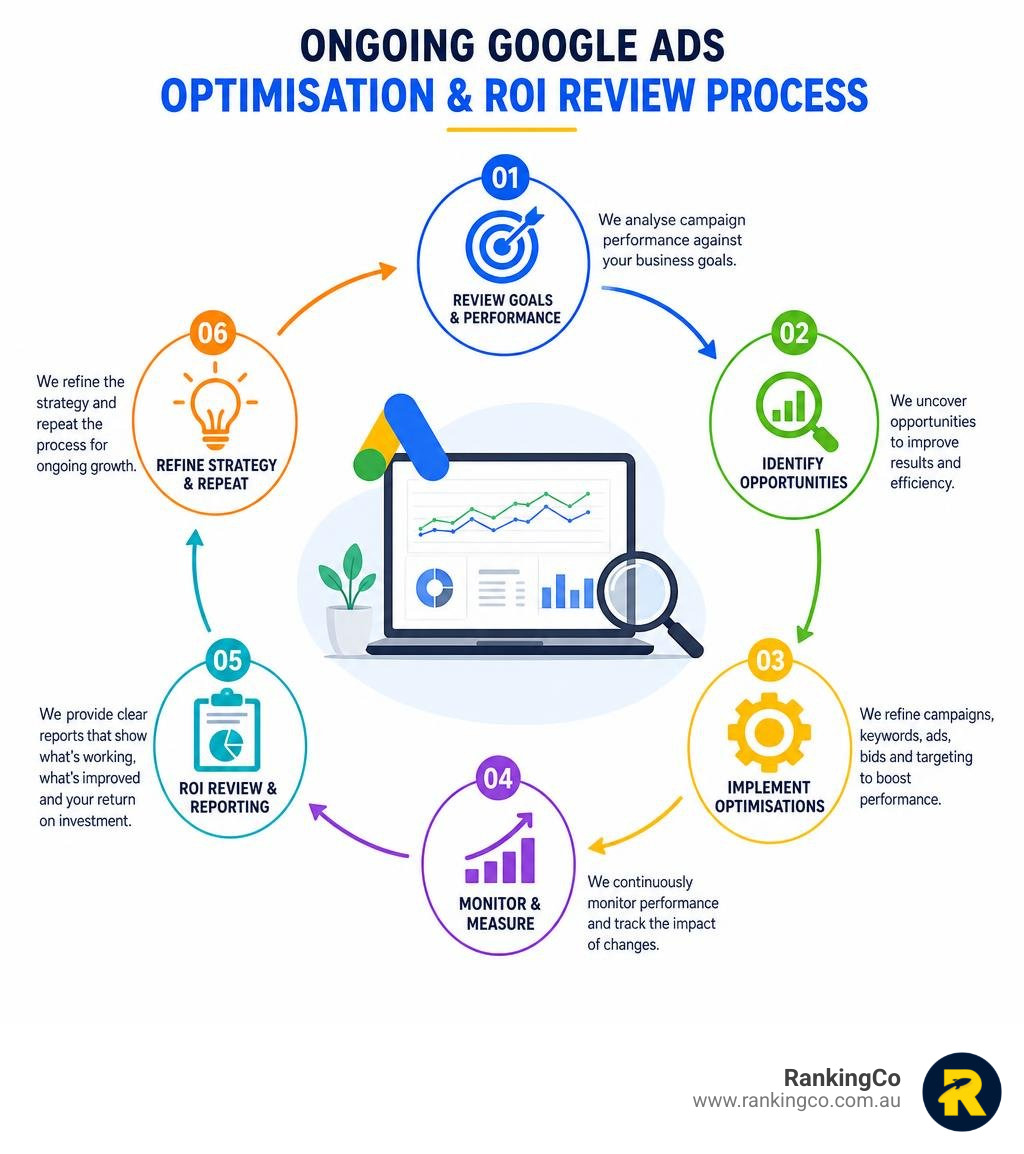
A strong agency relationship should make performance easier to judge every month. You should not be left guessing what was done, why it mattered, or what will be tested next. Each review should connect account activity to the same five evaluation criteria.
What should you see in your Google Ads account?
You should be able to see account ownership, conversion settings, campaign changes, billing visibility, and performance data. The agency may manage the work day to day, but your business should still understand where the account lives, who has access, and how decisions are being made.
The account should also show a clear trail of management activity. Search term reviews, negative keyword updates, ad tests, asset improvements, budget changes, bidding adjustments, and targeting refinements should connect back to the goals you agreed with the agency.
Which numbers should you question?
Question numbers that look positive but do not match commercial reality. High traffic with poor enquiry quality, rising cost per lead without an explanation, sudden conversion increases after tracking changes, or strong platform results that your team cannot verify all deserve closer review.
Also question any report that celebrates clicks, impressions, or Click-through rate (CTR) while avoiding lead quality, sales feedback, cost per qualified enquiry, or Return on investment (ROI). Activity metrics can be useful, but they should support the main conversation about business results.
What should your agency do when results are flat?
Flat or declining results should lead to a clear diagnosis and action plan. Your agency should explain whether the issue appears to involve search demand, competition, budget, targeting, ad relevance, landing-page performance, conversion tracking, or lead quality.
The next step should be specific enough to review later. That may include testing new ad messaging, refining locations, adding negative keywords, adjusting budgets, improving landing pages, reviewing conversion actions, or comparing enquiry quality with sales feedback.
A useful partner will welcome those questions. At RankingCo, we believe ongoing Google Ads management should give business owners clarity, not just reports. We focus on transparent account activity, accurate tracking, and regular optimisation so Australian businesses can see whether paid search is supporting real growth.
What Working With RankingCo Looks Like

Working with RankingCo means you should not have to guess whether your Google Ads activity is being managed properly. We focus on making the evidence easy to review, from account access and tracking setup through to campaign changes, lead quality, and next-step recommendations.
RankingCo is a Google Premier Partner 2026, which reflects our direct focus on Google Ads management, performance visibility, and accountable campaign support for businesses that want clearer evidence from their paid search investment.
Our account review process is shaped by practical campaign experience rather than generic reporting templates. When we review a Google Ads account, we look at how tracking is configured, whether conversion actions reflect meaningful customer enquiries, how search intent is being filtered, and whether the account changes match the commercial goals behind the campaign.
You should expect clear communication about what we changed, why we changed it, and how those decisions relate to your commercial goals. For businesses that need local campaign focus, our Google Ads Management Brisbane service supports targeted visibility across Brisbane and wider Queensland markets while still keeping performance evaluation practical and transparent.
Our team can also help compare Google Ads performance with other acquisition channels, including Meta Ads, Bing Ads, and Search Engine Optimisation (SEO). That broader view matters because a strong agency should not defend every result in isolation. It should help you understand where paid search is working, where the funnel needs support, and where budget should be reviewed.
If you want a clearer view of whether your current account is being managed well, you can Contact RankingCo for direct strategic support. We will help you review the account evidence, ask better performance questions, and identify the next practical steps without relying on vague promises or surface-level metrics.
When It’s Time to Reassess Your Google Ads Agency
Recognising when your paid search account requires immediate professional attention is vital to stopping budget loss and restoring campaign momentum. If your business experiences stagnating lead volume, rising acquisition costs, ambiguous reporting, or long periods without visible account updates, it is time to perform a full technical and strategic account audit.
Evaluating agency performance gives decision-makers the clarity needed to demand higher standards or seamlessly transition to a proactive digital partner that puts client outcomes first. When you partner with us, you gain access to an experienced team that reviews your full funnel, ensures complete tracking accuracy, and actively refines campaigns to support your commercial growth.
If you are wondering how do I know if my Google Ads agency is doing a good job , we invite you to reach out for a transparent, no-obligation conversation. Business owners ready to take complete control of their ad performance should Contact RankingCo to arrange a thorough account evaluation, or explore our complete suite of digital marketing solutions below:
- Explore dedicated search strategies with Google Ads Management.
- Learn about local search growth across Brisbane via Google Ads Management Brisbane.
- Review our multi-channel advertising services on Our Services.
Frequently Asked Questions About Evaluating Google Ads Agency Performance
How do I know if my Google Ads agency is doing a good job with campaign optimisations?
Check the change history log inside your account regularly to confirm that ongoing optimisations are being made. An active agency will consistently perform A/B testing on ad copy, refine bidding strategies, update responsive search ads, review negative keyword lists, adjust geographic targeting settings, and align campaign elements to reflect market trends.
How often should my Google Ads agency review search term reports?
Search term reports should be reviewed on a regular, ongoing basis to identify irrelevant queries, add negative keywords that prevent wasted advertising spend, discover new high-intent search variations, and ensure campaign budgets remain directed toward prospective customers who are ready to convert.
What is the difference between vanity metrics and business outcomes?
Vanity metrics such as impressions, raw click numbers, and click-through rates highlight account volume but do not guarantee revenue or business profit. Business outcomes focus directly on actual conversion tracking, qualified cost per lead, return on ad spend, closed sales attribution, and true customer acquisition value.
Should I have full admin access to my Google Ads account?
Yes, every business owner should maintain full administrative ownership of their primary Google Ads account. Your managing agency should connect to your account via a Manager Account (MCC), ensuring that your business retains complete ownership of historical campaign data, conversion settings, and commercial digital assets.
What should I do if my agency restricts account access or landing page ownership?
Review your initial contract terms immediately to clarify asset ownership rights. If an agency restricts account access or retains proprietary control over landing pages, request full administrative transfers or prepare a transition plan to partner with an agency that operates with total operational transparency and client asset control.





Share online