Why Your Tech Startup Needs a Growth Mindset Right Now
How to Accelerate Tech Startup Growth with Connected Digital Marketing

Tech startup growth depends less on having the best product and more on building a connected marketing system that consistently brings the right customers to your door.
Here is a quick snapshot of what drives sustainable growth for tech startups in 2026:
- Build before you buy : organic channels like SEO, content, and community consistently outperform paid acquisition in the early stages
- Set benchmarks by size : small-cap startups (under $250k revenue) project median first-year growth of around 1,096%, while larger startups project closer to 156%
- Track the right metrics : vanity metrics like total signups tell you very little; active usage and revenue growth tell you everything
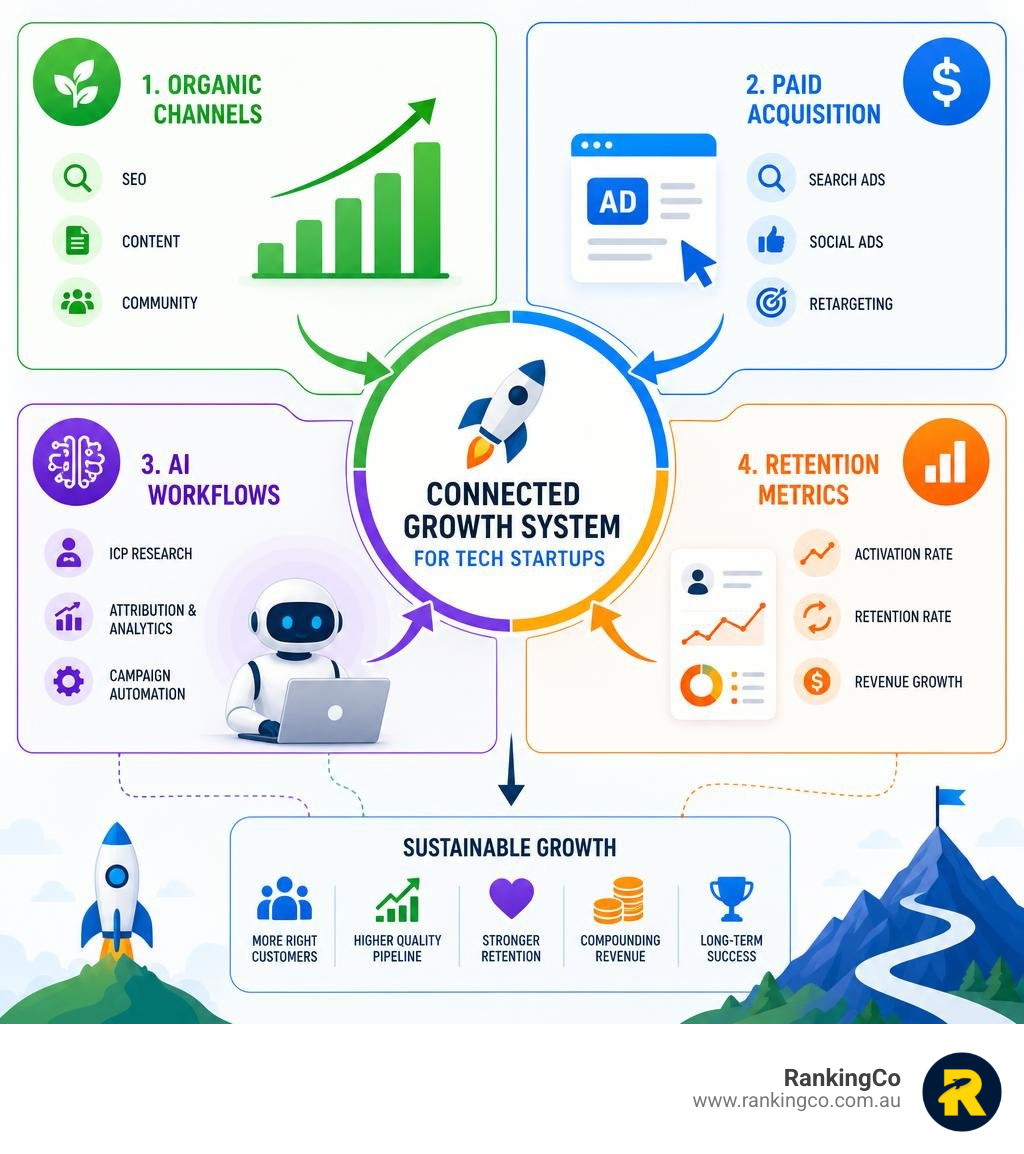
- Connect your channels : SEO, Google Ads, content, and retention are not separate tactics; they work as one system
- Use AI to accelerate : AI tools can now run ICP research, attribution tracking, and campaign execution without a full marketing team
Most tech founders set revenue targets based on gut feel or copy the hockey-stick curves they see in pitch decks. That approach leads to poor planning and investor distrust. Data-backed benchmarks, mapped to your company size and industry, are a far more reliable starting point.
The good news is that the gap between guessing and knowing has never been smaller. AI-powered marketing workflows, combined with a clear digital strategy, now give small teams the ability to compete at a level that previously required much larger budgets and headcount.
By leveraging local marketing automation and Meta Ads automation, early-stage companies can scale their acquisition efforts efficiently.
I'm Kerry Anderson, co-founder of RankingCo and a digital marketing strategist with over 15 years of experience helping businesses at every stage of tech startup growth build scalable, connected marketing systems that deliver measurable results. I have personally worked across the full journey from early-stage acquisition strategy through to scaling past $200 million in revenue, and I will walk you through exactly what works in the current landscape.
Scaling Tech Startup Growth Through Connected Digital Marketing
To scale a technology startup effectively, you must treat your marketing channels as a single, connected growth system rather than isolated tactics. When search engine optimisation (SEO) and paid search are treated as separate departments, your customer acquisition costs rise, and your messaging becomes fragmented.

A connected digital marketing strategy aligns every touchpoint across a full-funnel intent framework. By mapping user search behavior to specific stages of the customer journey, we ensure that high-intent Google Ads capture immediate demand, while organic SEO content nurtures long-term authority. This integrated approach builds a highly efficient funnel where paid search insights immediately inform your organic content strategy, maximising your overall marketing performance.
What Are the Core Stages of Tech Startup Growth?
The tech startup lifecycle is defined by three distinct phases: the pre-seed stage, the seed stage, and the venture stage. Each phase requires a unique marketing focus to transition users from initial awareness to long-term brand advocates.
During the pre-seed stage , the priority is market validation and defining your ideal customer profile (ICP). Marketing milestones here are focused on qualitative feedback and building early interest lists.
In the seed stage , the focus shifts to testing acquisition channels and establishing your organic foundation. This is where investing in high-quality SEO content services becomes critical. By creating helpful, search-optimised content early, you build a compounding traffic asset that lowers your customer acquisition costs over time.
When a startup enters the venture stage , the goal is scaling a repeatable acquisition engine. At this point, retention metrics and customer lifetime value (LTV) take center stage. Marketing teams must closely monitor the customer journey to ensure that rapid user acquisition does not lead to high churn, balancing aggressive top-of-funnel campaigns with robust retention strategies.
Benchmarking Revenue Targets and Growth Rates
To set realistic revenue targets, founders must look at empirical benchmarks rather than hypothetical growth curves. According to global business registry datasets covering over 25,000 companies, growth expectations vary significantly based on a startup's current revenue scale, geography, and industry sector.
The average startup forecasts a growth rate of 522% in revenue for its first year, 236% for the second, and 136% for the third. However, these figures diverge dramatically when segmented by company size. Small-cap startups (under $250k TTM revenue) project a median growth of 1,096% in Year 1, while large-cap companies (over $250k TTM revenue) project a more modest median of 156%.
| Growth Metric | Year 1 Projection | Year 2 Projection | Year 3 Projection |
|---|---|---|---|
| Small-Cap (<$250k TTM) | 1,096% | 292% | 160% |
| Large-Cap (>$250k TTM) | 156% | 118% | 71% |
| Overall Average | 522% | 236% | 136% |
Industry sector also plays a massive role in these projections. Banking and investment services lead small-cap industry growth expectations at 501%, while software and IT services consistently show robust, compounding growth across all cap sizes due to digital technology adoption.
Organic Levers: Personalisation, Community, and Product-Led Tech Startup Growth
Product-led growth (PLG) relies on the product itself to drive acquisition, retention, and expansion. In modern digital marketing, this strategy is supercharged by a deep personalisation strategy and community-building efforts that turn early adopters into vocal brand advocates.
A key pillar of PLG is establishing a strong Trust Architecture . We define Trust Architecture as the process of building early credibility through transparent data security practices and highly intuitive, user-centric product design. When users trust how their data is handled and find the product immediately valuable, friction disappears from the acquisition funnel.

Instead of focusing on total signups, successful PLG companies track Paid Power Users , which we define as highly active, paying customers who engage with your platform four to five days a week.
By focusing your marketing and product resources on keeping these power users engaged, you build a durable competitive advantage. This focus on user utility is why leading platforms often achieve exceptional user retention, sometimes reaching an 85% Day 30 retention rate among paying users with almost zero initial paid acquisition.
Balancing Paid Acquisition and AI-Powered Workflows
While organic channels build long-term value, paid acquisition channels like Meta Ads and LinkedIn Ads are essential for accelerating growth once you have confirmed product-market fit. Meta Ads operate as a creative-led channel where broad targeting and engaging visual assets perform best, whereas LinkedIn Ads function as an identity-led platform, allowing precise targeting based on job titles, industries, and company size.
Modern growth teams use AI workflows to reduce manual work and make faster decisions. Tools like Claude Code can help marketers build lightweight scripts for campaign checks, customer data analysis, reporting, and budget pacing. The goal is not to replace strategy, but to remove repetitive tasks so the team can focus on better positioning, experiments, and conversion quality.

To measure the efficiency of these hybrid workflows, enterprise B2B startups track POC Velocity . We define POC Velocity as the speed at which a trial or proof-of-concept transitions into a fully paid, production-level deployment. Maximising this velocity requires a tight integration between your paid search ads, automated email sequences, and local search visibility.
Working with specialised local SEO services ensures that your business remains highly visible to local decision-makers in Brisbane, Sydney, and Melbourne throughout their decision-making process.
Frequently Asked Questions about Scaling Modern Startups
As a leading Brisbane AdWords and digital marketing agency, RankingCo frequently helps founders navigate these complex scaling challenges. Here are direct answers to the most common questions we encounter regarding tech startup growth.
What is the average revenue growth rate for early-stage startups?
According to global benchmarks, the average startup forecasts a revenue growth rate of 522% in its first year, tapering to 236% in year two and 136% in year three. Small-cap startups under $250k TTM revenue project significantly higher median growth rates (1,096% in Year 1) than larger startups due to their smaller revenue base.
When should a tech startup begin investing in paid acquisition?
Startups should typically begin investing in paid acquisition only after confirming product-market fit and establishing a baseline of organic traffic. Initiating paid campaigns too early can lead to high acquisition costs and poor conversion rates if your messaging, onboarding flow, and target audience segments are not yet aligned.
How do Meta Ads and LinkedIn Ads strategies differ for B2B tech?
Meta Ads are creative-led and perform best when targeting broader audiences with highly engaging, visual creative that highlights user pain points. LinkedIn Ads are identity-led, relying on precise targeting filters like job title, company size, and industry to reach specific decision-makers with professional, value-driven offers.
What is the difference between vanity metrics and active usage metrics?
Vanity metrics, such as total registered users or website visits, show superficial interest but do not correlate with business health. Active usage metrics, like Paid Power Users (users active 4-5 days a week) and Daily Active Apps, measure true product engagement, which is a far more accurate predictor of customer retention and lifetime value.
How does AI improve modern startup growth workflows?
AI tools streamline growth workflows by automating repetitive tasks like customer data enrichment, CRM attribution tagging, and copy generation. By using AI to handle the execution layer of marketing, small teams can run highly targeted outbound and paid campaigns that previously required a dedicated agency or internal team.
Building a Connected Growth System for Startup Success
Building a sustainable path to tech startup growth requires moving away from fragmented tactics and embracing a connected growth system.
At RankingCo, we combine advanced AI technologies with proven SEO and paid search strategies to help businesses across Brisbane, Sydney, and Melbourne build high-performing acquisition engines. As a Google Premier Partner, our team, led by founders Amber Porter and Kerry Anderson, is dedicated to turning your marketing spend into measurable, compounding business outcomes.
Take the next step in your scaling journey by exploring our core services:





Share online