How to Win the AI Search Game in 2026
What Is AI Search Engine Optimisation and Why Does It Matter in 2026?
AI search engine optimisation is the practice of structuring, writing, and formatting your content so that AI-powered search systems like Google AI Overviews, Perplexity, and Microsoft Copilot select and cite it in their generated answers. This process ensures your brand remains visible as search engines transition from listing links to directly answering user queries. By aligning your content with these systems, you secure valuable citations in conversational search results.
Here is a quick breakdown of what it involves:
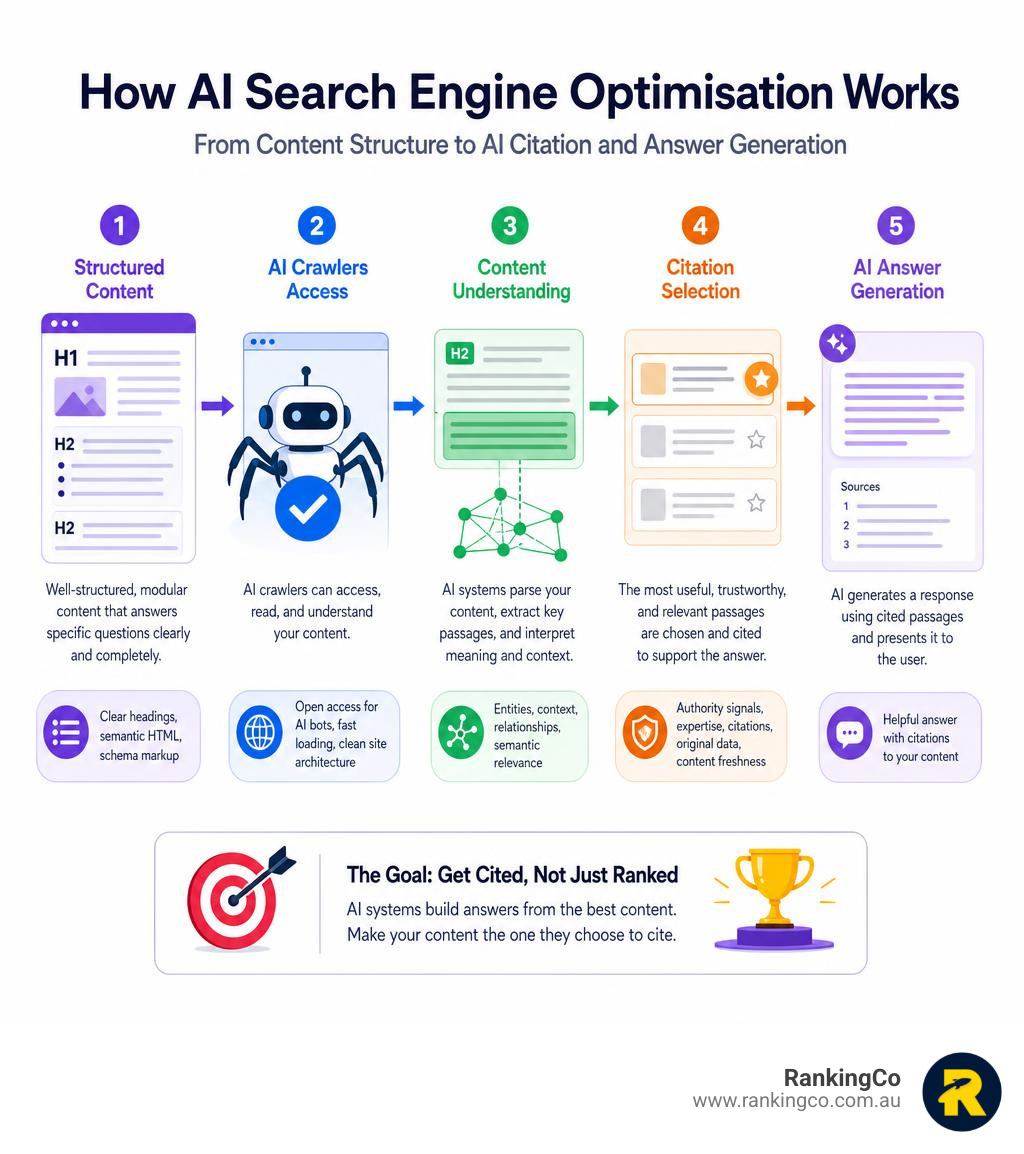
- Get cited, not just ranked : AI systems extract passages from your content to build answers, so structure matters as much as position.
- Write modular, self-contained answers : each section should answer a specific question clearly and completely on its own.
- Use schema markup and semantic HTML : this helps AI systems understand what your content is about with confidence.
- Allow AI crawlers access : blocking bots like GPTBot or PerplexityBot in your robots.txt removes you from consideration entirely.
- Build authority signals : citations from third-party sources, expert quotes, and original data all increase your chances of being featured.
- Keep content fresh : AI systems favour recently updated content, especially for competitive or time-sensitive topics.
Search behaviour has shifted dramatically over the past year. Industry tracking data suggests that over 100 million people now search using AI every day, with AI referrals to websites spiking 357% year-over-year in June 2025 to reach 1.13 billion visits. At the same time, search analysis platforms report that AI Overviews now appear in roughly 45% of Google searches. This shift fundamentally changes how users discover and engage with online content.
The traditional search model focused on ranking on page one to secure direct clicks. The modern landscape operates differently, as AI systems read your content, extract the most useful passages, and assemble an answer for the user directly on the results page. If your content is not structured to be easily extracted, your brand risks becoming invisible in this new search ecosystem.
This shift does not mean traditional SEO is dead. Google has confirmed that its generative AI features, including AI Overviews and AI Mode, run on the same core ranking and quality systems as classic search. However, the bar for inclusion is now significantly higher. Being indexed is no longer enough, meaning your content must be parseable, authoritative, and genuinely useful at the passage level.
As the co-founder of RankingCo and a digital marketing strategist with over 15 years of experience, I help Australian businesses navigate these rapid technological shifts. Our team positions RankingCo as the leading Brisbane expert by using an integrated, connected marketing systems approach that aligns SEO, paid search, and content strategy. This guide covers the exact steps required to compete and win in this new search environment.
How Do You Master AI Search Engine Optimisation in 2026?
To master AI search engine optimisation, you must treat digital marketing as an interconnected growth system that aligns technical SEO, paid search, and content strategy. Traditional keyword lists are no longer enough to sustain business growth because search engines now focus on how Large Language Models (LLMs) find, extract, and synthesise information.

This shift requires a transition from traditional search engine optimisation to Generative Engine Optimisation (GEO) and Answer Engine Optimisation (AEO). The goal is to ensure your brand is the direct answer when a user asks a conversational query. For local services in Brisbane, Sydney, or Melbourne, AI engines rely heavily on semantic clarity and structured data to verify their recommendations.
Why Is Traditional SEO Only the Starting Point for AI Search?
Traditional SEO gets your website indexed, but AI search engine optimisation is required to get your brand cited in conversational answers. While standard search rankings remain important, generative engines rely on retrieval-augmented generation to verify facts across multiple authoritative sources.
Projections from Gartner suggest a potential 25% drop in traditional search engine traffic by 2026. Industry analysts attribute this projected decline to the rise of zero-click searches, where platforms like Google AI Overviews, Microsoft Copilot, and Perplexity answer user queries directly on the results page.
Industry benchmarks suggest that brands are 6.5 times more likely to be cited via third-party sources than their own domains in conversational search results. To capture this citation share, businesses must understand retrieval-augmented generation (RAG) and query fan-out. These systems do not just look at your website, as they search the web concurrently to verify facts across multiple sources.
While these AI systems are highly advanced, they still rely on a technically sound website to crawl your content. Ensuring your technical SEO is flawless remains the critical foundation. If search crawlers cannot easily parse your pages, your content will never be considered for generative answers.
How Should You Structure Content for AI Search Engine Optimisation?
You should structure your content into modular, self-contained sections with clear heading hierarchies and direct answers placed at the very beginning of each topic. This formatting allows AI engines to easily parse, extract, and cite your information for conversational queries.
AI engines do not read your pages the way humans do, as they parse them into modular, evaluation-ready blocks. To ensure your content is eligible for snippet selection, you must structure every page with clear hierarchies and self-contained answers.
When writing, we recommend leading each section with a direct, standalone answer of 40 to 60 words. This length is highly optimised for LLM extraction. Avoid burying the lead by answering the user's question in the very first sentence, then using the rest of the section to provide supporting evidence, structured lists, or tables.
| Traditional Keyword Structure | AI Modular Content Structure |
|---|---|
| Focuses on keyword density and search volume | Focuses on semantic clarity and intent matching |
| Long, unstructured blocks of text | Clean, modular sections with H2/H3 question headings |
| Relies heavily on exact-match phrases | Uses synonyms, structured tables, and numbered lists |
| Built around ranking a single page | Built for passage extraction and direct citation |
Using descriptive headings instead of vague labels makes a massive difference. For example, instead of using "Our Services" as an H2, use "What Services Does a Brisbane Digital Marketing Agency Provide?". This matches the conversational queries users input into AI engines, making it easier for the system to identify your page as the perfect match.
How Do Semantic Clarity and Schema Help AI Parse Your Pages?
Semantic clarity and schema markup help AI parse your pages by translating plain text into structured, machine-readable data that explicitly defines your business entities and relationships. By using precise language and JSON-LD markup, you provide the exact context that search crawlers need to verify your brand's authority.
Semantic clarity means using precise language that leaves no room for algorithmic misinterpretation. AI search engines are trained to understand context and entity relationships. To help them, we must use measurable facts, clear synonyms, and authoritative terminology.
Implementing schema markup in JSON-LD format is one of the most effective ways to translate plain text into structured data that machines can interpret with confidence. By explicitly labelling your content as a Product, LocalBusiness, FAQ, or Event, you provide the exact context AI crawlers need.
This structured approach is particularly critical for local SEO in Brisbane, Sydney, and Melbourne. Ensuring your Name, Address, and Phone number (NAP) are consistent across your website and third-party directories helps AI engines establish your business as a trusted, real-world entity. This directly feeds into Google's E-E-A-T (Experience, Expertise, Authoritativeness, Trustworthiness) guidelines, which continue to govern how information is filtered and prioritised.
What Common Mistakes Reduce Visibility in AI Search?
The most common mistakes that reduce AI search visibility include keyword stuffing, blocking AI crawlers in your robots.txt file, and publishing thin or outdated content. These practices prevent generative engines from accessing, understanding, or trusting your website's information.
Research published in the Princeton and IIT Delhi GEO study suggests that keyword stuffing can reduce AI visibility by approximately 10%. Generative engines strongly prefer natural, fluent phrasing over forced search terms.
Another severe error is blocking AI bots in your robots.txt file. While some publishers block crawlers like GPTBot, ClaudeBot, or PerplexityBot to protect their intellectual property, doing so guarantees your brand will never be cited in their answers.
Additionally, we must avoid gating essential content behind forms or logins where AI bots cannot crawl it. Publishing thin content that merely summarises existing web pages without offering a unique perspective also reduces visibility. Finally, omitting freshness signals like "Last updated" dates on highly competitive topics can prevent your content from being selected.
There are no shortcuts in AI search engine optimisation. Generative search features still depend on the same core quality signals that support organic search. Sneaky redirects, cloaking for AI crawlers, and other manipulative tactics are more likely to reduce visibility than improve it.
What Emerging Tools and Strategies Drive AI Search Engine Optimisation?
Emerging tools like real-time NLP analysers and strategies like Agentic SEO workflows drive AI search engine optimisation by automating content gap analysis and semantic updates. Implementing an llms.txt
file also helps independent crawlers quickly map and understand your site's most important information.
To stay ahead of the competition, we must leverage specialised tools designed for the AI search landscape. Platforms like Rankability, Surfer SEO, and Clearscope have evolved to provide real-time NLP analysis, helping writers optimise content for both human readability and machine parsing.
For advanced teams, Agentic SEO workflows are changing the game. By connecting autonomous AI agents to live data sources like Google Search Console, we can automatically diagnose traffic drops, identify content gaps, and generate highly targeted semantic updates.
Additionally, creating an llms.txt
file is an emerging best practice for guiding non-Google AI crawlers. This file acts as a clean, markdown-based map of your site's most important information, allowing LLMs to quickly understand your brand's core offerings without wasting crawl budget on unnecessary code.
What Are the Most Common Questions About AI Search?
What Is the Difference Between Traditional SEO and AI Search Engine Optimisation?
Traditional SEO focuses on ranking a full web page at the top of organic search results through keywords and backlinks. AI search engine optimisation focuses on getting specific passages of your content extracted and cited within AI-generated answers across conversational search engines.
Do You Need to Create Special Files Like llms.txt to Be Visible in Google's AI Search?
No, Google does not require special files like llms.txt
or unique schema formats for its generative AI features. Google uses its standard search index to feed its AI Overviews, though creating these files can help other independent AI crawlers parse your site more efficiently.
How Does Schema Markup Improve Your Brand's AI Search Visibility?
Schema markup acts as structured data that translates your website's content into a clean, machine-readable format. This helps AI engines identify entities, verify facts, and confidently pull your data for product comparisons, local business recommendations, and FAQ answers.
Should You Break Your Content Into Small Chunks Specifically for AI?
No, Google's algorithms are highly capable of understanding complex, multi-topic pages. Instead of breaking your content into tiny, fragmented pieces, focus on using clear H2 and H3 headings to naturally organise your page into modular, easy-to-read sections.
How Does Page Speed Affect Voice Search and AI Search Results?
Page speed is incredibly critical because AI assistants and voice search tools prioritise immediate delivery of information. Research suggests that pages loading in under 3 seconds are significantly more likely to be selected as the source for voice search and conversational answers.
How Can RankingCo Help You Navigate AI Search?
The search landscape in 2026 requires a unified, connected growth system. At RankingCo, we believe that SEO, paid advertising, and high-quality content must work in perfect harmony to drive measurable business outcomes. As a leading Brisbane digital marketing agency and Google Premier Partner 2026, our team, led by founders Amber Porter and Kerry Anderson, is dedicated to keeping our clients ahead of rapid technological shifts. We focus on delivering integrated marketing systems that secure your brand's visibility across both traditional and generative search engines.
If you are ready to secure your brand's visibility in AI search results, let's build a strategy that delivers real ROI. Our team is here to help you implement these advanced optimisation techniques seamlessly.




Share online