Organic vs Paid in ChatGPT: How Marketers Can Compete in the Generative Era
Introduction: The New Rules of Getting Seen Online

AI has changed the game for marketers. The focus is no longer if you should use AI, but how to use it strategically. With artificial intelligence reshaping how customers discover brands, products, and services online, ranking #1 on Google no longer guarantees visibility, not when AI-generated answers appear before traditional search results.
Here's what you need to know:
- AI is changing search behaviour : Users now get instant answers from AI Overviews and chatbots like ChatGPT, often without clicking through to websites.
- Organic and paid strategies must evolve : Marketers need to optimise for AI-generated visibility, not just traditional rankings.
- Success requires a dual approach : Build organic authority to train AI models while exploring paid partnerships for guaranteed placement.
- Data and expertise matter more than ever : AI prioritises authoritative, well-structured content from trusted sources.
- The competitive gap is widening fast : Early adopters are securing visibility while others watch their traffic decline.
By 2030, the worldwide AI market is projected to surpass $1.5 trillion. Yet, many marketers already struggle with having the time and energy to do their jobs.
The good news? When used strategically, AI can be your competitive advantage instead of another burden.
This shift isn't just technical; it's changing the entire customer journey. When someone asks an AI for recommendations, your brand either appears in the answer or becomes invisible.
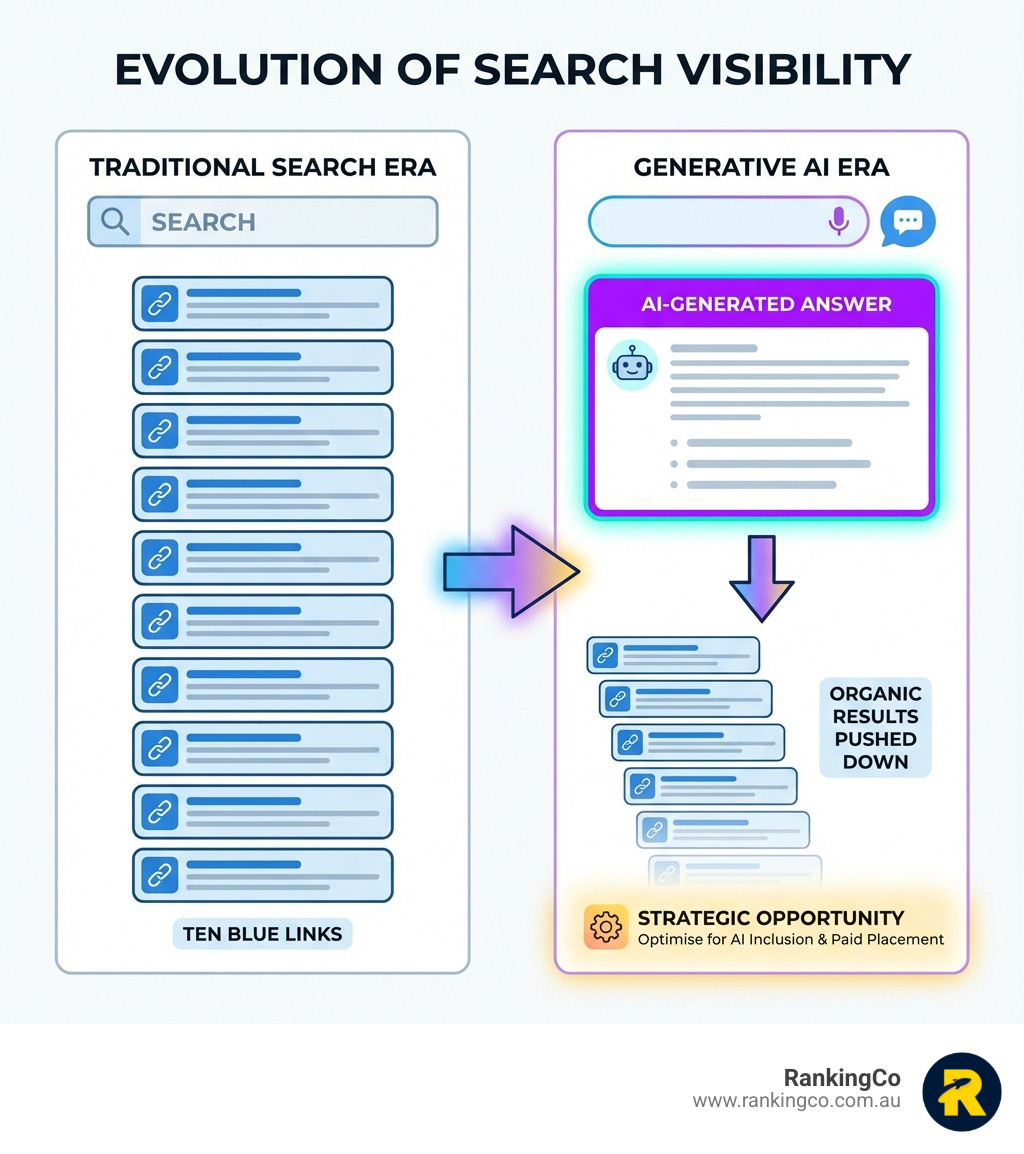
Traditional SEO focused on a list of ten blue links. Modern marketing requires optimising for a single, synthesised response that pulls from dozens of sources.
This creates two distinct battlegrounds. The organic play involves building such strong topical authority that AI models naturally cite your content as a trusted source.
The paid play involves securing sponsored placements within AI-generated responses. This is similar to paid search ads but more integrated into the conversation itself.
I'm Kerry Anderson, and over 15 years in digital marketing, I've helped businesses adapt to every major platform shift. Understanding how marketers can use AI to compete in this generative era is now critical for any brand that wants to stay visible and relevant online.
Similar topics to how marketers can use AI :
How Marketers Can Use AI: Competing for Organic vs. Paid Visibility
The digital marketing landscape is buzzing, all thanks to artificial intelligence. At its core, AI is a branch of computer science focused on creating intelligent machines that can perform human-like tasks.
This includes learning, problem-solving, and understanding language. In digital marketing, AI has evolved from simple recommendation tools to today's sophisticated generative models.
Understanding the Shift: How AI Answers Change Everything
Generative AI models, like Generative Pre-trained Transformers (GPTs), are game-changers. They are powerful because they can generate human-like text, images, and even video.
Trained on vast amounts of data, they understand context and can create original content. This capability is revolutionising marketing.
The rise of AI Overviews and chatbots means users often get answers directly in the search interface, leading to 'zero-click searches'.
This fundamentally changes user behaviour. Instead of scrolling through links, people get a concise, AI-generated answer.
For marketers, this means our visibility strategy needs a serious update. We must optimise for inclusion within these AI answers, not just traditional page rankings.
Our guide on AI Overviews Are Reshaping Search: Why Your Brand Needs a New Visibility Strategy digs deeper into this.

The core capabilities of GPTs, like generating diverse content and engaging in natural conversations, are significant for marketing. They enable new levels of automation and personalisation.
For instance, AI-powered customer service can create proactive experiences that boost consumer engagement.
The Organic Play: Training AI to See You as an Expert
In the AI era, organic visibility isn't dead; it's just different. We are no longer just trying to rank for keywords.
Now, we're trying to train AI models to see our content as authoritative and trustworthy. This means doubling down on E-E-A-T: Experience, Expertise, Authoritativeness, and Trustworthiness.
AI models learn from the best information available. If your website consistently publishes high-quality, in-depth content, AI is more likely to cite you as a source.
This involves building strong topic authority by creating comprehensive content clusters around your core subjects.
For example, a local Brisbane business specialising in eco-friendly products should have a wealth of content demonstrating their knowledge of sustainable practices, product benefits, and local environmental initiatives. This signals to AI that they are a go-to expert.
Our article on AI and Authenticity: The New Rules of Trust in Content Marketing explores how crucial authenticity is in this new landscape. According to industry research, advanced algorithms use customer and market data to segment and target relevant audiences, helping marketers find high-quality leads.
How can marketers use AI to improve organic content creation?
- Content Generation : AI tools can draft articles, social media posts, and product descriptions, saving significant time.
- Content Optimisation : AI can suggest topics, optimise headlines, and modify output based on real-time user feedback, ensuring content is relevant and engaging.
- Visual Content : AI is adept at handling images and videos, recognising objects, and automating tagging for improved search functionality.
By providing AI with well-researched, original, and expert-driven content, we organically increase our chances of being featured in AI-generated answers.
The Paid Play: Securing Your Spot in the AI Conversation
While organic authority is essential, the future of AI also includes paid placements. We anticipate opportunities within AI responses, similar to how Google Ads works for traditional search.
This could take several forms:
- Sponsored Responses : Imagine an AI chatbot recommending a product or service with a small disclaimer indicating it's a sponsored suggestion.
- Native Ads within Chatbots : As AI conversations become more sophisticated, native advertisements could be seamlessly integrated into the dialogue.
- Custom GPTs with Brand Integrations : Brands might develop their own custom AI assistants designed to promote their products or services.
This is a new frontier for advertising. It’s about securing your brand's presence directly within the AI conversation. Our insights on ChatGPT Advertising and the Future of Customer Experience highlight these emerging possibilities.
These paid integrations allow for unprecedented personalisation at scale. They can deliver custom content and offers based on individual user preferences and predicted behaviour.

This represents a significant opportunity for businesses in Sydney, Melbourne, or even Auckland to ensure their offerings are presented to customers at the exact moment of need. It's about being part of the AI's recommendation.
How marketers can use AI for a winning strategy
So, how can marketers use AI to truly win? The key is an integrated strategy that combines organic authority with smart paid placements.
This approach allows you to automate, optimise, and strengthen your digital presence.
Here’s how AI contributes to a winning digital marketing strategy:
- Improved Content Creation : AI tools can draft articles, social media posts, and emails, saving significant time for strategy and creativity.
- Better Customer Engagement : AI-driven chatbots provide 24/7 support, answer common queries, and help generate leads through proactive engagement.
- Smarter Data Analysis : AI processes vast amounts of data to deliver accurate business insights, helping predict trends and optimise campaigns. It can also analyse unstructured data like customer reviews.
- Precise Audience Targeting : AI enables segmentation beyond traditional demographics, using behaviour and purchasing patterns to create hyper-targeted campaigns.
- Personalisation at Scale : Deliver highly customised content, offers, and experiences to individual users, improving their journey with your brand.
- Increased Efficiency and ROI : By automating time-consuming tasks, AI frees up marketers to focus on high-impact work, leading to better results and a strong competitive advantage.

A wide range of AI marketing tools are available to help. These include platforms for content generation, copywriting assistants, social media management, and workflow automation. They can help streamline operations and allow even small businesses in places like Perth or the Gold Coast to compete effectively.
How marketers can use AI to prepare for the future
The future of AI in marketing is dynamic and exciting. Emerging innovations like generative AI, voice-driven interactions, and AI-powered augmented reality campaigns are ready to redefine how brands connect with audiences.
Ethical Considerations and Challenges As we integrate AI, we must address critical ethical concerns:
- Privacy : Marketers must prioritise data protection and ensure AI systems comply with privacy laws. This means obtaining proper consent and being transparent about data usage.
- Bias : AI models can perpetuate discrimination if trained on biased data. We must evaluate AI models for unintended bias to ensure fair marketing practices.
- Transparency : Understanding how AI makes decisions is crucial. Marketers need to be transparent about AI's role in content creation and customer interactions.
- Accountability : Clear guidelines and human oversight are essential to determine responsibility when AI makes a mistake.
The Journal of Responsible Technology highlights these ethical concerns at the intersection of AI and marketing. To stay ahead, marketing teams must remain adaptable, invest in continuous learning, and align AI with both strategic goals and ethical responsibility.
Developing AI Expertise The landscape is evolving rapidly, and marketers need to evolve with it.
- Continuous Learning : Recent industry reports show AI adoption is accelerating, with many marketers now using it daily. Staying updated through courses and workshops is vital.
- Hands-on Experience : Experiment with AI tools to understand their capabilities and limitations. Start with small projects and scale up.
- Collaboration : Work closely with data scientists and IT professionals to bridge the gap between marketing strategy and technical implementation.
- Organisational Readiness : Businesses must invest in educating their workforce, developing clear AI policies, and creating implementation roadmaps.
The increasing adoption of AI in marketing presents both opportunities and challenges. While AI can automate tasks, it also demands new skills and a shift in mindset. The opportunity is to become an AI-powered marketer, where your role is enhanced and improved by technology.
Take Control of Your Digital Future – Get Found Now
The future of marketing is here, and it's powered by AI. As we've explored, using AI effectively means embracing a dual strategy of building organic authority and leveraging paid placements.
This integrated approach ensures your brand remains visible, relevant, and competitive in a rapidly changing digital world.
At RankingCo, we like to think of ourselves as the world's best little digital agency. Based in Brisbane, QLD, our teams support scaling businesses across the globe, from Sydney and Melbourne to Auckland and Toronto.
We are at the forefront of AI-driven marketing. Our expertise in Google Ads, Meta Ads, and SEO is deeply integrated with advanced AI, allowing us to create campaigns that deliver results.
We help businesses like yours stay seen, chosen, and trusted—no matter how the rules change.
Ready to build a future-proof marketing strategy? Let's harness the power of AI for your business.



Share online