Your Go-To SEO Audit Checklist for 2026 and Beyond
Why Every Website Needs a Solid SEO Audit Checklist
An SEO audit checklist is your roadmap to identifying what's holding your website back from ranking higher on Google. Think of it as a health check for your site. It reveals hidden issues, uncovers quick wins, and creates a clear action plan to improve your online visibility.
A comprehensive audit covers technical health, content quality, off-page authority, and local SEO signals. Without regular audits, you're flying blind while technical errors and outdated content quietly drag your rankings down.
I'm Kerry Anderson, co-founder of RankingCo. For over 15 years, I've helped businesses turn SEO audits into real growth strategies. A solid checklist does more than find problems; it builds a foundation for long-term success.
Essential Tools for Your SEO Audit
Before you dive in, you need the right tools. Many offer free versions that are perfect for getting started.
- Google Search Console : This free tool is your direct line to Google's insights. It shows you how Google sees your site, identifies errors, and tracks which keywords you're ranking for. You can access it via Google Search Console.
- Google Analytics : Another free powerhouse, Analytics helps you understand user behaviour, track organic traffic, and assess the real-world impact of your SEO efforts.
- Website Crawlers : Tools like Screaming Frog simulate how a search engine crawls your site, finding broken links, duplicate content, and other technical issues.
- Page Speed Tools : Google's own PageSpeed Insights is fantastic for analysing your site's loading speed and provides actionable suggestions for improvement.
- Backlink Analysis Tools : Many reputable SEO software suites offer features to help you understand your backlink profile, identify toxic links, and analyse competitor strategies.
The Complete SEO Audit Checklist
This section breaks down the audit process into manageable steps, covering the critical areas that impact your site's performance on Google.
Technical SEO Health Check
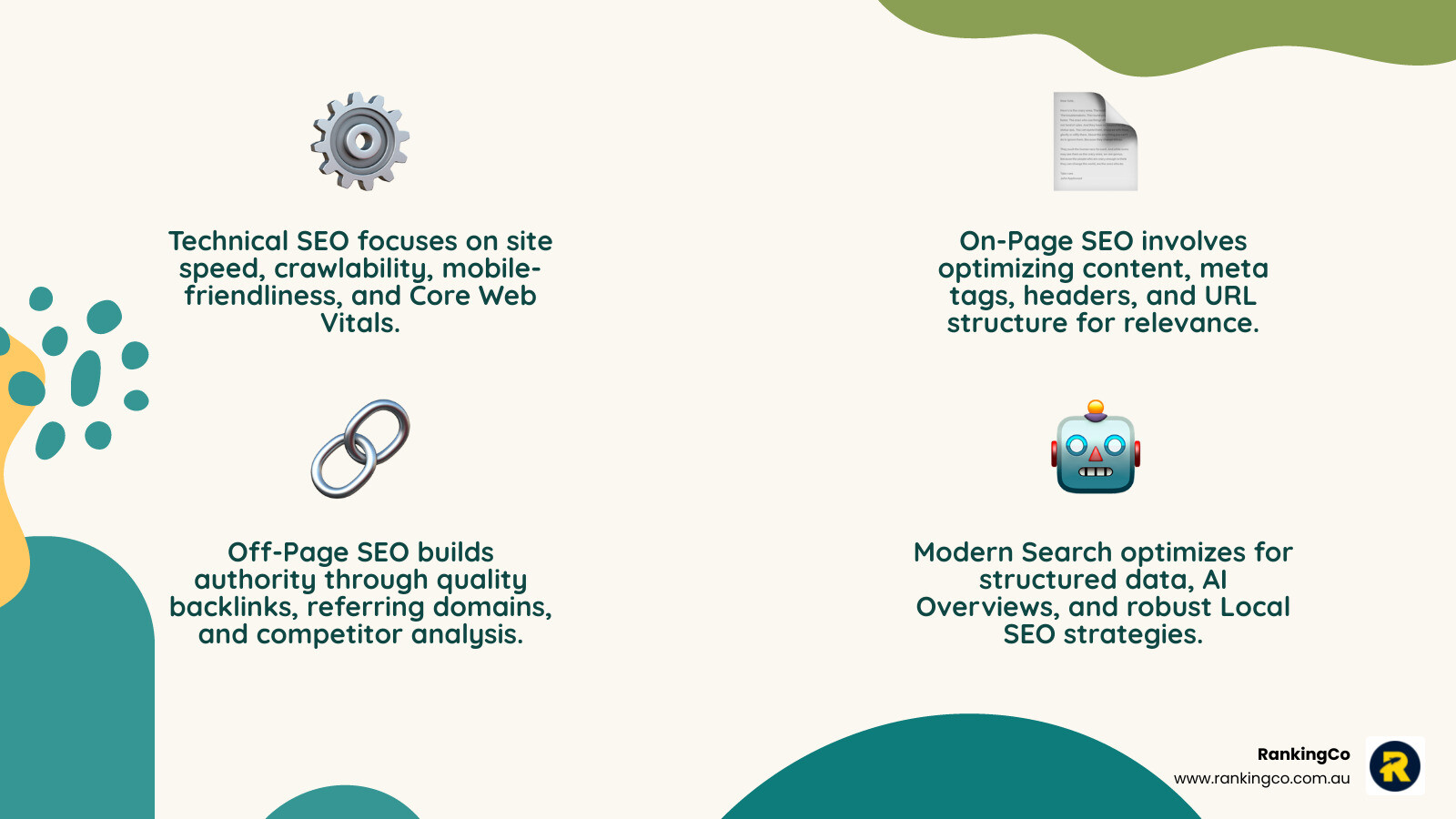
Technical SEO is the foundation of your website. If Google can't crawl or index your pages properly, your other efforts are wasted.
- Crawlability
: Can search engines access your important pages? Check your
robots.txtfile. - Indexability
: Are your pages showing up in Google? Look for
noindextags that might be blocking them. - Robots.txt Review : Ensure this file isn't blocking essential resources like CSS or JavaScript.
- XML Sitemaps : Make sure your sitemap is up-to-date, error-free, and submitted to Google Search Console.
- Site Architecture : A flat, logical structure helps users and search engines. Important pages should only be a few clicks from the homepage.
- Internal Linking : Use relevant internal links with descriptive anchor text to guide users and spread authority.
- HTTPS Security : Your site must use HTTPS. Ensure all versions redirect to a single, secure URL.
- Site Speed : Fast-loading pages improve user experience and rankings. Page speed has been a ranking factor since 2010.
- Core Web Vitals : Check Google's key user experience metrics: Largest Contentful Paint (LCP), Interaction to Next Paint (INP), and Cumulative Layout Shift (CLS).
- Mobile-Friendliness : Your site must work perfectly on mobile. Test it with Google's Mobile-Friendly Test.
- Broken Links (404s) : Find and fix broken links to improve user experience and stop leaking authority.
- Redirects : Use permanent 301 redirects for moved content to pass link equity. Avoid confusing redirect chains.
For more detailed insights, explore our dedicated technical SEO services.

On-Page & Content Audit: Your SEO Audit Checklist for Quality
Once your technical foundation is solid, focus on your content. This is how you communicate value to users and search engines.
- Title Tags : Ensure every page has a unique, keyword-focused title under 60 characters.
- Meta Descriptions : Write compelling descriptions (around 155 characters) to encourage clicks.
- Header Tags (H1, H2) : Use a clear hierarchy with one H1 per page to structure content for readability.
- URL Structure : Keep URLs short, clean, and descriptive. Short URLs tend to rank better.
- Image Alt Text : Add descriptive alt text to all images to improve accessibility and help search engines understand them.
- Thin Content : Identify pages with little value and either improve them with more detail or remove/redirect them.
- Duplicate Content : Use canonical tags or 301 redirects to resolve identical content issues. Read Google's official guide on duplicate content.
- Keyword Cannibalisation : Make sure multiple pages aren't competing for the same keyword and confusing Google.
- Search Intent : Does your content truly answer the user's question? Analyse top-ranking pages to align your content.
- Information Gain : Add unique value, data, or perspectives that competitors don't offer.
- E-E-A-T Signals : Demonstrate Expertise, Experience, Authoritativeness, and Trustworthiness with clear authorship and credible sources.
To help your website's content shine, explore our onsite SEO services.

Off-Page Authority & Competitor Analysis
Off-page signals, like backlinks, are votes of confidence from other sites that tell Google you're trustworthy.
- Backlink Quality : Focus on earning links from relevant, authoritative websites. The top result in Google has 3.8x more backlinks than positions 2-10.
- Referring Domains : Aim for a diverse and growing number of unique sites linking to you.
- Link Toxicity : Identify and disavow spammy links that could harm your rankings.
- Anchor Text : Ensure the text used in links is natural and varied, not over-optimised.
- Competitor Backlink Gaps : Find sites linking to competitors but not you—these are fantastic opportunities.
- Unlinked Brand Mentions : Find mentions of your brand online and reach out to ask for a link.
- Digital PR : Create link-worthy content and proactively reach out to earn high-quality editorial links.
Learn more about how we can help you get more traffic and qualify your outbound links to Google.
Optimising for Modern Search (AI Overviews & Local SEO)
The search landscape is always evolving. Your SEO audit checklist must account for AI and local search.
- Structured Data (Schema) : Use schema markup to help search engines understand your content and earn rich results. Test your pages with the Google Rich Results Test.
- Rich Snippets : Implement schema to get eye-catching results like star ratings or prices in the SERPs, which can boost click-through rates.
- Featured Snippets : Structure content with clear, concise answers (40-60 words) to capture "answer box" positions.
- AI Overviews : Optimise content to be authoritative and easily digestible for AI-generated summaries.
- Local SEO : If you're a local business in a city like Brisbane or Sydney, ensure your site is optimised for \"near me\" searches.
- Google Business Profile : Fully optimise your GBP with accurate information, services, and posts.
- NAP Consistency : Keep your Name, Address, and Phone number consistent across the web to avoid confusing search engines.
- Customer Reviews : Encourage and respond to reviews to build trust and improve local rankings.
For businesses in Brisbane, we offer dedicated Brisbane digital marketing services to help you dominate local search.

From Audit to Action: Implementing, Monitoring, and Maintaining SEO Health
An audit is worthless without action. This final section guides you on turning your findings into measurable results.
Prioritising Fixes and Tracking Your SEO Audit Checklist Results
Once your SEO audit checklist is complete, it's time to create an actionable plan.
- Create an Action Plan : Group all audit findings by category (e.g., technical, content) and severity.
- Prioritise (Impact vs. Effort) : Use a simple matrix to identify \"quick wins\" (high impact, low effort) that can deliver immediate results, while planning for longer-term strategic projects.
- Set SEO KPIs : Before you start, define how you'll measure success. Key Performance Indicators (KPIs) often include organic traffic growth, keyword ranking improvements, and conversion rate increases.
- Monitor Performance : Use tools like Google Analytics and Google Search Console to track your KPIs. An increase in organic traffic and better rankings are strong signs your efforts are paying off.
After implementing fixes, you should see positive signs within 1-2 months. Look for more indexed pages, lower bounce rates, and increased organic traffic.
Get Expert Help and Watch Your Business Grow
An SEO audit isn't a one-off task; it's an ongoing journey. Google's algorithm is constantly changing, so your strategy needs to adapt.
- Audit Frequency : We recommend a comprehensive SEO audit at least annually, with mini-audits after any major website change or performance drop.
- Ongoing Maintenance : Consistent effort in content updates, link building, and technical checks yields significant long-term gains, like compound interest for your website.
- Adapting to Updates : We stay ahead of Google's core updates, like the Helpful Content System, to ensure our clients' content remains relevant and helpful to users.
- AI-Driven Strategies : At RankingCo, we integrate AI into our SEO strategies to analyse data, identify content gaps, and scale updates efficiently. This helps our clients stay competitive.
- Global Expertise : From our Brisbane headquarters, we serve startups and scaling businesses across Australia, New Zealand, and North America. We offer full-funnel marketing services, from local SEO to global paid ad campaigns.
Making SEO audits a regular part of your digital strategy is key. You'll move from simply fixing problems to proactively building a resilient online presence that drives long-term growth.
Ready to turn your audit into action and drive real growth? Let's Get You Found Online.




Share online