
How to Bridge the Content Gap and Dominate Your Niche
Why Your Competitors Are Getting Traffic That Should Be Yours

Content gap analysis SEO is the process of finding topics and keywords your competitors rank for that you don't. It's a powerful way to find missed opportunities, capture more organic traffic, and guide customers through their buying journey.
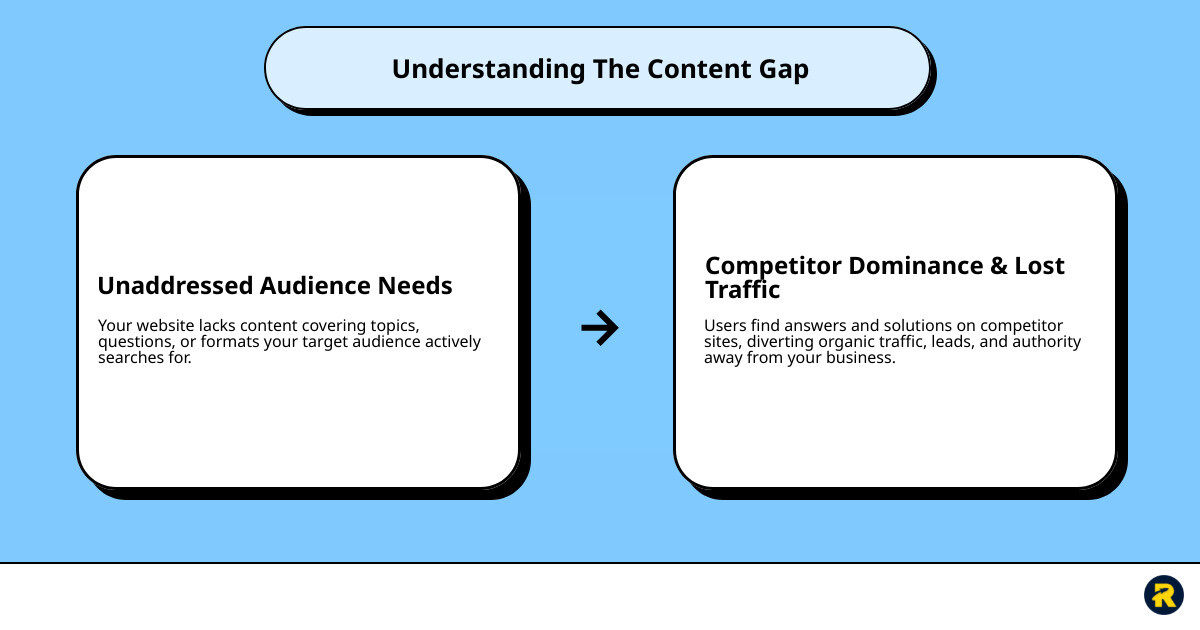
Most websites miss out on potential visitors because they haven't covered topics their audience is actively searching for. If a competitor ranks for thousands more keywords than you, it is not luck. It is strategic content planning.
Ranking number one for a few keywords isn't enough. Your audience has questions at every stage of their journey. If you're not there to answer them, your competitors will be. At RankingCo, we've seen that a content gap analysis is one of the fastest ways to find high-value topics that drive qualified traffic and conversions.
The Ultimate Guide to Content Gap Analysis SEO
Ever feel like you're playing digital catch-up? The good news is there's a powerful strategy to turn things around: content gap analysis SEO . This powerful strategy helps you do more than just find what is missing. It allows you to strategically fill those voids and outrank the competition.
What is a Content Gap Analysis? (And How It Differs from Keyword Gaps)
Simply put, a content gap analysis finds relevant topics your website hasn't covered or could cover better. It’s like looking at a puzzle and realising you’re missing key pieces that your rivals already have. A gap can be an unaddressed topic, but it can also be existing content that's outdated, lacks depth, or doesn't satisfy user intent.

You might think this is just keyword research, but it's broader.
- Keyword Gap Analysis: Focuses on specific search terms your competitors rank for, but you don’t. It’s about finding precise phrases.
- Content Gap Analysis: Looks at entire topics, content formats (e.g., videos vs. text), and overall quality. It's a more holistic view of your content landscape.
Both are vital, but a content gap analysis ensures your website becomes a complete resource for your audience. We use this approach to help our clients in Brisbane, Sydney, Melbourne, and across the globe build their authority.
Why a Content Gap Analysis is Your Secret SEO Weapon
A thorough content gap analysis is your secret weapon for digital growth. It offers a treasure trove of benefits that directly impact your bottom line.
- Steal Competitor Traffic: By finding and filling the content gaps your rivals are exploiting, you can capture a key audience segment that you were previously missing.
- Improve User Experience: When your content directly answers a user's questions, they stay longer, engage more, and are more likely to convert. It's about building trust with real people.
- Inform Your Content Strategy: It provides clear insights into your brand's strengths and opportunities for improvement. This leads to better content that drives qualified leads.
- Build Brand Authority: Consistently providing comprehensive, high-quality answers positions your business as an industry expert, giving you a significant competitive edge.
It helps you Get More Traffic and boosts your online presence, leading to better business results.
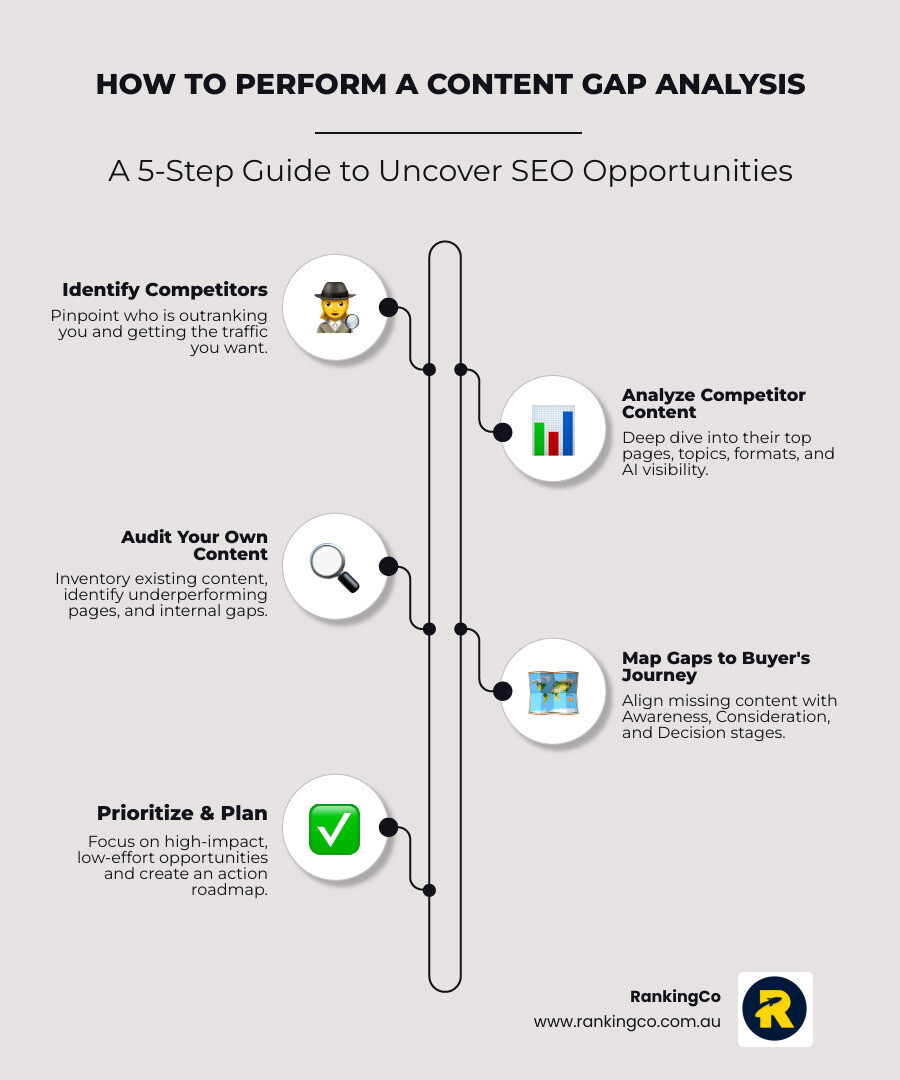
How to Perform a Content Gap Analysis: A 5-Step Guide for SEO
Ready to uncover those content opportunities? Here’s a clear, 5-step process to guide you.
Step 1: Define Your Competitors
First, identify your true online competitors. These are not just direct business rivals, but anyone ranking for the keywords you want to target, including informational blogs or industry sites.
Once you have a list, clarify your goal. Are you trying to:
- Expand into new topics?
- Improve existing content?
- Target a specific buyer stage?
Step 2: Analyse Competitor Keywords and Content
Next, play detective. Use SEO tools to compare your site against competitors and look for keywords they rank for that you don't.
Beyond keywords, analyse their top-performing pages. What topics, formats, and questions do they cover? This helps you understand the depth required to compete.
Step 3: Audit Your Own Content
Don't forget to look at your own site. Create a content inventory and identify underperforming pages. Look for content that is outdated (over two years old), lacks depth, or has poor readability.
Also, check for internal gaps. Are there important topics related to your core services that you have never addressed?
Step 4: Map Gaps to the Buyer's Journey
Every piece of content should serve a purpose. Map your identified gaps to the different stages of the buyer's journey to ensure a cohesive user experience.
- Awareness: Content that introduces a problem (e.g., "What is SEO?").
- Consideration: Content that helps evaluate options (e.g., "Best SEO tools").
- Decision: Content that helps users make a choice (e.g., "RankingCo SEO services").
Step 5: Prioritise Opportunities and Create a Plan
You will likely have a long list of gaps, so it is important to prioritise them based on impact versus effort.
Focus on opportunities with high search volume and business relevance that are relatively easy to tackle. Remember the 80/20 rule: a few top-performing posts often drive most of your traffic, so optimising these can yield big returns.
Once prioritised, create a clear action plan with tasks, deadlines, and content briefs.
Best Practices for an Effective Content Gap Analysis SEO
To truly dominate your niche, embed these best practices into your ongoing strategy.
Understand Search Intent Deeply
Google's goal is to serve the most relevant content. You must understand why someone is searching for a term. Ask yourself what they are looking for:
- Information?
- A product?
- A comparison?
Aligning your content with this intent is critical for creating helpful, reliable, people-first content.
Build Comprehensive Topic Clusters
Google evaluates how thoroughly your site covers a subject. Instead of creating isolated posts, build topic clusters.
Create a central "pillar page" on a broad topic and support it with "cluster content" that dives into specific sub-topics. This structure signals your expertise and strengthens your topical authority.
Prioritise for Maximum Impact
You cannot do everything at once. Focus on quick wins first, which are high-impact, low-effort tasks.
Then, move to strategic opportunities that align with your core business goals. Optimising your existing top-performing articles can often generate more traffic than starting from scratch.
Optimise for AI Overviews
The search landscape is changing. With AI Overviews appearing above traditional results, you need to optimise for AI visibility.
This means strengthening organic signals like site authority and well-structured content. Doing so helps influence AI models and ensures your helpful content is found by AI systems.
Continuously Measure and Refine
Content gap analysis is an ongoing process. After implementing changes, track your keyword rankings, organic traffic, and conversions.
Regularly auditing your content and comparing it to competitors keeps your strategy sharp. For a deeper dive, explore our Onsite SEO services.
Common (and Costly) Mistakes to Avoid
Steer clear of these common pitfalls when conducting a content gap analysis.
- Ignoring Search Intent: Creating content based only on keywords without understanding the user's motivation is a recipe for failure. Always ask what the user really wants.
- Copying Competitors Blindly: Your goal is to create something 10x better, not just to copy. Analyse your competitors to find their weaknesses and create more valuable, comprehensive content.
- Forgetting Your Own Content: Don't get so caught up in new topics that you neglect existing assets. An old blog post might just need a refresh to leapfrog competitors.
- Not Prioritising: Trying to tackle every gap at once is inefficient. Focus on high-impact opportunities first to see meaningful results without spreading your resources too thin.
- Skipping Measurement: If you don't track results, you can't learn or adapt. Monitor rankings, traffic, and conversions to know if your efforts are paying off.
- Neglecting Technical SEO: Even the best content will struggle on a slow, poorly structured site. A holistic approach that includes Technical SEO is essential for success.
Get Expert Help and Watch Your Business Grow
Navigating the complexities of content gap analysis SEO can feel like a full-time job, especially for busy business owners. You have a business to run, and diving into keyword spreadsheets isn't always the best use of your time.
That's where we come in. At RankingCo, we pride ourselves on being the world's best little digital agency, helping clients in Brisbane, Sydney, and across the globe. We combine cutting-edge AI with human expertise to uncover hidden opportunities, craft content that resonates, and drive tangible results.
We help businesses stay seen, chosen, and trusted, even when Google changes the rules. From in-depth analysis to strategic content creation, we're here to turn missed opportunities into your greatest strengths.
Ready to Be Seen? Let's Get You Found Online
Contact Us today for a chat. Explore our SEO Content Creation Services and see how we can help you bridge the gap.






Share online


