
Domain Authority Explained: 15 Dos and Don’ts for Long-Term SEO Growth
Why Your Website's Reputation Score Matters

Build domain authority might sound like technical jargon, but it's simpler than you think. It's essentially your website's reputation score. This number tells search engines how trustworthy and credible your site is compared to others.
Here's what you need to know right now:
- Domain Authority (DA) is scored from 1 to 100. A higher score improves your chances of ranking in search results.
- It's not a direct Google ranking factor , but it's a reliable way to measure your site's competitive strength.
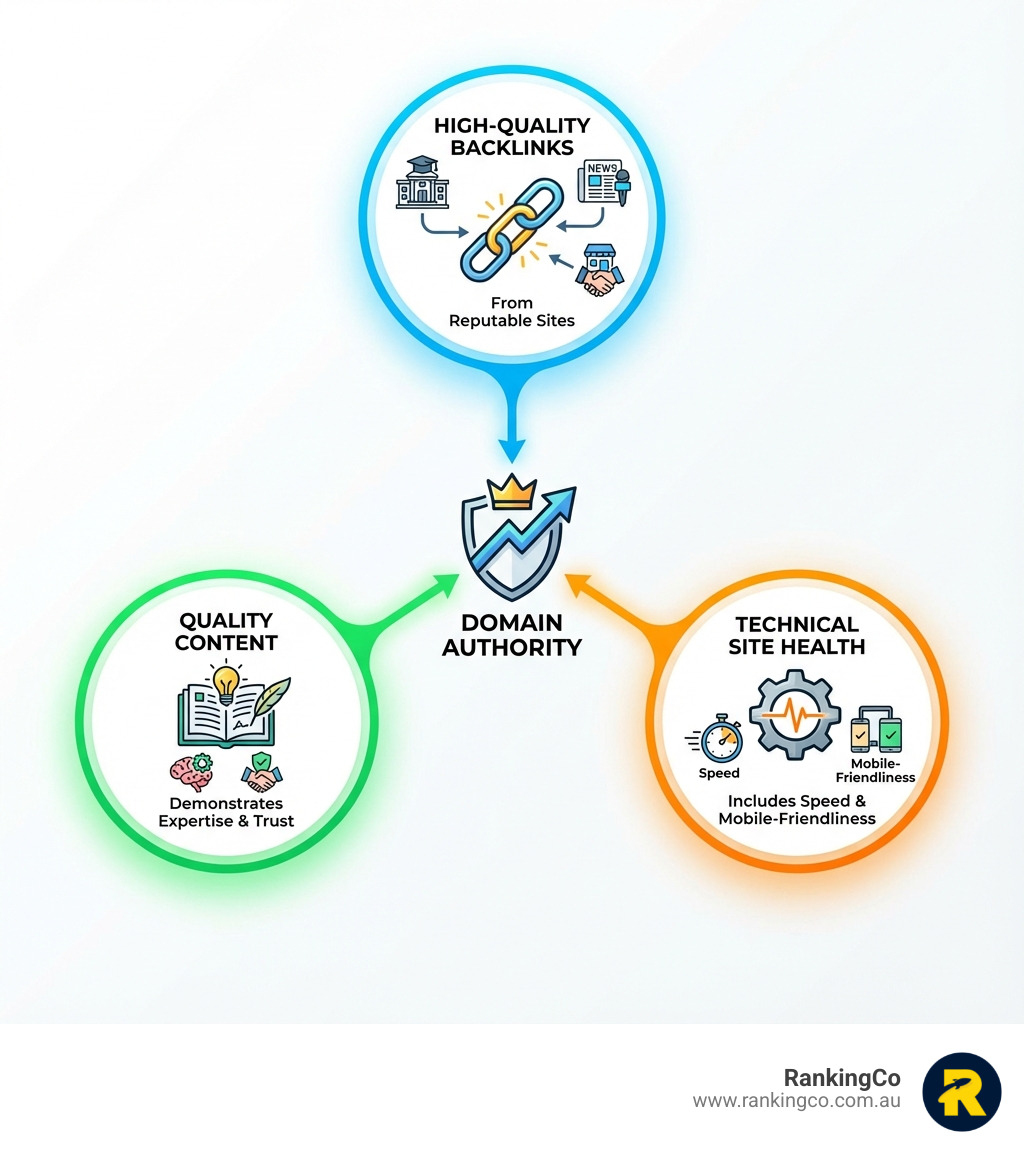
- Three main factors drive your score: the quality and quantity of backlinks, your content quality, and your technical site health.
- Building DA is a long-term strategy. The focus is on earning trust and achieving sustainable growth.
Ever wonder why some websites seem to rank effortlessly while yours struggles to get noticed? The difference often comes down to domain authority.
It's the reason a well-established competitor might outrank you even when your content is just as good. Focusing on your site's reputation is one of the smartest investments you can make for long-term SEO growth.
I'm Kerry Anderson, co-founder of RankingCo. For over 15 years, I've helped businesses of all sizes build domain authority through strategic, sustainable SEO. From startups to businesses scaling internationally, the principles for building a trusted, high-performing website remain the same.
What is Domain Authority (and How Is It Calculated)?
Think of Domain Authority (DA) as your website's "credit score" in the digital world. It's a popular metric from a leading SEO software company that predicts how well a website will rank on search engine results pages (SERPs). A higher score means your site is more likely to appear prominently when people search for what you offer.
This score ranges from 1 to 100, with 100 being the highest possible authority. It's calculated using a complex algorithm that considers dozens of factors, including the number of unique websites linking to yours and the trustworthiness of those links.
While Google doesn't use DA directly in its ranking algorithm, the factors that contribute to a high DA score are often the same ones Google values. Improving your DA usually means you're doing the right things for Google, too. It's a fantastic way to gauge your site's strength and potential.

Domain Authority vs. Page Authority: What’s the Difference?
When we talk about authority in SEO, you'll often hear two terms: Domain Authority (DA) and Page Authority (PA). While they sound similar, they focus on different aspects of your website.
Domain Authority measures the overall ranking strength and credibility of your entire website. It gives you a bird's-eye view of your site's reputation across the web.
Page Authority, on the other hand, focuses on the ranking power of a single, specific page on your website. It assesses how likely that individual page is to rank well in search results.
These two metrics are closely connected. Pages with high Page Authority can significantly contribute to your overall Domain Authority. A strong Domain Authority can also help new pages on your site rank faster, as they inherit some of that site-wide credibility. For more tips on improving individual pages, check out our Onsite SEO guide.
What’s a ‘Good’ Domain Authority Score?
One of the most common questions we hear is, "What's a good DA score?" The truth is, there's no magic number. Your "good" score is entirely relative to your industry and competitors.
A brand new website might start with a DA between 1 and 20, which is perfectly normal. For small to medium-sized businesses, a score of 30-40 is average, while 40-60 is good.
Anything above 60 is considered excellent. Established giants like Wikipedia or Forbes often boast DAs in the 90s.
The key is to benchmark your score against similar businesses in your niche. If your competitors are hovering around a DA of 45 and you're at 35, you know where to focus your efforts.
Instead of chasing an arbitrary number, aim for steady growth that outpaces your rivals. This is usually achieved through strong backlinks and high-quality content.
How to Build Domain Authority: Core Strategies for Long-Term Growth
Building Domain Authority is a marathon, not a sprint. It requires a focus on quality and a great user experience. Think of it like building a solid reputation in the real world: it takes time, consistent effort, and a commitment to providing real value.
We've seen countless businesses try to cut corners, only to find themselves back at square one. The most effective strategies focus on sustainable growth, earning trust, and creating an exceptional online experience. Google's ultimate goal is to provide its users with the most helpful and authoritative content available.
Strategy 1: Earn High-Quality Backlinks
Backlinks are the lifeblood of Domain Authority. They act as "votes of confidence" from other websites, signalling to search engines that your content is valuable and trustworthy. In fact, studies show that a vast majority of websites don’t get any organic traffic because they lack backlinks.
The goal is to earn high-quality links, not just any links. One authoritative link from a reputable source is worth far more than a dozen low-quality ones. For example, a well-researched statistics page on a trending topic can earn hundreds of backlinks from many different domains.
Here's how to earn those coveted links:
- Create Content People Want to Share: Develop helpful guides, original research, or engaging infographics. Content that provides unique insights naturally attracts links.
- Guest Post and Collaborate: Offer to write for reputable industry blogs or collaborate on projects to get in front of new audiences and earn valuable links.
- Claim Unlinked Mentions: Use tools like Google Alerts to find mentions of your brand online that don't include a link, then politely ask the site owner to add one.
- Broken Link Building: Find broken links on other websites and suggest your relevant content as a replacement. It's a win-win!
Need help building a robust backlink profile? Explore our Leads SEO and eCommerce SEO services for expert support.
Strategy 2: Master On-Page SEO to Build Domain Authority
While backlinks are crucial, your website's internal health is just as important for building Domain Authority. On-page SEO refers to all the optimisations you make directly on your website's pages. This process makes your content clear, helpful, and accessible for both users and search engines.
Here are the essentials:
- Write Helpful, Original Content: Your content should demonstrate experience, expertise, authoritativeness, and trustworthiness (E-E-A-T). This means providing in-depth answers and genuinely valuable information.
- Organise Your Site: A clear, logical site structure helps visitors and Google's crawlers navigate your website effortlessly. Use categories, tags, and internal links to create a seamless user journey.
- Optimise for Mobile and Speed: Most web traffic comes from mobile devices, and Google prioritises mobile-friendly sites. Ensure your website loads quickly on all devices. You can test your site's performance with Google’s PageSpeed Insights tool.
- Implement Schema Markup: This special code helps search engines understand your content better. Using schema can help your pages earn rich snippets in search results, improving visibility and click-through rates.
Want more tips on making your website shine? Check out our Onsite SEO solutions.
Strategy 3: Clean Up Your Link Profile
Just as good backlinks boost your Domain Authority, bad or "spammy" backlinks can drag your score down and even lead to Google penalties. Manipulative link-building schemes, like buying links or using private blog networks (PBNs), are strictly against Google’s spam policies.
It's crucial to regularly audit your backlink profile to spot any harmful links. These could be from sites with low authority, irrelevant content, or a history of spammy tactics. If you find any, you have a few options:
- Reach Out: The first step is to contact the website owner and politely ask them to remove the link.
- Disavow: If removal isn't possible, you can use Google’s Disavow Tool to tell Google to ignore those specific links. This helps prevent them from negatively impacting your site.
Keeping your link profile clean is an ongoing process, but it's essential for maintaining a healthy Domain Authority. Our Technical SEO team can help you keep your site healthy and penalty-free.
Dos and Don’ts for Building Domain Authority
Building Domain Authority can feel like a big task, but by focusing on smart, consistent actions, you'll see progress. Make your journey easier with these beginner-friendly tips.
DO:
- Create genuinely helpful content that answers real questions and provides unique value. This is the foundation of attracting natural links.
- Build relationships with other reputable sites in your industry. Networking can lead to guest posting opportunities and valuable collaborations.
- Keep your website fast and mobile-friendly. A great user experience keeps visitors engaged and signals quality to search engines.
- Update old content to keep it fresh and relevant. This can revive its ranking potential and attract new links.
- Use clear, descriptive page titles and headings. These help both users and search engines understand what your content is about.
- Encourage happy customers to mention your business online. Positive reviews and mentions build brand authority and can lead to links.
- Regularly check your backlink profile for any issues like broken links or spammy connections.
- Organise your site with a simple, logical structure. This makes it easy for visitors to find information and for Google to crawl your pages.
- Share your content on social media to reach a wider audience. While not a direct ranking factor, social shares increase visibility and can attract links.
- Monitor your progress with tools like Google Analytics and Search Console. These help you track traffic, rankings, and backlink growth.
- Focus on quality over quantity when building links. One strong, relevant link is better than many weak ones.
- Optimise images and use alt text for better accessibility and SEO. Descriptive alt text helps search engines understand your images.
- Make sure your site is secure (use HTTPS). This protects your users' data and is a ranking signal for Google.
- Stay up to date with the latest SEO best practices. The digital landscape changes constantly, so continuous learning is key.
- Ask for help when you need it —SEO is complex, and expert support can save you time and stress, especially for local businesses in Brisbane, Sydney, Melbourne, or even across the Tasman in Auckland and Wellington.
DON’T:
- Don’t buy links or use “black hat” tactics. These manipulative strategies can lead to severe penalties from Google, undoing all your hard work.
- Don’t ignore technical issues. Broken links, slow pages, or crawl errors can severely hinder your site's performance and DA.
- Don’t stuff your content with keywords. This outdated tactic makes your content unreadable and can be penalised by search engines. Focus on natural language.
- Don’t copy content from other sites. Duplicate content offers no value and can seriously harm your search rankings. Always strive for originality.
- Don’t neglect your site’s user experience (UX). A confusing, slow, or difficult-to-steer website will drive users away, increasing bounce rates and negatively impacting your SEO.
Common Mistakes to Avoid
Even with the best intentions, it's easy to stumble when building Domain Authority. Many business owners make common mistakes that can slow their progress or even cause setbacks. Let's shine a light on these pitfalls so you can steer clear.
One major trap is chasing quick wins . SEO is a long game, and Domain Authority is built over time through consistent, ethical effort. Shortcuts like buying links or using automated tools rarely pay off and can lead to harsh penalties from Google.
Another common oversight is ignoring technical SEO . You might have amazing content, but if your site is slow, broken, or hard to crawl, it's like having a brilliant shop hidden down a dark alley. Technical issues like slow page speeds and broken links act as speed bumps, hurting your site's potential.
Many also fall into the trap of focusing only on link quantity . They mistakenly believe that more links automatically lead to higher authority.
However, quality always trumps quantity. A single high-quality, relevant link from an authoritative site is far more valuable than dozens of spammy ones.
Finally, letting your site go stale is a big no-no. Outdated content, broken internal links, and a lack of new, valuable information can hurt your reputation. Regularly refreshing your content and keeping your site technically sound is crucial for sustained growth.
Get Expert Help and Watch Your Business Grow
Building Domain Authority takes time, patience, and the right strategy. It's an ongoing commitment to quality, user experience, and strategic outreach.
We understand that as a busy business owner, you might not have the hours to dedicate to every aspect of SEO. This is true for businesses in Brisbane, Sydney, Melbourne, and across the globe in Auckland, Wellington, Toronto, the US, and Canada.
The good news is you don’t have to do it all yourself. At RankingCo, we're here to help.
We combine AI-driven strategies, local expertise, and a global perspective to help your business grow. Our advanced technologies allow us to analyse market trends and create effective campaigns to keep you ahead of the curve.
We are the world’s best little digital agency, working with clients across Australia, New Zealand, the US, and Canada to build robust online reputations and drive tangible results. Ready to get more traffic? Get More Traffic with RankingCo.
Ready to Grow Your Authority?
Boost your website’s reputation and get found online! Reach out to our Brisbane-based team at RankingCo. We're helping businesses grow across Australia, New Zealand, the US, and Canada.





Share online


