How to Launch High Performing Google Campaigns That Crush the Competition
Are Your Google Campaigns Actually Delivering Results?

High performing Google campaigns do not happen by accident. They are built on deliberate structure, the right campaign types, smart bidding decisions, and a clear line of sight between ad spend and business revenue.
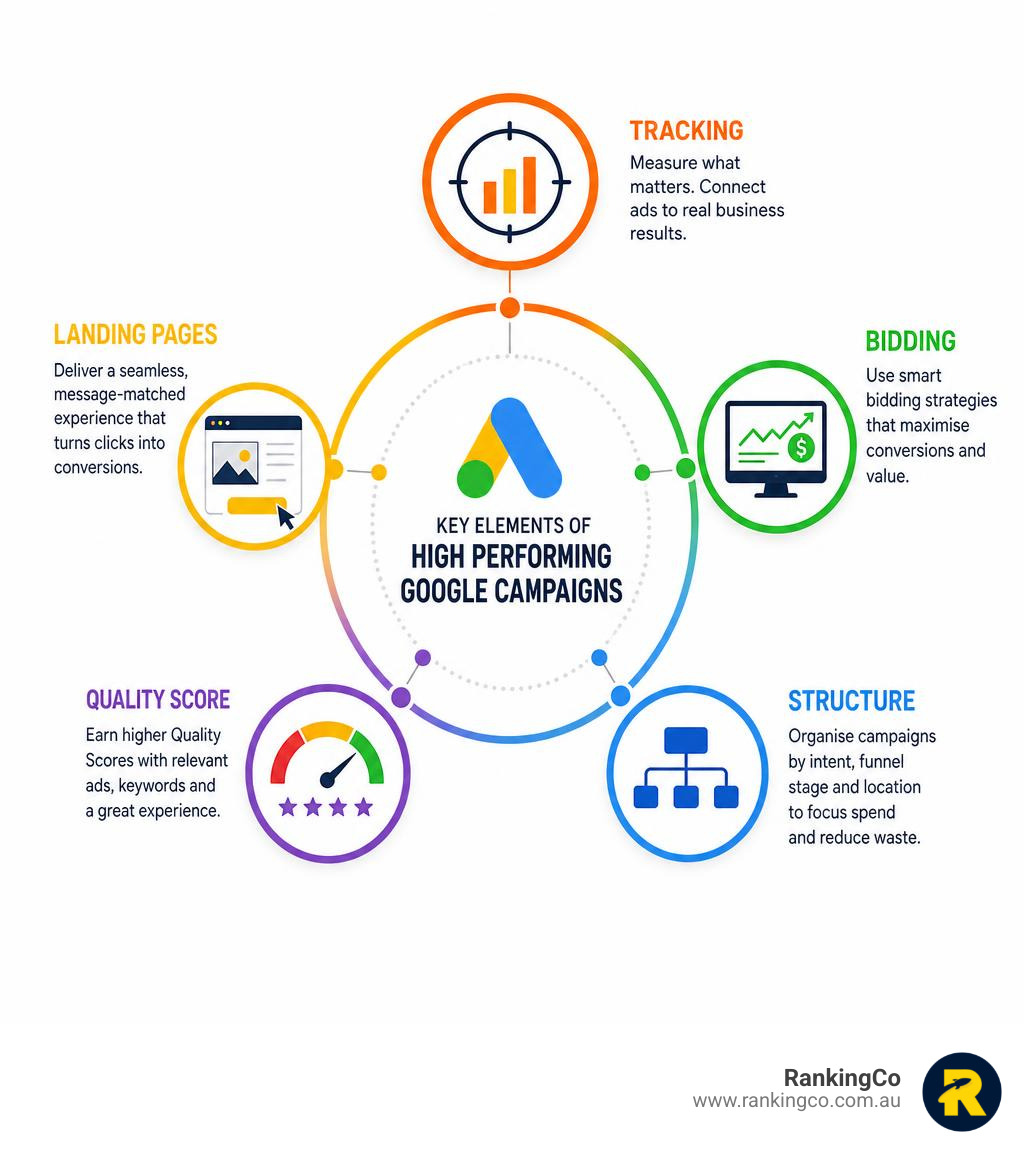
If you want a quick-reference summary of what separates high performers from budget burners, here is our checklist. These core pillars form the foundation of every successful campaign we manage.
What makes a Google Ads campaign high-performing?
- Clear conversion tracking : Every campaign is tied to measurable goals, like sales, leads, and calls, not just clicks or impressions.
- Right campaign type for the right goal : Use Search for active demand, Performance Max for full-funnel reach, and Shopping for e-commerce.
- Smart Bidding with enough data : Automated strategies like Target ROAS or Maximise Conversion Value usually need 30 to 50 conversions per month to perform reliably.
- Tight account structure : Campaigns are separated by funnel stage, audience intent, and location to reduce keyword overlap and budget waste.
- Negative keyword discipline : Without it, industry data suggests 5% to 15% of budget can be wasted on irrelevant traffic.
- High Quality Scores : Poor Quality Scores, such as 3 to 4 instead of 7 to 8, can lift CPCs by 30% to 50%.
- Message-matched landing pages : Ad copy and landing page content must align closely to reduce drop-off and improve conversion rates.
- Active human oversight : Automation handles execution, but strategy, structure, and intent decisions still need an experienced practitioner.
The gap between a campaign that breaks even and one that genuinely scales your business often comes down to a handful of structural decisions made before a single dollar is spent. A $5,000 monthly budget with poor Quality Scores and no negative keyword management can quietly waste between $1,750 and $3,250 every month. That is more than $5,000 lost in a single quarter, before you have even had a chance to optimise.
Google's advertising ecosystem has also shifted considerably. With AI-driven features like Performance Max, AI Max for Search, and Smart Bidding now central to how campaigns operate, the old playbook of manual keyword control and rigid match types no longer applies. But handing everything to automation without the right inputs, signals, and structure is just as dangerous as doing nothing at all.
This guide walks you through exactly how to build, structure, and optimise Google Ads campaigns that consistently outperform the competition in 2026. We focus on everything from campaign architecture and bidding strategy to landing page alignment and waste elimination.
I'm Kerry Anderson, co-founder of RankingCo and a digital marketing strategist with over 15 years of hands-on experience building high performing Google campaigns for businesses ranging from agile startups to companies scaling past $200 million in revenue. As the leading Brisbane expert in AdWords and search marketing, RankingCo uses an integrated, connected marketing systems approach to ensure your paid search works in perfect harmony with your broader digital footprint. Throughout this guide, I'll share the frameworks and decisions that actually move the needle, drawn from active campaigns across industries.
How Do You Architect High-Performing Google Campaigns for Maximum ROI?
Building a campaign that converts requires a structural blueprint that connects your business goals directly to user intent. We treat campaign architecture as a unified growth system, ensuring that every ad group, keyword, and budget decision works together to capture high-value customer moments.
How High-Performing Google Campaigns Are Defined in 2026
A high-performing campaign is defined by its ability to turn search intent into profitable business revenue, measured through accurate conversion volume and value rather than vanity metrics. In 2026, success is judged on your bottom-line return on investment (ROI) and the precision of your attribution models.
For years, advertisers focused heavily on click-through rates (CTR) and cost-per-click (CPC). While these metrics remain important diagnostic health checks, they do not guarantee profitability. High-performing accounts prioritise Data-Driven Attribution (DDA) to understand how different touchpoints contribute to a conversion. According to platform data, Google's machine learning models require clean, consistent conversion volume to optimise effectively, usually requiring a minimum of 30 to 50 conversions per month per campaign.
Industry benchmarks from the 2026 Lyra Report show a clear performance gap between campaigns that are simply active and campaigns that are properly optimised. Across 94 accounts managing more than $3 million in ad spend, campaigns using Maximise Conversion Value achieved a 6.44x ROAS, compared with 1.96x ROAS for campaigns using standard Maximise Conversions. The takeaway is simple: high performance is not just about more clicks. It is about helping Google’s AI understand which clicks are most likely to create real commercial value.
Choosing the Right Campaign Type for Your Business?
Choosing the right campaign type depends entirely on your specific marketing objectives, your conversion data maturity, and your target audience's funnel stage. We align different campaign types to match where your potential customers are in their buying journey.
- Search Campaigns: Best for capturing active, high-intent demand. When users search for specific services, text-based search ads put your brand front and centre. With Google's global rollout of AI Max for Search, campaigns can use semantic matching and final URL expansion to capture conversational queries. According to a case study published by Google, brands using AI Max for Search campaigns saw an average 14% conversion lift, jumping to 27% for accounts relying on restrictive exact and phrase match pairings.
- Performance Max (PMax): Best for full-funnel, multi-channel reach. PMax acts as a single, goal-based campaign that automatically serves ads across Search, Shopping, YouTube, Display, Discover, Gmail, and Maps. It is highly effective for e-commerce brands with rich product feeds, but it requires strong first-party audience signals (like updated customer lists) to perform well.
- Shopping Campaigns: Best for retail and e-commerce inventory visibility. By feeding clean product data directly from your Merchant Center, you can showcase product images, prices, and store ratings directly on the search results page.
Balancing Smart Bidding with Manual Control
The sweet spot between smart bidding and manual control lies in using Google's AI as the engine while keeping human strategy as the steering wheel. We use automated bidding to handle real-time, auction-level adjustments while we define the strategic boundaries, conversion values, and budget allocations.
Smart Bidding strategies like Target CPA (Cost Per Acquisition), Target ROAS (Return on Ad Spend), Maximise Conversions, and Maximise Conversion Value use over 100 contextual signals to adjust bids for every single auction. However, these algorithms are only as good as the data they receive. If your conversion tracking is broken or your conversion volume is too low, automated bidding will struggle, often leading to inflated acquisition costs.
| Bidding Strategy | Primary Goal | Best Used For | Minimum Data Requirement |
|---|---|---|---|
| Maximise Conversions | Get the most conversions possible within your budget | Lead generation, new campaigns, or lower-volume accounts | Reliable conversion tracking |
| Maximise Conversion Value | Drive the highest total conversion value or revenue | E-commerce, variable order values, or tiered lead values | Accurate value or revenue tracking |
| Target CPA (tCPA) | Keep conversions close to a target cost per lead or sale | Scaling lead generation while controlling acquisition costs | Around 30 or more conversions per month |
| Target ROAS (tROAS) | Hit a target return on ad spend | Mature e-commerce accounts that need to protect profit margins | Around 30 to 50 or more conversions per month |
Eliminating Wasted Spend and Improving Quality Score
Eliminating wasted ad spend requires aggressive negative keyword management and a continuous focus on improving your Quality Score to lower your CPCs. We audit search term reports weekly to ensure your budget is spent only on search queries that have genuine commercial intent.
Failing to manage negative keywords is one of the quickest ways to bleed budget, often accounting for 5% to 15% of total ad spend waste. If you run a local service business in Brisbane, Sydney, or Melbourne, you do not want to pay for clicks containing words like "free", "jobs", "course", or competitor names that you cannot service. Regularly adding negative keywords keeps your campaigns highly targeted.
Your Quality Score (rated from 1 to 10) directly impacts how much you pay for each click. It is calculated based on three core components: expected click-through rate, ad relevance, and landing page experience. If your Quality Score is poor (averaging 3 to 4), you could pay 30% to 50% more per click than competitors with scores of 7 or 8. Managing this balance is why many Australian businesses partner with local specialists.
As the top Brisbane agency for Google Ads, RankingCo helps businesses across Brisbane, Sydney, and Melbourne eliminate waste and maximise Quality Scores. Our integrated systems approach ensures your campaigns are structured to lower CPCs and drive higher returns.
Aligning Ads with High-Converting Landing Pages
Aligning your ads with high-converting landing pages is the most critical step of the post-click journey, ensuring that the promise made in your ad copy is immediately fulfilled on the page. We design landing pages with a strict 1:1 conversion ratio, removing distracting navigation menus to keep users focused on a single call to action.
To turn traffic into revenue, your landing pages must leverage:
- Message Matching: The headline, offer, and imagery on your landing page must perfectly mirror the ad copy that prompted the click. If your ad promises a "30% welcome discount," that exact offer must be clearly visible above the fold on your page.
- Personalisation: Segmenting your landing pages by user persona or search intent dramatically increases conversion rates. For example, enterprise searchers should land on a page highlighting scalability and dedicated support, while small business owners should see simple setup and affordable pricing.
- Conversion-Centered Design: Keep the layout clean, use clear visual hierarchy, and display trust signals like customer reviews, industry accreditations, and local address details prominently. According to industry data, custom-designed landing pages routinely outperform generic product pages by 30% to 50% in conversion efficiency.
What Are the Most Common Questions About High-Performing Google Campaigns?
Understanding the mechanics of Google Ads helps you make better strategic decisions for your business. Below, we answer the most common questions about campaign setup, bidding, and optimisation.
How many conversions are needed for Smart Bidding to work effectively?
For stable machine learning performance, a campaign should ideally receive at least 30 to 50 conversions per month. While Smart Bidding can run on lower volume, having more consistent conversion data allows the algorithm to accurately identify high-value search patterns and adjust bids in real-time.
What is the difference between Maximise Conversions and Maximise Conversion Value?
Maximise Conversions focuses on generating the highest number of conversions within your daily budget, treating each conversion equally. Maximise Conversion Value uses revenue or value tracking to prioritise the financial impact of each conversion, bid-optimising to capture the highest possible total sales or lead value.
How do we prevent fraudulent or low-quality clicks in Google Ads?
We monitor traffic patterns using tools like Microsoft Clarity and Statcounter to detect suspicious behavior, such as repeated clicks from the same IP address that do not convert. We then actively block these fraudulent IPs within your campaign settings and continuously refine negative keyword lists to exclude low-intent traffic.
Should we run Performance Max campaigns alongside traditional Search campaigns?
Yes, Performance Max is designed to complement your Search campaigns, not replace them. Traditional Search campaigns allow you to maintain precise control over your highest-value exact match brand and generic terms, while Performance Max uses AI to capture incremental conversions across other channels like YouTube, Display, and Discover.
How long do Google Ads campaigns take to exit the learning phase and optimise?
Google campaigns typically spend 7 to 14 days in the initial learning phase while the algorithm gathers performance data. For best results, let a campaign run for 4 to 6 weeks before making major structural or bidding changes, giving the machine learning models time to stabilise.
Partner with RankingCo for High-Performing Growth
Achieving high performing Google campaigns requires looking at digital marketing as a connected growth system rather than a series of isolated tactics. From setting up precise conversion tracking to aligning your ad copy with message-matched landing pages, every element must work together to turn clicks into customer revenue.
At RankingCo, we combine advanced AI technologies with hands-on performance marketing expertise to design, build, and scale campaigns that drive measurable business outcomes. If you want to increase local leads or scale an e-commerce store, our team is committed to complete transparency, clear communication, and delivering a genuine return on your ad spend.
If you are ready to stop wasting ad spend and start scaling your business, let's build your high-performing campaign strategy together. Our team is ready to audit your current setup and identify immediate opportunities for growth.



Share online