Beginner's Guide to Facebook Ads Campaign Management
Why Facebook Ads Campaign Management Determines Whether Your Ad Spend Works
Facebook Ads campaign management is the process of structuring, launching, optimising, and scaling paid advertising across Meta's platforms, including Facebook and Instagram, to drive measurable business outcomes.
Here is a quick overview of what effective campaign management involves:
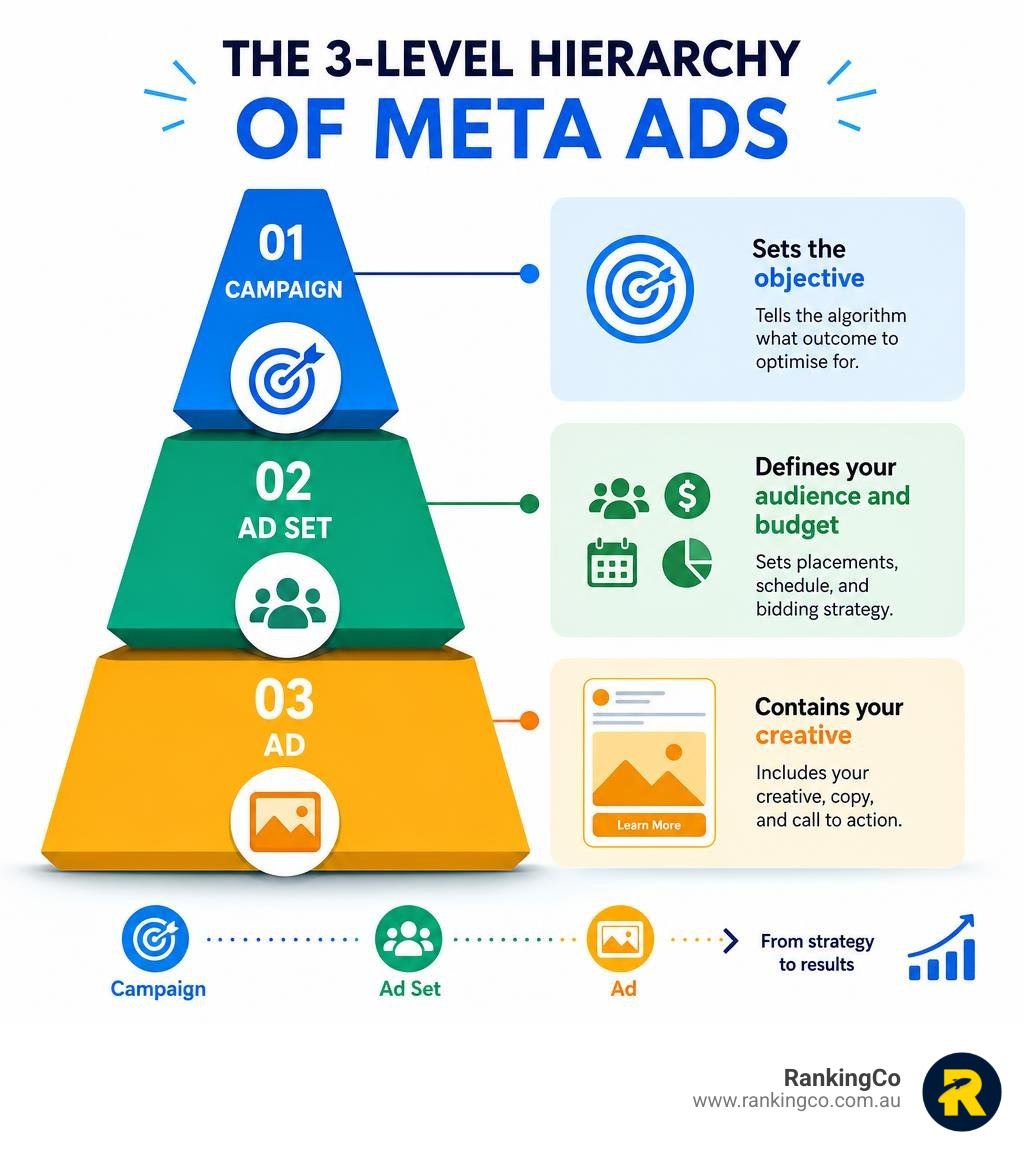
- Campaign level: Sets the objective (awareness, traffic, leads, sales) and tells Meta's algorithm what outcome to optimise for
- Ad Set level: Defines your audience, budget, placements, schedule, and bidding strategy
- Ad level: Contains your creative, copy, and call to action
- Learning phase: Each ad set needs roughly 50 conversion events within 7 days to exit learning and stabilise performance
- Budget approach: Campaign Budget Optimisation (CBO) lets Meta distribute spend automatically; Ad Set Budgets (ABO) give you manual control
- Structure principle: Keep cold prospecting, warm retargeting, and hot remarketing audiences in separate campaigns to avoid overlap and signal fragmentation
Getting this structure right is not just about organisation. It directly controls how well Meta's algorithm can learn, optimise, and deliver results for your budget.
Most small business owners running Facebook ads are not losing money because of bad creative. They are losing money because their account structure is working against the algorithm rather than with it. Too many ad sets, mixed objectives, overlapping audiences, and inconsistent naming all fragment the learning signal Meta needs to find your best-performing audience and creative combination.
Understanding how to build campaigns that concentrate signal, exit the learning phase quickly, and scale without destabilising performance is the practical skill that separates profitable accounts from wasteful ones. This guide walks through every layer of that system, from the three-tier hierarchy to naming conventions, creative testing, and budget decisions, so you can build a Facebook Ads account that actually compounds over time.
I'm Kerry Anderson, co-founder of RankingCo and a digital marketing strategist with over 15 years' experience helping businesses build profitable growth systems, including hands-on Facebook Ads campaign management across industries ranging from local trades to national eCommerce brands. I will walk you through the practical framework we use to structure, test, and scale Meta campaigns that deliver real ROI.
Mastering Facebook Ads Campaign Management: The Three-Tier Hierarchy
To manage Facebook Ads successfully, you must treat your ad account as a structured business machine rather than a random collection of boosted posts. The foundation of this system is Meta's three-tier hierarchy: Campaigns, Ad Sets, and Ads. Each level answers a distinct question and controls a specific mechanical function of your advertising.
The Campaign level is the strategic anchor where you define your primary business objective. If you want to drive lead forms, physical store visits, or online sales, your campaign objective tells Meta's algorithm what success looks like. Choose this carefully, because Meta does not allow you to change the campaign objective after creation. The algorithm calibrates its machine learning models and optimisation graphs specifically to your chosen goal; changing it would break the data model entirely, requiring a fresh campaign setup.
The Ad Set level is where you define the targeting, placements, schedule, and budget controls. This is where you outline who should see your ads and where they should see them. The Ad level is the execution layer containing your visuals, copy, and call-to-action buttons.
One of the most critical decisions in Facebook Ads campaign management is how you allocate your budget. You can choose Campaign Budget Optimisation (CBO) (known within the interface as Advantage Campaign Budget) or Ad Set Budgeting (ABO).
| Feature | Campaign Budget Optimisation (CBO) | Ad Set Budgeting (ABO) |
|---|---|---|
| Budget Control | Set at the Campaign level | Set individually at each Ad Set level |
| Distribution | Meta's AI dynamically distributes budget to top-performing ad sets | Manual allocation; guaranteed spend per ad set |
| Best Used For | Scaling proven audiences and consolidated accounts | Creative testing and strict audience allocation |
| Algorithm Freedom | High; allows machine learning to find the lowest-cost conversions | Low; forces spend regardless of performance drops |
How to Structure Your Facebook Ads Campaign Management for Scale
Structuring your account for scale requires concentrating your data signals so Meta's algorithm can work efficiently. Many advertisers fall into the trap of signal fragmentation, which occurs when you split your budget across too many campaigns and ad sets. This prevents any single ad set from gathering the 50 optimisation events required within a 7-day window to exit the learning phase.
At RankingCo, we apply proven Facebook Campaign Structure Best Practices 2026 to keep our clients' accounts streamlined. For most businesses, keeping a lean structure of 2 to 4 active ad sets per campaign is the sweet spot. When you limit the number of ad sets, you consolidate your budget, allowing the algorithm to gather conversion data faster and stabilise your Cost Per Acquisition (CPA).
To maintain clean reporting and enable fast decision-making, we use a standardised naming convention that acts as a join key across analytics and reporting tools. We recommend using a clear separator, such as a vertical pipe ( |
), to split key dimensions consistently across all campaigns.
Standard Naming Taxonomy Template
Campaign Level:
[Objective] | [Funnel Stage] | [Target Location] | [Month/Year]
Example: CONV | BOF | Brisbane | June2026
Campaign naming focuses on high-level strategy and reporting alignment:
- Objective (e.g. Awareness, Traffic, Engagement, Conversions)
- Funnel stage (e.g. TOF / MOF / BOF or Awareness / Consideration / Conversion)
- Geographic targeting
- Time period
Ad Group / Ad Set Level:
[Audience Type] | [Targeting Method] | [Optimisation Strategy]
Example: LAL_1%_Purchasers | Broad / Interest / Keyword | LowestCost
This layer defines who we’re targeting and how the system is optimising:
- Audience type (e.g. cold, warm, retargeting, lookalike, custom)
- Targeting method (e.g. interests, keywords, broad, behaviour-based)
- Optimisation strategy (e.g. lowest cost, cost cap, value optimisation, bid strategy equivalent)
Ad / Creative Level:
[Creative Format] | [Angle / Hook] | [Asset ID]
Example: Video_UGC | Problem-Aware_Discount | UGC_Sarah_V1
This layer tracks individual creatives and messaging variations:
- Creative format (e.g. video, image, carousel, static, UGC)
- Angle or hook (e.g. pain point, offer-led, testimonial, education)
- Asset identifier for version control and iteration tracking
Using this systematic approach to Facebook Ads Management ensures that anyone looking at your dashboard can immediately understand the strategy without guessing. This level of clarity is why RankingCo is regarded as a leading digital agency in Brisbane, helping local and national brands streamline their paid social operations.
Audience Segmentation and Funnel Mapping in Facebook Ads Campaign Management
A successful performance marketing strategy maps your audiences cleanly to different stages of the customer journey. We divide audiences into three distinct buckets to prevent audience overlap and bid self-competition:
- Prospecting (Top of Funnel, TOFU): Cold audiences who have never heard of your brand. We use broad interest targeting, lookalike audiences based on high-value customer lists, or completely open broad targeting where we let the creative do the targeting.
- Retargeting (Middle of Funnel, MOFU): Warm audiences who have interacted with your social pages, watched your videos, or visited your website but haven't taken a high-value action.
- Remarketing (Bottom of Funnel, BOFU): Hot audiences who have added products to their cart, initiated checkout, or filled out a partial form but haven't completed the conversion.
To ensure your campaigns run smoothly, you must actively exclude down-funnel audiences from your prospecting campaigns. For example, when running a prospecting campaign, you should exclude website visitors from the last 180 days and past purchasers.
If you do not set up these exclusions, your ad sets will compete against each other in the auction, driving up your CPMs (Cost Per Mille). Use Meta's Audience Overlap tool within your Audiences dashboard to compare your custom lists.
If your audience overlap is higher than 20%, consolidate those audiences into a single ad set to keep your delivery healthy. This is especially vital when setting up high-performing campaigns for Facebook Ads Lead Generation.
Creative Testing, Budget Optimisation, and Tracking Best Practices
To scale your Meta campaigns without causing performance spikes, you need a structured creative testing framework. Never test new, unproven creatives inside your main scaling campaigns, as this contaminates your production data and resets the learning phase of your winning ad sets.
Instead, build a dedicated testing campaign using Ad Set Budgeting (ABO). Within this testing campaign, keep a "control" ad set containing your current best-performing creative, alongside "challenger" ad sets testing one variable at a time, such as a new hook, visual style, or copy angle. Give each challenger ad set a small, dedicated daily budget until it reaches at least 1,000 impressions.
Once you identify a clear winner, migrate it to your primary scaling campaign. To preserve the valuable social proof (the likes, comments, and shares your ad has accumulated), do not simply duplicate the ad. Instead, copy the original ad's Post ID and paste it into the "Use Existing Post" field in your scaling campaign. This keeps your engagement intact, which helps lower your CPMs in the auction.
When setting up tracking, handle your UTM parameters separately from your ad names. Rather than hardcoding campaign names into your landing page URLs, use dynamic UTM macros in the "URL Parameters" field at the ad level:
utm_source=facebook&utm_medium=paid&utm_campaign={{campaign.name}}&utm_content={{ad.name}}
This approach ensures your Google Analytics and internal tracking systems stay perfectly aligned, even if you update your ad names later. To keep your account organised at scale, take advantage of Meta's built-in efficiency tools:
- Saved Views: Create customised dashboard views for "Testing", "Scaling", and "Retargeting" to filter out unnecessary clutter.
- Name Templates: Use Meta's native naming tool to enforce your taxonomy automatically during creation.
- Automated Rules: Set up rules to pause underperforming creatives or increase budgets by 20% when performance meets your target KPIs.
Frequently Asked Questions
Managing Facebook Ads successfully is about working with Meta's machine learning algorithm rather than trying to outsmart it. By keeping your account structure consolidated, using a clean naming taxonomy, mapping your funnel stages precisely, and running isolated creative tests, you give the platform the clean data signals it needs to lower your costs and scale your results.
At RankingCo, we treat paid social as a connected growth system. Our team of digital strategists integrates advanced AI workflows and precise audience targeting to ensure your ad spend drives real business outcomes. As a premier Brisbane digital marketing agency, we build performance-driven campaigns tailored to your specific business goals.
To learn more about how we can help you grow, explore our specialised services. We offer tailored solutions across paid social and search channels to maximise your return on investment.
What is the difference between CBO and ABO?
Campaign Budget Optimisation (CBO) sets your budget at the campaign level, allowing Meta's AI to dynamically distribute funds to the best-performing ad sets. Ad Set Budgeting (ABO) sets the budget at the individual ad set level, giving you manual control over exactly how much spend each audience or test receives.
Why can't I change my campaign objective after creation?
Meta's algorithm calibrates its optimisation models, delivery graphs, and machine learning data specifically to the objective you select at launch. Changing this objective post-creation would break the data model completely, which is why the platform requires you to set up a new campaign instead.
How many ad sets should I run per campaign?
For most accounts, we recommend running 2 to 4 active ad sets per campaign. Running too many ad sets fragments your budget, making it difficult for individual ad sets to reach the 50 conversion events required to exit the learning phase.
How do I scale my budget without breaking my campaigns?
When scaling vertically, increase your budget by no more than 20% to 30% every 3 to 5 days. Making larger budget changes can trigger significant edits, resetting the learning phase and causing your CPA to fluctuate.
How often should I run creative tests?
Creative testing should be an ongoing process, typically run weekly or fortnightly depending on your overall spend. Continuous testing helps you discover fresh winning creatives to replace older ads before creative fatigue sets in and performance drops.



Share online